Unfree Speech Abroad

Daniel McCarthy explains how it makes events like those in Egypt and Libya possible:

[T]here is no such thing as worldwide free speech. It’s not simply that few countries other than the U.S. have constitutional speech protections as broad as those of our First Amendment. What’s more important is that few people in the developing world separate tolerated expressions of hatred from official endorsement of such views.

Indeed, while Americans think of free speech as something that protects everyone from censorious government, elsewhere peoples not infrequently demand that their governments limit speech. American diplomats must communicate with peoples and governments which not only recognize nothing like our First Amendment rights, but which see such rights as extreme and destabilizing — and with good reason. We in the U.S. may think that attitude barbaric and beyond the pale of civilized discourse, but diplomats addressing the public or officials of a foreign country have no choice but to deal with that reality, like it or not.

An Egyptian reader passes along the above Twitter pic of a sign that reads in Arabic, “We condemn insulting the Prophet, but not with terrorism”.
Is The Muhammad Movie Even A Real Movie?

Rosie Gray created an (unembeddable) video highlighting the heavy dubbing of the trailer. She theorizes that the "anti-Muslim 'movie' that served as the spark or pretext for a wave of violent unrest Egypt and Libya may not be a movie at all":

[N]early all of the names in the movie's "trailer" are overdubbed. The video is a compilation of the most clumsily overdubbed moments from what is in reality an incoherent, haphazardly-edited set of scenes. Among the overdubbed words is "Mohammed," suggesting that the footage was taken from a film about something else entirely. The footage also suggests multiple video sources — there are obvious and jarring discrepancies among actors and locations.

“Arab Spring Fatigue”


Michael Brendan Dougherty uses the recent violence to condemn the Arab Spring. Shadi Hamid rejects this view: 

The easy response, for Americans suffering from Arab Spring fatigue, would be to give up on the Middle East. They could disengage, and treat the Arab world as what it seemed to be yesterday — a place well outside the grasp of normal, reasoned political analysis. But that would be a grave mistake, especially now. It should be obvious that disengaging from the Arab world is what both Salafi extremists — not to mention Arab dictators — want. The more the United States disengages, the more room they will have to grow in influence and power, and the more commonplace events like those of last night will become.

Unfit For Government, Ctd

Fallows feels that Romney has failed a key test:

[W]hen faced with a 3 a.m. test, he reacted immediately, rather than having the instinct to wait. And after he waited, he mistook this as a moment for partisanship rather than for at least the appearance of statesmanlike national unity. The irony, of course, is that resisting the partisan impulse today would have been the greatest possible boost to his horse-race prospects two months from now.

How Ezra Klein understands Romney’s rash statements:

Romney’s comments were, to be sure, unusually noxious and indecent. But this is also what happens when campaigns get desperate. Like a gambler who’s already lost too much, they begin taking risks in the hope of making it all back. And then, more often than not, they pay the price.

Frum blames “the dangerously distorting effect of disrespect for one’s political opponents”:

Inside Team Romney, and among Romney’s donors and core supporters, it may be taken absolutely for granted that Barack Obama is a weak-willed appeaser of radical Islam, a cringing apologizer for America who does not love the country the way “we” do. So why not say it loud, especially when you think you’ve just caught his administration doing it again? And then you discover the mistake only after the statement has departed the outbox.

And Pareene rounds up Romney apologists:

After a period of practically bipartisan disgust with Romney, the right is finally lining up behind him. A whole set of (frequently contradictory) defenses are already being mustered: that Romney was totally right, that Romney was unfortunately careless with his timing but essentially correct in his criticism, that Romney is the victim of a liberal media conspiracy, that the Democrats are actually the ones politicizing the tragedy and demanding that no one criticize the president during a crisis, etc.

To read all of today’s Dish coverage in one convenient place, go to the thread page “The Embassy Attacks On Libya And Egypt.”

Face Of The Day

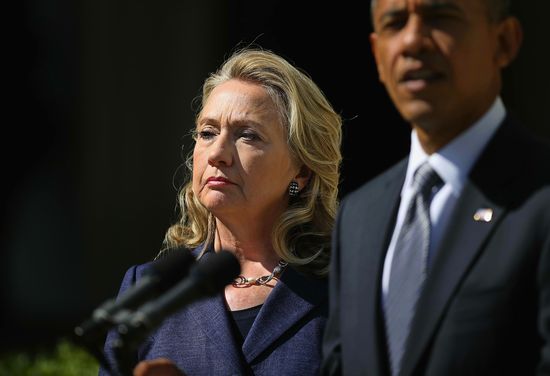
GT_CLINTON-EMBASSY_120912

U.S. President Barack Obama, standing with Secretary of State Hillary Clinton, makes a statement about the death of U.S. ambassador-to-Libya J. Christopher Stevens on September 12, 2012. Stevens and three other embassy employees were killed when the embassy in Benghazi was attacked by a mob potentially angered by an American-made video mocking Islam's founding prophet. By Chip Somodevilla/Getty Images.

This AP photo of a smiling Romney as he left his podium today is a close second.

Here Come The Salafis

Though it's not yet clear exactly who perpetrated the deadly attack in Libya, Christian Caryl notes a similarity between the anti-film protests in Libya and Egypt:

The rioters in both cases come from the region's burgeoning Salafi movement, and the Salafis have been in the headlines a lot lately. In Libya, over the past few months, they've been challenging the recently elected government by demolishing ancient Sufi shrines, which they deem to be insufficiently Islamic. In Tunisia, they've been attacking businesses that sell alcohol and instigating nasty social media campaigns about the country's female competitors in the Olympics. In Syria's civil war, there are increasing reports that the opposition's wealthy Gulf financiers have been channeling cash to Salafi groups, whose strict interpretation of Islam is considered close to the puritanical Wahhabism of the Saudis and others. Lately Salafi groups have been gaining fresh prominence in parts of the Islamic world — from Mali to Lebanon, from Kashmir to Russia's North Caucasus

Caryl goes on to explore some of the debate over what kind of influence they might play, cautioning that not all Salafis are created militant.

The Embassy Attacks In Libya And Egypt: A Dish Thread

To read all of today's coverage of the tragedy and the political fallout from Romney's disgusting and dishonest swipes at the Obama administration, in one convenient place, go here. We will be updating the chronological thread as posts are added to the Dish in the coming days. (For a reverse-chronological version of the thread, with the newest posts at the top, go here.)

Will Morsi Apologize? Ctd

This isn't a good sign:

Egyptian President Mohamed Mursi asked the Egyptian embassy in Washington to take legal action in the United States against makers of a film attacking the Muslim Prophet Mohammad, the official state news agency said on Wednesday.

Frum puts this action in context: 

It's important to understand that Morsi is concerned with Egyptian, not American, laws. Morsi is taking a page from the 1979 Khomeini playbook, fabricating an international incident to mobilize religious passions as a weapon for his political grouping against more secular blocs in Egyptian society – the Egyptian military very much included.

Earlier commentary on the subject here.

Was The Libyan Attack Planned?

The NYT provides reason to think so:

The protesters in Cairo appeared to be a genuinely spontaneous unarmed mob angered by an anti-Islam video said to have been produced in the United States. By contrast, it appeared the attackers in Benghazi were armed with mortars and rocket-propelled grenades. Intelligence reports are inconclusive at this point, officials said, but indications suggest the possibility that an organized group had either been waiting for an opportunity to exploit like the protests over the video or perhaps even generated the protests as a cover for their attack.

Max Fisher rounds up other analysis:

Who actually pulled off the Libya attack, anyway? The "chief suspect" is an obscure extremist Islamist group called "the Imprisoned Omar Abdul Rahman Brigades," according to CNN, citing U.S. intelligence. The Libyan group, which has surfaced only this year, appears to support al-Qaeda, but it's not clear if there are any direct operational links. Earlier reports cited Ansar al-Sharia, a loose network of Libyan extremists. The Libyan ambassador to the U.S. blamed former fighters for Muammar Qaddafi's staunchly anti-Islamist regime.