The televangelist Romney campaigned with this weekend has some advice for a husband whose wife is giving him trouble:
Rosie Gray reports:
A spokeswoman for the Romney campaign didn't respond to a request for comment.
The televangelist Romney campaigned with this weekend has some advice for a husband whose wife is giving him trouble:
Rosie Gray reports:
A spokeswoman for the Romney campaign didn't respond to a request for comment.
A reader quotes David French from our previous post:
Ask a woman working two jobs to provide for three kids by two different deadbeat dads if the hook-up culture has empowered her.
Nothing in hookup culture prevents the use of birth control. The root causes of generational fatherlessness and poverty are more about lack of comprehensive sex education in schools and access to health care, ie, birth control. Yet why am I not surprised that the same cultural conservatives who decry sexually liberated behavior also oppose anything but abstinence-only programs and try to defund Planned Parenthood? Opposition to sexual freedom is all about the rear-guard action of cultural conservatives unable to adapt to modernity.
Another writes:
Rod Dreher doubled down on his belief that gay promiscuity is a "culture of death" by saying that the heterosexual "hook-up" culture is also part of a "culture of death." He brought up his daughters and how he's trying to raise them to be, I guess, virgins till they're married. I'm also the father of two girls, and I see youthful sexual adventure as normal healthy exploration of this beautiful world – finding out what their bodies do, trying out relationships and especially trying out sex without relationships.
I don't want my girls to become self-destructive with compulsive, dark, promiscuous sex. But I also don't want them to marry as virgins and find out they're completely incompatible with their husbands. It's so normal and healthy to explore sex as a young person that it seems weird and life-denying and actually kind of perverted to abstain completely. I know some people find happiness and security in a difficult virtue. But it's mostly the phrase that keeps sticking in my craw – culture of death. Culture of death? Sex is the foundation of life!
Another is also animated over the phrase:
Gay culture is the "culture of death"? Conservatives like Dreher spend most of their time insisting that gays cannot participate in traditions like marriage, while then turning around and lamenting the iniquity of gays who won't settle down. You can't lambast people for not making the choices you would deny them or not accept. Conservatives have the power to promote monogamy and commitment in the gay community by simply allowing gay people to get married (which they're going to do whether anyone recognizes it or not) and not being huge assholes about it. Calling out the promiscuity of parts of the gay community while refusing to recognize the monogamous inclinations of so many other gay men is just dishonest. Refusing gays marriage in their culture, and then complaining that not enough gay men get married is ridiculous. They can't have it both ways.
Another:
About all this hookup culture stuff: I just don't get it. When was this magical time when nobody was having sex except when they were in love? Was it in the '60s, during the "Summer of Love"? Probably not. Was it in the '70s, when cocaine was everywhere and HIV was nowhere? Not exactly. Was it in the '80s, the days of hair metal and still more cocaine and clothes so overtly sexualized that they're a joke now? (I mean, I wouldn't have had sex with anyone with that hair, but it didn't seem to bother them then at all.) So it must have been the '90s, when Ecstasy set off a new generation of ravers obsessed with physical pleasure.
You see where I'm going with this. All this noise about a "hookup culture" is the anxiety of a generation who screwed their way through their youth and are now raising children, desperate to find some line of demarcation between their own behavior and what they wish their children wouldn't do. I don't care what the statistics say, I really don't. I don't think for a minute that you can trust ANY self-reported sex or drug statistics.
So what are we worried about? America hasn't had a prudish culture since at least the '50s, and even then, I'd bet my boots it was just going on behind closed doors. My grandmother got pregnant out of wedlock at 17 in 1951, after all. The only difference was that she was bundled off, married at shotgun-point, and forced into the kitchen for 40 years. Goodbye and good riddance, as they say, to all of that.
Seth Stevenson subjected himself to 45 hours of Ohio TV advertising, which at this point largely consists of campaign ads:
Something happens when you’ve been exposed to the same short video clip 21 times; your mind untethers, shifting its focus from the script to the symbols. I began to dissect Romney’s body language. Why, I wondered, was this spot so intent on establishing a side-by-side spatial relationship between Mitt and the viewer? Mitt chauffeurs us, gripping the wheel, looking at the road, throwing sidelong glances as he lists his accomplishments. "Aha," I exclaimed: a classically male, shoulder-to-shoulder, barstool conversational alignment—in tune with Romney’s big advantage among male voters. By contrast, President Obama is usually gazing directly into the camera lens, locking in eye contact as though he and the viewer are on a promising first date.
Relatedly, a reader in Colorado reacts to Romney's big post-convention ad buy:
As a resident of Denver, I've been experiencing the avalanche for many months. It's worst from 4-6 during local news and national network news, when we routinely get 4, 5, 6 back-to-back ads at every commercial break. One or two will be from Obama, with the rest from Romney and his super-PACs. Like many others here, I jut hit the mute button when they start. I hear friends joke that they now watch everything via DVR, so they can fast-forward through the commercials.
I loathe and fear Citizens United as much as anybody, but I do believe there is a law of diminishing returns with the onslaught of ads.
I lived in California in 2010 when a flood of outside money and money from wealthy candidates blanketed TV for months supporting the Republican statewide candidates, especially Meg Whitman and Carly Fiorina. It was as relentless as the Romney avalanche is now. Yet the Democrats won every statewide office, largely, I believe, because the Republican "brand" is so toxic in California.
The Obama campaign has blanketed Colorado with field offices and young, energetic organizers who are busy canvassing, registering voters and getting the word out with friends and neighbors. My only complaint is that they stopped airing a very effective response to the welfare-work lies, and I hope that ad reappears soon. The election will be close, but I'm confident Colorado will stay blue this fall.
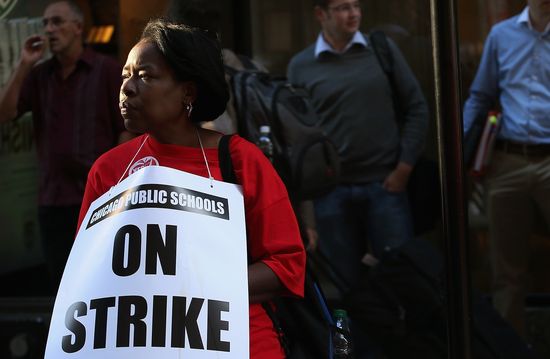
Dylan Matthews has a useful primer on the Chicago Teachers' Union strike. One point of conflict:
The Chicago Public Schools in March unveiled an evaluation system (pdf) in which standardized testing makes up 40 percent of the rubric, a percent that increases by 5 percent every year thereafter (45 percent in year two, 50 percent in year three, etc.), which was designed by panels that included teachers, principals, and teachers’ union officials (including the president). The system goes above and beyond the state requirement that testing make up 20-40 percent of teacher evaluations. The teachers’ unions are resisting this system, calling it too punitive.
Dylan Matthews also rounds up the research on how teachers' strikes affect students. Nick Gillespie takes the Teachers' Union to task for rejecting a salary increase on the basis that it is tied to standardized test performance:
One of the most ridiculous claims emanating from teachers unions is the persistent idea that teaching abilities can't be quantified in any meaningful way as it relates to merit. Somehow, every other profession on the planet – including teaching at the college level – finds ways to assess and reward good performance.
McArdle considers why the Teachers' Union is so adverse to merit pay:
Chicago public school teachers have planned their lives around the way the school system is right now. Anything that threatens this status quo is likely to trigger a violent reaction–particularly since jobs from which it is impossible to be fired tend to attract people who are unusually risk averse.
Doug Mataconis argues that Mayor Emanuel has little to lose in the standoff:
We’ve already seen the electoral benefit that Scott Walker received in Wisconsin for taking on public sector unions, as has New Jersey Governor Chris Christie. Just north of Christie in New York, Governor Andrew Cuomo has been as hard-nosed as his Republican neighbor in dealing with the unions, and he’s got approval numbers that would seem to indicate that he’s pretty much untouchable for re-election in 2014 at this point in time. It’s just as likely that Emanuel will reap political gains from this showdown with the CTU, a showdown that, in the end, he is likely to win simply because of the economic and political realities of the situation.
Mataconis also points out that the strike might bolster the case for charter schools; since most aren't unionized, some 45,000 students at these will still be getting an education. Rick Perlstein is much more sympathetic to the Teachers' Union:
Since Rahm Emanuel’s election in the spring of 2011, Chicago’s teachers have been asked to eat shit by a mayor obsessed with displaying to the universe his "toughness" — toughness with the working-class people that make the city tick; toughness with the protesters standing up to say "no"; but never, ever toughness with the vested interests, including anti-union charter school advocates, who poured $12 million into his coffers to elect him mayor (his closet competitor raised $2.5 million). The roots of the strike began when Emanuel announced his signature education initiative: extending Chicago’s school day. Overwhelmingly, Chicago’s teachers support lengthening the day, which is the shortest of any major district in the country. Just not the way Rahm wanted to ram it down their throats: 20 percent more work; 2 percent more pay.
(Photo: Lisa Bates, a sixth grade teacher, marches with thousands of other Chicago public school teachers in front of the Chicago Public Schools (CPS) headquarters on September 10, 2012 in Chicago, Illinois. More than 26,000 teachers and support staff hit the picket lines Monday morning after the Chicago Teachers Union failed to reach an agreement with the city on compensation, benefits and job security. With about 350,000 students, the Chicago school district is the third largest in the United States. By Scott Olson/Getty Images)
A reader writes:
If, as Hanna Rosin says, the wage gap gets huge after 4-5 years after the first child is born, can't an explanation be that that's when the women see that their kids are growing and won't stop, that the ideals of their youth are not relevant in the face of the deep emotional attachment they are feeling towards her child? I have always seen myself as a huge feminist, and was completely blindsided by the depth of my need to be with my daughter. It is a basic hunger; I feel a nearly physical attachment to her. On top of that, she needs me to be with her, to hang out, to talk, to just *be* together. In the face of that, how can spreadsheets and after-work socializing compete?
I pity/don't understand people who never feel this with their kids. I know that before having kids, I felt a deep love for my cat – and afterwards, I realized that I had no idea how deep deep was.
Another writes:
No wage gap exists for me at the moment because I am a union member in a blue-collar industry.
I've seen not only my own paychecks, but occasionally my coworkers', when our semi-conscientious payroll company screws up and mails the wrong check. I've also seen the labor bills we submit, and I know how fast our business moves, substituting one person for another in last-minute jobsite changes. Not only is it written in our constitution and by-laws, it would be horrendously difficult. I'm sure gender discrimination could exist, but it would take a level of organized conspiracy so determined and widespread as to be unlikely, at least in my local.
We women make the same wage for the same job because we are deemed interchangeable. Our contracted employers do not specify gender; they assume that the personnel we supply for each job are competent to do the job and earn the same rate. If they object to the quality of the work, they take that up with us on a case-by-case basis – individual problems are addressed individually, but not via wage changes. If they don't like your work you don't get asked again, which is brutal but in some ways fair.
It is true that women are usually not offered certain better-paying jobs because their gender is considered a proxy for their ability to lift, and those positions require lifting that is heavier than average for men, under safety conditions requiring a cushion of certainty. I won't consider that discrimination until I see a woman clearly able to do the job turned aside. Haven't yet. (I suppose there's a conversation worth having about structural coercion and why the load an average worker should be expected to carry should be based on the average man's lifting ability rather than the average woman's … wouldn't it be worthwhile to consider the relatively weaker gender a baseline for, ha, manual labor? Why not make our loads manageable and theirs easy and expand both the workforce and its safety in one move? I suspect it would require more people to give a damn than they do.)
By no means do I deem unions perfect constructs. In fact, they are a last resort, a signifier of human indecency, to be resorted to when employers value individual employees so low that collective action is the only leverage possible to force employers to treat us well. Why else do Wal*Mart and Amazon so routinely crush union formation? If the GOP's revulsion for unions succeeds in damaging not only public-sector unions but (as is their clear intent) private-sector unions as well, Hanna Rosin's projections are going to need some updating. The ground women have won is not yet solid, for more reasons than the so-called "women's issues."
Aisha Harris unpacks the new Cloud Atlas trailer (seen above). Meanwhile, Aleksandar Hemon profiles Lana and Andy Wachowski, the film's co-directors, offering a moving account of the family's support for Lana (formerly Larry), a male to female transgender, during her transition:
Larry told [his mother Lynne Wachowski], "I’m transgender. I’m a girl." Lynne didn’t know what he meant. "I was there when you were born," she said. "There’s a part of me that is a girl," Larry insisted. "I’m still working at that." Lynne had been distraught on the plane, worried that she might lose her son. "Instead, I’ve just found out there is more of you," she said. Ron [Larry's father], who soon flew in, too, offered his unconditional support, as did Larry’s sisters and Andy, who had suspected for a while.
A couple of days later, the Wachowski family went out to dinner in Sydney. Larry was now renamed Lana and was dressed as a woman. A waiter referred to Lana and Lynne as "ladies." The next day, Lana showed up at work in her new identity, as though nothing had happened.
Earlier Dish on Lana's transition here.
Blake Gopnik looks at how two American museums dealt with objects in their collections originally obtained under questionable circumstances. One, the Cleveland Museum of Art, decided the benefit of displaying a historical piece of art to the masses outweighed any ethical questions about its origins. The other, the University of Pennsylvania, worked out an arrangement to return 24 gold objects to Turkey, the country from where they believe the works had been originally looted:
There’s [a] downside to repatriations like the one Penn has announced. They play into the notion that the countries in today’s U.N. have a unique claim to every object ever made within their modern borders, as part of their trademark "cultural heritage."
[Cleveland Museum of Art Director David] Franklin points out that with his head of Drusus [Minor, a portrait discussed in the article as having a questionable paper trail], "you have an object where the marble seems to be Turkish and the artist was probably Roman, working in Algeria … The whole concept of ownership by a country goes against the way art was made." Does the Drusus head really belong to Turkey, where it was born and the Roman empire ended its days, or to Algeria, where Drusus would have been worshipped, or maybe even to the Italians of modern Rome? Or maybe it belongs just as much to some little girl in Cleveland, who has read about the Romans from the time of Christ, and wants to see what one of them looked like and what kind of artworks they would have treasured. Franklin points out that, uniquely in a museum like his, she can compare that marble head to a long history of Christian art that either rejected a Roman model or tried to match it.
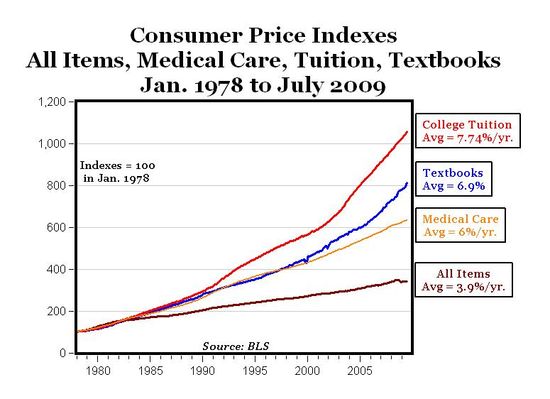
With student debt skyrocketing and college costs continuing to increase well over the rate of inflation, McArdle questions college's return-on-investment, especially if students are seeking the experience or the degree more than the actual knowledge:
[W]hile the value of an education can be very high, the value of a credential is strictly limited. If students are gaining real, valuable skills in school, then putting more students into college will increase the productive capacity of firms and the economy—a net gain for everyone. Credentials, meanwhile, are a zero-sum game. They don’t create value; they just reallocate it, in the same way that rising home values serve to ration slots in good public schools. If employers have mostly been using college degrees to weed out the inept and the unmotivated, then getting more people into college simply means more competition for a limited number of well-paying jobs. And in the current environment, that means a lot of people borrowing money for jobs they won’t get.
But we keep buying because after two decades prudent Americans who want a little financial security don’t have much left. Lifetime employment, and the pensions that went with it, have now joined outhouses, hitching posts, and rotary-dial telephones as something that wide-eyed children may hear about from their grandparents but will never see for themselves. The fabulous stock-market returns that promised an alternative form of protection proved even less durable. At least we have the house, weary Americans told each other, and the luckier ones still do, as they are reminded every time their shaking hand writes out another check for a mortgage that’s worth more than the home that secures it. What’s left is … investing in ourselves. Even if we’re not such a good bet.
Along the same lines, M.C.K. at Free Exchange calls policies to up college enrollment fairly ineffectual:
Chang [Ha-Joon] has noted that Switzerland—one of the richest countries in the world and the nation with the third-highest ratio of Nobel scientists per person—has a lower rate of college enrollment than every other rich nation, as well as other beacons of prosperity like Argentina, Lithuania, and Greece. In fact, once a country has crossed some very low threshold, there is no relationship between the number of graduates and national wealth. The explanation is simple: a typical college education does not linearly increase labor productivity.
(Chart from Tyler Cowen)
From a PopSci exploration of the science of bodily functions:
A fourth of adults have an inherited tendency to sneeze or an increased ability to sneeze around bright light, a phenomenon called the photic sneeze reflex. Some say that light-induced sneezing is a meaningless neurological quirk, but [Curious Behavior: Yawning, Laughing, Hiccupping, and Beyond author Robert R. Provine] suggests that it evolved as a "daybreak ritual" that provides daily nasal cleansing. The fact that the photic sneeze often can’t be repeated too soon seems to support a theory of a health-promoting cleanse triggered daily by the sun (or artificial light in modern times). The benefit, however, may be offset by the dangers inherent in the closed-eyed nature of the sneeze, car crashes among them.
For more on Provine, check out Maria Popova's excerpts from his book on crying.
Today on the Dish, Andrew appreciated Obama's introversion and agreed with Beinart that Dubya is a "moaning skeleton in Romney's closet." After calling Romney's Obamacare positioning a "flip-flop that's also a lie," he then highlighted the impact, or lack thereof, of out gay servicemembers. Crunching the poll data, Andrew declared that Romney needs a game-changer. And as he called out a sudden dive in GOP support, Obama's number ticked up. Noah Millman battled Frum on Romney's hypothetical foreign policy, and Romney invoked God while backing Steve King. Jonathan Bernstein noted the Gipper's fibbing, Drezner thought foreign policy could hurt Romney and David Sessions decried Kerry's and Biden's blitheness on bloodshed.
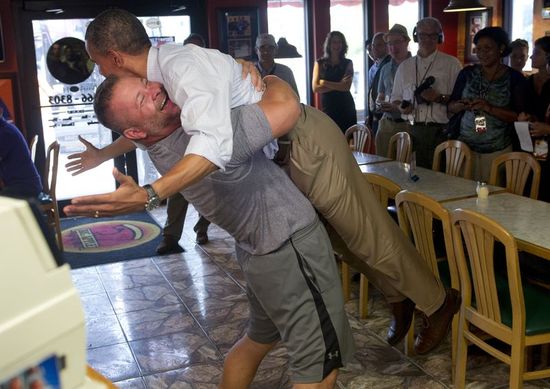
Elsewhere in politics, as Ambinder sized up the race, Texas' purple future looked distant and Michael Grunwald discussed the stimulus that keeps on giving. Then a pizzamaker bear-hugged Obama, Romney's ad machine unleashed in Wisconsin and politicians fought for credit for Ohio's recovery. Meanwhile, Suzy Khimm flagged workforce flight, stadiums returned little on their investment and bloggers debated the manufacturing comeback. John Hodgman mused on Eastwood's speech as readers got Mittrolled.
In sports coverage, Serena Williams redefined tennis, and as a reader reflected on the Paralympics, athlete Kyron Duke watched the London crowd.
In assorted commentary, as Al Qaeda threatened, James Barilla contemplated living in disaster-prone areas. Then a latter-day direwolf sang the Game of Thrones theme, Paul Bourke captured fractal earth and Philip Roth dueled Wikipedia. And though the jury remained out on hydration's cosmetic upside, women definitely out-schooled men. Meanwhile, a scientist became the go-to guy on apocalypse, Jehovah's Witnesses warned the deaf against onanism – with the help of R. Kelly – and Jonothon Gold explained the tricks of his trade. Finally, a charming VFYW here!
– G.G.
(Photo: US President Barack Obama is picked up by Scott Van Duzer, owner of Big Apple Pizza and Pasta Italian Restaurant, during a visit to the restaurant in Fort Pierce, Florida, on September 9, 2012, during the second day of a two-day bus tour across Florida. By Saul Loeb/Getty Images)
 The Dish
