Bounce Update

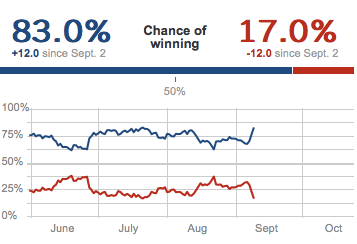
Nate Silver is defending himself from criticisms that he is exaggerating the polling shift since the conventions. His model is indeed reflecting the likelihood that Obama's bounce will fade soon. We won't know till the middle of this week. But the way his model has moved so swiftly in Obama's direction in the past two weeks is striking. I mean: look at this graph of what would happen if the election were held today, on Silver's model:
Screen shot 2012-09-10 at 11.05.26 AM
You can see that only in late June was there this kind of dramatic movement. More to then point, Obama's chances have never been this high in the model and Romney's – at a sad 17 percent – have never been this low. Sam Wang reaches the same conclusion:

The state poll meta-analysis has jumped by 10 electoral votes, and by 0.7% in Popular Vote Meta-Margin. Movements of >5 EV and >0.5%  usually happen only when a real shift is occurring. Already things are looking very unlike the GOP-convention anti-bounce. Note that the last time the Meta-analysis moved this fast on the first day was the post-Ryan-VP bounce, which peaked at about 40 EV and 3-4%.

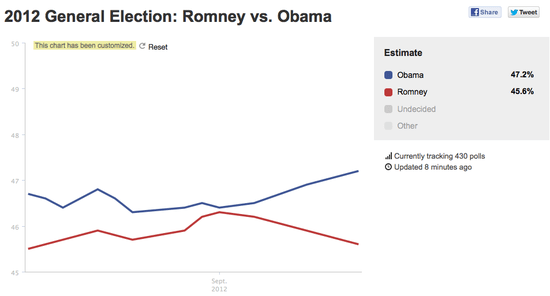
Wang now puts Obama as an 87 percent favorite to win. Here's Pollster's national poll of polls for the last three weeks, adjusted to lessen smoothing and show sudden changes (which may fade):
Screen shot 2012-09-10 at 11.15.09 AM
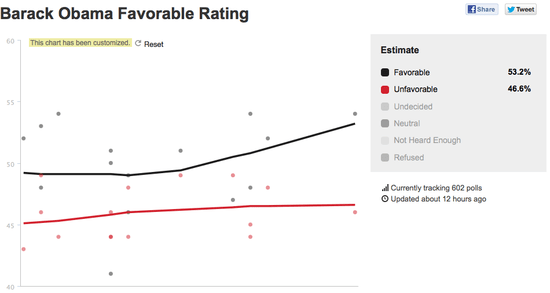
Here are Obama's favorables in the same period nationally:
Screen shot 2012-09-10 at 11.18.28 AM

Even Rasmussen is showing Obama moving toward net approval of 52 percent, the critical threshhold for re-election, and reaching 50 percent against Romney in their tracking poll today, the biggest lead they have ever shown for the president. Money quote:

The Rasmussen Reports daily Presidential Tracking Poll for Monday shows President Obama attracting support from 50% of voters nationwide, while Mitt Romney earns 45% of the vote. Two percent (2%) prefer some other candidate, and three percent (3%) are undecided.

Even if Romney wins every undecided voter in this poll, he still loses. He needs a game-changer. Will it be the ad blitz or the debates? Or are we seeing a landslide beginning to form?

The Manufacturing Comeback

Latest_numbers_CES3000000001_2002_2012_all_period_M08_data

It's increasingly hard to miss since Obama's first year. Here's one take on why:

States such as Alabama are aggressively courting local and international manufacturers. They are dangling tax breaks and other lucrative incentives to attract companies — and in turn are generating industry jobs and boosting their revenue. The federal government's bailout of the auto industry in 2009 saved General Motors (GM, Fortune 500) and Chrysler from bankruptcy and helped propel American automakers to improved sales, record profits and more hiring.

Rising expenses in China are another big reason domestic factory work has heated up considerably in the last 12 months. As labor and raw material costs skyrocket, more American companies are bringing production back home. One example is WindStream Technologies, which makes small wind turbines. WindStream opened a facility in North Vernon, Ind., last year so it could move production out of China. The change eliminated overseas shipping and travel expenses and helped lower production costs by 10% for each turbine.

A fluke?

It’s too earlier to claim victory with the current recovery in the manufacturing sector, but it is the the first positive slope since mid-1990′s.

How To Change A Wikipedia Entry

Philip Roth had to write a New Yorker blog post in order to get Wikipedia to change an entry on his novel, The Human Stain:

I am Philip Roth. I had reason recently to read for the first time the Wikipedia entry discussing my novel "The Human Stain." The entry contains a serious misstatement that I would like to ask to have removed. This item entered Wikipedia not from the world of truthfulness but from the babble of literary gossip—there is no truth in it at all.

Yet when, through an official interlocutor, I recently petitioned Wikipedia to delete this misstatement, along with two others, my interlocutor was told by the "English Wikipedia Administrator"—in a letter dated August 25th and addressed to my interlocutor—that I, Roth, was not a credible source: "I understand your point that the author is the greatest authority on their own work," writes the Wikipedia Administrator—"but we require secondary sources."

Thus was created the occasion for this open letter. After failing to get a change made through the usual channels, I don’t know how else to proceed.

Translating Taste

Food writer Jonathon Gold describes the tricks of his trade:

Food words are pretty specific. If something’s salty, you’ve gotta say it’s "salty." There’s no other word that means the same thing. You could say "briny," but that’s something different. You could use an analogy, but since saltiness is something you have to convey in almost every column—there’s salt, you know? You have to talk about it. … A lot of [learning to write about food] was reading Balzac’s twenty-page descriptions of somebody’s socks. The nineteenth-century guys used tons of physical description because there wasn’t photography yet, much less movies. In Dickens, the wrinkles in somebody’s jodhpurs actually meant something. And they would have to be described exactly. That transfers to food writing.

Eyes On The Storm

IMG_20120727_144953

James Barilla contemplates living in South Carolina during hurricane and tornado season:

I’ve spent much of my life learning the vernacular of place: the local flora and fauna, foods, building materials, soil qualities, human cultures, the folklore that grows up around what’s useful. You have to go out looking for these things. Recently I’ve come to realize that disaster is also part of the lexicon. You don’t find it, necessarily. It finds you.

The signs of local calamity, the way the sky behaves, the longstanding patterns of human anticipation, the behavior of birds and livestock: these are regionally distinctive. But it’s also true, in this era of accelerating climate change, that your local language of environmental catastrophe and mine, your flood and my drought, are connected in ways they’ve never been before. … The accessibility of meteorological data changes my sense of the bioregional riskscape. I need to care about what Cuba and the Antilles are experiencing, about what’s brewing in that oceanic expanse where storms are born, a space that previously meant nothing to me, that simply didn’t exist on any mental map I’d ever made.

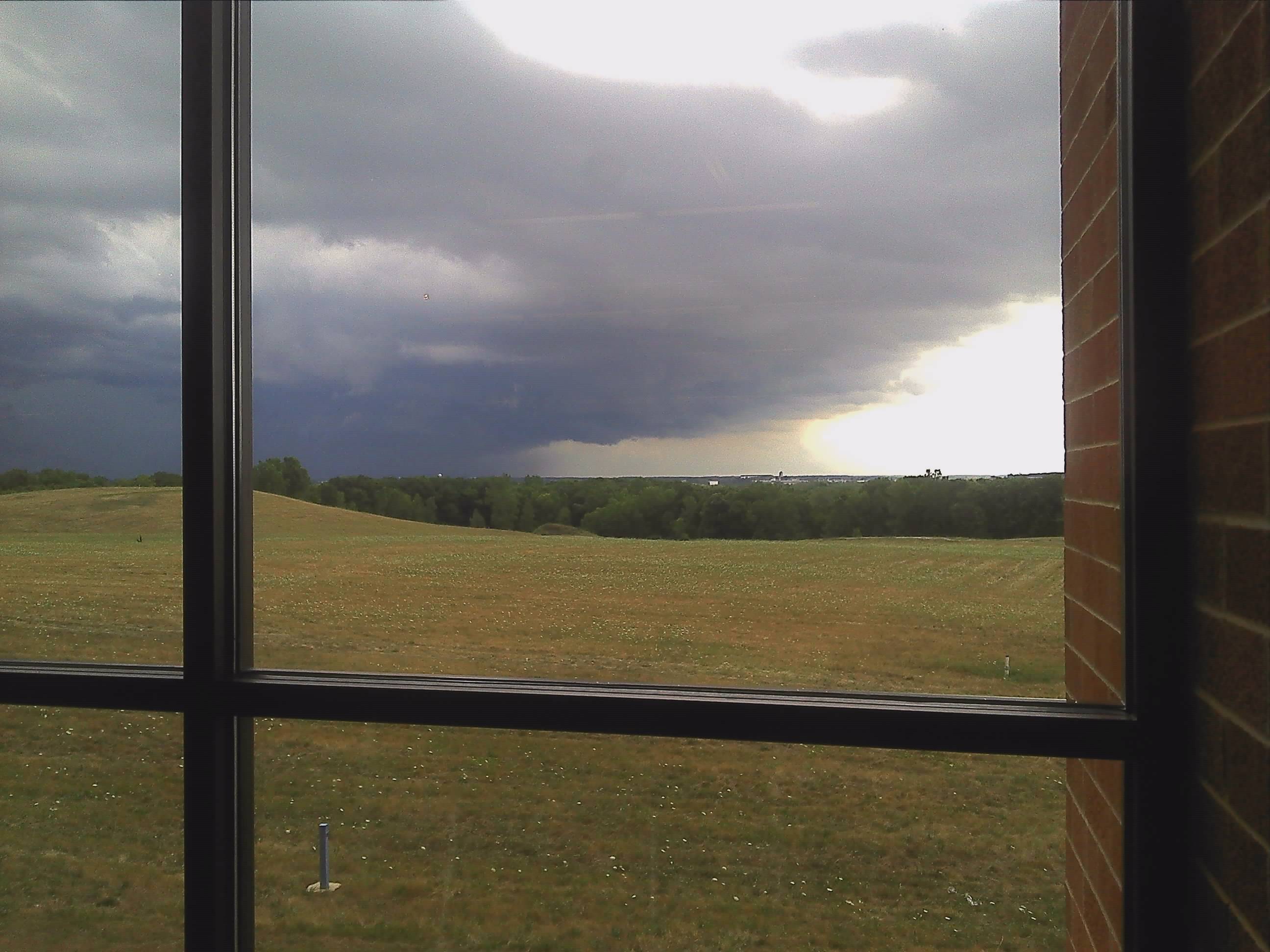
A reader submitted the above photo as a VFYW:

This picture was taken from the Kentwood Branch library (Kentwood, Michigan) on July 27, 2012 at 2:55 pm.  It was taken from the second floor looking east.  The airport in the background is the Gerald R. Ford International Airport.  The grass in the foreground is an old landfill. 

A Dewy Complexion

Does drinking water improve your skin? Claudia Hammond parses the science:

A review by the dermatologist Ronni Wolf at the Kaplan Medical Centre in Israel found just one study looking at the effect of long-term water intake on the skin. But the results were contradictory. After four weeks, the group who drank extra mineral water showed a decrease in skin density, which some believe suggests the skin is retaining more moisture, while those who drank tap water showed an increase in skin density. But regardless of the type of water they drank, it made no difference to their wrinkles or to the smoothness of their skin.

The Back-To-School Gender Gap

Gender-ratio-of-recent-us-graduates

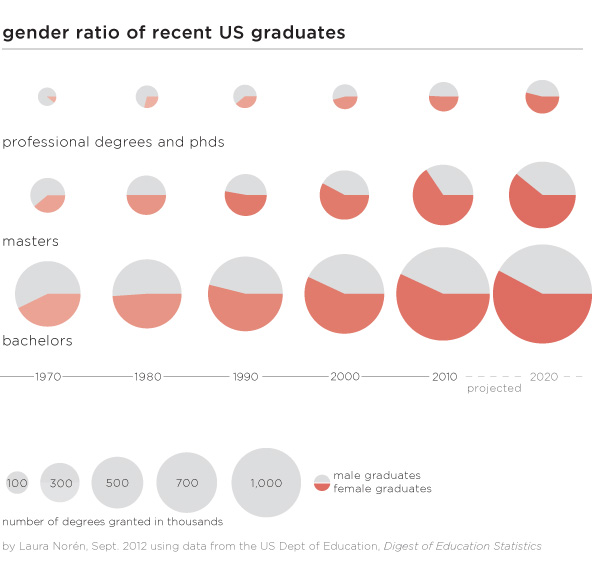
Laura Norén charts it:

All of the three degrees were more likely to be earned by men in 1970. Then between 1970 and 1980 women made rapid gains which continued through the 1980s. The gains for women slowed down once they hit the 50/50 mark for both bachelors and masters degrees and I predict they will also slow down for phd and professional degrees. Though it’s hard to tell by looking at the graphic, women are earning the largest proportion of masters degrees (projected to be 61% in 2020) which is slightly more than the 58% of bachelors degrees they are projected to earn in 2020.

The Weekend Wrap

Ww

This weekend on the Dish, Andrew asked if the conventions had changed the presidential race – and grew more hopeful about Obama's chances – while George Weigel provided a glimpse of how the misguided rightwing mind still views the contest. Deborah Orr fell in love with America, Vladimir Putin spoke of a different sort of romance in Russia, Texas continued its outsized ways, and Tom Junod mused on what waterparks teach us about democracy.

Mostly, though, politics receded as we thought about books and culture. John Jeremiah Sullivan defined the latter for a young Southerner, Martin Amis explained how the world was becoming less innocent, Jonathan Franzen approached birdwatching with awe, and D.T. Max described the difficult work of interviewing those who loved David Foster Wallace. Thomas Heis remembered F. Scott Fitzgerald's downward spiral, Caleb Crain considered the critic's freedom, Kerry Howley noticed the remarkably consistent guidelines at erotic publishing houses, BLS Nelson portrayed Wittgenstein as a lone wolf, Alan Lightman meditated on life's inevitable changes, and Zoë Heller complicated Naomi Wolf's ideas about sex and creativity. It wasn't all highbrow, however – Jessica Roy uncovered the history of Rickroll and Alexis Madrigal highlighted a great Missed Connection at Burning Man. Read Saturday's poem here and Sunday's here.

We explored religion, too. Francis Spufford defended the emotional core of Christian faith, Yuan Zhiming saw the universal message of Jesus as a threat to Chinese communism, Peter Berger investigated the religious significance of beards, Kate Blanchard pondered when religion deserves our respect, David Montgomery noted the surprising contribution of creationism to geology, and Francine Prose plumbed the connection between art and the divine.

In assorted coverage, Drew Nelles recounted the strange history of animals being tried in court, Jamie Feldmar looked back on the power lunch, Linda Besner analyzed why depressives are in touch with reality, Sam Dunne covered the latest in condom wrapper innovation, Ike Anya disproved the myth that depression is just for Westerners, and Adam Frank reflected on how we experience time. FOTDs here and here, MHBs here and here, VFYWs here and here, and the latest window contest here.

– M.S.

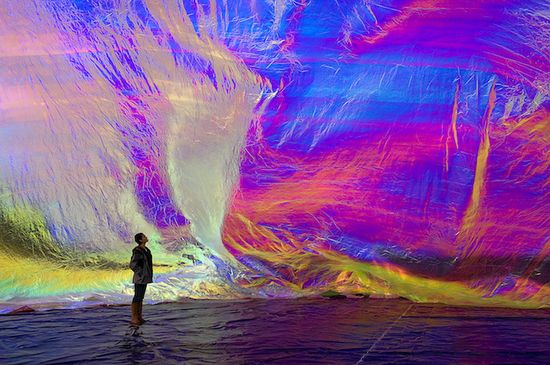
(Image ‘Poetic Cosmos of the Breath’ by Tomas Saraceno via Ignant)

Making It To 100

Statistician David Spiegelhalter considers his chances:

The stats tell me that I have a 1.4% chance of scoring a century and getting a letter from the Queen. In fact, there is at least a 6% chance of the Queen getting a letter from the Queen (or whoever has the job in 2026), but she is not in the least bit average, and has good family precedents, with her mum hitting 101.

Dutch filmmaker Jeroen Wolf reveals the biggest hurdle to making the above video, which contains snapshots of people from age 1 to 100:

I had particular problems finding a 99 year-old. (Apparently 100 year-olds enjoy notoriety, but a 99 year-old is a rare species…) And when I finally did find one, she refused to state her age. She simply denied being 99 years old! But finally, some 4 months after I recorded my first 'age', I was able to capture the 'missing link' and conclude this project.