Writing In The World’s Most Violent City

GT_PAKISTANBLAST_120919

Mohammed Hanif reflects on his life in Karachi, Pakistan:

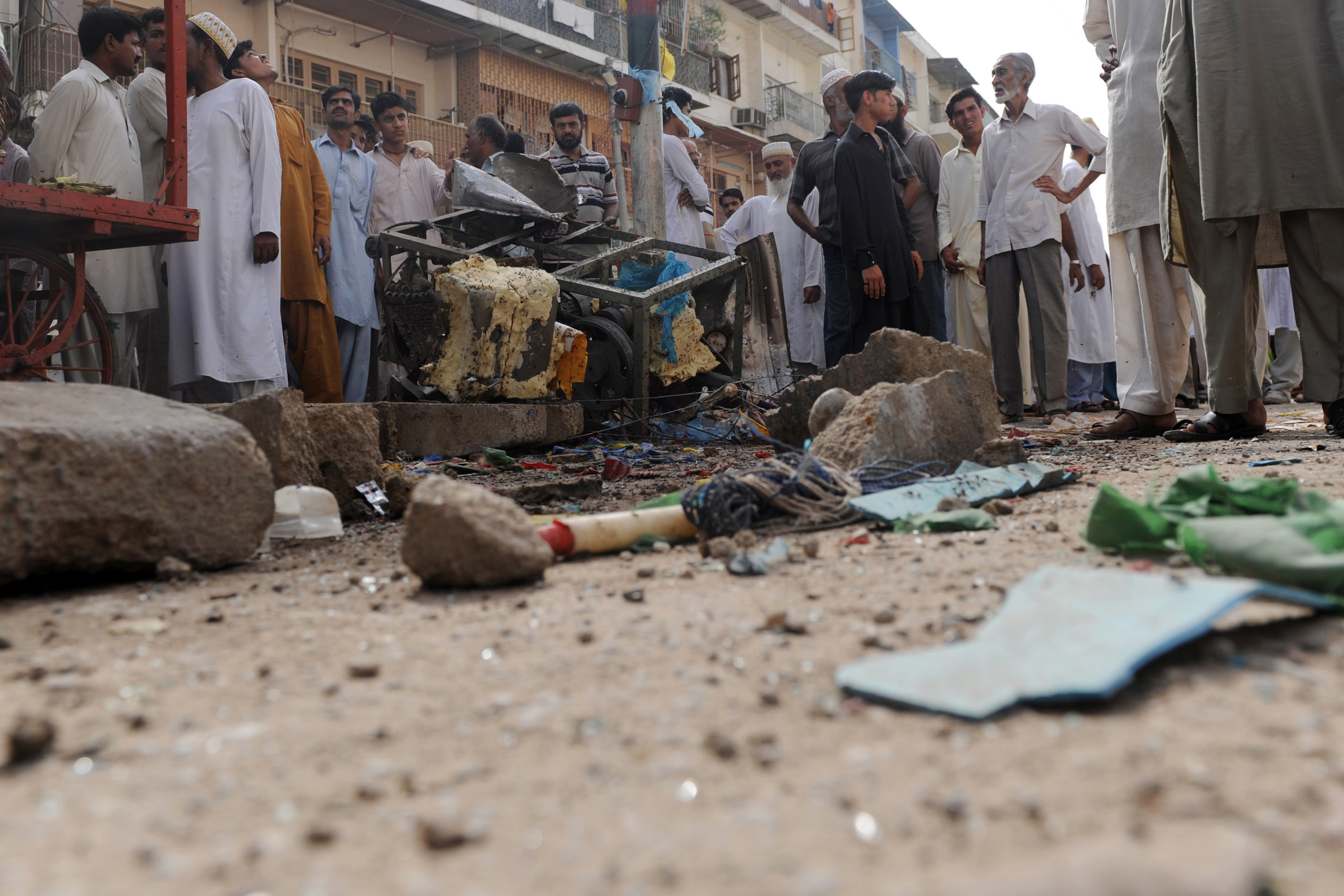
Foreign journalists visiting Karachi use the word “resilient” about this city and often tell their audiences: There was a killing spree yesterday, but people have shown resilience and are out on the streets. As a citizen, I know that after a traumatic event, people don’t decide that they must go out and show the world how resilient they are. They go out and pretend everything is normal because they need to make a living. But then visiting journalists also need to make a living.

(Photo: Local residents gather at the site of an overnight bomb explosion in Karachi on September 19, 2012. The death toll from twin bomb blasts in Karachi rose to seven as police said they suspected the attack was targeted at members of a minority Muslim sect. By Rizwan Tabassum/AFP/Getty Images)

The Middle-Class Ceiling

Jim Tankersley fears that upward mobility is a thing of the past:

There is … growing—though still nascent—evidence that from one American generation to the next, mobility is declining. It’s getting harder, that is, to work your way into a higher income level than the one into which you were born. A son’s adult income in the United States is about half dictated by how much his father made, a percentage that is nearly as high as in any country in wealth-by-birthright Europe, according to the Organization of Economic Cooperation and Development. In Europe, family connections and the circumstances of one’s birth are considered crucial determinants of success, a consequence of the entrenched aristocracies in the United Kingdom and, to a lesser extent, Italy and France.

This is far from the up-by-the-bootstraps, Horatio Algeresque self-image that most Americans hold dear. In the United States, immobility is a way of life, especially for the very rich and the very poor. Brookings Institution economist Isabel Sawhill estimates that 40 percent of children born into the topmost or bottom income quintile won’t budge as adults from where they began. Katharine Bradbury, a senior economist at the Federal Reserve Bank of Boston, agrees. “Most of the long-term poor are stuck at the bottom; most of the long-term rich have a strong grip on the top; and each of these two groups is somewhat more entrenched than the corresponding groups 20 years earlier,” she concluded in a research paper last spring.

The Apple Mapocalypse, Ctd

David Pogue, the NYT’s tech reviewer, says Apple Maps “may be the most embarrassing, least usable piece of software Apple has ever unleashed”:

Unfortunately, in this new app, the Washington Monument has been moved to a new spot across the street. The closest thing Maps can find for “Dulles Airport” is “Dulles Airport Taxi.” Search for Cleveland, Ga., and you’ll wind up right smack in Cleveland, Tenn. Riverside Hospital in Jacksonville, Fla., is in the right place but the wrong decade; it became a Publix supermarket 11 years ago. And on, and on, and on. Entire lakes, train stations, bridges and tourist attractions have been moved, mislabeled or simply erased. Satellite photo views consist of stitched-together scenes from completely different seasons, weather conditions and even years.

What happened, as AllThingsD reports, is that the end-user got lost in the business war between the two tech superpowers:

Apple pushed Google hard to provide the data it needed to bring voice-guided navigation to iOS. But according to people familiar with Google’s thinking, the search giant, which had invested massive sums in creating that data and views it as a key feature of Android, wasn’t willing to simply hand it over to a competing platform. And if there were terms under which it might have agreed to do so, Apple wasn’t offering them. 

So Apple, a company long known for protecting its user experience over almost everything else, sacrificed that experience for a business advantage. Joshua Gans thinks the mess has been a revealing one:

[A]ll this brinkmanship smacks of mistakes. Google misjudged Apple’s desire to go it alone possibly because they knew Apple could not have had a superior product. But, more critically, and related to this, Apple misjudged just how important it is for maps to be highly accurate and also just how confusing it is for consumers to have to switch to other apps. After all, while people may have lamented Apple not supporting Flash or the uselessness of is Passbook app recently, the Maps issue took away features consumers had. So there was degradation. And, as I said last week, it is the willingness of Apple to do that rather than be beholden to Google’s power a little longer that has spooked many.

Previous Dish coverage here.
Literary Lust

Gideon Lewis-Kraus reviews DFW's final non-fiction collection, the forthcoming Both Flesh and Not, which includes the 1998 essay on writing, "The Nature of the Fun":

When you first start to write, [says DFW] "you’re writing almost wholly to get yourself off." When your work starts to get some attention, the masturbatory motive is supplanted by a seductive one: You start to need to feel liked. But if you can work through the fear and vanity that characterize art-as-seduction, the fun returns. "Under fun’s new administration, writing fiction becomes a way to go deep inside yourself and illuminate precisely the stuff you don’t want to see or let anyone else see, and this stuff usually turns out (paradoxically) to be precisely the stuff all writers and readers share and respond to, feel."

The implicit trajectory is from masturbation to seduction to love. This is perhaps clearest in his best late essay, "Federer Both Flesh and Not," which opens the new volume and gives it its title. By the time of this piece (2006), romantic love has become his symbol of maturity, the ability to be up-front about one’s own needs while attending to the needs of someone else.

Writing Skills Aren’t Catching

Peg Tyre considers how learning to write has changed:

Fifty years ago, elementary-school teachers taught the general rules of spelling and the structure of sentences. Later instruction focused on building solid paragraphs into full-blown essays. Some kids mastered it, but many did not. About 25 years ago, in an effort to enliven instruction and get more kids writing, schools of education began promoting a different approach. The popular thinking was that writing should be “caught, not taught,” explains Steven Graham, a professor of education instruction at Arizona State University. Roughly, it was supposed to work like this: Give students interesting creative-writing assignments; put that writing in a fun, social context in which kids share their work. Kids, the theory goes, will “catch” what they need in order to be successful writers. Formal lessons in grammar, sentence structure, and essay-writing took a back seat to creative expression.

The catch method works for some kids, to a point. “Research tells us some students catch quite a bit, but not everything,” Graham says. And some kids don’t catch much at all. Kids who come from poverty, who had weak early instruction, or who have learning difficulties, he explains, “can’t catch anywhere near what they need” to write an essay.

Former 5th grade teacher Robert Pondiscio claims it is a mistake for grade school writing curriculums to value ideas and personal expression over grammar and mechanics:

Far from imposing a cultural norm or orthodoxy–silencing their stories and compromising their authentic voice–teaching disadvantaged children the mechanics of writing, and emphasizing evidence over anecdote, is liberating not constraining. Teaching grammar, vocabulary. and mechanics to low-income black and Hispanic students is giving them access to what Lisa Delpit, an African-American educator and a critic of progressive education methods, famously called the "culture of power."

Let me hasten to add that there should be no war between expressive writing and explicit teaching of grammar and mechanics. It's not an either/or proposition.

Further discussion on the topic here.

The Daily Wrap

Silverrace
Today on the Dish, Andrew argued that neocons are running against Carter, claimed the inalienable right to medical marijuana, and thanked extremists for alienating the Catholic mainstream. He then explained Obama's lack of complacency, flagged Obama's "closing argument" ad, and, after declining to rule out a landslide, called attention to David Corn's unearthed Bain video.

As Dick Morris declared the race to be tied and the poll-doubting craze caught on even more, Tomasky asked Republicans to face reality. Meanwhile, as the Obama campaign rolled out another slew of high-impact ads, Chait analyzed the team's superior return on investment.

Mark Lilla then framed middle-roader Obama expectations, Dylan Matthews identified the lobbying boost for DC's economy and Weigel highlighted how redistricting locked in 2010 gains. Bloggers debated the upward jobs revision, almost everyone depended on the government, and as Jacob Sullum hailed a turning point in pot legalization, Shamus Khan longed for yesteryear's tax attitudes.

In coverage of global issues, Netanyahu drew a bomb at the UN, Steve Coll questioned Muslim rage and Alec MacGillis exposed Romney defense of free trade with China. And while Americans increasingly supported torture, Joshua Foust questioned the reliability of the Stanford drone report.

In assorted commentary, Andrew shared his struggles with doggie anxiety and relayed how Drudge cheered up the, uh, drudgery of moving. Parul Sehgal then reflected on the immigrant's relationship to books, academics offered more perspectives on the papyrus scroll mentioning Jesus' wife and the Mormon Church cracked down on a Mormon blogger. Dina admired Fatty Arbuckle, more readers speculated on whom weddings are for and James Bond voyaged in style. Brian Fung then wondered what to do when you can't fall asleep and Jackson Landers investigated chicken taste. New-fangled angling here and VFYW here.

G.G.

Going Back

I was searching through the Dish archives a minute ago and came upon this post in the period when I was afraid that Sarah Palin might run for the presidency in 2012. It's from February 2010:

My concern is the remarkable lack of talent in GOP ranks at a possible presidential level, and the unknowable economic future, in which populism could surprise us all. I mean: Romney?

Killer Robots Above, Ctd

Joshua Foust questions the reliability of the Stanford/NYU report:

For starters, the sample size of the study is 130 people. In a country of 175 million, that is just not representative. 130 respondents isn't representative even of the 800,000 or so people in the Federally Administered Tribal Areas (FATA), the region of Pakistan where most drone strikes occur. Moreover, according to the report's methodology section, there is no indication of how many respondents were actual victims of drone strikes, since among those 130 they also interviewed "current and former Pakistani government officials, representatives from five major Pakistani political parties, subject matter experts, lawyers, medical professionals, development and humanitarian workers, members of civil society, academics, and journalists." 

James Cavallaro and Sarah Knuckey, two of the study's authors, want more transparency:

Today, it is almost impossible to have an informed public debate about U.S. policies on drone warfare – primarily because of efforts by the government to shield its targeted killings program from democratic accountability. The U.S. should release Department of Justice memorandums outlining the legal basis for targeted killings, make public critical information about U.S. policies, ensure independent investigations into drone strike deaths (with prosecutions, as appropriate) and establish compensation programs for affected civilians.

Tucking Yourself In

Brian Fung wonders about the best thing to do when you can't fall asleep:

[Y]our best move, if you've been in bed for 20 minutes and still aren't dozing off, is to get up and engage in a low-light, low-stress activity like reading until you begin to feel tired. Taking your mind off of "Why am I not sleeping?! I need to sleep!" is crucial. When you do get up, though, don't use your computer or phone or watch TV — the blue-colored light from the screens tricks your body into thinking it's daytime and not releasing melatonin. Sweet, sweet melatonin.

Meanwhile, Austin Frakt reads a recent sleep study and ponders whether too much sleep is unhealthy. His bottom line:

All we can say is that sleeping about 7 to 8 hours is what healthy people tend to do. There’s no evidence sleeping longer is helpful, and it could be harmful.