Washington’s Wonk King

Matt Welch profiles Ezra Klein:

[H]e has become arguably the prototypical insider in the Age of Obama: confident, cloaked in numbers, assured about the virtues of economic intervention but alarmed by the growing dysfunction of politics. In fact, he is so deep inside now that he’s come to an even more terrifying conclusion about life in The Village than his Netroots compatriots could ever have dreamed: "I’m much more certain that the problems are systemic and the various forms of gatekeeping elites [are] impotent," he wrote me in a follow-up email to our interview. "And that feeling—that the people in charge aren’t just wrong or bought off, but that, quite often, they fundamentally don’t know what they’re doing—is a bit scary, and fairly radicalizing."

Unsafe In Iraq

Average_Deaths_Quarter

Joel Wing relays the bad news:

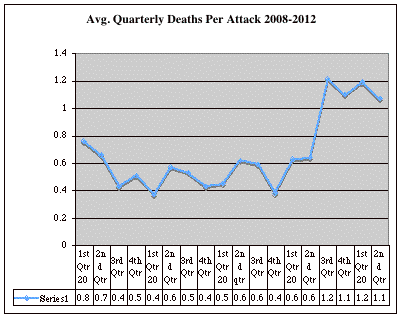
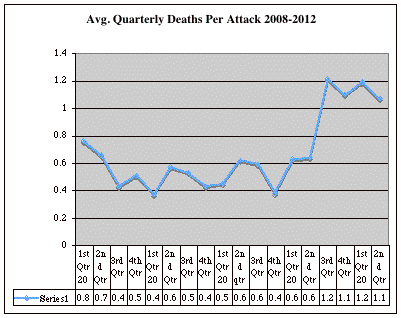
The withdrawal of American forces from Iraq has not improved security. In fact, the country has become more dangerous since their departure. Al Qaeda in Iraq, the Baathist Naqshibandi, and other insurgent groups are now carrying out more operations, and killing more people in each attack. That undermines hopes that militants would be in decline after foreign forces were out of the country, and that reconciliation might be possible. Instead, Sunni militants have simply gone from targeting the Americans to the Iraqi security forces and government officials.

Naturally Shy

Michael Byrne contemplates shyness:

Some 15 to 20 percent of humans are born shy, which roughly parallels the incidence of shyness or anxiety or whatever you chose to call it within different species of animals. Shyness is an evolutionary tactic. Someone within a society must be shy for that society to be selected for and survive. If every member of a population was gregarious and stoked to rush into vulnerable positions, that would be a population less likely to persist. In other words, it’s natural and neccessary for species to have shy members. Humans aren’t an exception. Some of us are just like this, and that’s for the good of the species, no matter how aggresively we try to medicate it away.

Bryne, who is shy himself, isn't happy about this:

[B]eing shy, or having "social phobia," sucks. It feels bad. It limits opporitunities, by definition, to experience pleasure. This is why there’s a massive market for SSRI treatment for SAD and social phobia — Pfizer isn’t marketing into a void or inventing experiences. And this is why it gets really frustrating when armchair experts start going on about how it’s all the drug companies making up new diagnosis for "normal" feelings. Feeling terrible and excluded — thinking here of that solitary elk lurking on well-trampled pee-snow under the same evergreen branches hiding from hunters — may be normal, but often, it’s also terrible. Shouldering the persistence of a species or not, no one wants to feel that way.

The Ultimate Stoner Movie, Ctd

Samsara_myanmar Chinesechickenplant

Previewed last month on the Dish, the provocative Samsara is now in theaters. Ebert gave it four stars, calling it an "uplifting experience":

I met [filmmakers Ron] Fricke and [Mark] Magidson when a restored version of [their previous film] "Baraka" was shown at Ebertfest, and had the impression that traveling the world and recording these images was sort of their calling. Some of these places, structures, peoples and practices will not endure forever, and if this planet someday becomes barren and lifeless, these films could show visitors what was here.

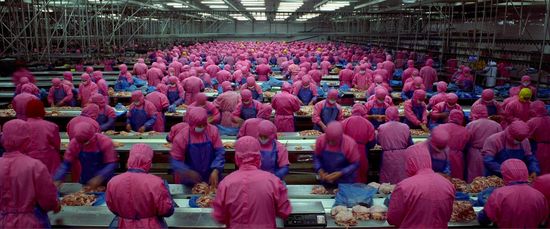
"Samsara" may also suggest some of the ways in which it was lost. Although the documentary presents speeded-up images of city traffic and unseemly mechanical haste, for me the most unforgettable sequence is not one of breathtaking vistas or natural beauty, but of chickens in a food-processing plant [seen above].

Joe Fassler talked to the filmmakers about how they filmed the more difficult locations, including the factories:

"In the U.S., we got a lot of no's when we asked to show the kitchen where your food is made," Fricke said. Chinese producers, though, didn't demonstrate the caginess and secrecy that typifies large-scale American agriculture. Instead, they were happy to let the light in. "They were interested in showing the efficiency and cleanliness of their factory," Magidson said. "In fact, the poultry facility actually required us to put their corporate logo in some of the shots."

(Photos from Oscilloscope)
Rebuilding Burma

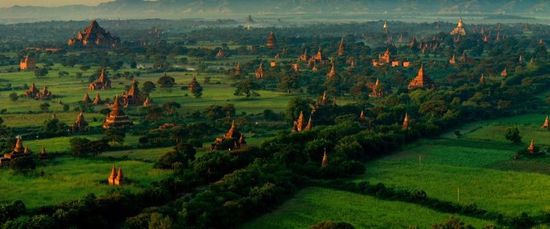
Francis Fukuyama, who recently visited Burma, outlines the country's needs:

While I have a relatively jaundiced view of economists these days, it struck me that what Myanmar really needed now was not more democracy activists but some competent economists like the Berkeley mafia that advised Indonesia. The country’s needs are incredible in virtually every sphere. There is no banking system, to begin with; all transactions have to be carried out in cash and foreigners are advised to enter the country with crisp American bills with which to settle their accounts.

Outside of Naypyidaw, the country’s infrastructure is crumbing; it is hard to move goods across the border, and electricity is highly irregular outside of the monsoon season. There is a tremendous shortage of human capital as a result of the country’s isolation: among other things, Burma stopped teaching English back in 1964, and closed Rangoon University for three years after the student protests. We witnessed a tremendous hunger to learn about the outside world, one that will take more than a generation to fill.

Photographing The Dead

Sleepless and haunted by the grisly scenes he often photographs, Mexican photojournalist Jorge Luis Plata is concerned about the spirits of his dead subjects:

When I arrive at a crime scene I have to show respect for the dead, for the Great Spirit that is inside every person as my grandmother taught me. Even people who are killers, drug dealers, pimps, abusive and violent themselves have a Great Spirit and if their life is taken in a brutal way, their Great Spirit finds no peace and has nowhere else to go but into someone else’s living body. My way of showing respect is to say a little prayer before taking pictures. I tell the dead that I’ve come in good faith and that I’m not there to harm or disturb them. Whenever I have a chance, I light a candle or take a bunch of flowers to a church afterwards in gratitude that I’ve been able to do those pictures without being harmed.

What Bombing Iran Would Entail

Noah Shachtman summarizes the research (pdf) of Anthony Cordesman, "one of Washington’s best-connected defense analysts":

Should the U.S. actually take Benjamin Netanyahu’s advice and attack Iran, don’t expect a few sorties flown by a couple of fighter jocks. Setting back Iran’s nuclear efforts will need to be an all-out effort, with squadrons of bombers and fighter jets, teams of commandos, rings of interceptor missiles and whole Navy carrier strike groups — plus enough drones, surveillance gear, tanker aircraft and logistical support to make such a massive mission go. And all of it, at best, would buy the U.S. and Israel another decade of a nuke-free Iran.

Cordesman is skeptical that Israel could successfully attack by itself:

“Israel does not have the capability to carry out preventive strikes that could do more than delay Iran’s efforts for a year or two.” Despite the increasingly sharp rhetoric coming out of Jerusalem, the idea of Israel launching a unilateral attack is almost as bad as allowing Tehran to continue its nuclear work unchallenged.  It would invite wave after wave of Iranian counterattacks — by missile, terrorist, and a boat — jeopardizing countries throughout the region. It would wreak havoc with the world’s oil supply. And that’s if Israel even manages to pull the mission off — something Cordesman very much doubts.