Freudian Family Feud:
Month: September 2012
Getting Copy-Wronged
For a brief period after Tuesday's convention broadcast, the official YouTube recording of the event was unviewable due to copyright complaints. Ryan Singel explains:
The most likely culprit is YouTube’s pre-emptive content filters, which allow large media companies to upload content they claim to own and automatically block videos that an algorithm decides matches their own. That would make the glitch the second livestream copyright-policing snafu in the span of a few days: On Sunday, a similar algorithm at uStream interrupted the livestream of the Hugo science fiction awards. The award show included clips of copyrighted videos, though the algorithm didn’t know that the clips had been authorized. [Also, in] early August, an official NASA recording of the Mars landing was blocked hours after the successful landing, due to a rogue DMCA complaint by a news network.
A whopping ten companies (or company algorithms) made copyright claims on the convention recording. Tim Cushing fumes:
There's a few of the usual suspects in there, including AP, UMG and Warner, entities not known to be shy about claiming content that isn't theirs.
Now, these entities aren't directly responsible for this takedown. This is more of an automated match situation, but it still doesn't change the fact that the inherent stupidity of the action, automated or not, does absolutely nothing to lock down stray, unmonetized content and absolutely everything to highlight the ridiculous nature of copyright protection in a digital age. If Google can work with copyright holders to produce content matching software, it seems like it might be possible to designate certain accounts or entities as "off limits" from the wandering killbots. If the stream is authorized by, I don't know, the party of the current President of the United States, maybe, just fucking maybe, everything's "above board."
Update from a reader:
There's an easier way to fix the problem than to create a special class of people whose feeds are automatically approved: just penalize anyone who claims copyright infringement falsely. I'd say a "three strikes and you're out" policy would be appropriate. After that, each erroneous takedown notice carries an escalating fine. This puts the incentive on the rights holder to actually make a verified claim, rather than shutting down innocents because Youtube's algorithim was being unfriendly.
Chart Of The Day
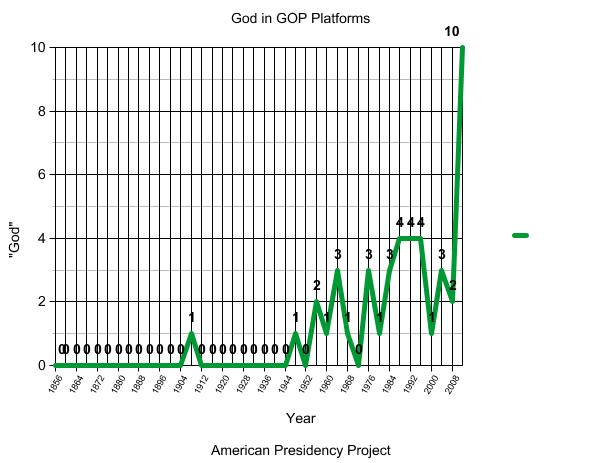
Dave Noon reviews the archive of party platforms:
1. The 2012 GOP platform is a total outlier, presumably designed to intimidate the Saracen hordes biding their time for Obama’s re-election.
2. Judging entirely by the text of its platforms — for by their words, or works, or whatever, ye shall know them — the party clearly had no use for God from its founding through the 1960s. By my sophisticated calculations, the godlessness of the Republicans from 1856-1956 likely accounts for the successful passage of 93 percent of Progressive Era legislation and 97 percent of the New Deal.
That's also a superb graph revealing just how new the God fixation is in American politics. Of course there was always constant, rote invocation of the Almighty in decades passed – but the neurotic quality of rigid, truth-denying fundamentalism is waxing particularly strongly right now, and not just in Christianity. Head to the West Bank settlements or Timbuktu. It's real and it's in America too.
Clinton’s Medicaid Attack
Frum found it extremely effective:
Republicans have promised to hold harmless from Medicare changes everyone under age 55, assuring high-voting senior citizens that they have nothing to fear from Republican budget plans. But while Medicare is left alone until 2023, Medicaid is immediately subject to very large cuts. Many of us may think of Medicaid as above all a program for the poor. It is also, however, increasingly the way in which America pays for nursing home care — and indeed nursing care is the fastest-growing part of Medicaid. Very large and immediate Medicaid cuts draw a large early question mark over the future of nursing care — not just for those now under 55, but for the current elderly.
Sarah Kliff fact-checks Clinton's Medicare and Medicaid attacks. He claimed that "nearly two-thirds of Medicaid is spent on nursing home care for Medicare seniors who are eligible for Medicaid." That isn't true:
Kaiser Family Foundation looked at this issue in an April 2012 brief. It found that, "Although these ‘dual eligibles’ accounted for only 15 percent of Medicaid enrollment in 2008, 39 percent of all Medicaid expenditures for medical services were made on their behalf."
Here’s where his number probably comes from: Later in the Kaiser brief, it notes that of all the Medicaid dollars spent on dual eligibles, 69 percent were for long term care services. But there’s a big difference between 69 percent of 39 percent of Medicaid spending – and two-thirds of all Medicaid dollars.
Ask Ta-Nehisi Anything
[Updated from yesterday with many more questions added by readers]
Ta-Nehisi Coates' excellent piece in the current Atlantic, "Fear of a Black President," begins:
The irony of President Barack Obama is best captured in his comments on the death of Trayvon Martin, and the ensuing fray. Obama has pitched his presidency as a monument to moderation. He peppers his speeches with nods to ideas originally held by conservatives. He routinely cites Ronald Reagan. He effusively praises the enduring wisdom of the American people, and believes that the height of insight lies in the town square. Despite his sloganeering for change and progress, Obama is a conservative revolutionary, and nowhere is his conservative character revealed more than in the very sphere where he holds singular gravity—race.
To submit a question for TNC, simply enter it into the field at the top of the Urtak poll (ignore the "YES or NO question" aspect and simply enter any open-ended question). We primed the poll with questions you can vote on right away – click "Yes" if you have a strong interest in seeing him answer the question or "No" if you don't particularly care. We will air his responses soon. Thanks to everyone for participating.
The Cars Of The Future, Today
It looks like self-driving cars are coming to California. The Economist assesses the technology:
Getting a car to drive along an open road without crashing into other vehicles is one thing. Getting it to handle a complete journey on its own—including navigating junctions and roundabouts, responding appropriately at pedestrian crossings and avoiding obstacles on the road—is rather more difficult. To build such a machine costs around $1m for the car, kit, software, and brainpower, says Jonathan Sprinkle, co-leader of an American-Australian team that entered a driverless vehicle in the 2007 DARPA Urban Challenge, a robotic-car contest sponsored by the research arm of the American Department of Defence. Because modern engines, drivetrains, and brakes already receive their instructions via electronic signals, there is surprisingly little need for additional mechanical parts.
What is needed, however, is an array of extra sensors to make cars more aware of their surroundings. Mapping nearby features, spotting road edges and lane markings, reading signs and traffic lights and identifying pedestrians is done using a combination of cameras, radar and lidar (which works like radar, but with pulses of light rather than radio waves).
Why Was The Speech Moved Indoors?
Krauthammer, in a creative fashion, believes that Obama's speech was moved inside because he couldn't fill the stadium:
Nate Cohn doubts this:
[T]he Obama campaign lost an opportunity. By all accounts, Obama's speech in Denver endowed Obama with an army of new volunteers and text messages to their friends and relatives. With Obama down slightly in most polls, a big speech to rejuvenate the enthusiasm of tens of thousands of North Carolina volunteers could have been extremely useful. Perhaps more than any other state, North Carolina is all about turnout. If switching venues cost the Obama campaign a fantastic organizing opportunity, the optics or weather risks must have been serious, at least in the Obama campaign's judgment.
Jonathan Cohn lists other reasons to believe the Obama campaign:
The first is that the decision will disappoint a lot of groups who were distributing tickets to members. The second is that the campaign will have to re-accommodate donors that paid for skyboxes. The third is that the campaign and administration officials I’ve seen today seem genuinely disappointed that Obama won’t get a chance to reprise his performance in Denver, when he spoke to the football stadium at Mile High.
Silver is more skeptical. Since the tickets were sold and there was a waiting list, I'm inclined to believe Chicago. But it strikes me that an outdoor stadium event simply wouldn't be right for an incumbent president in tough times. He needs intimacy with the average voter; he needs to explain; he needs to get away from all the celebrity crap that surrounds him. Inside is better – less hubristic, less dramatic, more real. A reader raises a good point:
I'm inclined to believe the campaign when they cite weather concerns as the reason for moving the speech, even if it doesn't end up raining. If there's a chance of rain (and as a North Carolinian who has seen the skies go from blue to black in a matter of minutes, "a chance" is often as good as a promise), people are going to wear ponchos and raincoats and carry umbrellas. It's one thing to get 65,000 people through security when the weather is nice – but add all the extra bulk and accessories that a rainy forecast necessitates, and you have a potential security nightmare.
Awaiting The Obama Bounce
Plouffe is trying to lower expectations. Drew Linzer sees none for Romney:
Either voters didn’t like what they were hearing, had already made up their minds, or simply weren’t paying much attention (all relatively speaking, of course). Considering Obama’s current lead in the polls, none of these scenarios are good for Romney. And if it turns out that Obama does receive a bounce coming out of the DNC, then we can likely conclude that the reason Romney didn’t get a bounce from the RNC isn’t because voter opinion is just fundamentally difficult to move this year.
Silver likewise ponders the bounce.
Women Aren’t Victims Of The Hookup Culture
In the Atlantic piece she discussed in Monday's "Ask Anything" video, Hanna Rosin stands up for the sexual choices of Millennials:
When they do hook up, the weepy-woman stereotype doesn’t hold. Equal numbers of men and women—about half—report to England that they enjoyed their latest hookup "very much." About 66 percent of women say they wanted their most recent hookup to turn into something more, but 58 percent of men say the same—not a vast difference, considering the cultural panic about the demise of chivalry and its consequences for women. And in fact, the broad inference that young people are having more sex—and not just coarser sex—is just wrong; teenagers today, for instance, are far less likely than their parents were to have sex or get pregnant. Between 1988 and 2010, the percentage of teenage girls having sex dropped from 37 to 27, according to the latest data from the Centers for Disease Control and Prevention. By many measures, the behavior of young people can even look like a return to a more innocent age.
Kate J.M. Baker claps. Dreher gets defensive:
I wrote the other day about how a gay culture of promiscuity is a "culture of death." This is a heterosexual version of the same. It is a culture of spiritual death. I see one of my primary jobs as a father as raising my sons and my daughter to hate this culture, and to resist it, mostly by learning to love what is good, true, and beautiful. Nothing — nothing — about the hook-up culture is good, true, or beautiful.
Maggie Gallagher waves a study suggesting that women prefer hookups much less than men do. David French, in a defense of Nathan Harden’s Sex and God at Yale against critiques by Hanna and Nora Caplan-Bricker, is on the same page as Maggie and Dreher:
One has to be willfully blind to believe that men and women approach sex on the same terms.
Sure, there are some women who sleep around with gusto and some men who just want to settle down, but to believe that there aren’t profound differences in the way men and women experience the world is to live in a fairy land. If Ms. Rosin and Ms. Caplan-Bricker want to see the true fruits of the sexual revolution, I suggest that they get out just a bit more — out of the world of wealth and privilege (which can absorb a multitude of sins) and into the working-class world of skyrocketing illegitimacy, generational fatherlessness, and deepening poverty. … Ask a woman working two jobs to provide for three kids by two different deadbeat dads if the hook-up culture has empowered her.
The $16 Trillion Dollar Question Missing In Charlotte
The $16 trillion debt is all Obama’s fault. He should’ve gone back in time and stopped Bush from invading Iraq for absolutely no reason.
— Andy Borowitz (@BorowitzReport) September 4, 2012
Matt Welch seethes over the new peak in national debt:
[Tuesday night’s] speeches were notable less for what they contained and more for what they did not: any engagement with the issue of having a debt load (of $16 trillion) that is now larger than GDP, of having a long-forecasted entitlement time bomb marching northward toward 100 percent of federal spending, of having underfunded obligations in the trillions of dollars promised by politicians addicted to handing out “free” benefits…. One of the great ironies of this convention already is that speaker after speaker denounces Republicans for being unable to tell the truth or get their facts straight. Meanwhile, one of the most important truths of modern governance—we are well and truly out of money—sits neglected in the corner.
Yglesias rebuts Welch:
Many states and municipalities are up against hard budget constraints, but the US government has the ability to create US currency in unlimited quantities. It hasn’t run out of money and won’t ever run out of money. It would be nice for people to understand this point separately from controversies over whether public sector programs are wise or just.
This graph helps rebut Yglesias’ complacency:
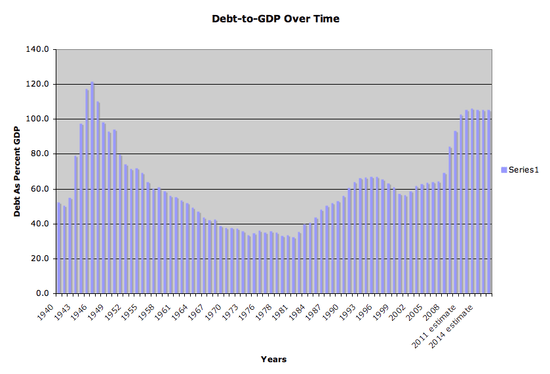
We are approaching World War II levels. What conceivable reason is there for that – apart from rank profligacy under Bush and deep recession under Obama? I know interest rates are not soaring; that low demand is the main economic problem right now; but to keep this monster metastasizing over the next few years is asking for trouble – especially when a Bowles-Simpson-style deal could be done in a sane and constructive polity. Mark Thoma urges everyone to chill for the moment:
Deficit spending does not hurt the economy so long as debt loads remain below the critical threshold where investors worry about default, and there’s no sign we are near that point. In fact, the evidence says that in the presence of high unemployment an increase in the deficit helps the economy so long as we make the necessary adjustments to taxes and spending — and both types of changes will be required to solve our long-run budget problem — once the economy is on healthier footing.
However, in the long term, Thoma notes, the debt will become a problem, particularly if the biggest driver – rising healthcare costs – aren’t tamed:
All other problems, including Social Security, pale in comparison. It’s also important to recognize that this is not a government problem: Private sector health care costs are rising just as fast or faster, so simply shifting the burden away from government is not enough to solve the problem. In one way or another — and which way is the source of much of the rancor between the parties — the health care cost problem must be addressed.
Frankly, I’ve been shocked at the Democrats’ inability to grapple with the debt question. The platform is a pathetic reversion to paleo-liberalism. Even Bill Clinton didn’t bring it up at length, although he did help explain why the Grand Bargain failed. The Obama argument is simple: we need to cut the long-term debt urgently, while keeping growth alive for now. The only way to do that convincingly is a bipartisan deal in which Democrats give on entitlements and Republicans give on taxes. Obama offered a 2.5:1 spending cuts-tax hike debt reduction package. The GOP refuse to compromise an inch on taxes. Obama has even cut Medicare already. The case is closed on who can compromise to move us forward. What Obama needs to argue is that his re-election would force the GOP to compromise.
If Obama fails to make this case tonight – for how he would grapple with the debt going forward – he will miss a giant opportunity to bring back worried independents.
 The Dish