A sentence by sentence deconstruction of Clinton's riffs.
Month: September 2012
Breaking Away?
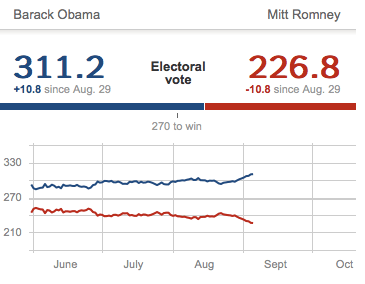
Far too soon to judge, but this is Nate Silver's current November 6 projection for the electoral college. There's been more movement in the past two weeks than in the previous two months. And it's toward the president. Here's the Princeton Electoral Vote predicter over the last few weeks as well:
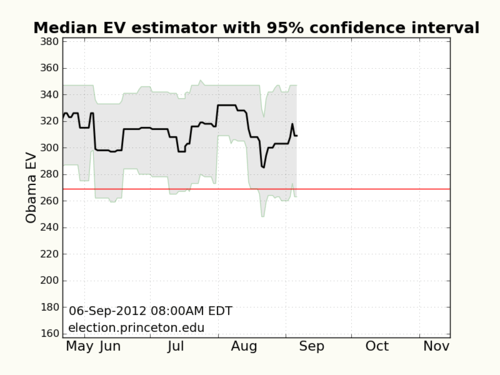
Romney appears to have gotten a post-Ryan bounce, which has since been declining. Obama has been gaining since the middle of August, with a blip up during the Republican Convention.
My view has long been that if the election is a choice election and if Obama's record and proposals are presented well – as they were by Bill Clinton last night – he should win handily. Romney, in picking Ryan, had clearly decided a referendum on Obama's record wasn't going to be enough. And since the election became about the choice for the future, and as the details are filled in – or lack of them exposed – Obama has been gaining in the electoral college.
I know conventions are not as bouncy as they were. But for Romney not to have established any lead at all over Obama over the weekend and now strikes me as a bad sign for him. Still: give him a 2 point bump in every single state, and he suddenly gets very close in the Electoral College.
Champion Or Cheater … Or Both?
The following thread discusses the legacy of cyclist Lance Armstrong in light of his decision to stop fighting the charges that he cheated throughout his career:

Lance Armstrong, though he maintains his innocence, has decided to cease contesting the doping charges filed against him by the US Anti-Doping Agency [NYT]:
Armstrong’s decision, according to the World Anti-Doping Code, means he will be stripped of his seven Tour titles, the bronze medal he won at the 2000 Olympics and all other titles, awards and money he won from August 1998 forward. It also means he will be barred for life from competing, coaching or having any official role with any Olympic sport or other sport that follows the World Anti-Doping Code. … Although it is possible that the International Cycling Union, the world’s governing body for cycling, will appeal his suspension to the Court of Arbitration for Sport because it had battled over jurisdiction over this case, Armstrong’s choice to accept his sanction tarnishes the athletic achievements of an athlete who inspired millions with his story of cancer survival.
Darren Rovell believes that the moral verdict on Armstrong is “more complex than any athlete we’ve ever had to judge”:
Sure, we came to know him as the guy who nobody could beat on a bicycle, but his legacy has to be the lives he improved, the lives he saved. We often use statistics to ask ourselves if a maligned athlete, particularly one who was found to have used performance-enhancing drugs, should deserve the praise we give them. But judging Lance Armstrong by any other statistic than that he has raised almost $500 million for the fight against cancer in the past 15 years just seems small. And even that doesn’t strike at the heart of what Armstrong did. While so many athletes love to show up at hospitals when the news cameras come along, Armstrong gave some pretty incredible one-on-one time to so many sick people. When he couldn’t do it in person, he recorded a video and sent it in an email, even if he heard that someone had hours to live.
(Photo: Lance Armstrong of the US prepares to take part in the 51 km Cancer Council Classic cycling race, part of the 2011 Tour Down Under, in Adelaide on January 16, 2011. By Mark Gunter/AFP/Getty Images)
A reader writes:
In response to the claim that Lance’s contributions come from his work on cancer … well, not so much? Outside ran a pretty damning article about how Livestrong spends its money:
The foundation gave out a total of $20 million in research grants between 1998 and 2005, the
year it began phasing out its support of hard science. A note on the foundation’s website informs visitors that, as of 2010, it no longer even accepts research proposals. [In 2001], Livestrong had four staffers and a budget of about $7 million. Now it has a staff of 88, and it took in $48 million in 2010.
$20 million for research doesn’t seem like much. While I appreciate donating facetime to cancer survivors and victims, some research support would be nice.
Another writes:
Just a personal anecdote about Armstrong from someone who never met him but was inspired. In October of 1996, at the age of 28, I began my first round of chemotherapy for Hodgkins Lymphoma.
Cancer is a pretty lonely disease, and you kind of grasp at those with good news regarding surviving cancer and definitely notice those who have bad news. The same week I began my treatments, Armstrong’s case was in the NY Times and it caught my eye. After all, he was 28 and I was 25. I recall that his situation was much worse than mine was (my odds were 85% and his were 40%). He also said he would refuse to take drugs that would increase his odds of survival if they impacted his ability to race. At that point the insipration was not that he survived cancer … but that he was willing to die for the sport he loved.
Three years later my cancer relapsed. It was 1999 and Lance was in the midst of his first Tour de France victory. I can recall watching his final stage with my mom and just thinking that what he was doing is what anyone who has cancer wants: a chance to have life not only return to normalcy but to be better than it was before. It was beyond beautiful to watch him riding through Paris.
It wasn’t until early 2000 that I had my stem cell transplant. Armstrong was just beginning to become a legend. The bracelets were still to come. But I knew his story and I carried it with me through my treatments. And for that I am thankful.
Update from another:
I strongly disagreed with the Outside article when it came out and definitely disagree with the claim that it is “damning.” I understand that the author of the article was upset, but you should really understand what charities do before you donate to them. The National Cancer Institute’s budget is over $5 billion, Livestrong raised $42.3 million in 2010. Far from being “nice,” the amount of money the Lance Armstrong Foundation can give to cancer research is way past the rounding error in the national cancer research budget and the $20 million in research that LAF funded over seven years probably had no discernible effect. The LAF Board was completely justified in focusing on the things they do well – things that no one or almost no one else is doing – and they were completely clear about it.
Another is more specific:
Livestrong is not and has never claimed to be an organization that solely raises money for cancer research (an obviously important cause). It exists to improve the quality of life of people battling cancer – which, until there’s a cure, is equally crucial.
Buzz Bissinger mounts a vigorous defense of the cyclist:
I still believe in Lance Armstrong. I believe his decision had nothing to do with fear of being found guilty in a public setting before an arbitration panel, but the emotional and mental toll of years and years of fighting charges that have never been officially substantiated—despite stemming all the way back to 1999. “I am more at ease and at peace than I have been in 10 years,” he told me in an exclusive phone interview with Newsweek.
Michael Specter, a former fan who wrote “my lengthy and adulatory Profile of Armstrong,” feels betrayed:
He said he was tired of the fight. Tired? Really? Armstrong made it clear on several occasions he would fight to the death. (My favorite Lance quote about pain, clearly applicable to the accusations, is, “Pain is temporary. It may last a minute, or an hour, or a day, or a year, but eventually it will subside and something else will take its place. If I quit, however, it lasts forever.”) Yes, quitting lasts forever. And he did not even have the decency to admit his guilt.
A silver lining to Armstrong’s decision to quit the fight, via Buzz:
[B]etween Friday and the day before, the number of donors was up tenfold, the amount given up twenty-five-fold, and the amount of merchandise sold up two-and-a-half-fold.
More thoughts from readers on the Armstrong controversy:
I was in Paris in 2000 and 2004 and was on the Champs Elysees both times to watch the peloton come home on the final stage and see Lance win the Tour. (Hearing the Star Spangled Banner waft up the Champs was one of the cooler moments in my life.) I thoroughly enjoyed watching Lance all those years, particularly the crazy-filled 2003 Tour. I firmly believe Lance doped through all of those Tours. I also firmly believe that most of the people he beat were doping. And I just don’t care.
That was the culture of cycling (and to some extent still is). But after all these years what still stands out is that Lance Armstrong was a bad-ass cyclist. For me, that’s enough. I get why he continues to deny, but in my opinion that just shows the perils of building a too-good-to-be-true persona.
Another writes:
I’ve no idea if Lance Armstrong cheated, but it’s very obvious that there is an out-of-control witch hunt culture at work when it comes to doping and drugs amongst athletes.
Whether it’s snowboarders getting kicked out of the Olympics for smoking pot or baseball players getting dragged before Congress and charged with purjury, this is what happens when a myth of purity meets men with too much power.
We’ll look back at the battle over PEDs in sports some day and laugh, since pretty much every aspect of human performance will soon be modified by our expotentially growing understanding of biochemistry. We already use our increased scientific knowledge of the body to make old records tumble. Whether you improve on the past through a strictly manipulated diet, scientifically programmed exercise routines, shoes designed by physics PhDs, or through ingesting a tablet, it will become a line so blurred as to be meaningless.
Right now we are in a moment of bio-chemical counter-enlightenment; the backlash that comes when new knowledge pours onto the scene. Armstrong might be the Giodano Bruno of biochemistry, or he might be a totally innocent man caught in an hysterical culture. Whether or not he swallowed a pill, he’s still getting sent to the stake, and we’ll still shake our heads some day.
Continued conversation at our Facebook page.
Definitely a cheater, according to the new book by one of Armstrong’s teammates, Tyler Hamilton, who collaborated with nine other teammates. Christopher Keyes is convinced:
The Secret Race isn’t just a game changer for the Lance Armstrong myth. It’s the game ender. No one can read this book with an open mind and still credibly believe that Armstrong didn’t dope. It’s impossible.
And it’s not just an expose of Armstrong but of an entire era of cycling:
[He] was not just another cyclist caught in the middle of an established drug culture—he was a pioneer pushing into uncharted territory.
In this sense, the book destroys another myth: that everyone was doing it, so Armstrong was, in a weird way, just competing on a level playing field. There was no level playing field. With his connections to Michele Ferrari, the best dishonest doctor in the business, Armstrong was always “two years ahead of what everybody else was doing,” Hamilton writes. Even on the Postal squad there was a pecking order. Armstrong got the superior treatments.
Henry Blodget is compelled by Hamilton’s story:
In 2000, Hamilton says, he and Armstrong and a third U.S. Postal rider named Kevin Livingston flew to Spain to have blood drawn before the race. This blood was later delivered to the riders’ hotel rooms during the Tour and infused back into them before the crucial (and grueling) 11th Stage. In this case, Hamilton says, Armstrong was next to him when he got the transfusion. As to the risk of getting caught–and all those drug tests that Armstrong cites to prove his innocence–Hamilton has this to say:
“The tests are easy to beat. We’re way, way ahead of the tests. They’ve got their doctors and we’ve got ours, and ours are better. Better paid, for sure.”
Along with Floyd Landis, another former Armstrong teammate, Hamilton was later busted for doping, stripped of victories, and given a suspension. So the dwindling number of people who still believe that Armstrong raced cleaned will likely dismiss Hamilton’s book with the same obstinate explanation with which all evidence against Armstrong has been dismissed–as a vendetta launched by a proven liar. But given the amount of evidence that has been produced against Armstrong in recent years, it’s no surprise that the US Anti-Doping Agency decided to go after him aggressively.
They Don’t Like Him, They Really Don’t Like Him
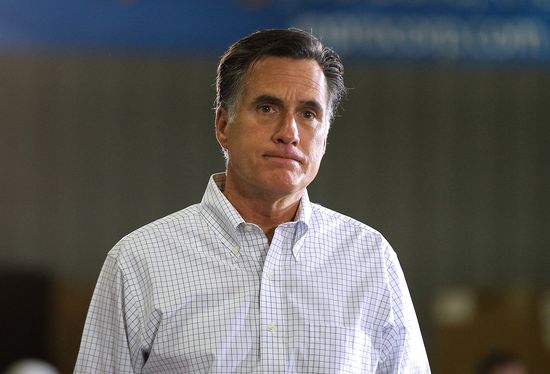
Andrew Romano studies Mitt’s unfavorables:
Romney is the only nominee since at least 1988 who, after three straight days of balloons, banners, and fawning speeches on primetime TV, couldn’t manage to convince more voters to like him than dislike him. In this he most closely resembles an earlier challenger, Walter Mondale, whose favorables actually fell after the 1984 Democratic convention in San Francisco.
Popularity isn’t everything. But it’s something, especially in a presidential election. If Romney’s current post-convention-yet-still-underwater favorables represent the high point of his appeal—and if past is prelude, they will—then he’s in serious trouble.
(Photo: Justin Sullivan/Getty)
Ask Hanna Anything: Is Discrimination Causing The Wage Gap?
Hanna Rosin has a new book out, The End Of Men. Chloe Angyal complicates her thesis:
Statistically speaking, when it comes to work and money at least, women are doing better than ever before, and it looks as though that trend will continue. On the ground, though, the view looks very different. While the long view is crucial, so too is the everyday lived experience of young American women. And there are a lot of young American women whose boats aren’t being lifted with women’s rising tide. The gender wage gap is closing more slowly for women of color than it is for white women. Lesbians and bisexual women are still at greater risk of poor health outcomes and chronic health conditions like obesity and mental illness. Even the women who are recipients of the progress that Rosin investigates don’t feel like they, or their gender team, is “winning.”
Previous videos of Hanna here, here, here, here, here and here. “Ask Anything” archive here.
Tomorrow’s Big Jobs Number
One omen is good:
Paycheck processing firm ADP said private companies added 201,000 jobs last month, up from 173,000 in July. That was much better than the 143,000 jobs economists surveyed by Briefing.com were expecting.
Major caveat: this is the private sector only. Another data point:
Weekly applications for unemployment benefits fell by 12,000 to a seasonally adjusted 365,000, the Labor Department said Thursday. The four-week average, a less volatile measure, ticked up to 371,250. Unemployment benefit applications are a measure of the pace of layoffs. When they consistently fall below 375,000, it suggests that hiring is strong enough to lower the unemployment rate.
Why Is There No Republican Bill Clinton?
Jonathan Bernstein's answer:
Probably, Republican audiences don't want that kind of thing.
It's not that there are no solid, factual, arguments for the policies Republicans prefer. There certainly are! But a politician who tried to stick to those would be competing with the Glenn Becks of the party, and the Rush Limbaughs, and the Newt Gingriches, and the "facts" that those party leaders constantly trot out. Democrats, to be sure, have to compete with some fringe voices who have a dubious grasp of facts and policy, but for whatever reason those voices are kept on the fringe. That's just not the case for Republicans.
Also: their most recent former president was the worst in modern history. And both Bushes had a hard time arguing their way out of a paper bag. Let's face it: Clinton, whatever you think about his character, is one of a kind. Always was. I saw it in 1991 and, as a very green editor of TNR, realized almost instantly he was the next president:
"The magazine's support for Clinton was not only vigorous — "a journalistic soul kiss," says Shafer of City Paper — but early, extending to an attempt to create a self-fulfilling political prophecy by dubbing Clinton "the Anointed" on its Feb. 3, 1992, cover. "He was the most impressive politician I have ever seen," Sullivan says."
He reminded all of us of that last night. May Hitch forgive me.
Could Elizabeth Warren Cost Obama The Election? Ctd
A reader writes:
You're being way too hard on her. Her Youtube sensation was actually a fairly nuanced defense of public investment to make capitalism work for everyone. Yes, she was passionate, but Democrats need passion! I know it probably irks you that the Dems have a liberal wing, but it's ostensibly the party in America that represents liberals! Also, Warren is not losing in MA because she's smug. She's tied because Brown was recently elected in a "change" election, MA voters are a little whip-sawed, Brown is likable, and he's deftly distanced himself from national Republicans. Can you really argue that she should be up by a healthy margin given the fundamentals?
Another:
I find it kind of laughable that you quoted the part of the article which takes issue with Warren criticizing Hillary since you have been making the same comments since the '90s.
Another:
That anecdote about Warren in which she remarked that she is running for the Senate to uphold her principles not because it is a great career move (implying that in Hillary's case it was a career move) is exactly the kind of thing I want to hear from a politician.
Frankly, I like her principles. Also, I don't think the dig at Hillary is that devastating, but in any case it is true that Democrats have largely capitulated to Wall Street and the lobbyist culture, so if anything it is deserved. All of a sudden you're knocking someone for being a principled politician??
You also point to the fact that "Warren is guided by 'the Aaron Sorkin–esque notion that, if a candidate laid out the facts and made her argument with conviction, voters would see the light'," as if it is a bad thing. Would you rather have a candidate who twists the truth and panders and constantly follows polls and focus groups? Those kind of tactics may help win elections, but at the cost of a candidate's integrity. Perhaps she is naive that voter's will see the light, but if the facts are on your side and your convictions are strong, I think that is the way to run a race. Thank God she isn't just another typical politician. I'm happy to see someone put their trust in Truth and let the chips fall where they may.
Another:
Liz is a warm, wonderful person. I've personally worked with her; she's brilliant, and she's a true progressive. I've been reading you for years, but today is the first I've heard you were so down on her. So far, the only concrete criticism I've heard from you is her comment about Hillary Clinton's vote on the 2005 bankruptcy law. Let me say that I'm a bankruptcy lawyer (corporate bankruptcy law, but still), and the 2005 law is an absolute, utter, unmitigated abomination. It's ugly, punitive, senseless, and simply a gift to big banks. I wouldn't fault Liz for a minute in questioning a vote for that abominable bill. Plus, Liz is the reason we have a Consumer Financial Protection Bureau, which is long, long overdue.
So why are you so down on Elizabeth Warren?
Full video of Warren's convention speech here.
Hot Or Not Politics
Romney's face may be an asset:
Mitt Romney is better looking than almost everyone reading this blog. Back in 2008, I wrote about how Sarah Palin’s looks put her in the 95th percentile of politicians. Romney has even Palin beat—he scores above the 99th percentile.
These results come from a study with my colleagues Matthew Atkinson and Seth Hill, in which we developed a method for obtaining the ratings of the facial competence of governor and Senate candidates from 1994 to 2006 by showing the images of these candidates to undergraduate students for 1 second, as pioneered by Alex Todorov. In 2007, when we collected this data, we removed highly-recognizable candidates so that opinions about the candidates, other than their appearance, would not affect the ratings. However, as with Palin, we are fortunate that Romney was a relative unknown at the time (at least to the undergraduates in California that we used), so we obtained a rating of his face.
Clinton’s Big Speech: Blog Reax II
His full remarks for those who missed them and have 49 minutes to spare:
Matt Latimer spells out why Clinton soared:
For all of his tortured arguments and wonky, ponderous asides, Bill Clinton made a substantive case. He dealt with facts and statistics. He made points and then explained why he made them. He had details. Boy, did he have details. In short, he did what almost no one at the Republican convention tried to do, what few conventions bother to do anymore. He treated the American people like thinking human beings.
Larison adds:
[H]e gave the sort of speech that Ryanmaniacs might have once imagined that Ryan would deliver and the sort that some Romney supporters still imagine Romney is capable of giving. Romney-Ryan was supposed to be the presidential ticket of the "data-driven" manager and his budget wonk sidekick, and between the absence of any significant policy discussion last week and what happened tonight that has lost all credibility.
Ryan Lizza calls Clinton "the ideal spokesman to appeal to those skeptical former Obama voters that his campaign is trying to win back":
This was the anti-Michelle speech. While she naturally gave personal testimony about Barack Obama’s character and urged voters to support him on that basis, in the story Clinton told Obama was an ephemeral figure. There were few personal details or anecdotes about the President because Clinton isn’t particularly close to Obama. It was a speech about facts and three and a half years of decisions made and outcomes achieved. By the end of it, the only logical conclusion, Clinton argued, is that Obama would do a better job than the alternative.
Alex Castellanos claims the speech "will be the moment that probably reelected Barack Obama." Jonathan Bernstein counters:
A quick caveat is necessary about the effects of the speech. No, it’s not going to suddenly make voters run out and vote for Barack Obama; I don’t know how to judge these things, but I sort of doubt that it was as good at energizing Democrats as Michelle Obama’s excellent effort last night. On the other hand, you’re going to hear some silly analysis about Clinton’s speech somehow or another hurting Obama. That’s nonsense.
Suderman fact-checks Clinton:
On Medicare, for example, he argued that ObamaCare’s Medicare cuts extend the solvency of Medicare — which, as I noted recently, is only true if you double count the savings, using them to pay for both an extension of Medicare’s trust fund and ObamaCare’s new insurance subsidies. He went after Mitt Romney’s campaign for attacking the Obama administration’s assertion of new, legally dubious authority to grant waivers to welfare’s work requirements. “The requirement was for more work, not less,” he said. Not wrong, exactly, but not the best truth. The requirement was to move 20 percent more people from welfare to work — and an easy way to do that is to increase the program’s rolls, thereby increasing the number of people who successfully move on from the program. He bragged about the higher number of jobs created by Democratic presidents, a comparison that, as Ron Bailey [noted] last night, is less favorable depending on how you perform the count.
Noah Millman, who downplayed the speech before delivery, eats his words:
[W]hat I’m most impressed by is that Clinton really did seem like the elder statesman of the party. He’s replaced Ted Kennedy. This speech was “about him” only in the sense that you could never forget who was giving the speech. Clinton himself never became a distraction.
Jonathan Cohn pinpoints Clinton's strongest arguments:
You can take real issue with Clinton’s claim that Obama did all that he could to create jobs. You can't really argue that Romney, who’s never put forward a plan for short-term job growth, would do more. You can quibble with Clinton’s suggestion that Obama has focused enough on the deficit. You can’t really suggest Romney, whose own budget plan is the stuff of fantasy, is more serious about it. You can disagree with Clinton’s argument that Obama has reached across the aisle. You can’t suggest, with a straight face, that Romney and the Republicans ever had the slightest interest in compromise.
Cassidy thought the speech a tad long:
At half the length, or a bit shorter, Clinton’s speech would have been extremely effective. Even as it was, it was certainly memorable. … Clinton went on, and on. By the end, he sounded a bit like an insurance salesman who has been invited into the parlor to describe his policies and who refuses to leave.
Just how much did Clinton ad lib? This much:
Bill Clinton’s prepared remarks: 3,136 words. Bill Clinton’s remarks as delivered: 5,895 words (counting audience cheers).
 The Dish