Ad War Update: Obama’s One-Two Punch

It's worth featuring again this simple but brutal new Obama ad, which is running in seven states:

The other important Obama ad out today was the two-minute spot we featured earlier that argues for a "new economic patriotism," rhetoric the president just launched on the campaign trail. Cillizza spells out why the length of the ad is important:

The Obama team knows that if you live in a swing state you have been absolutely snowed under with TV ads and that it’s next to impossible to differentiate one from the other. A two-minute ad, almost by definition, looks different than all of the other ads deluging the swing state airwaves — and standing out (or at least getting people not to fast forward through the ad) is the name of the game at this point.

Meanwhile, pro-Obama Super PAC Priorities USA has teamed with AFSCME to put out a new radio ad around Romney's 47% comments. The ad is part of a multi-ad $1.25 million radio campaign that will run through election day in Ohio and Virginia:


From the other side, the Romney campaign is pushing back on Obama's pushback of Romney's coal-focused attacks. This ad digs up some 2008 footage of Obama detailing the intended effect of his cap-and-trade proposal on the coal industry:

In outside spending news, Sasha Chavkin pushes back on the WSJ report we profiled earlier this week claiming that Super PACs might not be having much impact on the campaign:

"You can’t say his failure to close the gap shows the ads aren’t effective," said Michael Malbin, executive director of the Campaign Finance Institute and a political science professor at SUNY Albany. "They’re running ads at a time when the candidate is off in London putting his foot in his mouth."

It is always difficult to isolate the role of individual variables in a scenario as complex as a presidential campaign, where the quality of candidates, the flow of current events, and both campaign substance and campaign gaffes can all have an influence on voters. That does not mean that journalists should avoid drawing out factors such as super PAC spending, but that they have to be careful about linking cause and effect.

Right-wing headline writers are surely rejoicing as George Soros finally enters the campaign with a $1 million donation to Priorities USA. Meanwhile, Rove's Super PAC American Crossroads is out with a new, well, this:

On the other side of outside spending, Emily's List is teaming up with SEIU to spend $1 million going after Todd Akin:

In other down-ticket news, Maine's GOP Senate candidate Charlie Summers is out with a new biographical spot:

Lastly, Samuel L. Jackson adapts to the presidential campaign in this NSFW play for Obama voters:
Jesus Said To Them “My Wife … ” Ctd

In an interview with Time, historian Karen King straightens out the meaning of "gospel" and why she chose to call the fragment "Gospel of Jesus' Wife" (pdf):

There has been considerable misunderstanding about this, partly because people think of a gospel as a genre of the New Testament canon. But for those of us who work in the literature of the 2nd century, we have the Gospel of Thomas, the Gospel of Mary, the Gospel of Philip and many, many other early Christian gospels. My suggestion in calling it a gospel is that it fits into this kind of genre. It’s not a claim for authority or canonicity at all.

And when it comes to gospels, she says, size doesn't matter:

With regard to the New Testament, for example, from this period we have tiny fragments of the New Testament gospels, John and Matthew, dating from the 2nd and 3rd century. These are actually the earliest physical existing pieces of these gospels that still remain, and they are tiny fragments like this one. The size of the fragment doesn’t actually indicate the size of the work it comes from.

King notes that ink testing, which is currently underway, will help resolve the issue of the fragment's authenticity, which, as we highlighted on Sunday, other academics have disputed. Professor Simon Gathercole, an expert on apocryphal gospels, offers some key context on what the timing of the script might imply about theological disagreements in early Christianity:

It could reflect debates about marriage and sex in the early church.

Tertullian (c. 200, the time of this fragment), discussed marriage a lot, in particular re-marriage after death of a spouse (which [Jesus] said was wrong), and his view of marriage was that the ideal marriage was without sex. Others at the time, like Clement of Alexandria, report opponents using Jesus’ celibacy as an argument for Christians remaining celibate. Some, he says, “say outright that marriage is fornication and teach that it was introduced by the devil. These arrogant  people say that they are imitating the Lord, who neither married nor possessed anything in this world, boasting that they understand the gospel better than others.” (Clement, Stromateis3.49.1). The use of such a striking motif as Jesus being married obviously had a point to it: it may have been that Jesus’ marriage was invented as a reason to justify marriage.

Other academics agree with that possibility:

According to Michael Peppard, a professor of theology and Coptic language at Fordham University, a belief in asceticism saw rapid development in the second to fourth centuries, especially in Egypt where Christian monasticism was born. Some bishops at the time “were saying that the highest ideal was asceticism,” which included renouncing “all the trappings and worries of material life,” including marriage.

But Peppard said other bishops in the same period “were figuring out how to give everyone their space,” and letting it be known it was all right for Christians to live in the world. The new text published by King may be a sign of early Christians “pushing back” against asceticism and moving closer to mainstream Jewish attitudes “of blessing sex and procreation,” Peppard said.

Meanwhile, Fred Clark adds some comparative context from the New Testament to the debate:

Consider the apostle Peter’s wife. Mark’s Gospel tells us that Jesus healed Peter’s mother-in-law. If Peter had a mother-in-law, then he must have also had a wife, yet she isn’t mentioned in that story, or anywhere else in the Gospels, in Acts, or in the epistles attributed to Peter. The only other mention of her is in one of Paul’s letters, when he says, in passing, that apostles should take their wives along like Peter does (see 1 Corinthians 9:5).

So on the one hand, if Jesus had been married, then it seems like his wife ought to have been mentioned as being present at least at his death and burial. But on the other hand, if Peter’s wife could be invisibly present throughout the book of Acts, then the same thing could be true for Jesus’ wife in the book of Luke.

Clark also muses on the potential impact of the notion of a married Jesus:

It’s possible that would lead to the church becoming a bit less patriarchal, but probably not. The cult of virginity (in both its Catholic and Protestant forms) would live on in new forms. The same forces that conspired to turn Jesus’ brothers into his cousins so that his mother could declared a perpetual virgin — a madonna rather than that other thing — would likely create a parallel myth to attribute perpetual virginity to his wife as well. Sure, Jesus was technically married, they would say, but somehow he and his wife — just like poor Mary and Joseph — never did what married people do.

Previous Dish coverage here, here and here.

Face Of The Day

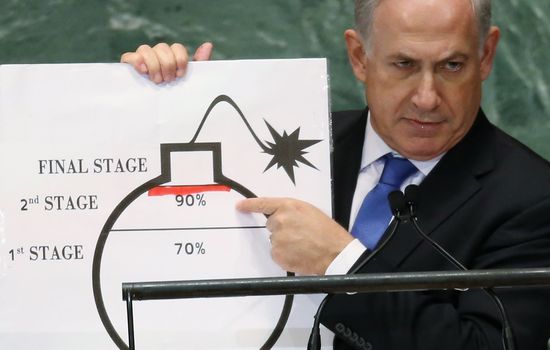
GT_BIBI-UN_120927

Israeli Prime Minister Benjamin Netanyahu points to a red line he drew on a graphic of a bomb while addressing the United Nations General Assembly on September 27, 2012 in New York City. The 67th annual event gathers more than 100 heads of state and government for high-level meetings on nuclear safety, regional conflicts, health and nutrition and environment issues. By Mario Tama/Getty Images.

The Mormon Church Isn’t Big On Free Speech

Last week, Jamie Reno reported on David Twede, a Mormon blogger who ran afoul of the church's hierarchy and faces excommunication. Twede printed articles critical of Romney and exposed "secret" rituals anyone with an Internet connection can learn about. Jessica Ravitz checks in on the story:

Twede admits that what’s driving this prospective spiritual slap-down seems to be a matter of debate. Was it Twede’s criticism of Romney or something else? … The New York Times reported that it was Twede's public admission that he was trying to sway the beliefs of others at church that got him into trouble. The Salt Lake Tribune said it was his sharing of details about sacred LDS temple ceremonies – disclosures that faithful Mormons find offensive – that raised concerns. The LDS Church is staying mum.

Joanna Brooks puts the story in context:

While the institutional LDS Church once preferred to manage controversial elements of its own history—for example, the polygamy of Joseph Smith, or questions about the origins of the Book of Mormon—by presenting carefully crafted lessons in its own manuals, leaving more complicated discussions to scholarly journals and progressive magazines known to only a minority of Church members, the internet has now put an array of information within a mouse-click of questioning members. Some members report feeling betrayal when they encounter on the internet unexpected information that runs contrary to what they’ve learned from their parents and teachers, especially after they’ve made deep investments in their faith.

That question of openness—the matter and manner in which the LDS community sorts through its own history and practices—is a source of tension among Mormons today. … The questions and feelings stirred up by David Twede’s impending Church court are profound beyond partisan politics.

Today’s Economic Mixed Bag

Benchrev

Jared Bernstein highlights the good news …

[T]he preliminary benchmark revision to the payroll jobs survey showed that as of March of this year, employers added 386,000 more jobs than we thought (453K in the private sector)…. So, good to know we’ve had a bit more momentum on the jobs front, though obviously we’re still way behind where we need to be to tighten up the job market.

… and the not-so-good news:

Real GDP growth for the second quarter was revised down from an annual rate of 1.7% to 1.3%.  Downward revisions in consumer spending and business investment largely explain the drop, along with weaker exports.

Matthew Zeitlin reviews Obama's overall jobs record:

Should this revision hold up, it will mean that 125,000 net new jobs had been created since Obama’s inauguration in January 2009—rather than a net job loss. The economy lost around 4.3 million jobs in the first year he was in office. With the new revision, roughly 4.4 million jobs have been created since the job market started consistently adding new jobs in March 2010.

James Pethokoukis isn't so upbeat:

If you combine high unemployment, low labor force participation, and slow GDP growth, 2012 might well be the worst non-recession, non-depression year in the history of the United States. The only other challenger is 2011. Or maybe next year …

Greg Sargent weighs in:

The revised jobs numbers do suggest that one reason Obama seems to be defying political gravity may be that the economy was doing a bit better than previously thought. But again, jobs numbers alone are overhyped as a determinant of how people are really experiencing the economy, which is far more complicated than one metric can capture.

Brad Plumer, meanwhile, examines the impact of the drought on GDP:

Roughly half of [the] decline came from a sharp fall in farm inventories. Crop production declined $12 billion over the quarter, data showed, "due to this summer’s severe heat and drought."

Polls Are Now Part Of The Liberal Conspiracy, Ctd

Like many Republicans, the hosts of Fox & Friends don't trust the polls:

It appears the liberal media has also infiltrated Fox News:

One problem with the theories: FOX’s own polling also shows Obama surging in swing states. A survey released by the network just last week showed the president leading Romney by no fewer than five points in Ohio, Virginia and Florida.

Harry Enten points out that Fox isn't alone:

[I]t is a ridiculous charge that the media purposely skews polls. If so, they have persuaded many Republicans to get in on the act. Polls from Fox News – an organization few would accuse of a pro-Democratic bias – have shown poor results for Romney. (Its polling is also partially run by the openly Republican Daron Shaw.) The NBC/Wall Street Journal national poll is part run by Bill McInturff: a Republican, John McCain's own pollster, and professional partner to Mitt Romney's pollster. The GWU/Battleground poll has Republican pollster Ed Goeas on board. The list goes on and on.

However, just because the polls aren't purposely being manipulated doesn't mean the polls are infallibly right. One estimate has the chance of Romney winning, if the election were held today, at about 2%. That's very small, but it's not 9/11 conspiracy territory, not even close.

Can Democrats Retake The House? Ctd

Weigel shakes his head:

Most states give the power of the map to whomever happens to run the legislature. As 2011 began, Democrats only controlled the redistricting process for 47 seats—safe blue turf like Maryland and Illinois, which they squeezed for every possible gain. They had to. Republicans controlled the process for 202 seats. The Democrats had built the Pelosi house in states like Wisconsin, Ohio, Michigan, North Carolina, and Pennsylvania. Then they lost everything, and the other guys got to draw the maps.

“Republicans weren’t thinking ‘Hey, just how do we draw these lines to screw over Democrats?’ ” says John McHenry, a pollster at Resurgent Republic. “It was, ‘How do we make this suburban Philadelphia seat safer for the Republican who just won it?’ The goal wasn’t so much to add seats as it was to hold on to the 2010 gains.”

Earlier commentary on the subject here.

Whom Are Weddings Really For? Ctd

Readers continue the thread:

My father always used to say that weddings are for the aunts and uncles. The couple, and their immediate families, are stressed and distracted. Friends and more distant relatives are happy to be there, but for the most part aren't emotionally invested enough in the couple to treat the day as much more than a party. But the aunts and uncles – they've known one of the partners since childhood. They've watched his or her growth and development, joys and sorrows, though always from something of a distance. And now they get to participate in the next stage in their niece or nephew's life, surrounded by their extended family. While leaving the planning and stress to others. What could be better?

Another writes:

The wedding is all about … the mother of the bride. Full stop.

Another:

It's not just that some of those family members who attend your wedding might be unpleasant.  In planning the wedding, they will be unpleasant (and pleasant) in exactly the same ways they will be unpleasant (and pleasant) in the years to come.  The mother-in-law who doesn't like your choice in cake probably won't like what you feed your kids either; the relative who criticizes your wedding is probably going to criticize your house; the control freak mother-of-the-bride is probably going to be overly involved in your married lives, too.

That may not be a reason to have a wedding, but in a way, the planning is an opportunity for full disclosure, of both the family you're joining and quirks of the family you thought you knew.

Another:

Weddings are a celebration by the couple of their existing relationship. The couple invite friends and family to join them in this celebration, but the wedding is still for and about the couple. It is important for the couple to defend their prerogatives. When my wife and I got married, we avoided professional caterers and photographers. We conscripted an aunt to serve the punch, a sibling to direct parking, and a friend to help cut and dish out the cake. Then we proceeded through the wedding at our own pace, enjoying each moment before moving on. The only part that was scripted was when we stood in front of the judge, and it was our script.

Weddings can and should be about the couple, and they can exert themselves to ensure that it is so. But they must make sure never to cede control to relatives or professionals.

Another:

People should stop overthinking the whole wedding thing and just try to have a good party!

On that note:

As for your reader who writes that weddings are like funerals, I would answer that in the American weddings ARE funerals.  I got married in the Czech Republic to a Czech and, while the marriage was a ghastly mistake, the wedding was a blowout.  Imagine a mountain inn and pub all to yourselves; toasts and good wishes washed down with slivovice, and instead of 40 little ghettos – I mean tables – of the bride's design, all 50 guests sit together on either side of two long tables.  Those who could hang in danced till sunrise, while the innkeeper kept the liquor flowing and put out a groaning table of meat and fish from his own smoke house. Anyone who could still walk and was game joined the old-timers on a hike up a nearby mountain the morning after.

Bond Voyage

Reflecting on 50 years of James Bond, David Kamp examines the glamorization of travel in the early films:

Dr. No and its two follow-ups, From Russia with Love (1963) and Goldfinger (1964), are the cornerstones of Bond-mania. Like the early Lennon-McCartney singles that spurred Beatlemania, they augured bigger, more elaborate things to come, but the sheer excitement they generated remains unsurpassable. Not only were these movies terrifically entertaining, they also delivered a sort of jet-age holodeck experience, granting regular folk an opportunity to glimpse the future awaiting them. As of 1960, fewer than 2 percent of all Americans had traveled internationally by air. So both Dr. No and From Russia with Love include what are essentially fetish shots of Pan Am jets landing on runways as air-traffic controllers announce their arrival. (“Hello, London, your flight PA1 just landed in Istanbul.”)

“It was a sense of ‘Buy your ticket—we’re going to take you places!’ ” says Guy Hamilton, the director of Goldfinger.