Yes, We’re Better Off Than We Were Four Years Ago

Unemployment-rate-2001-2011_thumb

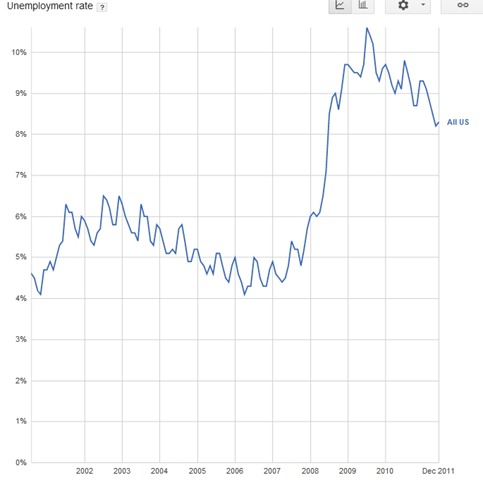
Timothy Noah thinks the answer is obvious, even looking at the graph above:

There can be little doubt that Americans are worse off, economically, than they were in 2008. Median household income has fallen since 2008, and (according to one study) it’s fallen even more steeply during the recovery than it did during the 2007-2009 recession. Back in 1980, Ronald Reagan tormented Jimmy Carter with the “misery index,” which was the unemployment rate plus the inflation rate. At the moment the misery index is 9.7 (8.3 percent unemployment plus 1.4 percent inflation), compared to 7.8 (7.8 percent unemployment plus 0 percent inflation) the month Obama took office. So by that venerable metric we’re worse off than we were four years ago. We just are.

The month after Obama took office, the unemployment rate was 8.3 percent; it's 8.3 percent now. Sticking him with the January number when he was president for only ten days of it seems silly to me (as, by the way, does the unemployment in his first year). But the difference is that in February 2009, we were losing 800,000 jobs a month; in July 2012, we're adding around 150,000 jobs a month over the past year, despite a huge drop in government employment. The stock market has made big gains – from around 6500 in the spring of 2009 to almost 13000 today, inflation is under control, and interest rates are at deep lows. We're out of the quagmire of Iraq and al Qaeda has been decimated. 30 million more people have potential access to health insurance. Yes, median household income is very meaningful – but it's not the only metric. Of course, we're better off. Steven Taylor adds:

Look, one can think that Obama’s policy were wrong and that other policies would have created more jobs, etc.  And if one thinks that, then one should do one’s best to make that case.  (Indeed, one of my criticisms of the Romney campaign  is that they infer that something better could have been done without actually laying out an argument for what that might have looked like).  However, what one cannot do is assert that the job situation is worse now than it was at the end of the Bush administration.  Further, one cannot pretend (though many try anyway) that the trends were made worse by Obama policies.

Meanwhile, David Graham reiterates that the shedding of public-sector jobs has obscured the private-sector revival:

Government jobs are shrinking quickly — the government has fewer employees than it has for 45 years, and job losses in the public sector have been a consistent drag on the unemployment rate.

Of course, all this may be moot come Friday.

Obama’s Good Omens

Sargent explains why “the Obama team is cautiously confident”:

The Romney camp seems to be hoping for a big, late break of undecided voters his way. But Dems remain convinced they understand who these voters are and what motivates them better than the Romney team does — and don’t see a way that these voters break to Romney in large enough numbers to overcome a two or three point deficit in the key battlegrounds.

“The question is, Is Romney going to get enough of the undecided vote to overcome a two or three point deficit in the battle ground states?” Plouffe told me. “Most assuredly not.”

Silver likewise suspects that Obama is now the favorite:

Being only tied in the polls immediately after his own convention is unambiguously a bearish sign for Mr. Romney — and probably the most tangible sign to date that Mr. Obama is the favorite.

That’s my sense as well after the botched Tampa event. We have two scenarios, it seems to me. 1. The Charlotte convention, if it keeps up the momentum of last night, could help Obama break away; or 2. Everything comes down to the debates.

In Lieu Of A Kennedy Hologram

Before the prime time speeches last night, the Democrats deployed a tribute video to Ted Kennedy that doubled as an attack on Romney, using footage from the pair’s 1994 Senate campaign. A clip is seen above, but the full video is here. Taegan Goddard called it “one of the more remarkable moments” of the night. The RNC chairman huffed:

Ezra wasn’t impressed with the outrage:

Brett Smiley adds:

Call it classless or crafty, the content of the video at least had the blessing of Joe Kennedy III, Ted Kennedy’s 31-year-old nephew who’s running for outgoing congressman Barney Frank’s seat. Kennedy III introduced the video, saying of his uncle: “Make no mistake he is here with us this evening.” And still campaigning!

This wouldn’t be the first time the Democrats have been inspired by Kennedy’s attacks on Romney. Back in July, Politico collected a bunch of his 1994 ads against Romney – notice any similarities?

Update from a reader:

The funniest part about Priebus’ response to the Kennedy video is that he apparently thinks it’s fine for a Hollywood actor to suggest that an imaginary Obama is telling Romney to “fuck off” during a prime-time convention speech, but to use footage of real people somehow lacks class.

Attacking Sexual Pleasure At Birth

Chuck Ross corralls the research against circumcision. Numbers worth emphasizing:

In research recently published in the International Journal of Epidemiology by Dr. Frisch et al. found that circumcised men and their partners suffer from higher rates of sexual difficulty than uncircumcised men and their partners. Eleven percent of circumcised men and only 4% of uncircumcised men reportedly experienced frequent difficulties reaching orgasm. Thirty-eight percent of the female partners of circumcised men versus 28% of female partners of uncircumcised men experienced incomplete sexual fulfillment; 31% versus 22% experienced frequent sexual difficulties; 19% versus 14% experienced difficulties surrounding orgasm.

This is obvious. If you cover a sensitive glans with scar tissue, it is less sensitive. It's an attack on male sexual pleasure. But Jesse Bering thinks parents should follow the American Academy of Pediatrics's recommendation on male genital mutilation:

What is vital to understand about the AAP’s recommendation is that the Academy is not discounting, in any way, the biological purpose or function of foreskin. What the task force has implied, rather, is that the whatever the advantages to being an intact male—such as increased sensitivity of the glans, protection, lubrication facilitating better heterosexual intercourse (in addition to the lubricating properties of shed skin cells and oils that accumulate under foreskins, an accentuated coronal ridge may also retract more vaginal fluids during copulative thrusting)—these advantages are overshadowed in importance by the prophylactic benefits of removing highly receptive HIV target cells that are found on the inner mucosal surface of the foreskin. And when performed by a skilled physician on neonates under sterile conditions, circumcision is a quick, safe, minor procedure.

To circumcise, or not to circumcise? To me, at least, that’s no longer even a question.

It remains as much a no-brainer as it was when I first wrote about this issue two years ago. If male circumcision reduces the probability of contracting the HIV virus even a fraction of a percent—let alone the estimated 60 percent reduction that scientists believe it does—then why on earth wouldn’t you choose circumcision? Have you ever seen a person slowly succumb to AIDS? The pain inherent therein is not even in the same galaxy of subjective experience as whatever minute qualia of pleasure may or may not be lost to such a "mutilation." The sacrifice is no longer one made to a mythological deity, but to the child himself.

Yes, I have seen someone slowly succumb to AIDS and it wasn't because they were uncircumcized. It was because we had no treatments for it. The 60 percent number is from female-to-male transmission in Africa – with very very limited application in the US.

It's rare to read a gay man who still echoes the HIV-phobia of the 1980s – but Bering's irrational panic is pretty glaring. And the notion that in order to prevent infection via a body part, you just  remove that body part after birth is equally bizarre. Can you imagine post-birth removal of tonsils? Or forcible prophylactic mastectomies to prevent breast cancer? This whole thing is madness. Mutilation of any part of an infant's body should only be for vital immediate health dangers, not nebulous future threats, which the person could choose for himself later, if he so wanted.

It's only the foreskin and the clitoris that can be treated this way – and rational people defend the barbaric. And by the way, why doesn't Bering demand his unmutilated partner to remove his own foreskin to lower the chance of HIV infection? Because this kind of barbarism could only be done to infants and be defensible.

John Cage At 100

Today is his 100th birthday (he died in 1992) and above is a clip on his views on sound. Here is an American heresy of his, noted by Alex Ross of the New Yorker, that still resonates on my Burkean soul:

“We would do well to give up the notion that we alone can keep the world in line, that only we can solve its problems. . . . Our political structures no longer fit the circumstances of our lives. Outside the bankrupt cities we live in Megalopolis which has no geographical limits. Wilderness is global park. I dedicate this work to the U.S.A. that it may become just another part of the world, no more, no less.”

Quote For The Day

"This is the president who delivered the security of affordable health care to every single American after 90 years of trying. This is the president who brought Osama bin Laden to justice, who ended the war in Iraq and is ending the war in Afghanistan. This is the president who ended 'don’t ask, don’t tell' so that love of country, not love of another, determines fitness for military service. Who made equal pay for equal work the law of the land. This is the president who saved the American auto industry from extinction, the American financial industry from self-destruction, and the American economy from depression," – Deval Patrick in the second best speech of last night.

The Lost Boy vs The Favorite Son

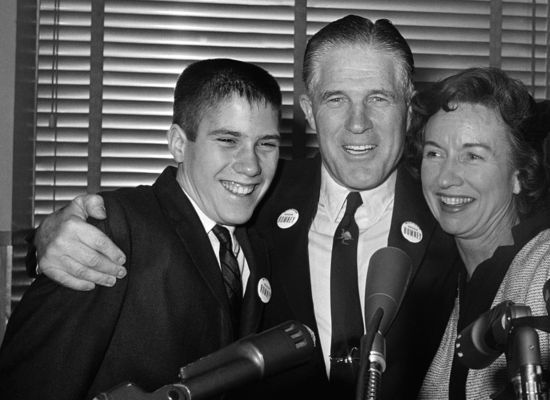
GT_MITT-FATHER_120904

Walter Kirn calls 2012 the "most compelling election in years":

The problem with treating politics as stagecraft, particularly this year, is that it mistakes the production for the play and confuses theater with drama. Theater is shallow, drama deep. And it’s at the dramatic level that this campaign is singularly engrossing. Down in the catacombs of the group unconscious where elections really occur, where the spotlights don’t reach, and where the polls can barely penetrate, a mythological struggle is unfolding between two profoundly different archetypal figures: a lost boy who knew his father largely in dreams and grew up bedeviled by questions of identity, and a favorite son whose father’s support freed him from having to question much of anything.

Barack Obama, a lonely meritocratic floater whose searcher parents met while on the drift and then wafted off in separate directions, fashioned a self from thin air; while Mitt Romney, from a family of pioneers who’d safely reached the promised land, hit the ground already in position.

Last night's biographical sections underlined that stark difference. But both sons do seem to have mastered fatherhood themselves.

(Photo: American politican George W. Romney (1907-1995), announces his intention to run for governor of Michigan, with his son Mitt and his wife Lenore, on February 10, 1962. By RDA/Getty Images.)

Charlotte, Day One: Reader Reax

A reader writes:

It’s striking how well this convention is organized compared to the RNC. The speeches contain themes and ideas that rebound and reinforce each other. From the subtle and aggressive attack lines in the earlier speeches against Romney’s truthfulness and being out of touch to Michelle Obama’s positive recitations of Barack’s own qualities, empathy, and poor background. Themes like opportunity and investment ring throughout with speakers designed to appeal to different audiences, without sounding forced or cliched.

Compare that to “we did build that,” “I love women,” and “humanize Mitt” – the three things the Romney campaign told us the first day was about. It’s the difference between well-crafted oratory and hamfisted, obvious attempts to check boxes, recite lines, and accomplish goals.

Another writes:

Did the Republicans sleep through their convention? Are there vastly more Democrats in the hall? What’s going on? The energy and enthusiasm tonight – the first night of the convention – is simply no comparison to anything we saw in Tampa last week. Going into tonight the media asked questions about flagging Democratic enthusiasm. Is this the awakening of a slumbering Democratic machine?

Another:

I’ve read many pundits discuss (bemoan, praise, deny) the Republican Party’s shift to far-right, including yourself, and I had a thought (just one!) about the matter after watching tonight’s convention: This very real shift has had a corollary effect of shifting the Left to the Center. I will leave it to you to tease out the truth or falsity of this observation if you so cared. For me, it was more a feeling. I watched Dems bring the essences of opportunity and personal responsibility to the fore, as well as praise successful governmental interventions and the communitarianism so integral to their party’s record. And this all felt Centric, every bit of it.  Our parties are undoubtedly connected; when one brand molds, the other is bound to blossom.

Another:

No doubt Michelle delivered a wonderful speech, but I really have to call you out on your supposed “conservative” appreciation of the first night of the convention.

There was a lot of unfair framing of the abortion debate, as is typical of the Democrats. There were also many mean and pointless swipes at Romney for his bank accounts etc. Otherwise, spending, spending, spending (also known as “investments”), without a mention of the national debt. Seriously? And are we meant to be reassured by the rock star status of the mayors of LA and Chicago, the govs of Maryland and Illinois? These places are basically bankrupt and plagued by rising crime, poor educational results, etc. At least they had the decency not to foist any Californians on us. The GOP was killed for not having sufficient specifics, but at least they mentioned employment and the debt. Not a word from these supposed “conservatives”.

Update from a reader:

I’ll let the residents of Illinois and California speak for themselves, but I can tell you that Maryland has falling crime (the lowest in nearly 40 years), the highest median household incomes in the nation, and top-ranked public schools (my son just started pre-K yesterday). Your reader’s list of Reagan-era stereotypes doesn’t match the reality of life here in the Free State.

Another:

Your comment on the First Lady’s speech having been a speech that “a presidential candidate could be proud of” got me thinking. Perhaps she doesn’t want it (and I sense she doesn’t), and perhaps she genuinely wants to get out of the public spotlight one day (which I sense she does), but if Michelle Obama’s ambition extended this far, it bears noting that Sen. Mark Kirk, Republican of Illinois, is up for re-election in an ever-bluer state in 2016.  Hillary Clinton made the transition from spouse to candidate, and I’d posit that Hillary was far more polarizing and less popular in 2000 than Michelle seems likely to be in 2016. Not to mention, there’s no carpetbagging charge to be had. 

Good reactions tonight – thanks for calling Ted Strickland out.

Another defends Strickland:

While I agree with your statement that Mitt Romney has the right to do whatever he wants with his money, and while I recognize that everything that he has done has been legal (insert “we don’t actually know about his taxes” line here), I think Gov. Strickland did what many have been clamoring for – he called a lie a lie: “On what he’s saying about the president’s policy for welfare to work, he’s lying. Simple as that.”

I find the frankness refreshing.  He acknowledged what many middle-class Democrats feel about Mitt Romney – that we are but “numbers on a spreadsheet” to him, that he cares for nothing but the bottom line, that he is so cravenly ambitious that he sprints away from his signature public sector accomplishment because it has become politically problematic. 

In regards to the “Cayman Islands” lines, I think Strickland pointed out something key – what do Romney’s actions say about him, as a man and as an American?  Sure, he has the right to these tax havens and the means to pursue every advantage possible, but just because he can, does that mean that he should?  I think it IS unpatriotic for a person to do whatever he or she can to avail themselves of their means to avoid paying into the social safety net, to avoid participating in the democracy and the government which he is asking us to let him lead.  He’s clearly somewhat ashamed of it, or else he’d explain it. 

Live-blogging here, blog reax here, and tweet reax here.
The Arab Spring’s Royal Exemption

Marc Lynch poses a question:

What does it mean that no Kings have thus far fallen in the Arab uprisings while four non-monarchical rulers (Ben Ali, Mubarak, Qaddafi and Saleh) have toppled from their (non-royal) thrones and a fifth has plunged his country into a brutal civil war?

His answer:

Access to vast wealth and useful international allies seems a more plausible explanation for the resilience of most of the Arab monarchies. Surviving with the financial resources and international allies available to Saudi Arabia, Qatar and the UAE seems like no great trick. The active, concerted economic, political, media (and occasionally military) Saudi and Qatari support for their less wealthy fellow monarchs seems to be more important to the survival of the current crop of kings than the intrinsic institutional characteristics of a throne.