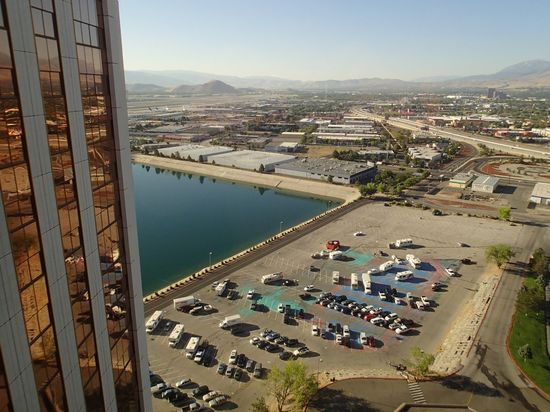
Reno, Nevada, 9 am
Reno, Nevada, 9 am
Shafer suspects that "the growing sensitivity to political lies has less to do with more lying by more politicians than it does with the growth of the fact-checking industry over the last decade or so":
Truth-telling would matter a lot more to politicians if it were as effective in persuading people as truth-bending. Plus, trapping the truth and serving it in a palatable form to an audience is damn hard, as any university professor can tell you. It’s easier and more effective for campaigns to trim, spice and cook facts to serve something tastier, even if they must brawl with the fact-checkers in the aftermath.
You might as well fact-check a sermon as fact-check a campaign speech.
Neither are exercises in finding the truth. That doesn’t mean we can excuse political lies. Please take a mallet to Romney’s fallacious assertion that Obama ended work requirements for welfare and to the Obama campaign’s ad that misstated Romney’s views on abortion. I pair these two fact checks not just to declare moral equivalence between the two parties or candidates but to demonstrate that the mutual-aggression pacts that govern politics make futile the fact-checking machinations of journalists. Give them a million billion Pinocchios and they’ll still not behave.
Glaswegians have a disturbingly high mortality rate, and researchers haven't been able to explain why:
People have a tendency to blame Glasgow’s peculiar outcomes on whatever they worry about most in Britain today. At last count there were 17 competing explanations for the phenomenon, ranging from the unquantifiable (culture) to the simplistic (not enough vitamin D), via DNA, inequality and history. For this reason, the "Glasgow effect" is also resistant to the remedies peddled by politicians.
What needs explaining is the following: in modern times, up until 1950 Glasgow did not stand out as particularly sickly. But between 1950 and 1980 a gap opened up between it and other big cities in Britain. The difference was mainly explained by a greater number of deaths from cancer and heart disease. Then, starting in about 1980, the gap widened again, though this time the symptoms were different. Glasgow still had too many cancers and heart attacks; but the marked difference from other cities came in deaths from suicide, violence, drug abuse, alcohol and traffic accidents.
As far as the above clip from Trainspotting:
Despite being set in Edinburgh, almost all of the film was filmed in Glasgow, apart from the opening scenes of the film which were filmed in Edinburgh, and the final scenes which were filmed in London.
Another unhealthy scene, in Glasgow:
Peter Salisbury warns that Yemen is running out of water:
Most potable water in Yemen is produced from a series of deep underground aquifers using electric and diesel-powered pumps. Some of these pumps are run by the government, but many more are run by private companies, most of them unlicensed and unregulated. Because of this, it is nigh on impossible to control the volume of water produced. By some (conservative) estimates, about 250 million cubic meters of water are produced from the Sanaa basin every year, 80 percent of which is non-renewable. In recent years, the businessmen who produce the water have had to drill ever-deeper wells and use increasingly powerful pumps to get the region's dwindling water reserves out of the ground.
(Hat tip: Brian Ulrich)

Cord Jefferson visits a consumer merchandise trade show, ground zero for all the junk you find in souvenir shops and gas stations across the country:
Want a wind chime topped by a giant blue fairy who is hugging a dolphin, a jewelry box emblazoned with a flaming skeleton riding a motorcycle, or a metal sign that says "Man Cave" on it? Got it, got it, and got it. This is where good taste goes to die. This is what impulse buy dreams are made of, and a communist's worst nightmare: A giant room in the middle of Las Vegas in which people buy and sell cheap, poorly made garbage that literally nobody actually needs. And where is most of this stuff made? China.
But he points to some critical context:
It's worth noting that, despite what fearmongering stories about China's ascent may have you believing, the majority of the stuff Americans buy is made in the United States. Conversely, goods labeled "Made in China" account for less than 3 percent of U.S. consumer spending. Yes, the Chinese may be slowly developing a monopoly on the manufacture of crass gag keychains, but keychains that say "Queen Bitch" in sparkly letters do not empires make.
(Image by Jefferson)
Keith Humphreys examines it:
Some people believe the ‘gateway effect’ exists because early drug use primes the human brain for more drug-seeking, others argue that the friends you make using drugs as a youth are a ready source for other drugs later, and still others argue that there are factors, like impulsivity, that causes both early and later drug use. Which camp is correct? Probably, all of them.
He later adds:
Science is thankfully more accepting of complexity than ideology, which is particularly important when trying to solve a puzzle as intricate as human development. And in any case it’s rather ridiculous that discussions about drug gateway effects are held captive to legalization debates when the key gateway drugs (alcohol and tobacco) are already legal.
Paul Joseph Watson passes along the above video showing how the TSA has started testing drinks bought by passengers beyond the security checkpoints. From the guy who uploaded the video:
"My wife and son came back from a coffee shop just around the corner, then we were approached. I asked them what they were doing. One of the TSA ladies said that they were checking for explosive chemicals (as we are drinking them). I said "really – inside the terminal? You have got to be kidding me."
I asked them if they wanted to swab us all. She responded with something like, ‘yes sometimes we need to do that’. I then asked if she wanted a urine sample…nonetheless, the TSA is way out of control," he adds, joking that the TSA’s next move could be to visit people’s homes before they even leave for the airport (they’re already in the parking lot demanding to search people who aren’t even flying!)
As we have previously highlighted, the drinks policy was recently introduced with virtually no explanation from the TSA whatsoever. The much vaunted 2006 liquid bomb plot on which this nonsense is all based completely collapsed in court and was revealed to be farcical at best.
California is on the verge of doing so. Lindsay Abrams reviews the practice's dark history:
[In] Germany, replacing a patient's testicles like faulty light bulbs caught hold. It sounds like a sick Nazi experiment, because it was. Dr. Eugen Steinach, whose practice of removing one testicle from a homosexual male and replacing it with one from a heterosexual donor was, insists one writer, "a logical culmination of his experiments on the sex glands." Again, in the 1980s, this line of thinking was adapted to the idea that homosexuality begins in the womb, and a German researcher theorized that it could be prevented through the manipulation of sex hormones during pregnancy.
The same doctor who, in the 1950s, recommended brothels, also reported treating homosexuality by threatening patients with beatings. In 1963, aversion therapy went DIY, with the innovation of "a small electroshock device that would be suitable for home use." But the award for most creative attempt at convincing gays that their sexual preference is gross goes to British psychologist I. Oswald, who in 1962 "inject[ed] a man with nausea-inducing drugs, repeatedly playing audiotapes of men engaging in sex and surrounding the man with glasses of urine."
A Scottish skipper recently made a record-breaking discovery: a bottle that had been afloat for 98 years:
Within the bottle, a postcard written in June 1914 by Captain CH Brown of the Glasgow School of Navigation promised the finder a reward of 6 pence. It had been part of a scientific experiment in which 1,890 such bottles were released, in a bid to chart currents around Scotland.
Like almost everyone on Twitter, Will Wilkinson raves over the First Lady's performance:
[I]t's apparent that Democratic conventioneers remain more enthusiastic about Barack Obama than Republican convention-goers ever got about Mitt Romney. Deval Patrick wins the night's up-and-comer laurels, but Michelle Obama out-shined the entire line-up my a few billion lumens. Ms Obama's speech was paint-by-numbers, but the painting happened to be the Mona Lisa. She was perfect. The speech was in many ways profoundly conservative; witness "Mom-in-Chief". Such reactionary tropes are liberals' best defence, and good defence is all Mr Obama really needs.
Even Jonah Goldberg gives props to Michelle:
I thought as a political speech it was excellent and did nearly everything she needed it to do. She was more comfortable and convincingly passionate than Ann Romney and made not only a defense of her husband the man (where Ann also excelled) but also of her husband’s policies (where Ann Romney was largely silent, if memory serves). Will it convince anyone already leaning against Obama to change their mind, I sincerely doubt it. Will it win back a few waverers? Quite possibly. Will it fire up the Democratic base? Absolutely.
Michael Barone's two cents:
She said more about the health care legislation than political consultants might advise. Some sentences struck a different note than the earlier proceedings. She said her and his family "didn’t begrudge anyone else’s success or care that others had much more than they did"–after other speakers attacked Romney for being born rich and having gottem [sic] richer himself.
Ezra Klein noticed that healthcare reform was front and center:
[D]uring the first night of the Democratic National Convention, the Democrats talked about Obamacare. A lot. That was, in itself, a surprise. Obamacare — or, as it’s officially called, the Patient Protection and Affordable Care Act — doesn’t poll particularly well, and it’s believed to have been a key contributor to the Republican victory in 2010. But Democrats appear to think that the politics have changed. Indeed, if the first night of the Democratic Convention is to be remembered for anything aside from Michelle Obama’s speech, it will probably be remembered as the night that Democrats stood up and began fighting for their health-care law.
Josh Barro argues that Democrats are still running against Bush:
San Antonio Mayor Julian Castro set the tone for the Democratic National Convention in his keynote address tonight. He wants America to put Democrats in power so they can create jobs for the middle class. Listening to his speech, and many that preceded it, you might not immediately realize that America has had a Democratic president for the last four years.
Larison feels that "the Democrats’ main speakers tonight did a much better job of promoting their candidate and attacking their opponent than the other party did a week ago":
I don’t think the Democrats were any better at speaking to people outside their party than the Republicans were. Nonetheless, the Democrats far outperformed their opponents in the presentation of their speakers and the delivery of their speeches. They made a reasonably coherent case for Obama’s re-election. That case doesn’t impress me, but it was never going to do that.
Ed Kilgore wonders if Democrats can keep it up:
I personally figured tomorrow night with Bill Clinton would provide the first big fireworks of this convention. Now the big question is whether Clinton’s speech and Obama’s will build on tonight’s momentum, and present the complex, coherent case they need to move the numbers a bit and set the stage for an epic GOTV effort.
Tomasky sensed a lot of energy in the room:
[A] much stronger first night than the Republicans’. Better orchestrated. Better speeches. And far more excitement in the hall for the candidate. What was that about the "enthusiasm gap" the Democrats are suffering from, which has been conventional wisdom for months, or actually a couple of years?
And Mark Kleiman quips:
I think the President is the second-best speaker in the household.
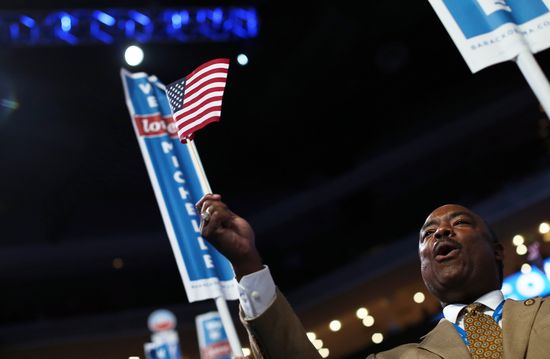
(Photo: A man waves a flag as First lady Michelle Obama speaks on stage during day one of the Democratic National Convention at Time Warner Cable Arena on September 4, 2012 in Charlotte, North Carolina. By Justin Sullivan/Getty Images)
 The Dish