What’s The Worst That Could Happen?

The Economist's More Intelligent Life hosts a forum on the question. Edward Carr nominates war, specifically between China and the US:

The shadow of nuclear devastation is one reason to be fearful. But even if we avoided that last, hideous step, the cost would be immense. That is partly because today’s conventional weapons are so potent, but also because China and America depend on each other in ways that Russia and America never did. The flow of goods to our shops would dry up, as globalisation failed. The financial system might collapse, because America could not borrow from China, and China would have nowhere to put its savings. Cyber-warriors might wreck communications and infrastructure. Collaboration on trade, science and action on climate change would be swept aside. Global economic depression would drag billions back into poverty.

Face Of The Day

151192041

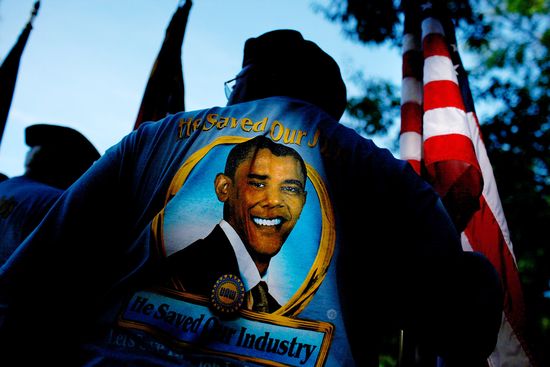
Peter Williams, with United Auto Workers Local 5283, holds an American flag while waiting for the start of the 'Charlotte Labor Day Parade' on September 3, 2012 in Charlotte, North Carolina. Labor groups from across the state participated in the Labor Day event on the eve of the Democratic National Convention. By Tom Pennington/Getty Images.

Married To The Military

A heartbreaking account from the wife of a deployed British soldier:

[I’ve noticed that] … after about four months, I forget what he looks, sounds and smells like, and it becomes easier to get along without him. That home-made flapjacks and gingernuts keep the best for the two weeks it takes to get there. But not chocolate – it melts, and messily! That – irrationally – the closer his return date comes, the more frightened I am of unexpected rings at the doorbell. That no one understands it quite like another army wife, and their friendships are what I’ll miss the most, when we leave. That I now truly agree with E. when he writes that if it’s only ever just the two of us, that’ll be alright. Not brilliant, I think to myself, but a bit more than ok. That it’s not actually disloyal to wear mascara or a skirt while he’s away, even if it feels it. That I’m not the only one whose life is on hold till his return; his mum’s is, too. And that I’m still so ridiculously, unexpectedly, gratefully lucky to be with him.

The Common Man’s Utopia

Screen shot 2012-08-31 at 6.22.37 PM

What makes us human? Mike Dash believes it is the search for a place without work:

I want to look at … the idea that somewhere far beyond the toil and pain of mere survival there lies an earthly paradise, which, if reached, will grant the traveler an easy life. This utopia is not to be confused with the political or economic Shangri-las that have also been believed to exist somewhere “out there” in a world that was not yet fully explored (the kingdom of Prester John, for instance–a Christian realm waiting to intervene in the war between crusaders and Muslims in the Middle East–or the golden city of El Dorado, concealing its treasure deep amidst South American jungle). It is a place that’s altogether earthier—the paradise of peasants, for whom heaven was simply not having to do physical labor all day, every day.

(Sculpture by Jonathan Benjamin)

Few Little Fish In The Sea

Dating in the little people community can present problems:

Little people are probably just as likely to marry or have long-term relationships as average-sized people, says Leah Smith, vice president of public relations for [Little People of America]. However, it may take them longer. They may have to deal with prejudice from average-sized people — Smith says lots of her female friends have been told by men, "If you weren't little I would date you." And if they want to date other little people, they have to navigate dating in a community that's small and spread out — and can have a big gender imbalance.

Smith says about one in every 30,000 people is born with some condition that leads to small stature. So even if you grew up in a big city, there may be only two or three other little people in your age group — and since families who have children with dwarfism often connect, "the likelihood is you grew up with them, and they're like a brother. It doesn't mean you can't date, but it's harder."

The Slow Book Movement

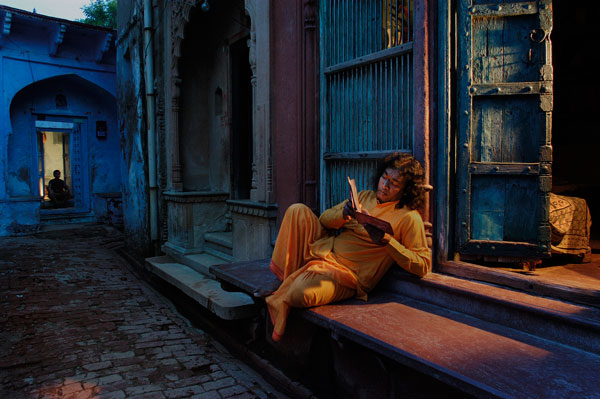
India

Benjamin Percy advocates for it:

After taking in a paragraph, I might pause and stare off into the distance for fifteen minutes. I will then read it again, maybe twice more if it’s especially striking, and pick apart its construction. I almost always have my yellow legal tablet in my lap. … It might take me two weeks or it might take me a month or more to finish a novel, but by the time I close the cover, I know it completely and see it as Neo might the Matrix, as a sparkling string of code that comes together to create an alternate reality.

(Image above from Steve McCurry's series of people reading around the world, via Emily Temple)

“Pure Distilled Evil In Liquid Form”

Michelle Nijhuis hasn't acquired a taste for Chinese alcohol:

Baijiu, usually distilled from sorghum, has been part of Chinese life for hundreds if not thousands of years. The reaction of the first laowai to taste it is lost to history, but for well over a century foreigners have described baijiu with escalating horror. “One can hardly imagine what pleasure the Chinese find in imbibing these burning drinks, which are absolutely like liquid fire, and, moreover, very ill tasted,” the French Catholic missionary Évariste Régis Huc wrote in 1854. Dan Rather, reporting on Nixon’s visit to China in 1972, described Maotai, a famous variety of baijiu, as ”liquid razor blades.”

But this doesn't prevent people from drinking it:

Among the business and government classes, baijiu is social fuel, used not just to loosen up a banquet crowd but to cement relationships and prove one’s mettle in China’s male-dominated power networks. Refusing any one of the dozens of toasts during a typical banquet is considered an insult or a sign of weakness — and definitely bad business. The result is that China is the only country where binge drinking increases with age.

A Formula For Criticism

Daniel Mendelsohn argues that the best critics teach their readers "how to think." He says criticism relies on a simple equation, "KNOWLEDGE  + TASTE  = MEANINGFUL JUDGMENT":

The key word here is meaningful. People who have strong reactions to a work—and most of us do—but don’t possess the wider erudition that can give an opinion heft, are not critics. (This is why a great deal of online reviewing by readers isn’t criticism proper.) Nor are those who have tremendous erudition but lack the taste or temperament that could give their judgment authority in the eyes of other people, people who are not experts. (This is why so many academic scholars are no good at reviewing for mainstream audiences.) Like any other kind of writing, criticism is a genre that one has to have a knack for, and the people who have a knack for it are those whose knowledge intersects interestingly and persuasively with their taste. In the end, the critic is someone who, when his knowledge, operated on by his taste in the presence of some new example of the genre he’s interested in—a new TV series, a movie, an opera or ballet or book—hungers to make sense of that new thing, to analyze it, interpret it, make it mean something.

Robert Butler amends the equation:

That's neat, but it leaves out one of the most important qualities in a critic: their voice. The impact that Kenneth Tynan or Pauline Kael or Clive James made with their criticism is inseparable from the force and personality of their voices. I would refine Mendelsohn’s equation one stage further:

KNOWLEDGE + TASTE + VOICE = PERSUASIVE MEANINGFUL JUDGMENT.