Copying Nature

Tom Vanderbilt surveys advances being made in the realm of biomimicry:

Everyone’s talking about ways to reduce the human footprint, or to get to “net zero” impact. But nature, says [Tim McGee, a biologist and member of consultancy Biomimicry 3.8] usually goes one step further: “It’s almost never net zero—the output from that system is usually beneficial to everything around it.” What if we could build our cities the same way? “What if, in New York City, when it rained, the water that went into the East River was cleaner than when it fell?” And what if, when forests caught fire, the flames could be extinguished by means that didn’t depend on toxic substances? “Nature creates flame retardants that are nontoxic,” notes McGee. “Why can’t we?”

For years researchers have focused on the chemistry of flame retardants, without results. But perhaps natural processes could offer some path to innovation in the laboratory, McGee says. Maybe it’s the way jack-pine cones open in the face of heat (to allow reproduction even as fire destroys the forest), or the way eucalyptus trees shed scattered pieces of quick-burning bark to suck up oxygen and take fire away from the main trunk. Jaime Grunlan, a mechanical engineer at Texas A&M, has developed a fire-resistant fabric that uses chitosan, a renewable material taken from lobster and shrimp shells (and a chemical relative of the chitin in butterflies’ wings), to create a nanolayer polymer coating that, when exposed to heat, produces a carbon “shell” that protects the fabric.

Sleeping Yourself Smart

Sleeping is as important as studying:

In a new study, scientists had more than 500 high school students document how long they studied and slept over two weeks. They also had them note any negatives during that period—things like not understanding a lecture. The researchers found that the students who studied a lot at the expense of sleep had significantly more issues than those who kept a more balanced study schedule.

Maggie Koerth-Baker broadens the debate:

This study is really about chronic sleep deprivation, habits and behaviors that happen over weeks and months. Along with several other studies that have come out in recent years, it helps build a persuasive case not against occasional cram sessions, but against academic routines that all-but require students to operate constantly on an abnormal sleep cycle.

A Poem For Monday

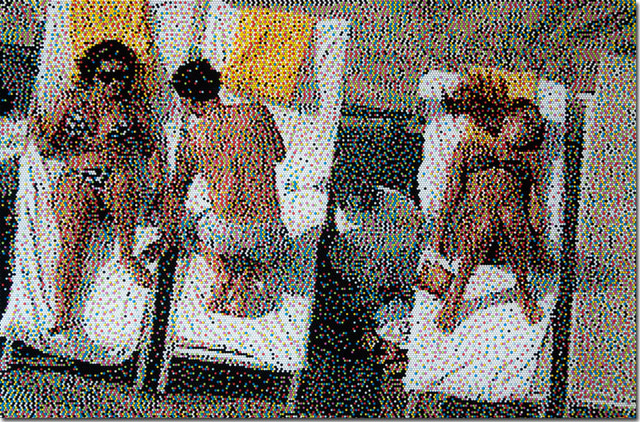
Summ_evening

"The Poet at Seven" by Donald Justice:

And on the porch, across the upturned chair,
The boy would spread a dingy counterpane
Against the length and majesty of the rain,
And on all fours crawl under it like a bear
To lick his wounds in secret, in his lair;
And afterwards, in the windy yard again,
One hand cocked back, release his paper plane
Frail as a May fly to the faithless air.
And summer evenings he would whirl around
Faster and faster till the drunken ground
Rose up to meet him; sometimes he would squat
Among the low weeds of the vacant lot,
Waiting for dusk and someone dear to come
And whip hm down the street, but gently, home.

(Reprinted from Collected Poems by Donald Justice © 2004, with permission from Alfred A. Knopf, Inc. Photo by Flickr user Michael Ragazzon)

The Stopped Clock Illusion

Ever notice the second hand on a clock momentarily slow down? Researchers recently recreated the effect in a lab. Tom Stafford explains how it works:

The theory is that our brains attempt to build a seamless story about the world from the ongoing input of our senses. Rapid eye movements create a break in information, which needs to be covered up. Always keen to hide its tracks, the brain fills in this gap with whatever comes after the break. Normally this subterfuge is undetectable, but if you happen to move your eyes to something that is moving with precise regularity – like a clock – you will spot this pause in the form of an extra long “second”. …

Like with everything else, what we experience is our brain's best guess about the world.

How Do You Pay For College?

Salliemae

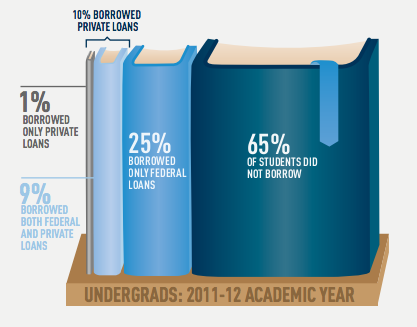
Sallie Mae surveyed the country. Kay Steiger sees the chart above as evidence that college is mostly for rich kids:

This indicates to me that the vast majority of those attending college (and it’s worth noting that Sallie Mae defined “undergraduates” for the purpose of this survey as 18 to 24 year olds, who are very much the “traditional” college student) are people who can afford to do so without taking out loans, which means they’re wealthier. There are still some low-tuition schools out there that you can attend without taking out vast amounts of loans if you don’t have wealth or savings, but that’s an increasingly small portion of colleges these days.

Why Are Airlines So Broke?

The Economist investigates:

Averaged over the past four decades, the net profit margin of the world’s airlines, taken together, has been a measly 0.1%. By contrast, other bits of the travel business that depend on the airlines—such as aircraft-makers, travel agents, airports, caterers and maintenance firms—have done very nicely.

The airlines aren't without blame:

The airlines’ chronic unprofitability is partly the result of a wave of competition—especially from new low-cost carriers—unleashed by the steady deregulation of aviation since the 1970s. But it is also due to two moves by the airlines, from the 1990s onwards, that in retrospect were strategic errors. One was to stop paying direct commissions to travel agents. The other was to set the reservation systems free to become (as the airlines see it) profit-gobbling monsters that devour their parents.

The Mortgage Math

Screen shot 2012-08-28 at 6.07.27 PM
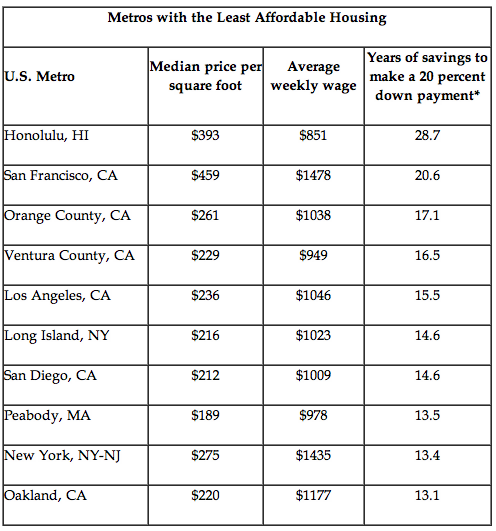
Jed Kolko crunches the numbers to see how long the average worker would have to work in order to buy a home in different parts of the country:

If you want more affordable housing, you might guess that moving to the suburbs is the answer. Not always! You’ll actually need to work longer – earning the local average wage – to buy a home in Long Island (14.6 years) than in New York (13.4 years); more years in Ventura County (16.5 years) than in Los Angeles (15.5 years); and more years in Peabody, Massachusetts (13.5 years), than in Boston (12.1 years).

New York, Los Angeles, and Boston all have more expensive housing than Long Island, Ventura County and Peabody, respectively, but higher wages in those urban metros relative to their suburbs more than offset higher housing prices. Homes cost 27 percent more per square foot in New York than in Long Island, for example, but average wages are 40 percent higher in New York than in Long Island.

Saint Monday

Peter Frase excerpts a fascinating bit of Witold Rybczynski's 1991 essay, "Waiting For The Weekend," which examined leisure in the 18th century:

It was not unusual for sporting events, fairs, and other celebrations to last several days. Since Sunday was always an official holiday, usually the days following were added on. This produced a regular custom of staying away from work on Monday, frequently doing so also on Tuesday, and then working long hours at the end of the week to catch up. Among some trades the Monday holiday achieved what amounted to an official status. Weavers and miners, for example, regularly took a holiday on the Monday after payday—which occurred weekly, on Friday or Saturday. This practice became so common that it was called “keeping Saint Monday.”

Saint Monday may have started as an individual preference for staying away from work—whether to relax, to recover from drunkenness, or both—but its popularity during the 1850s and 1860s was ensured by the enterprise of the leisure industry. During that period sporting events, such as horse races and cricket matches, often took place on Mondays, since their organizers knew that many working-class customers would be prepared to take the day off. And since many public events were prohibited on the Sabbath, Monday became the chief occasion for secular recreations. Attendance at botanical gardens and museums soared on Monday, which was also the day that ordinary people went to the theater and the dance hall, and the day that workingmen’s social clubs held their weekly meetings.