Hathos Alert

Why should Christmas have a monopoly on terrible holiday songs?

Marlow Stern talks to the singer, Nicole Westbrook:

[She] hasn’t been too concerned about the song’s reception—including a recent critically maligned live performance on Access Hollywood. "It’s just been such a great experience," she says. "I’m very happy with the song and how it turned out. I haven’t read any of the comments—whether they’re good or bad—I just stayed away. I think it’s really helped me because I haven’t felt depressed or regretful."

Working The Holiday

In acknowledging the individuals who have to work today, Shamus Khan provides a short history lesson on servants:

Working on holidays has always presented something of a class divide. From the 1870s through the 1920s, middle and upper class Americans often lived with "the help" – mostly women of color whose job it was to cook and clean and care for others, day and night. While shows like Downton Abbey seek to give life to servants, they also sanitize what was a brutal, back-breaking existence. It was common for a housemaid’s day to begin well before the family rose, and extend until after they retired for the evening. They did so seven days a week; working more than 80 hours a week –more than the 65 hours worked by most factory workers at the time. While we often imagine that these women were young and single, Evelyn Nakano Glenn’s research on such care providers has shown how over 30% of them were married, many with children. As they toiled for families not their own, they left their children, parents, siblings, and husbands behind. November and December was no doubt one of the hardest times of the year, and their own families felt their absence.

A Holiday For Adults

Rosecrans Baldwin favors Thanksgiving now that he's grown up:

Thanksgiving, our eminent moral holiday, doesn't have much for children. At its heart are conversation, food, drink, and fellowship–all perks of adulthood. If you throw in sex, sports, and Homeland, as I imagine some families do, you've nearly got the whole of modern adult happiness.

I was 23 when I learned how to cook; I grew up around the same time. It was precisely then that Thanksgiving started to mean something more. Growing up, Christmas was always about me, and eventually you when I finally started to enjoy the giving part. But Thanksgiving is always about us.

Hacking The Holiday

Elizabeth Gunnison saves the day with tips on how to salvage various burned dishes. For gravy:

Transfer the gravy to another pan immediately, leaving behind the burnt stuff stuck to the bottom. Then take a quarter of a cantelope (or other melon), peel it, cut it into chunks and add it to the gravy. The cantelope will act like a big sponge, soaking up the bitter and imparting a little sweetness. Remove the cantelope before serving. If you don't have melon on hand, whisk a spoonful of Jiff peanut butter into the gravy. Don't ask why it works; it just works.

Elsewhere, the secret to the perfect pie crust, according to science:

The test cooks at America’s Test Kitchen suggest using a combination of water and vodka, in place of the water that a crust recipe calls for. When vodka is added to flour, its molecules, unlike water, do not cause the proteins to reconfigure into gluten. “Using a mixture of vodka and water allows us to add more liquid to the dough to get it to be as malleable and easy to work with as possible without causing excessive toughness,” the testers report.

Relatedly, J. Kenji López-Alt answers hosting questions over at Serious Eats:

If turkey is roasted well in advance of guests arriving, or there is a delay, what's the best way to re-heat? To what temperature?

If tented with foil and left in a warm place, a turkey should stay warm for at least a couple hours–at least internally. The real danger is the skin getting soggy and the surfaces getting cold. The best way to fix this? Just pop it in a 550°F oven for 7 to 15 minutes until the skin is crisp and piping hot again. The rest should take care of itself.
What Is Animal Welfare?

Marian Stamp Dawkins defines it as making sure "the animals are healthy, and that they have what they want":

There's a lot of new legislation about animal welfare. Unfortunately a lot of it is not evidence-based. One of the reasons for that is the fact that it's quite difficult to get hold of. One of the things we've been doing is trying to develop ways in which you can get really good evidence. For example, if you actually take a case of crowding in chickens or pigs or something like that, lots of people would say that must be bad for their welfare. Or they look at animals outside and they say they must be better off if they're free range and they're outside. That's a judgment of humans. But it seems to be very important, before you start saying this must happen or this mustn't happen, that you have very good evidence.

For example, we need to look at the health of animals inside and outside. It is a very striking fact that if you look at free-range chickens, the mortality rates are much higher than they are inside or in cages. That surprises a lot of people, but it's an important piece of evidence, before you actually start evaluating the welfare of the animals. For example, being outside in a cold English winter really isn't necessarily better for an animal's welfare than being warm and comfortable inside. We're very misled by these different words.

Torturing The Turkey

An investigation into animal cruelty:

Zack Beauchamp adds:

Even absent the extraordinary levels of cruelty on display in the video, Butterball turkeys live terrible lives. As Mercy for Animals reports, "Butterball’s turkeys have been selectively bred to grow so large, so quickly, that many of them suffer from painful bone defects, hip joint lesions, crippling foot and leg deformities, and fatal heart attacks." Contrary to popular belief, turkeys are both highly social and relatively intelligent animals. Butterball is the United States’ largest turkey producer, making up 20 percent of turkey sales year round and 30 percent of total Thanksgiving sales.

Ignore The Foodies

That's what Stephen Marche wants us to do today:

Today, your attitude toward pork belly is a clearer statement of who you are and where you come from than any television show you watch or band you follow. Tell me what you know about pasta, and I'll tell you how much your parents made, how much education you managed, how much is in your savings account.

Unlike other cultural phenomena, which are more or less generationally undefined now, food explicitly identifies youthfulness.

The younger you are, the more you know about food, generally speaking. There are experts, of course, who transcend the generalization, but I automatically know more about food than someone ten years older than me. If you put an Italian dish in front of me, I can probably tell you which region it's from. For my uncles, Italian food is Italian food. … The process of this generational divide in food is only accelerating. I once saw my six-year-old son explain the difference between a sushi bar and an izakaya to his grandmother. What the hell is he going to make of my love of Korean barbecue or bone marrow with squid-ink pasta? It will be like Kraft Macaroni and Cheese and Jell-O to him.

His advice? Relish Thanksgiving dinner as "an antidote to all that, a necessary break to remind us of how boring and dependable food used to be, and also of how great it is actually just to be able to eat as much as you want."

Endangered Dishes

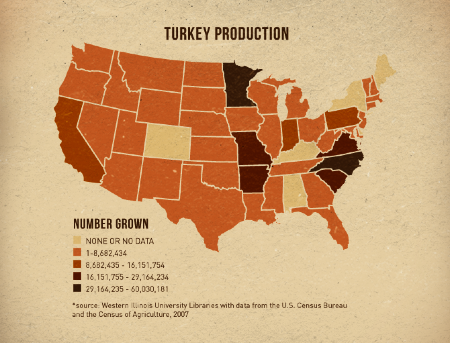
Full_1352920441Bird_Map_graphic_texture

Climate change could threaten much of the Thanksgiving Day meal:

The "turkey belt" of the United States is in the South, where states like Virginia, North Carolina, and Arkansas contribute the bulk of our national annual haul of over a quarter of a billion birds. But if you're worried about keeping turkey on your Thanksgiving table into the future, you might turn your attention to the Midwest. After this summer's record-breaking heat and drought in the Corn Belt, the grain supplies that plump the birds up for market dwindled, prices spiked, and as of fall turkeys are the most expensive per pound they've been in 10 years.

Your cranberries aren't safe either:

Over in Wisconsin—where growers typically produce more cranberries than any other state—the cranberry is actually the official state fruit. Like most woody perennials, cranberry plants go dormant for part of the year, and Wisconsin's typically bone-chilling winters are great for this important stage. Tod Planer, a coordinator with the Wisconsin State Cranberry Growers Association, says that during recent mild winters, berries have failed to freeze, forcing farmers to cover their crops in fresh water every few days to make sure oxygen reaches the plants. One Wisconsin farmer told Grow magazine that he saw his first cranberry blossom in mid-May this year, the earliest he's ever witnessed.

(Image: Partial view of an infographic on how to have a locavore Thanksgiving)

Filled To Capacity

Diet food companies claim that the average American consumes 4,500 calories on Thanksgiving Day. Tara Parker-Pope fact-checks:

Let’s start piling our plate with a generous 6-ounce serving of turkey, with the skin of course. Since dark meat has more calories, we’ll go with 4 ounces of dark meat (206 calories) and 2 ounces of white meat (93 calories). Did I mention we’re eating the crispy skin? Don’t forget the stuffing. I picked a not-so-healthy sausage stuffing (310 calories). Since it’s a holiday, let’s throw caution to the wind and eat lots of starchy, buttery foods. A dinner roll with butter (310 calories) plus two kinds of potatoes – a big serving of mashed sweet-potato casserole made with butter, brown sugar and topped with marshmallows (divide your casserole dish into 8 servings and it will be 300 calories each) plus a half-cup of mashed potatoes with butter and gravy (140 calories).

You’re not getting full are you? Let’s add 2/3 cup green bean casserole (110 calories), a dollop of cranberry sauce (about 15 calories), and roasted brussels sprouts because our mother made us eat them (83 calories). And since we don’t want to hurt anybody's feelings, we’ll take one slice each of pumpkin pie (316 calories) and pecan pie (503 calories) with generous dollops of homemade whipped cream on each slice (100 calories).

O.K., now I feel sick. How much have I eaten? The grand total is: 2,486 calories.