Chart Of The Day

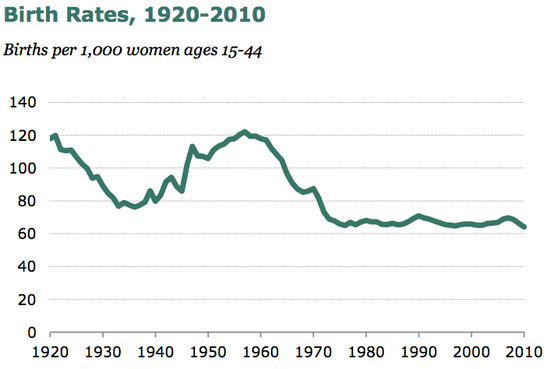
The US birthrate has hit a new low:

Birth_Rate

Ezra Klein captions:

A key contradiction in American public opinion is that many people simultaneously think that immigration is bad for the economy (“they’re taking our jobs!”) and that a low birthrate is bad for the economy. But they basically lead to the same economic problem: too many old people, not enough young people. The United States is lucky in that much of the world — including many people with lots of skills — wants to come here. The fact that our birthrate is dropping only strengthens the case for letting them in.

Journalists With Drones

Not as crazy as it sounds:

The cost of easy-to-maneuver drones equipped with quality video cameras is falling, and the technology is already more than capable. Really, the biggest impediment to news drones is probably federal regulation—the FAA won’t release its rules on UAVs until 2015, which means the current laws of the land stand; that it’s illegal to fly drones over 400 ft, and in most places where they could feasibly invade private property.

Rupert Murdoch’s always-nefarious News Corp found that out the hard way. Its Daily was, fittingly, one of the first media outlets to try to use drones, regulations be damned. Back in 2011, Forbes reported that the Daily twice flew drones into disaster zones on news-gathering missions, and probably violated federal regulations. It faces citations and fines—most news orgs are likely going to sit tight until 2015 in the wake of its example.

Investigating The Crime Drop

Lead_Crime

Matt Steinglass doubts the drop in crime over the last few decades has a single reason:

Random controlled trials might very well have found that the broken-windows strategy doesn't prevent crime, "Project Ceasefire" doesn't prevent crime, reducing rates of single motherhood doesn't prevent crime, family planning doesn't prevent crime, banning lead doesn't prevent crime, and so on and so forth; there might have been no statistically significant difference one could isolate for any of these things. And yet it seems extremely likely to me that most or all of these were good things to do! The drop in violent crime probably has to do with all of them. So we probably need to be a bit circumspect about demanding results from our cost-benefit analyses, and go ahead and do things that seem like they probably work.

Noting that crime has dropped almost everywhere, Kevin Drum thinks it's more likely that "there's some single factor underlying the decrease that affected the entire country":

In fact, since drops in violent crime were also recorded in Canada during the past two decades, and elsewhere around the world during other time periods, it's probably some worldwide factor. And on that score, gasoline lead reigns supreme. There's really nothing else that persuasively explains a global rise and fall in violent crime that happens at different times in different countries.

(Chart from (pdf) Understanding international crime trends: The legacy of preschool lead exposure by Rick Nevin)

Can Guns Be Controlled? Ctd

Jeffrey Goldberg's latest article tackles the subject:

A balanced approach to gun control in the United States would require the warring sides to agree on several contentious issues. Conservative gun-rights advocates should acknowledge that if more states had stringent universal background checks—or if a federal law put these in place—more guns would be kept out of the hands of criminals and the dangerously mentally unstable. They should also acknowledge that requiring background checks on buyers at gun shows would not represent a threat to the Constitution. “The NRA position on this is a fiction,” says Dan Gross, the head of the Brady Campaign. “Universal background checks are not an infringement on our Second Amendment rights. This is black-helicopter stuff.” Gross believes that closing the gun-show loophole would be both extremely effective and a politically moderate and achievable goal. The gun lobby must also agree that concealed-carry permits should be granted only to people who pass rigorous criminal checks, as well as thorough training-and-safety courses.

Anti-gun advocates, meanwhile, should acknowledge that gun-control legislation is not the only answer to gun violence.

Responsible gun ownership is also an answer. An enormous number of Americans believe this to be the case, and gun-control advocates do themselves no favors when they demonize gun owners, and advocates of armed self-defense, as backwoods barbarians. Liberals sometimes make the mistake of anthropomorphizing guns, ascribing to them moral characteristics they do not possess. Guns can be used to do evil, but guns can also be used to do good. Twelve years ago, in the aftermath of Matthew Shepard’s murder, Jonathan Rauch launched a national movement when he wrote an article for Salon arguing that gay people should arm themselves against violent bigots. Pink Pistol clubs sprang up across America, in which gays and lesbians learn to use firearms in self-defense. Other vulnerable groups have also taken to the idea of concealed carry: in Texas, African American women represent the largest percentage increase of concealed-carry permit seekers since 2000.

Earlier commentary here.

E-Cigs Are Here To Stay

E_Ciggs_Chart

Brian Merchant says to "expect the sight of e-smokers puffing away on glowing e-sticks to become increasingly typical":

[T]heir market share is undoubtedly growing. They may be tacky and pose unknown health risks, or they might be the best thing that ever happened to smokers who can’t quit. Either way, the future of inhaling nicotine into your lungs increasingly belongs to smokeless delivery cartridges made in China.

(Chart from Euromonitor)

The Base Doesn’t Love Cuomo

After reviewing approval numbers for 2016 contenders, Harry Enten finds that, "unless Andrew Cuomo dramatically repositions himself for a run for president in 2016, he may not find the liberal wing of his party backs his bid":

So, why isn't Cuomo more popular among the Democratic electorate? Only 22% of Democrats think he's liberal, 15% think he's actually conservative, and 65% peg him as moderate. Those numbers are quite staggering especially in comparison to how voters saw Hillary Clinton before her re-election to the Senate in 2006: 49% of New Yorkers saw her as liberal, 40% as moderate, and 11% as conservative. That's a far wider split than Andrew Cuomo's is currently. With Democrats, 38% thought she was liberal, 16 points ahead of Cuomo.

The Daily Wrap

Stalin

Today on the Dish, Andrew called out both political parties for their entitlement cowardice, then thought through Ezra’s fiscal cliff suggestions before insisting Obama take the present opportunity for a big deal. Andrew also considered the legacy and future of Zionism, responded at length to Fox News’ avoiding of him and other dissenting conservatives, and though he can’t take three pills a day to replace the tediousness of eating, he did explain the benefits of his single daily dish.

In political coverage, George Will pretended gerrymandering didn’t exist with regards to the House GOP’s “mandate”, Yglesias ignored Senate Republicans due to their irrelevance, Ezra and Waldman acknowledged Grover Norquist had been successful in moving the tax-cut goal posts, Drum charted the universal unpopularity of raising the retirement age, and Josh Barro suggested the GOP aim for some pro-growth redistribution. Also, our debate over the liberal leaning of Asian-Americans continued, the Obama campaign’s creepy fundraising emails worked, Nate Silver highlighted the substantive campaign advantage of having Silicon Valley’s support, and a millennial reader noted marriage equality was possibly the major issue driving young voters to support Democrats. Richard Socarides additionally hoped Obama would insist on gay rights as a part of immigration reform, Jon Huntsman took on the GOP’s war-mongering, Tom Ricks sized up MSNBC, Ackerman looked at the logistics of trying to close Gitmo, Massie offered his thoughts on the differences between Obamacare and the NHS, and Brian Doherty didn’t believe further gun control for the psychiatrically disturbed was worth pursuing. We also continued to process both the meaning and political implications of Lincoln.

In international coverage, Syria’s internet got switched off while Egyptian President Mohamed Morsi tried to make a (second language) point using The Planet of the Apes. In assorted coverage, Felix Salmon explored the world of stock-picking hobbyists, some readers in San Francisco chimed in with their thoughts on the city’s nudity ban, Ron Unz looked for possible discrimination against Asians at America’s elite universities, Mark Vanhoenacker checked the steam pipes under NYC, and Nick Carr pondered the possible moral decision-making abilities of computers. We hope you weren’t sitting down when Kalliopi Monoyios explained how your couch may be trying to kill you, meanwhile Xeni Jardin offered us our very own model fetuses, and readers added their thoughts on the morality of The Walking Dead as well as on the nature of of 401(k)s. We also dove into the story behind the Church of England’s rejection of women bishops, broke down the dynamics of alcoholism, met a cheetah ambassador in our FOTD, watched the leaves turn in our gorgeous MHB, and saw a morning in Virginia through the VFYW.

-C.D.

An Uncompromising President, Ctd

Aaron Bady argues that, by focusing on the negotiation for the Thirteenth Amendment, the film creates an "artificial sense that more is at stake in a single congressional bill than there actually was": 

As Eric Foner pointed out when he was asked about the movie, if it hadn’t passed when it did, Lincoln had pledged to call Congress into special session in March; “[a]nd there, the Republicans had a two-thirds majority and would ratify in a minute…It’s not this giant crisis in the way that the film’s portraying it.”

Bady goes on to complain that the film makes it seem "that black people had no effect on the politics of slavery and emancipation (except insofar as they inspired the people who mattered)"  - an important nuance given that slavery was in its death throes not primarily because Lincoln ratified its end but because slaves themselves were seizing freedom. Along those lines, historian Kate Masur wishes the film included the throngs of fugitive slaves who fled to Washington, DC:

By 1865 — Mr. Spielberg’s film takes place from January to April — these fugitives had transformed Washington’s streets, markets and neighborhoods. Had the filmmakers cared to portray African-Americans as meaningful actors in the drama of emancipation, they might have shown Lincoln interacting with black passers-by in the District of Columbia.

Black oral tradition held that Lincoln visited at least one of the capital’s government-run “contraband camps,” where many of the fugitives lived, and was moved by the singing and prayer he witnessed there. One of the president’s assistants, William O. Stoddard, remembered Lincoln stopping to shake hands with a black woman he encountered on the street near the White House.

Douthat, on the other hand, defends the film:

The problem is that every historical film has to “ignore the big picture,” because actual history just too big to fit the screens and stories that we have. The question isn’t whether to edit; it’s where and how and what, and how to balance the requirement to win a contemporary audience with the obligation to do justice to the actual historical record. The justice that “Lincoln” does to its complicated subject is necessarily flawed and incomplete. But I can see why its makers made the choices that they did, and I think the results, while imperfect, are more impressive than many films about the foreign country of the past.

A Letter From A Millennial Voter

A reader writes:

I was born in 1984. The first election I was able to vote in on a Presidential level was 2004, in which I voted for John Kerry, and have gone on to vote for Obama both in 2008 and 2012. To give some perspective on why the Democrats are winning voters like myself and of my generation, I can break it down.

Many people my age are more libertarian-leaning than anything.  I think the emergence of gay marriage as an issue in 2004 is what started the trend of the youth vote decisively going for the Democrats. While it may have been a shrewd political move by Karl Rove in 2004 to use marriage equality as a wedge issue, in the long run, it will be seen as a strategic error for the party. In addition to marriage equality, we also don't believe in stupid wars. It seems Bush really exposed my generation to an underbelly of the Republican Party that we don't identify with.

Furthermore, we are a technological generation. We came of age during the rise of the Internet, and we have embraced it, and in turn we have revolutionized its use (Zuckerberg, et al). We see the Republican party as anti-science, anti-technology know-nothings. We want no part of that.

And that's a big reason why Silicon Valley voters and donors went overwhelming for Obama, as we illustrated earlier today.

Alcoholics’ Addiction

Wray Herbert summarizes the findings of a recent study showing that alcoholics who were most ashamed of their last drink were far more likely to relapse:

This is the first scientific evidence to bolster what alcoholism counselors and recovering alcoholics have long known: Shame is a core emotion underlying chronic heavy drinking. Shame is what gets people into the rooms of AA — it defines the alcoholic "bottom" — but it's a lousy motivator for staying in recovery. The power of AA is that it offers something to replace the negative emotions that most alcoholics know all too intimately.

Meanwhile, Dr. Keith Humphreys sheds light on how an addiction vaccine could offer a new avenue for addicts seeking help:

[O]nly some 3,500 physicians in the U.S. specialize full-time in addiction, as compared with a population of about 21 million Americans with diagnosable drug and alcohol problems…. The existence of a medication would legitimize cocaine and methamphetamine addiction as medical disorders, which in turn would make doctors more comfortable treating the addiction.

However, Tobias Jones questions both AA's and the medical establishment's approaches to addiction, namely that "AA’s notion that alcoholism is a disease … has meant that for decades addiction has been seen in medical terms," inviting addicts to absolve themselves of control. He characterizes the growing backlash against these conceptions:

Voices on the right of politics, such as Theodore Dalrymple and Peter Hitchens, complain that the war on drugs has never actually been fought, that we have fudged it and allowed addicts to dictate policy. Damian Thompson’s polemic, The Fix (2012), eloquently challenges the ‘disease’ analysis, saying that ‘the behaviour of addicts looks voluntary because it is’….

To my mind the great drawback of medicalising addiction is that it actually obscures AA’s subtler diagnosis of a ‘spiritual malady’. It’s not, perhaps, surprising that in our secular age the spiritual tag is touted less often than the ‘disease’ one…. Abraham Twerski, the American psychiatrist and rabbi, has worked with addicts all his life and he, too, insists on the immaterial, or metaphysical, nature of recovery. ‘I know without doubt that the source of addiction is spiritual deficiency,’ he has written. ‘Irrespective of whether we are religious or atheist, all human beings are spiritual by nature, and spirituality is the cornerstone of our recovery.’

Jones says this is consistent with his own experience running a woodland retreat for addicts:

Treatment needs to be holistic, dealing with an individual in the round. It’s not just about repairing a brain, or a vein, but about repairing relationships and the spirit.