A Disaster In Slow Motion

David Remnick hopes Obama will confront climate change soon:

As the writer and activist Bill McKibben writes in The New York Review of Books, "Global warming happens just slowly enough that political systems have been able to ignore it. The distress signal is emitted at a frequency that scientists can hear quite clearly, but is seemingly just beyond the reach of most politicians." When the financial system collapsed, the effects were swift and dramatic. People could debate how best to fix the problem, but they could not doubt that there was a problem and it had to be fixed. Yet, as Nicholas Stern, a former chief economist of the World Bank, who studied the costs of climate change for the British government, has observed, the risks are vastly greater than those posed by the collapse of the Western financial system.

If today's press conference is any indication, the hopes of Remnick and McKibben appear dashed for now.

A New War In Gaza?

GT GAZAAIRSTRIKES 20121114

A new conflict is rapidly escalating in Gaza:

Ahmed al-Jaabari, the head of the Islamist organisation’s military wing, the Izz ad-Din al-Qassam, died when his car was struck in Gaza City by a missile after Israel warned it may step up targeted assassinations, having endured almost a week of intense rocket fire from Gaza. Reports suggested three other Palestinians were also killed. In the hours after the attack on Jaabari, Palestinian witnesses told the Associated Press that air strikes had hit a series of targets across Gaza City.

Goldblog tweeted today: “How many ‘indispensable’ Hamas leaders have been killed already? Have these deaths crippled Hamas? New thinking urgently needed by Israel.” A few days ago he weighed in on the rocket attacks:

There is no military solution to the Gaza conflict, at least not one that Israel could pursue. Gaza isn’t Chechnya and Netanyahu isn’t Putin. Flattening Gaza is not a moral solution, nor a practical solution. Nor, for that matter, is it a politically possible solution. Netanyahu is calling in Western diplomats to explain to them that Israel has no choice but to respond militarily to the rocket fire. What he doesn’t seem to understand is that he doesn’t possess the political capital to ask the West for its understanding. There’s plenty of blame to go around for the collapse of the peace process; his portion is substantial, and his alienation of leaders who might otherwise be friends is a continuing theme of his tenure. 

On Monday, Michael Koplow examined the implications of an Israeli ground campaign. He also considered the political angle for Bibi:

 Netanyahu has been campaigning on security issues pretty much his entire political life, and the current campaign is no different. His focus on security is so strong that Kadima, in what can only be described as a last ditch effort amongst its death throes, has adopted as its campaign slogan “Bibi is endangering us” superimposed against a backdrop of a mushroom cloud. The irony of Netanyahu’s hawkish public persona is that he has never presided over a large military operation during either of his two tenures as prime minister, but as risky as it may be to send ground forces into Gaza right now, he cannot afford to just sit on his hands.

Max Fisher worries about the reactions of Egypt, Turkey, and Iran. Why military action by Israel could stall US talks with Iran:

The New York Times’s Tehran-based Thomas Erdbrink warned on Twitter. “While #Iran and #Hamas have been estranged over Syria, Iran’s leaders will be highly upset over Jabari’s assassination today in Gaza,” he wrote. “Forget ANY #Iran-US talks if conflict in Gaza escalates. … #Iran leaders can never be seen as talking to US, while its ‘eternal’ ally Israel assassinates Iran’s ideological allies.” The Washington Post recently reported that Tehran is “locked in internal debate” over the possible U.S. talks, so anything that weakens Iranian advocates for negotiations and exposes them to greater political risk would seem likely to reduce the odds of those talks taking place.

Nervana Mahmoud doubts Cast Lead II would be effective:

Without controlling the Philadelphia corridor between Sinai and Gaza and preventing arms smuggling, Cast Lead II would end up like Cast Lead I: a temporary break at a hefty price in terms of innocent loss of lives, international isolation, plus the new possibility of Egyptian retaliation, and even perhaps revocation of the Camp David accords.

The Guardian is live-blogging today’s violence.

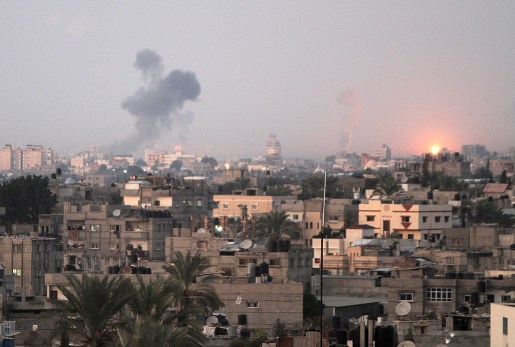
(Photo: Smoke rises following an Israeli air strike in Khan Yunis, southern Gaza Strip, on November 14, 2012. By Said Khatib/AFP/Getty Images)

Getting Better In Uganda, Ctd

A reader writes:

When I saw your post, I felt a soul-crushing sadness. You are grossly misinformed or naive. While I was trying to put together my thoughts for an email to you, I got an AP news item over Twitter and it speaks for itself: "Official: Uganda to pass anti-gay bill this year".  After you read it, think of those who hurry home in groups, look over their shoulder, keep up the phone-check with friends/family, and obsess about the stranger who said "no-one will mourn when you die". Those who just generally live in terror.

Look up activist David Kato [Dish link here]. It was ruled death by robbers even though everyone knows it was a homophobic murder. Most of us are not brave activists as he was, or have powerful/vocal friends like he did. So no one would notice, care, or question if someone walked in and smashed your skull in. It was just a robber. Think about that. I am lucky enough to live here in the US, but I talk to my elderly parents knowing I will probably never  see them alive again. Rethink gay Uganda please. Here's a White House petition.

Another:

While brief, this post has the latest on the bill and the timetable for it. The short answer is that the pressure is mounting in Uganda for action on the bill but the committee chair is keeping quiet and does not have the required report ready to present to Parliament. The bill has not appeared on Parliament’s order papers as well.

When Will Texas Become A Swing State? Ctd

A reader writes:

You mention that incoming Senator Ted Cruz "might" be the GOP answer to moderation in the party. Your skepticism could've run a lot deeper, since Cruz criticized his opponent for marching in a gay pride parade, thinks Shariah Law is an "enormous problem," and wants to triple the Border Patrol with "electronic surveillance, a wall, helicopters and, most importantly, boots on the ground" to fight immigration. That doesn't strike me as a guy who will successfully push Republicans towards libertarian positions or successfully reach out to and mend relationships with the gay community, Hispanics or other groups.

Another:

You quoted Munisteri: "You cannot have a situation with the Hispanic community that we’ve had for forty years with the African-American community, where it’s a bloc of votes that you almost write off…" Yet, Texas seems poised to continue its current trajectory. One of the four "emergency items" on the state legislative list from Gov. Perry's office is banning "sanctuary cities". One of last session's emergency items, Voter ID, was blocked in court. Three main legislators in Texas recently came out against offering in-state tuition to children of undocumented immigrants.

In the recent US Senate race here, both Cruz and and his main primary opponent, Lieutenant Governor David Dewhurst, opposed the DREAM Act.

Ads here in Texas had both candidates attacking each other falsely for "supporting amnesty", when in fact, both are far from it. Cruz and Dewhurst moved rightward, opposing any kind of a national guest worker program, with even the less conservative Dewhurst stating he would not support any path to citizenship. Cruz stated he would triple the size of the US Border Patrol in Texas, and supports e-verify.

I would say that from the perspective here in Texas, Perry looks like he realizes the coming change; he's shifted slightly leftward in regards to immigration reform. However, the legislature has not – and Perry's brand here is quite damaged among conservative groups. Furthermore, as more proof they're not making much inroads, Romney only got 29% of the Latino vote in Texas (the national rate was 27%). The move to getting Latinos here in Texas to follow the Republican party is, to be frank, a long, hard climb ahead. It can be done, but things – and people – will have to drastically change in the legislature.

Another:

Anecdotes are not the same as data, but my impression from here in Dallas is that Texas is indeed turning purple quicker than people think, and not just because of an influx in Hispanic populations

My wife and I moved to Texas five years ago for work. I am a Californian by birth who spent all his previous adult years living in New York City.  My wife is Canadian.  In short, we're pretty liberal. Culturally, moving was a huge shock.  The racism was overt and the Jesus talk was overwhelming.  I could fill a book with the crazy things I heard and saw. I heard people praise Katrina for killing so many black people.  I saw agnostics hounded at parties for hours until they accepted Jesus. My wife and I quickly learned that if we wanted any semblance of a social life we had to keep our mouths shut when race, religion, or politics came up.  We bit our tongues through many talks of Death Panels, Obama as a dictator, etc.  Arguing against it all had left us friendless for too long.  It was hard.

But things aren't like that anymore.  Part of it is that there has indeed been a large influx of people from other states.  I've met a number of people who have recently moved here from NYC, LA, etc. and every time I go to a social gathering, I meet more.  

The funny thing is, the reasons are pretty much all the things Perry was trying to trumpet in his bid for the White House.  The economy here didn't suffer as much, there wasn't as much of a housing boom (or bust), and the cost of living is cheap enough to attract those suffering in more expensive cities.  But, those people aren't Texans and they're not adopting Texas' politics as their own.  They're bringing their views and tastes with them.  When it comes to politics, it's our old conservative friends, the ones who used to lecture the rest of us about the evils of Obama, who stay quiet.  When we got the invite to an Election Day party, it was assumed that the attendees would be rooting for an Obama win.  My wife's work numbers about two dozen Obama supporters and one Romney supporter.

The amazing part is to see how it's benefited even the local conservatives. My once Bible-thumping co-worker who used to lecture me about Jesus was finally able to accept that she was gay. She's now in a committed, happy, and monogamous relationship with another woman.  The bitterness in her is gone (as are the Jesus lectures).  There are openly gay teenagers everywhere and the local gay neighborhood has become a focal point for social life, even among heterosexuals.  I can't even remember the last time someone said something overtly racist when it used to be a near-weekly thing.  My liberal friends still send me emails asking, "So what crazy racist things have you heard recently?" and my answer for quite some time has been, "I don't really hear anything anymore!"

Simply put, it's just a nicer, happier, more accepting place.  Don't get me wrong.  It's far from perfect.  There's still plenty of bad stuff and I still have many friends who are conservative (mostly those in the oil and gas industry). But I think even the locals are starting to realize that liberals aren't crazy communists who want to steal their money or their guns.  The politics of hate don't work when you actually start interacting with the hated "others" and realize they're nice people.  Not only that, the locals seem to really enjoy the new shops, art galleries, restaurants, street fairs, farmer's markets, etc. catering to the sensibilities of these new liberal arrivals.  Turns out there's more to food than Texas BBQ and more to clothes than shirts bedazzled with rhinestone crosses and they like it!

On a personal level, my wife and I went from counting down the days until our contracts were up and we could leave to thinking that maybe this isn't a half-bad place to settle down and raise some kids. The small towns of Texas, however, are another story …
Restaurant Review Of The Day

A classic from the NYT in the form of an open letter to the restaurant owner, Guy Fieri. Money quote:

Why is one of the few things on your menu that can be eaten without fear or regret — a lunch-only sandwich of chopped soy-glazed pork with coleslaw and cucumbers — called a Roasted Pork Bahn Mi, when it resembles that item about as much as you resemble Emily Dickinson? …

Hey, did you try that blue drink, the one that glows like nuclear waste? The watermelon margarita? Any idea why it tastes like some combination of radiator fluid and formaldehyde? …

And when we hear the words Donkey Sauce, which part of the donkey are we supposed to think about?

It's great to read a literate rant in a review section. It should happen more often. Crankiness is way more readable than gussied-up p.r..

Would The Recovery Survive A Fall Off The Fiscal Cliff?

Many liberals are arguing that temporarily jumping over the fiscal cliff wouldn't have major economic consequences. Neil Irwin isn't so sure:

Markets don’t like risk. And for the world’s largest economy to adopt a yo-yo approach to fiscal policy — steep tax increases and spending cuts one month, a reversal the next — would be an extra layer of risk for already jittery markets. A falling stock market hammers both households’ wealth and confidence and businesses’ willingness to invest.

Who knows if a few weeks of austerity would cause a recession or merely a soft patch in growth. But with unemployment at 7.9 percent, neither is particularly welcome.

Chart Of The Day

Middle_Eastern_Oil

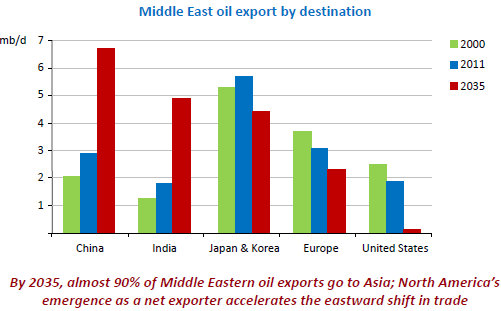
Ryan Avent studies the latest World Energy Outlook.  Given the trends in the above chart, he wonders whether "Asia, and China in particular, might come to develop a greater interest in Middle East security than it has now." He also considers the consequences for US climate politics:

In America "energy security" has long been a stalking horse for broad questions about the sustainability of current energy practice, including concern about climate change. As the economics of American energy markets change, it seems possible that the country's attitudes about climate matters may change as well, not in a good way, and it isn't as if America's commitment to addressing global warming is particularly strong as things stand.

Why Do Asian-Americans Increasingly Lean Left?

According to exit polls, Obama won the demographic by 47 points. Razib Khan's explanation:

In short, it’s religion. Barry Kosmin has documented that between 1990 and 2010 Asian Americans have become far less Christian, on average. Meanwhile, the Republican party has become far more Christian in terms of its identity. Do you really require more than two sentences to infer from this what the outcome will be in terms of how Asian Americans will vote?