Conservatives For Springsteen


Daniel Foster argues that conservatives shouldn't be ashamed to love the Boss:

Bruce, I’m sure, would disagree emphatically, but as I’ve gotten older I’ve come to read Springsteen songs more and more as funeral dirges for a very particular political promise that died some time in the Seventies — namely, the promise that America’s long streak of post-war prosperity meant that the great liberal and great conservative priorities were mutually deliverable; that a universal middle class was achievable by some magic mix of entrepreneurialism and redistribution; that high taxes, anticompetitive regulation, and industrial planning were consistent with limitless growth; that the nuclear family and the white picket fence could survive the institutionalization of the Sixties. And so on. On this reading, Springsteen’s music is indeed about the "distance between the American Dream and American reality," just not in the way he thinks it is.

Previous Dish coverage of Springsteen here, here and here.

The Right-Wing Canon

James McGirk imagines what books, besides Atlas Shrugged, might be included:

Flannery O’Connor’s short story "The Lame Shall Enter First" uses the idea of an omniscient, judging God to justify intricate shifts of perspective and steep the atmosphere in religious dread. An atheist father invites a troubled teenager into his home to spite his grieving son, and he is punished for it. O’Connor doesn’t waggle Catholicism in her readers’ faces, but she does seem to say, "Believe what you want, but don’t say I never warned you."

The belief in an immortal soul is important for both fictional suspense and conservative fear, as it is a hell of a thing to lose. James Ellroy, professed friend of policemen, Lutheran churchgoer, and serial supporter of the Republican Party, writes fiction that relies on a stark contrast between good and evil. His books are maniacally fast and innovative. He takes for granted that bad men die bleeding, and isolates a sliver of American history—Los Angeles after World War II—and fills it with sinners as lust-mad and doomed as Captain Ahab in Moby Dick.

There's just one problem, says McGirk: "With the exception of Ellroy, whose fiction is confined to a narrow moment in American history, the authors mentioned are all dead":

The Republican Party is in a moment of crisis, and there is a difference between being conservative and being a member of today’s right wing. The right has been radicalized by a ridiculous ideology that would be outrageous if expressed in literature. By comparison the liberal left is in an elegiac mode and mourning for an America that used to at least try to include everyone. The Democrats are perhaps the true conservatives, the nostalgic ones. In the year 2012, Republican writers are not publishing much literary fiction of note, as the right has traded in sentimentality for fantasy, spirituality for fanaticism.

The Real Petraeus Scandal, Ctd

Greenwald sees the FBI investigation that uncovered the affair as proof of "a surveillance state run amok":

So all based on a handful of rather unremarkable emails sent to a woman fortunate enough to have a friend at the FBI, the FBI traced all of Broadwell's physical locations, learned of all the accounts she uses, ended up reading all of her emails, investigated the identity of her anonymous lover (who turned out to be Petraeus), and then possibly read his emails as well. They dug around in all of this without any evidence of any real crime – at most, they had a case of "cyber-harassment" more benign than what regularly appears in my email inbox and that of countless of other people – and, in large part, without the need for any warrant from a court.

Previous coverage here and here.

The Reality Of Obamacare Begins To Sink In

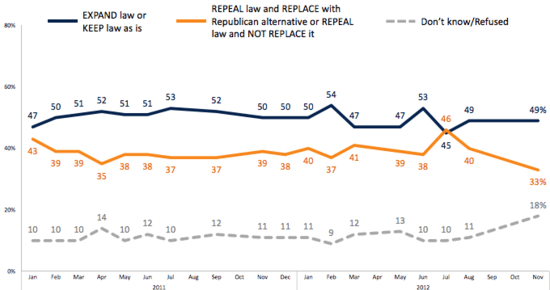
Kaiser finds that fewer Americans want Obamacare repeal:

Repeal_Popularity

Sarah Kliff comments:

In a lot of ways, this reflects larger shifts in thinking about the health-care law in the wake of President Obama’s reelection. There’s a general acknowledgement that the law, whose main components roll out in 2014, is here to stay. “Repeal of the whole thing, I just don’t see now how that’s possible,” Grace-Marie Turner, president of the Galen Institute, a conservative health-care think tank, told the Hill’s Sam Baker shortly after the election.

Quote For The Day

“In an age in which military officers are practically above public reproach – glorified and exalted by politicians and the media – the repeated failures of our military leaders consistently escape analysis and inquiry. This can have serious national security implications. As Joshua Rovner, associate professor of strategy and policy, US Naval War College, said to me in an email conversation, this lack of scrutiny has had grave consequences:

‘[W]e have misunderstood our recent history in Iraq and Afghanistan; we have created new myths about strategy that will persist for many years despite their manifest flaws; and we may make bad decisions about intervening in other civil wars based on these myths.’

The wars in Iraq and Afghanistan were more than just bad strategy; they reflected poor military tactics and generalship. Self-interested and incomplete interpretations of what happened in Iraq led to predictably disastrous results in Afghanistan. Perhaps we should spend a bit more time looking at that issue, rather who was sleeping with whom,” – Michael Cohen, The Guardian.

Free Speech At Commentary?

Under fanatic minicon, JPod? You’ve got to be kidding. 23 years after I wrote “The Conservative Case for Gay Marriage” at TNR, someone is fired for doing the same – in a thoughtful, intelligent way – at Commentary. JPod’s side of the story here. More here. I believe the dude was fired for offering a conservative case for marriage equality, which violated JPod’s own view of it as a libertarian project.

But firing a person just an hour after a post? Smells like neoconservatism to me – the kind that admits no error and tolerates no dissent.

The Fraying Of The GOP Tent

Weigel details it:

For the first time, there’s an issue that could pit the GOP’s best-organized and best-funded grass-roots against other parts of the party base. Talk radio helped kill immigration legislation in 2007. Some of the Tea Party’s leaders wanted that legislation to survive. Dick Armey, the former GOP majority leader who now chairs FreedomWorks, was warning Republicans to “get off this goofiness,” stop talking about a border fence, and pass the bill

David and Charles Koch, and other businessmen who’ve discovered politics in the Tea Party area, are far more simpatico to immigration reform than, say Rush Limbaugh or Mark Levin. In 2007, Iowa Rep. Steve King fought reform so hard that he brought a small model of a border fence to the floor of the House, to show how ready-made it could be. In 2009, King was linking arms with Dick Armey. King will be in D.C. come January. So will FreedomWorks. And for the first time, they completely disagree about how they can win the country.

Sweet. Hint: Dick and the Kochs are onto something.

Republicans Aren’t So Good With Money After All

Ind grp cost per vote propublica

Weigel takes stock of the GOP’s ineffective outside-money operation:

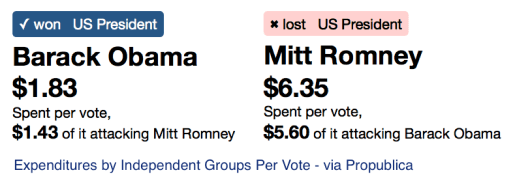
In the grand sweep of American politics, never has so much money been spent for so little gain. Up to $40 million of outside money was poured into Ohio to beat Brown. American Crossroads spent nearly $105 million on its campaigns nationally. Restore Our Future, the pro-Romney super PAC, spent nearly $143 million. Just those two groups, combined, spent more than the 2000 Rove-led presidential campaign of George W. Bush. The difference: These guys lost. Both Restore Our Future and American Crossroads shoveled money into swing states and bluer “reach” states, trying to soften them up for Mitt Romney. “In the month of August,” said Restore Our Future’s Charlie Spies to reporter Andrew Kroll, “we were one of the key things keeping Mitt Romney afloat.” It spent $21 million that month, in an attempt—don’t say “coordinated”!—to keep Romney competitive while the candidate held back and raised money. It did keep the race close. But Romney lost all but one swing state, North Carolina.

Karl Rove’s groups were among the worst performers:

Using available data, the Sunlight Foundation said of the $103.5 million American Crossroads spent in the general election, 1.29% of it ended in the desired result. None of the candidates American Crossroads supported won, and most of the candidates it opposed were victorious. Crossroads GPS, which does not have to disclose its donors, spent $70 million during the general election with 14.4% of it having the result it wanted, according to Sunlight Foundation’s analysis. None of the candidates GPS supported won.

Rebecca Berg has some feedback for Rove from one of Todd Akin’s campaign advisors:

“You can’t just run ads and do robocalls, and count that as contacting voters,” [advisor Rick] Tyler said. He pointed to the result of the presidential contest Tuesday. Because of the magnitude of funding Rove and Crossroads committed to win races that Republicans ultimately lost, Tyler added, the super PAC deserved more blame for Tuesday’s outcomes than did the Republican Party itself. “Rove spends more for Republican candidates than the NRSC and the NRCC. He’s running things,” Tyler said. He added, “Rove is definitely a problem.” Of the money invested by Crossroads versus the return, Tyler added, “It’s either malpractice or it’s corrupt.”

Weigel has some thoughts on the non-ad spending as well:

Some of the big money went to organizing. I hung out multiple times with volunteers for American Majority, Americans for Prosperity, and FreedomWorks, all of which got sizable donations in order to turn out votes. Tea Partiers signed up, taking literature from home to home, trying to repeat the magic of 2010. It did not work. It wasn’t just that the ads were lame, it was that the organizing was monumentally less effective than OFA’s four-year campaign.

Not everybody struck out with outside spending:

Planned Parenthood’s two political funds—both with much less money than the aforementioned conservative groups—both had success rates of more than 97 percent. The League of Conservation Voters notched up a 78 percent score. And labor groups got some serious bang for their bucks: The SEIU’s two outside spending groups, for instance, had “desired results” in 74 percent and 85 percent of the races in which they invested.

But Jamelle Bouie argues that the GOP’s outside-spending operation shouldn’t be underestimated:

If you expand [the definition of “effective”] to include “electoral influence,” it’s not at all clear that spending was wasted. For starters, the mere act of spending tens (or hundreds) of millions of dollars on an election has an effect on the policy views of the candidates the groups are trying to elect, and the issues they’re discussing. For example, the New Republic’s Alec MacGillis has noted that Mitt Romney’s pivot to the center — his “Etch A Sketch” moment — was delayed by the fact that he had to raise money from GOP mega donors who wanted him to commit to hardline conservative positions. A world where Romney won is one where there would have been a huge return on investment in policy terms; just because their favored candidates lost doesn’t mean that it wasn’t a worthwhile way to spend money.

Eric Posner also warns liberals about becoming complacent:

Some Democrats did lose, and super PAC money may have made a difference. More insidiously, if Republicans have wealthier backers than Democrats (as they do), and spending for candidates improves their chances of winning (as it does), then the influx of money will shift Democrats to the right, so they can reduce the incentive of wealthy donors to give to Republicans or get some of the money for themselves. If you think President Obama went easy on the banks in the last couple of years, you might point to Citizens United as the explanation.

Sargent adds:

I’m hoping for good research on the efficacy of all this spending — and on whether the enormity of it ended up producing a diminishing returns effect. Given just how much was spent — in return for so little of an impact — it does seem possible that wealthy donors may be somewhat more reluctant to hand over checks to these operations in the future. That would be a fitting outcome, given the loud chest thumping we heard from these groups early on about how their financial firepower would allow them to nuke Obama and Dems into toxic sludge in all these battlegrounds.

I don’t know if Tuesday’s outcome will dramatically reduce Super PAC spending on our elections in the future — a legislative solution may be the only thing that will work. But it was good to see that the Great Super PAC Attack of 2012 — the first time this has been tried on this scale in a presidential race — ended up being a big fizzle.

(Image created from ProPublica’s independent group expenditures analysis)