"We used to be the party that put out wars: Eisenhower, Korea; Nixon, Vietnam; Reagan, the Cold War. And here we talk about starting wars. That's all Republicans on the defense side seem to want to talk about — not negotiating a way forward diplomatically, as we had under earlier Republican administrations, but always falling back on the war option as if we haven't had enough over the past 12 years," – Jon Huntsman.
Month: November 2012
The Walking Dead Philosophers, Ctd
All kinds of spoilers below. But here's some hathos for everyone:
A reader writes:
While I respect your response to the death of Lori on "The Walking Dead," I had a completely different take.
Lori's decision to die so that her daughter could live can certainly be viewed as selfless, but you omit the fact that her young son Carl was there with her, and that he had to watch his mother suffer through the agonizing death of a Caesarian section performed by an amateur without any sort of anesthesia. Carl later has to shoot his mother in the head to prevent her from rising again as a zombie.
How does her sacrifice – particularly given the slim survival odds of a baby born of trauma, post-zombie apocalypse – do anything for Carl? How does her decision better the chances that either of her children will survive? If there was any chance that she could have lived through the labor, surely she owed that chance to the child she already had.
As a society, we already give a creepy sort of reverence to mothers who sacrifice their own well-being for the sake of their children. Let's not lionize a woman who chose to die while zombies were literally knocking at the door and made her child suffer with her.
Another writes:
This season I noticed that the killing of zombies is more rote, less morally complicated. The reality finally sunk in that to remain human, they had to recognize that there was no humanity left in the dead. To me, the best example of a man losing his own humanity is the Governor. We know he suffered a terrible loss (as they all did), but he snapped – retaining only the thinnest veneer of humanity, but he's really as dead as the zombies.
On a lighter note, I loved this: "I'm one episode behind, because Aaron was away and watching it without him would violate our marriage vows." HA! My boyfriend and I live together and have the SAME agreement. One could not watch on Sunday, so we DVR'd and plan to watch it Friday night! Oh, and by the way, did you ever see this from last season? Very funny.
This show has become better and better each season. I used to scream at the TV for the writers to kill off Lori and Carl because they were so annoying. But when Lori died giving birth – and Carl flashed back to his talk with Rick his dad, about difficult decisions and being a man – and he became the one to shoot his own mother, I wept copiously. I realized how much each of these characters had grown in the last season. I admit, I will miss Lori.
Update from another fan of the show:
As much as I appreciate applying a more complex lens to Lori's sacrifice, one major problem is that, as discussed earlier in the season, in that particular circumstance she was a goner either way: she would either die if she had the c-section because she'd lose too much blood, or if she didn't have the c-section the baby would die, reanimate, and then bite/infect her from within. So save the presence of Hershel or Carol who maybe could have done a better job cutting her open, Lori was dead as soon as she had complications in that boiler room – she simply chose the only chance for one of them to survive, rather than guarantee that they both would not. The rest was just (admittedly gripping) drama.
Also she didn't want Rick or Carl to have to shoot her; she asked Maggie to do it, but Carl insisted because it was his mother. And in the end, that was the right call both realistically and in the context of Carl's character arc. In the comic version of The Walking Dead, Carl makes a series of morally complicated calls while in the process of growing up (and right from the first issues), and that interplay is what makes his character so interesting (unlike the first two seasons of the show, during which he is essentially no more than a plot device). And in a world where everyone turns, to have a friend is to accept that one day you may have to kill them (again) – those are simply the new rules.
(Video hat tip: Copyranter)
Obama’s Creepy Emails, Ctd
They were obnoxious but they worked, raising $690 million:
The appeals were the product of rigorous experimentation by a large team of analysts. "We did extensive A-B testing not just on the subject lines and the amount of money we would ask people for," says Amelia Showalter, director of digital analytics, "but on the messages themselves and even the formatting." The campaign would test multiple drafts and subject lines—often as many as 18 variations—before picking a winner to blast out to tens of millions of subscribers. …
It quickly became clear that a casual tone was usually most effective. "The subject lines that worked best were things you might see in your in-box from other people,” Fallsgraff says. " 'Hey' was probably the best one we had over the duration." Another blockbuster in June simply read, "I will be outspent."
Propublica archived many of the messages and their variants.
Syria Goes Offline
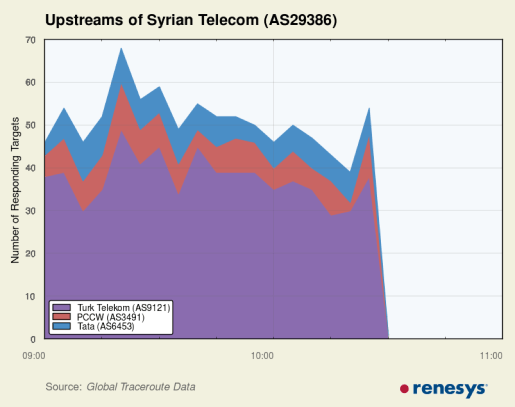
Internet monitor Renesys explains:
Starting at 10:26 UTC [today] (12:26pm in Damascus), Syria's international Internet connectivity shut down. In the global routing table, all 84 of Syria's IP address blocks have become unreachable, effectively removing the country from the Internet.
Arik Hesseldahl notes this could be an ominous sign:
Renesys is still investigating what’s going on, but, as we’ve seen in other countries, cutting off the Internet is usually meant to try and control the flow of information to the world. It’s also a pretty sure sign that the regime of Bashar al-Assad is either getting nervous about how it is being perceived in the world, or that it is planning something unspeakably harsh in the coming days and wants as little information emerging from that country as possible.
Max Fisher wonders why it didn't happen sooner:
[Syria's] uprising long ago exceeded Egypt’s and Libya’s in severity by the time those countries had instituted their own blackouts. One possible explanation is that Syria has been far more assertive online, using it as a tool for tracking dissidents and rebels, and sometimes even tricking them into handing the government personal data using phishing scams. President Bashar al-Assad has a background in computers, unlike the much older Hosni Mubarak and Moammar Gaddafi, and once even directly mentioned his “electronic army.” Assad’s regime may have seen opportunity as well as risk on the Web, where perhaps the Egyptian and Libyan authorities saw primarily a tool of the uprising. Or, perhaps the Syrian simply feared the economic consequences of an Internet blackout, or lacked the means to conduct it.
Heavy fighting in Damascus has now closed the city's international airport as well, while earlier this week rebels reportedly used surface-to-air missiles to down two of the regime's military aircraft – a potentially significant development in capability for the rebels. The rebels have also been using children in combat roles, according to a new report from Human Rights Watch.
The Republican “Mandate”
George Will touts it as a reason to dig in against any increases in tax rates:
And at least 219 of the 234 House Republicans won in November by margins larger than Obama’s national margin.
Because they were gerrymandered, as Will must surely know. The popular vote totals for the House actually shows a narrow Democratic victory – somewhere around 48.8 percent – 48.5 percent. It seems to me a "mandate" is if a candidate runs on a specific policy and wins. Obama's desire to recoup revenue by returning to the Clinton era tax rates for the very wealthy was a clear and central part of his campaign. It is supported by huge majorities in the polls. Tax reform – while necessary – will not raise the kind of revenue the government needs to stop the borrowing. Bowles-Simpson recognized this; Obama ran on it; Democrats ran on it and won the popular vote in the House and a clear majority in the Senate.
If that is not a mandate, what would be?
Fox And Unfriends

Bruce Bartlett recently noted that as soon as he offered a searing conservative critique of Bush's economics, he found himself largely barred from appearing on Fox News. There was one exception, an interview with Paul Gigot – but that interview was part of a combined WSJ and Fox show, and Bruce was invited by Gigot. Since then, after being a regular presence on the GOP TV network, Bruce has never appeared. He suspects there is some kind of list of people who are barred from appearing on Fox in prime time, and his publicist confirms that she has been unable to get Bruce on any Fox show since he put commitment to principle and intellectual honesty over partisanship. Last night, Greta Van Susteren, publicist for the Palin family, dismissed the idea:
I just read on http://www.tvnewser.com some boo-hoo from Bruce Bartlett. He thinks he was banned from appearing on Fox News for a book he wrote and complains about it in American Conservative. Banned? Huh? I have been at Fox News Channel almost 11 years and I have never heard that Bruce Bartlett was or is banned. I think he flatters himself…
I never heard about it. As far as I can recall, I never even heard about his book. And most importantly, I never got an “order from on high” as he claims his publicist was told.
If Van Susteren had never even heard of the book, then the strategy of simply ignoring dissent worked – and helped secure the GOP's current nadir. What happened in the Bush-Cheney years was a ruthless attempt to nullify as far as possible the reach of the dissidents. We live with the consequences.
For my part, I would have loved to have a chance to debate my critique of modern Republicanism – "The Conservative Soul" – on Fox News. You'd think a discussion of that kind would have enlivened a show segment. But the book was ignored by almost every conservative media outlet. My cover story on Obama's long game last January spawned several segments in prime time on Fox, but despite persistent requests from Newsbeast's publicist, Fox chose other people to defend the essay I wrote. When they put a screen shot of the magazine cover on TV they actually blurred out my name, in true Stalinist fashion in which an individual is simply airbrushed out of existence. Megyn Kelly, moreover, asserted that I was not an "actual journalist" and I was given no right of reply, despite insistent requests. If you don't remember this, here's the Kelly clip. And the January essay which predicted that Obama's long game would outlast his critics turns out not to have been such a bad bet after all. And in the marketplace of ideas, it blazed a trail – almost 60,000 Facebook likes, for example. Why not have the author on to defend his own work? Why not have at me and let me fight back? Because they were never interested in a real debate, just phony ones.
I'm lucky enough to have created and built the Dish as an outlet – and as a refuge for conservatives repelled by the current GOP. So I don't care. I don't need cable news to get my ideas out there. But the chilling effect on desperately needed discourse on where conservatism went so badly wrong is not a solution to a problem. It is the source of the problem.
Roger Ailes has helped kill conservatism in America, by never allowing it to criticize itself. When journalism puts power above truth it isn't, to coin a phrase, "actual journalism". It's propaganda. And I, like others in the Stalinist atmosphere, was just rendered invisible in the one-party state that is the GOP's media-industrial complex.
Eating Like A Predator
Nutrition writer J. Stanton encourages us to eat fewer meals during the day:
Some #sullyTMI thoughts. I've now been on a gluten free diet for over a year, and have slowly adjusted to eating only one real meal a day. Maybe I find that easier than most because eating bores the crap out of me, and is, for me, a necessary energy-producer, not something I treasure or savor or look forward to. If I could take three pills a day to provide nutrition, I'd prefer them to food. Because the less time I spend eating the more time I have for things I actually enjoy: going for a walk with the dogs, reading an essay or a book at leisure (those were the days), working out, watching The Soup, hanging with friends, slumping on the couch with my husband, etc. I'm unusual in that respect. I'm also unusual because I am now on a new drug called Egrifta which targets HIV-related lipodystrophy, i.e. strange fat accumulation around your internal organs, by triggering an increase in your own body's production of growth hormone.
Bottom line: I get less hungry and my body has slowly grown not actually to crave bread or cake or pasta or pizza. I've lost around 10 pounds or so – and 2 inches around my waist. I sleep better, eating like a predator. And because you only have one big meal a day, you actually enjoy it more, because you really are hungry. So I'm basically down to one full meal in my blogging break after 1 pm, and then a protein shake or some rice krispies in the evening. The effect is not sudden, like a crash diet, but gradual as your body adjusts to less processed wheat. Everyone's different, but it sure has worked for me.
Grrr.
“The Austerity Crisis”

That's Ezra Klein's preferred term for the tax increases and spending cuts scheduled to go into effect at the beginning of the year. He believes that calling it a "fiscal cliff" makes it difficult to devise practical fixes:
A sensible approach to the austerity crisis would identify mismatched policies — unemployment insurance or disarming the sequestration cuts — that deliver maximum stimulus at minimal cost and then extend, or perhaps even expand, them. With the austerity crisis resolved, and the economy bolstered, we could move onto crafting a long-term budget plan that includes tax and entitlement reform. There’s no real reason that preventing an austerity crisis should be linked to reforming the tax code. There’s no reason at all that raising the debt ceiling should even be a question.
He also wants to continue the payroll-tax cut, which would cost $115 billion and create 1 million jobs in 2013. However, that sort of cost-benefit analysis isn't happening, notes Klein:
Instead, many of the least stimulative, most costly, policies are widely considered untouchable: the Bush tax cuts for income less than $250,000, for instance. And many of the most stimulative, least costly, policies appear likely to lapse at the end of this year. … This kind of confusion is what happens when you miscast a crisis of austerity as a crisis of deficits. It’s also a measure of how poorly Washington works. Legislators from both parties have concluded that crises are the only impetus to get anything — and thus the opportunity to get everything — done.
There is a danger in this kind of everything-now approach, as there is in any deal reached by a looming deadline. At the same time, president Obama has maximal leverage now – he's been easily re-elected with a Democratic Senate and a popular vote victory in the House, and set up the GOP for drastic defense cuts and blame for raising taxes on the middle class if they cannot get to a deal. So while Ezra's right, I think, in worrying that stimulus is still the short-term imperative, I think he may be missing the historic potential of this pivot. It's not as if Obama just got elected. The long game requires an eventual deal. It strikes me that the time is now.
(Photo: Boys jump from cliffs into the ocean on December 28, 2011 in Blairgowie, Australia. By Bruce Magliton/Newspix/Getty Images.)
Are College Admissions Anti-Asian?
Ron Unz has a long essay on elite-college admissions and discrimination. This is worth contemplating:
[F]ears that checking the “Asian” box on an admissions application may lead to rejection are hardly unreasonable, given that studies have documented a large gap between the average test scores of whites and Asians successfully admitted to elite universities. Princeton sociologist Thomas J. Espenshade and his colleagues have demonstrated that among undergraduates at highly selective schools such as the Ivy League, white students have mean scores 310 points higher on the 1600 SAT scale than their black classmates, but Asian students average 140 points above whites. The former gap is an automatic consequence of officially acknowledged affirmative action policies, while the latter appears somewhat mysterious.
He goes on to argue that these colleges are "selecting future American elites which are not meritocratic nor diverse, neither being drawn from our most able students nor reasonably reflecting the general American population."
“Let Your Women Keep Silent In The Churches”
Last week, the General Synod of the Church of England rejected a measure to allow women bishops, a decision determined by the failed super-majority vote (132-74) in the House of Laity. This was despite 72% overall Synod support for the revision. Vicar Jeremy Fletcher reflects on the vote’s impact on his ministry:
I have an Associate Vicar and two curates. All women. I am Rural Dean of Beverley, which has a majority of female incumbents and retired clergy. It is only a tiny minority of clergy who will become a bishop…and they need their head examining if they aspire to be one. I’ve worked in a bishop’s office. You don’t want to be one. But this vote pats ordained women on the head and says ‘there there. You’re good for some stuff and not others. Leave it to the men.’ I will affirm, and help, and pray, and mentor and serve and everything else. But, for some years to come there are places I can go that my female colleagues can’t, and that is very bad, and I can’t say any more. Feelings are feelings, but God I feel awful.
Meanwhile, Joan Smith points out that women were instrumental in bringing down the revision:
Voting figures show that 33 of the 74 General Synod lay members who voted against the measure were women, most of them conservative evangelicals or members of the church’s Anglo-Catholic wing. They had the support of another 2,200 women who signed a petition opposing reform.
Pondering their motivations, Smith recalls anti-suffragette Mrs. Humphry Ward:
Ward had so internalised the notion of power as male that she couldn’t see the difference between wanting equality and wanting to be a man. I suspect a similar confusion lies behind the synod’s vote, at least on the part of lay members who fear that women would lose their femininity if they became bishops.
Noting that the revision’s defeat was due largely to “stealth” grassroots organization by conservative evangelicals, Jane Kramer analyzes the political implications:
Until last week, neither the Queen nor the Parliament has had to consider the elevation of women bishops—for the simple reason that no Synod had reached the stage of producing a canonical revision to that effect. The difference today is that a revision was produced and rejected before it left the Synod floor—which meant that an arm of the state had pointedly defied the state’s law against discrimination. …
No one knows what will happen now. Parliament does have the legal right to introduce a new bill that no one can contest. There are already calls for the disestablishment of the Church of England; this won’t happen, but there is some chance that its bishops will be asked to leave the House of Lords, at least until the Church accepts its obligations under the country’s anti-discrimination laws.
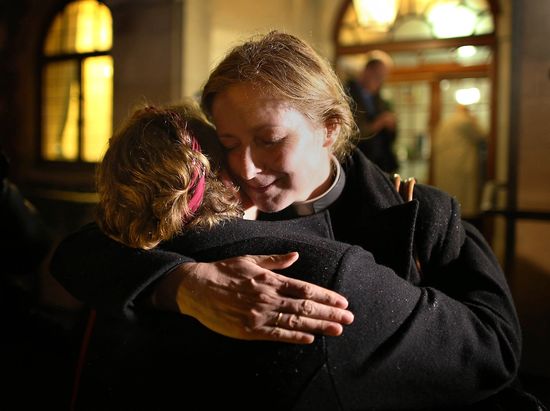
(Photo: Reverend Marie-Elsa Bragg hugs Reverend Angie Nutt after leaving Church House on November 20, 2012 in London, England. The Church of England’s governing body, known as the General Synod, has voted against allowing women to become bishops. By Peter Macdiarmid/Getty Images)
 The Dish