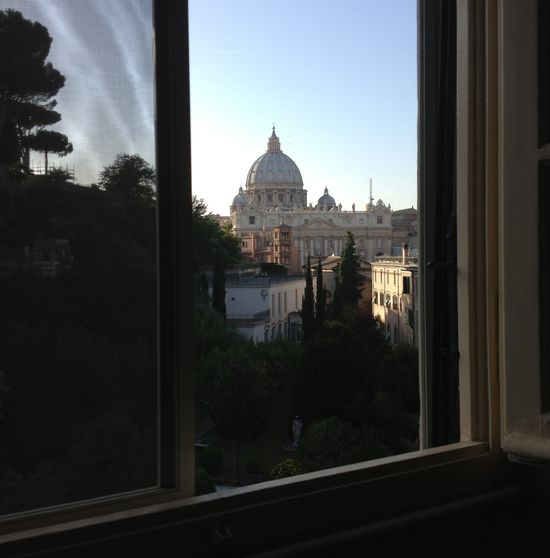
Vatican City, 4 pm
Vatican City, 4 pm
Chris Stedman, author of the forthcoming memoir Faitheist and a proponent of atheist-interfaith engagement, reflects on coming to terms with his sexuality while attending a conservative, Protestant church:
Since I didn’t really want to be gay, I decided I was going to change my sexual orientation. I got the idea from my Christian church, who said that homosexuality was solvable, changeable. I didn’t talk to anyone about it for fear of being ostracized, but I got the impression based on ideas promoted within the church that being gay was a spiritual affliction—one that could be overcome through dutifulness to tradition. So if I prayed and I fasted and I studied Scripture and was just this model Christian, my ‘burden’ would be lifted. I came to see my same-sex attractions as a test, or a punishment—one I could overcome. So I worked very hard to do just that, but became despondent as years passed by and I didn’t see any progress. The irony is that I had become a part of this community because I was looking for a way to make sense of suffering and because the communal aspect of Christianity was very appealing—but when I became increasingly serious about my quest to change my sexual orientation for them, I ended up retreating further and further into myself, and suffering more and more. Eventually I was just a zombie stumbling through my own life, completely unengaged with the world around me; focused solely on this one thing.
Behold Google Poetics, "born when Google autocomplete suggestions are viewed as poems." An example:
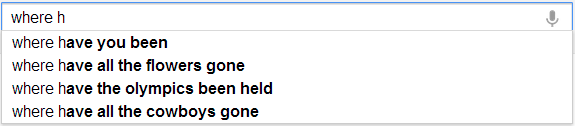
A philosophical analysis of the verse produced by our searching, by the creators of the site:
Despite the seemingly open nature of Western society, forbidden questions and thoughts still remain. When faced with these issues, people do not reach out to one another, instead they turn to Google in the privacy of their own homes. The all-knowing search engine accepts and embraces these questions and tangles them with popular song lyrics, book titles and names of celebrities: often with hilarious results.
Obviously Google is not Shakespeare, Whitman or Dickinson – it can not illuminate the unknown. But it does reveal our inner workings, our fears and prejudices, secrets and shames, the hope and longing of a modern individual.
After observing the media coverage of Hurricane Sandy, Avi Steinberg ruminates on the political dimension of ancient flood myths, especially those that preceded the Biblical account of Noah:
The Sumerian flood texts that preceded the Noah story were court narratives, propaganda. The basic elements of these stories—the anger of the god; the man who is warned of the flood, fashions a boat, seals it with pitch, and invites some other species aboard; the washing up on a mountaintop, the dispatching of scouts in the form of birds—are familiar to anyone who has read the biblical story of Noah. That’s because the Noah story is probably an adaptation of sagas that were already long in circulation. In the earliest of the written versions, a Sumerian poem etched into a tablet dated around 1600 B.C.E.—though it is thought to be an even older oral story—the flood survival story is an explicitly political tableau celebrating the staying power of the ruler, the ability of his regime to survive the absolute worst that the gods can impose on earth, and to flourish in the rebuilding process. Unlike Noah, an everyman, these earlier flood survivors were identified as political leaders. The image of the man emerging from his sealed boat—as from a tomb, as Christians would later point out—was, in the earliest texts, the image of a human sovereign unscathed, as strong as ever, ready to impose his governing will as before, stronger than before.
The ancient link between political propaganda and storms has stubbornly persisted into our day. We know from Katrina and Bush, and now Sandy and Obama, how much is at stake in the chief creating a compelling official post-storm narrative.

Ted Nyman imagines the invasiveness of social media while using the site sex.ly:
— Check-in to sexual encounters. You'll now never forget a night. Describe positions, durations, sounds.
— If (and only if) your partner(s) agrees, you can rate and review them. If they don't, you still can review them as anonymous partners. …
— Earn sex-cred for number of check-ins, which can be used at sex stores and other selected merchants.
The site is imaginary, but his fears aren't:
We have begun to pollute and desecrate and cheapen all of our experiences. We are creating neat little life-boxes for everything, all tied up with a geo-tag, a photo, a check-in; our daily existence transformed into database entries in some NoSQL database on some spinning disk in some rack in suburban Virginia.
The end-game is this. Slowly, gradually, without realizing: we stop participating in our own lives. We become spectators, checking off life achievements for reasons we do not know. At some point, everything we do is done soley to broadcast these things to casual friends, stalkers, and sycophants.
On a related note, photojournalist Kenneth Jarecke thinks people will regret using Instagram:
Instead of having a body of work to look back on, you’ll have a sad little collection of noisy digital files that were disposable when you made them, instantly forgotten by your followers (after they gave you a thumbs up), and now totally worthless. You’ll wish you’d have made those images on a Pentax K1000 and Tri-X (at the very least or most depending on your age and perspective), but the times you failed to record properly will be long gone. But don’t listen to me, listen to all your Insta-friends. They love you.
(Photo by Mathieu Grac, from a collection of "Amusing and Poignant Photos of Social Media Self-Portraits in Progress.")
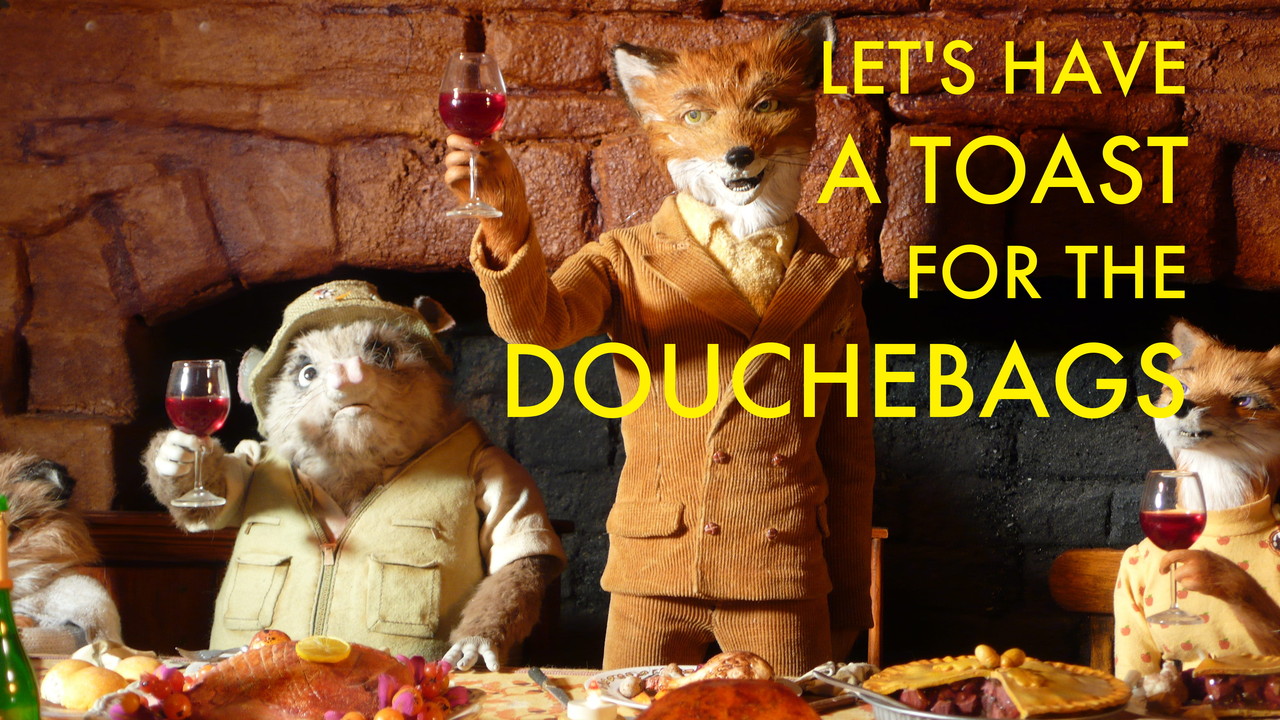
Somewhere between the Kardashians and the Franzens of the world lie the rest of us. "Call it upper middle brow," says William Deresiewicz:
It is post- rather than pre-ironic, its sentimentality hidden by a veil of cool. It is edgy, clever, knowing, stylish, and formally inventive. It is Jonathan Lethem, Wes Anderson, Lost in Translation, Girls, Stewart/Colbert, The New Yorker, This American Life and the whole empire of quirk, and the films that should have won the Oscars (the films you’re not sure whether to call films or movies). The upper middle brow possesses excellence, intelligence, and integrity. It is genuinely good work (as well as being most of what I read or look at myself).
The problem is it always lets us off the hook. Like Midcult, it is ultimately designed to flatter its audience, approving our feelings and reinforcing our prejudices. It stays within the bounds of what we already believe, affirms the enlightened opinions we absorb every day in the quality media, the educated bromides we trade on Facebook. It doesn’t tell us anything we don’t already know, doesn’t seek to disturb—the definition of a true avant-garde—our fundamental view of ourselves, or society, or the world. (Think, by contrast, of some truly disruptive works: The Wire, Blood Meridian, almost anything by J. M. Coetzee.)
Alan Jacobs ponders the piece:
So where do we turn for "an art that will disturb [our] self-delight," an art accomplished enough to demand respect but offering a serious challenge to complacency? My usual recommendation is to look for books from the past, since the past is, after all, another country, and its thoughts are full of challenges for us if we will listen without condescension. But what about art of today?
Noah Millman finds many films that indeed "disturb our self-delight":
I certainly thought “The Master” cleared that bar. So did "Blue Valentine." But so did other movies that are not as obviously stylish – "Rachel Getting Married," or "Greenberg," or "Martha Marcy Mae Marlene," to name a few films from the last few years that took significant emotional risks.
Jordan Bloom tackles music, wondering "what does emotional validation sound like?"
(Image from the tumblr Kanye Wes Anderson)
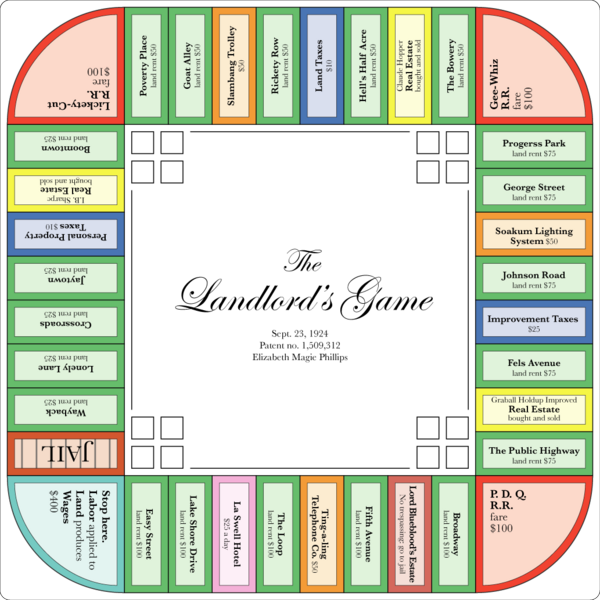
Christopher Ketcham claims that Monopoly's origins start with a Maryland actress named Lizzie Magie, who created The Landlord's Game in 1906. It was designed "as a tool for teaching the philosophy of Henry George, a nineteenth-century writer who had popularized the notion that no single person could claim to 'own' land":
It also had Chance cards with quotes attributed to Thomas Jefferson (“The earth belongs in usufruct to the living”), John Ruskin (“It begins to be asked on many sides
how the possessors of the land became possessed of it”), and Andrew Carnegie (“The greatest astonishment of my life was the discovery that the man who does the work is not the man who gets rich”). The game’s most expensive properties to buy, and those most remunerative to own, were New York City’s Broadway, Fifth Avenue, and Wall Street. In place of Monopoly’s “Go!” was a box marked “Labor Upon Mother Earth Produces Wages.”
The Landlord Game’s chief entertainment was the same as in Monopoly: competitors were to be saddled with debt and ultimately reduced to financial ruin, and only one person, the supermonopolist, would stand tall in the end. The players could, however, vote to do something not officially allowed in Monopoly: cooperate. Under this alternative rule set, they would pay land rent not to a property’s title holder but into a common pot—the rent effectively socialized so that, as Magie later wrote, “Prosperity is achieved.”
How it transformed into the game we know today:
The key to the mystery, he learned, was a radical socialist professor of economics named Scott Nearing, who taught at the Wharton School of Finance from 1906 to 1915. … The professor said he had learned to play the game around 1910, while living in Arden, then taught it to his students at Wharton in order that they might learn, in his words, “the antisocial nature of monopoly,” and in particular “the wickedness of land monopoly.” The students apparently taught it to their friends. It was around this time that the game became known as “monopoly”—denoted in lowercase, like checkers, chess, or dominoes. The game spread widely over the next several years, to the hometowns of Nearing’s students and to other universities. It would slowly lose its antimonopolistic message, however, as players came to the conclusion that Magie’s vision of Georgist redistribution was not nearly as entertaining as ruining one another.
(Image: Landlord's Game board, based on Elizabeth Magie Phillip's 1924 patent by Lucius Kwok from Wikimedia Commons)
Clay Risen takes stock of the White House's liquor supply:
If anything, Obama cuts against the tradition of chief-executive drinking by choosing beer as his relaxant of choice. Most presidents have kept whiskey on hand. George Washington was one of the biggest rye producers on the East Coast. Andrew Johnson, who occupied the White House between Lincoln and Grant, was drunk on whiskey pretty much his entire time in the executive branch. He took the oath of office as Lincoln’s vice president after a morning curled up with a bottle—“medicinal” whiskey, he said, for a cold. Six weeks later, hours after his boss was assassinated, Johnson was found in the second half of an epic bender, and had to be sobered up to take the oath of office as president.
But being a teetotalar, like Taft, presents its own problems:
Interestingly, Taft made one of the most consequential decisions in the history of American liquor. His predecessor, Theodore Roosevelt, had overseen the passage and enforcement of a law that essentially banned the label “whiskey” for anything that hadn’t been made of pure grain and aged for four years. As one of his first acts as president, Taft oversaw a mock trial between advocates for the blended whiskey industry, which wanted to overturn Roosevelt, on one side, and the bourbon industry and pure-foods lobby on the other. Taft, playing the Solomonic role he would later assume on the Supreme Court, reversed Roosevelt’s rule, declaring that anything could be called whiskey as long as its ingredients were made clear on the bottle.
It’s no coincidence Taft lost his reelection bid. Not because he made the wrong decision—though he did; the stuff that passed for whiskey before Roosevelt laid down the law was closer to turpentine than bourbon. He lost, and deserved to, because anyone who wastes the presidential clock on a topic for which they have such little affection probably isn’t the most effective chief executive.
"The Great Figure" by William Carlos Williams:
Among the rain
and lights
I saw the figure 5
in gold
on a red
firetruck
moving
tense
unheeded
to gong clangs
siren howls
and wheels rumbling
through the dark city.
(From Selected Poems of William Carlos Williams © 1985 by New Directions Publishing Corp. Used by permission of the publisher. All rights reserved. Image of the painting, "I Saw the Figure Five in Gold," by Charles Demuth via Wikimedia Commons. The poem inspired the painting.)
"Sexbots are coming, and we will cum with them. Three times a week or whatever our physician / longevity coach recommends. Because orgasms — especially the hormone-exploding O’s we’ll eventually enjoy with carnal cyborgs — are excellent for mental and physical health.
Remember the most convulsive, brain-ripping climax you ever had? The one that left you with “I could die happy now” satiety? Sexbots will electrocute our flesh with climaxes thrice as gigantic because they’ll be more desirable, patient, eager, and altruistic than their meat-bag competition, plus they’ll be uploaded with supreme sex-skills from millennia of erotic manuals, archives and academic experiments, and their anatomy will feature sexplosive devices. Sexbots will heighten our ecstasy until we have shrieking, frothy, bug-eyed, amnesia-inducing orgasms. They’ll offer us quadruple-tongued cunnilingus, open-throat silky fellatio, deliriously gentle kissing, transcendent nipple tweaking, g-spot massage & prostate milking dexterity, plus 2,000 varieties of coital rhythm with scented lubes — this will all be ours when the Sexbots arrive," – Hank Pellissier of transhumanity.net.
(Hat tip: Jessica Roy)

 The Dish