That’s A Wrap

2012-11-09-ScreenShot20121109at8.02.12AM

Lux Alptraum doesn't think Measure B, the condoms-in-porn law for Los Angeles County, which passed Tuesday, will bring serious changes:

Los Angeles may be the epicenter of porn production, but San Francisco, San Diego, and Miami are home to their own hardcore porn scenes and will remain unaffected by the regulations of Measure B (as, of course, will Europe, where quite a bit of hardcore porn also happens to be shot). Though most full time porn performers make the majority of their money in Los Angeles, work trips to out-of-town studios like San Francisco's Kink.com and Miami's Bang Bros are incredibly common. So if the LA climate becomes less friendly to the adult industry, San Francisco and Miami are well positioned to pick up the slack.

Marina Galperina spoke with porn stars James Deen and Stoya, who opposed Measure B:

"This law doesn’t affect anyone but the adult film industry," Deen sighs. "But we are the only community in the world with HIV transmission rate of 0. We haven’t had a case in almost a decade." He brags of the strict bureaucracy that precedes each shoot, the testing with allegedly best medical equipment available every 14 to 28 days, the extensive database chronicling all exchange and — since producers can’t legally discriminate against employees with HIV — the foreplay of real talk between performers, the swap of negative test result papers.

And the law presents physical problems as well:

"The sex that you have on camera is not like the sex you have at home," says Stoya, another Measure B opponent. "You’re being pounded for an hour and a half with a piece of rubber to get the necessary footage. You’re going to get kind of torn-up. As a woman, you have a very high likelihood of getting little tears in the delicate skin of your vagina." Here, the risk of transmission and condom breakage is many times higher.

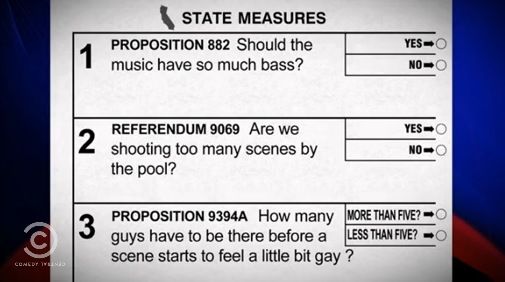
(Screenshot from the Daily Show's segment on Measure B, after asking "Are all porn decisions community based?")

The Search For Gay Genes

Lesbian scientist Emily Drabant wants to find out whether genes can explain sexual orientation. She's working with the DNA analysis company 23andMe to survey participants:

The company initiated its sexual orientation project about six months ago, and researchers are hoping that tens of thousands of LGBT folks take the genetic test and fill out the accompanying survey — the information from which allows 23andMe to see patterns among, for example, gay men or transgender women. They don’t know what they’ll find around gender identity yet, says Drabant, but “those are exactly the questions that we’re studying. We asked people about how they identify, including transgender male-to-female, female-to-male, and I think we kind of ask a question more broadly about identity, in terms of masculine and feminine.” Several thousand people have participated in the survey so far, though few identify as transgender.

As soon as the company has a big enough sample, it plans to make those results public, regardless of where they lead. “It’s a hot, sensitive topic,” Drabant says, “and I think that, no matter what comes of it, if we find genetic associations or if we don’t, [reaction] will be pretty heated. Our objective is to be objective. We feel that this is research that needs to be conducted, that’s neglected, that’s important to do. And that we’re in a position to do it.”

The Republican Minority Hasn’t Arrived?

McArdle downplays the GOP's demographic problems:

Ethnic coalitions are inherently unstable. It used to be a sort of natural law that urban Catholics voted Democratic. Then Reagan won them in huge numbers. And–contra those who are saying that the GOP now has to move left–they didn't win by getting more liberal. Rather, the Democrats got more liberal, on crime and bussing, and the white ethnics who felt victimized by these policies fled. The more ethnic groups you have, the more likely it is that you will eventually find the goals of those ethnic groups in direct conflict. And the Democrats sure do have a lot of groups.

Righting Themselves On Immigration

GOP big shots are voicing support for moderation on immigration: there are Boehner, Hannity, KrauthammerHaley Barbour , and smoke signals from Cantor’s camp. Adam Ozimek welcomes this development:

I think [Republicans] would make a lot of progress just by distancing themselves from the position of kicking out 10 million immigrants and towards one of amnesty. I think the net result will be that republicans capture more voters, and they just look relatively neutral on immigration rather than very negative. This is because the rhetoric required to conjure up an argument for kicking 10 million people out of the country is far worse and far more indifferent to the welfare of immigrants than what is needed to argue for low levels of annual immigration and a closed border. While I do think most arguments to keep immigration low or negative in this country require either false or immoral arguments, they are of a completely different magnitude than the arguments for kicking out 10 million people. Republican may never win the game of “who will welcome more Hispanic immigrants?”, but they can at least stop competing in the game of “who is more indifferent to their welfare?” during the primary season.

Larison doubts Republicans can win over Hispanics:

Most Hispanic voters aren’t “natural” Republicans just waiting for a different Republican immigration policy to give them permission to change their voting habits. Republicans that think this are relying on a distorted perception that they think non-Republicans have of their party. Very few people outside the partisan bubble think that being “religious, Catholic, family-oriented and socially conservative” makes a “striving immigrant community” inclined to favor the Republican Party. Republicans flatter themselves that these are all markers of “natural” Republicanism, but that is something most people don’t believe unless they already identify with the party. After all, describing people as religious, Catholic, or family-oriented can refer to different things.

Heather McDonald has more along those lines:

I spoke last year with John Echeveste, founder of the oldest Latino marketing firm in southern California, about Hispanic politics. “What Republicans mean by ‘family values’ and what Hispanics mean are two completely different things,” he said. “We are a very compassionate people, we care about other people and understand that government has a role to play in helping people.”

Michael Brendan Dougerty thinks the GOP base won’t tolerate change:

The working-class white vote that created the modern Republican majority is precisely the subset of voters that feels most threatened by mass immigration, culturally and economically. They revolted when Bush tried to force it on them. They will revolt again. 

Ed Kilgore agrees:

The important point here is that conservatives didn’t go down the road they most recently took on immigration policy because they thought it was a guaranteed vote-winner (they had the experience of the California Republican Party to show them otherwise), and they aren’t going to be able to toss it in the nearest trash can in order to boost their Latino vote 10% or so … Just wait. There will be a backlash against this “sellout” that will be ugly enough that those proposing it may wish they just hadn’t brought it up publicly.

Romney’s Bureaucratic, Bumbling Campaign

First, an overview of the ORCA Project, "the campaign-designed voter-tracking app that was supposed to rival the Obama campaign's ground-game efforts":

[I]t was described as a mega-app for smartphones that would link the more than 30,000 operatives and volunteers involved in get-out-the-vote efforts. PBS profiled it a few days before the election. The app was created and managed by the Romney campaign and was kept a secret among a close circle in Boston, according to POLITICO sources. It was supposed to be incredibly efficient and allow the campaign to streamline, from its War Room at the Garden in Boston, the efforts to maximize turnout of Romney backers.

But, according to a fascinating first-person account from a Romney volunteer on the front-lines of ORCA, it was a total debacle:

30,000+ of the most active and fired-up volunteers were wandering around confused and frustrated when they could have been doing anything else to help. …

The bitter irony of this entire endeavor was that a supposedly small government candidate gutted the local structure of GOTV efforts in favor of a centralized, faceless organization in a far off place (in this case, their Boston headquarters). Wrap your head around that.

For a similar account from within the campaign itself, go here. Allahpundit marvels at the incompetence of the Romney campaign compared to the efficiency of Obama's ground game:

This was supposed to be Romney’s strength, the reason to prefer him to Gingrich, Santorum, etc. Even if he didn’t always seem so "severely conservative," he could be trusted to hold his own against Team Hopenchange in a battle of the ground games. After all, that’s his brand — he’s a managerial genius. If anyone could build a company capable of capturing the presidency, he could.

But he couldn’t.

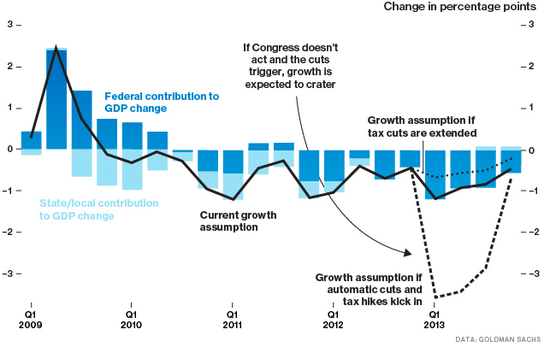
Nearing The Fiscal Cliff

Screen Shot 2012-11-08 at 3.56.59 PM

Minutes ago, Obama urged Congress to avoid the fiscal cliff. After Obama's victory, Speaker John Boehner remarked that because "the American people expect us to find common ground, we are willing to accept some additional revenues, via tax reform." Suzy Khimm notes the déjà vu:

Boehner and Republicans have long promised to enact comprehensive tax reform that would curb tax exemptions as long as that reform lowered tax rates instead of raising them…. [I]t came up often in the closed-door negotiations between the Obama administration and Boehner last summer. In the end, though, those negotiations failed because Boehner couldn’t sell his caucus on a revenue number the Obama administration would accept.

She reframes:

[T]he question here isn’t whether Boehner is open to some new revenues through tax reform…. It’s whether his members are open to enough new revenues through tax reform such that they can actually strike a deal with the Obama administration.

Peter Orszag doubts House Republicans will play ball. Clive Crook agrees:

The economy’s prospects aren’t bright, Republicans will reason, and implementing the health-care reform will be a mess, especially if they can help it. In 2016, the party will have a better presidential candidate. (That much, they’ll decide, is obvious. What were they thinking, nominating Romney?) Time is on their side. Why should the Republicans give ground?

Stan Collender remains skeptical that Boehner has the clout to strike a deal:

[T]he tea party wing of the GOP has kept him on a very short leash for the past two years and has never really trusted him. It's not clear that the tea partiers will trust or follow him now.

However, Joshua Green argues the Republican position isn't nearly as strong as it was in 2010:

Despite their post-election tough talk, Republican leaders have dealt themselves a lousy hand. Obama can propose a “middle-class tax cut” for the 98 percent of American households earning less than $250,000 a year—while letting the Bush tax cuts expire for those earning more—and dare the Republicans to block it. If they do, everyone’s taxes will rise on Jan. 1. It’s true that going over the fiscal cliff, as some Democrats believe will happen, would set back the recovery and could eventually cause a recession. But Democratic leaders in Congress believe the public furor would be too intense for Republicans to withstand for long.

Jonathan Cohn makes the case that the election tilted the balance in Obama's favor:

Remember, when Obama and the Republicans were debating these issues in 2011, Obama was at his weakest. … Today, by contrast, the recovery seems to be well underway, with unemployment below 8 percent and, most likely, on the way down. Obama’s approval rating is up to 48 percent. He just won a presidential election, with a sizeable margin in the electoral college and a surprisingly comfortable margin in the popular vote.

Kevin Drum calls Boehner's bluff:

Boehner knows full well that his caucus will eat him alive, with Eric Cantor leading the charge, if he wavers on taxes, so he's adopting the same hardline position as he did last year but trying to pretend that it's some kind of kinder, gentler proposal. It's not. … [P]oll after poll shows big majorities in favor of higher rates on the rich. Opposing a broad, bipartisan tax cut because it's not friendly enough to the rich is a losing hand and Boehner knows it. He just can't admit it yet, so instead he hauled out the same tired talking points from a year ago and did his best to dress them up a little differently.

Chait explains why many liberals want to go over the cliff:

Going over the fiscal cliff and then doing nothing for another year would mean a huge tax hike and spending cut. But waiting until January would mean extremely gradual tax increases and spending cuts, ones that would not evenbegin to take place immediately, because Obama has the ability to delay their implementation. And even after they're implemented, the effect would be gradual, and could subsequently be canceled out. It’s like saying if you go three weeks without food you’ll die so if dinner isn’t on the table at 6 o'clock sharp terrible consequences will follow.

Ambinder suspects that dinner will be late:

Here's betting that Obama doesn't begin to really negotiate until the next Congress is seated. That means NO agreement about the Bush tax cuts until after the new year, and it probably means allowing the dreaded sequester cutbacks to start the budget process next year. Obama's ability to force Republicans to compromise will be at an apex when taxpayers are forced to reckon with an across-the-board increase in income tax rates and Republicans have to stomach that, as well as huge defense cuts. Obama might appear to negotiate now, because the stock market seems ready to punish him if there is no forward movement towards a deal.

Dick Morris Nominee Awardgasm

The Dick Morris award "is given for stunningly wrong political, social and cultural predictions." A round-up of nominees:

"Here comes the landslide… The result was that the presidential race reached a tipping point. Reasonable voters saw that the voice of hope and optimism and positivism was Romney while the president was only a nitpicking, quarrelsome, negative figure. The contrast does not work in Obama’s favor," -  Dick Morris, The Hill.

"There is no denying the Republicans have the passion now, the enthusiasm. The Democrats do not. Independents are breaking for Romney. And there’s the thing about the yard signs. In Florida a few weeks ago I saw Romney signs, not Obama ones. From Ohio I hear the same. From tony Northwest Washington, D.C., I hear the same. Is it possible this whole thing is playing out before our eyes and we’re not really noticing because we’re too busy looking at data on paper instead of what’s in front of us? Maybe that’s the real distortion of the polls this year: They left us discounting the world around us," - Peggy Noonan, WSJ.

"In addition to the data, the anecdotal and intangible evidence—from crowd sizes to each side's closing arguments—give the sense that the odds favor Mr. Romney. They do. My prediction: Sometime after the cock crows on the morning of Nov. 7, Mitt Romney will be declared America's 45th president. Let's call it 51%-48%, with Mr. Romney carrying at least 279 Electoral College votes, probably more," - Karl Rove, WSJ.

"Bottom line: Romney 315, Obama 223. That sounds high for Romney. But he could drop Pennsylvania and Wisconsin and still win the election. Fundamentals," - Michael Barone, Washington Examiner.

"Both political science and the political polls too often imply a scientific precision that I no longer think actually exists in American politics. I have slowly learned that politics is a lot more art than science than I once believed. Accordingly, what follows is a prediction based on my interpretation of the lay of the land. I know others see it differently–and they could very well be right, and I could be wrong. I think Mitt Romney is likely to win next Tuesday," - Jay Cost, Weekly Standard.

"Feels like 1980 to me: Same failed president, same crisis-plagued globe, same upbeat GOP nominee written off four years ago who won the key debate, same chance to get the Senate. Romney is the president-elect on Wednesday, with Pennsylvania, Ohio, Wisconsin, New Hampshire, Iowa, and Colorado. Senate tied 50–50 after Ohio brings in Josh Mandel. Let the rebuilding begin," - Hugh Hewitt, National Review.

"Despite the pattern of skewed polls, most of the commissioned by the mainstream media, the overall electoral landscape is looking more and more favorable for Romney. But many others in the media project very favorable maps and projections for Obama but those doing so fail to realize or accept how heavily-skewed polls distort any average or analysis that relies on them,"- Dean Chambers, UnSkewedPolls.com.

"I'm projecting Minnesota to go for Romney. Now, that's the only state in the union, because Mondale held it — native son Mondale held it when Romney was — when Reagan was getting 49 states — the only state that's voted Democratic in nine consecutive elections. But this year, there's a marriage amendment on the ballot that will bring out the evangelicals and I think could make the difference. Romney: 321 Obama: 217," - George Will, Washington Post.

"Romney wins the Electoral College with room to spare — somewhere around 300 electors. All four marriage votes in the deepest of blue states (Washington, Maryland, Minnesota, and Maine) will be won by traditional-marriage supporters. This will happen even though supporters of same-sex marriage have outspent us by gargantuan amounts. … In Minnesota and Iowa, Mitt Romney will defy expectations and score truly historic wins. A state with longest track record of voting for Democratic presidential candidates — nine election cycles — will vote for a Republican. The marriage amendment will be part of the reason" - Brian S. Brown, National Organization For Marriage.