Sticker Status

Multi

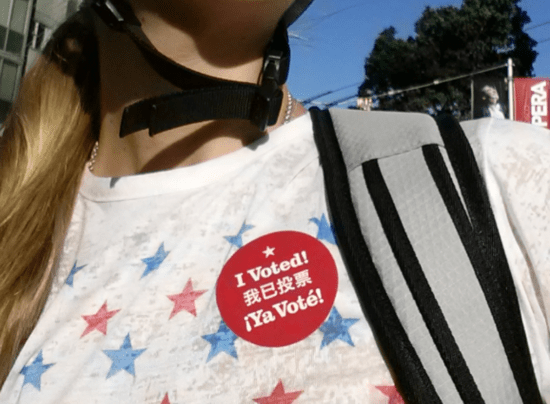
After considering a Swiss study on the social pressure behind voter turnout, Derek Thompson applauds America’s ubiquitous voting stickers:

In small Swiss towns, being seen at your voting location might be the perfect social motivator. But in larger cities, it’s probable that you won’t know the strangers in line with you at the polls. The primary social pressure to vote has to come from somewhere besides being spied by your best friends as you’re waiting in line. Where might it be? People like being seen voting, as [study author Patricia] Funk concluded, but we also like being seen having voted. Theoretically something signalling to our community that we’ve already voted should create the same feelings of social cohesion, civic duty, and belonging. And that’s where the “I Voted” sticker comes in.

And those stickers are even more effective if they’re virtual:

Today, Facebook is encouraging its legions of users to declare civic enthusiasm to their Screen shot 2012-11-06 at 3.16.29 PMfriends, with a prominent “I’m A Voter” botton at the top of the newsfeed. Large-scale, experimental research shows that simply clicking the button, and sharing your voting intention, could do more to increase voter turnout than any other partisan rant or news story you may share today. With a Single Message delivered electronically on Election Day,” researcher James Fowler explained to TechCrunch, “Facebook caused an extra third of a million people to vote. To put that number in context, remember that the 2000 U.S. Presidential Election was won by a margin of just 537 votes in Florida.”

Fallows passes along the top photo by Timbuk2:

Good for America (and California, and San Francisco) that is has the spirit for that kind of [multilingual] button. My one guiding insight about America over the years is that our openness to the world’s talent, through immigration, has been and remains the strategic advantage we have over anyplace else.

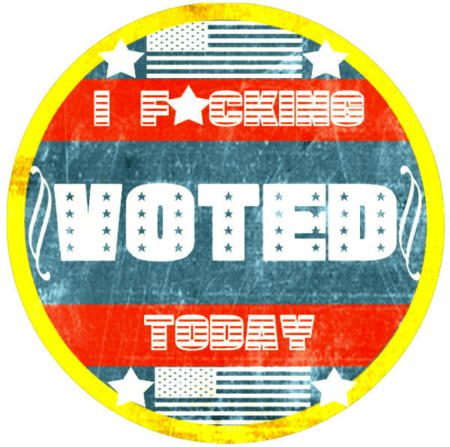
A reader gets creative:

So I voted absentee a few days ago and was sad to not have my sticker to show off so I made my own and have been sharing it with fellow absentee-ers:
Effing-voted

A Voting Holiday

Samuel Goldman wants to "make the first Tuesday after the first Monday in November a federal holiday":

Most of the practical obstacles to voting are rooted in the fact that Tuesdays are workdays. If more citizens had the day off, they’d have less need of absentee ballots, early voting, extended poll hours, and the rest of the mess.

His larger argument:

The benefits of making Election Day a holiday go beyond access. Doing so would also provide an opportunity for demonstrations, celebrations, protests, and encounters with our neighbors. In the 18th century, elections were the occasion for speeches, feasts, games, and, occasionally, drunken riots. We wouldn’t want to bring back the riots. Yet there’s no reason that the rest shouldn’t become part our public culture again. Independence Day is wonderful. But I’d rather see marching bands leading the way to the polls than to the fireworks.

“Not Nothing, Not Everything”

Stephen Squibb puts voting in perspective:

Someone once wrote that you shouldn’t confuse the process of writing somebody’s name on a piece of paper once every four years and dropping it in a box with emancipation. Voting has a part to play in political life, but a limited one, small compared to the importance of fostering communities based on mutual aid, deploying direct action, and practicing solidarity.

In this respect, those who loudly insist on not voting or proclaim its meaninglessness are committing the old misty-eyed mistake in reverse: not voting will no more free you than voting will. And the energy spent asserting that the two parties are identical is only well-spent if it leads directly into building some further form of institutional counterpower. Voting is not an overly difficult or time-consuming process—neofascist suppression tactics notwithstanding—at least when compared to planning a march, a boycott, or any other kind of organizing. It’s really closer to making an excellent banner or attending a meeting, activities that probably have a similar return on investment, as individual expenditures, as a trip to the polls does.

Voting The Party

Jonathan Bernstein endorses party-line voting. His reasoning:

But in the usual cases, voting the party line will be the best option. Think that makes the vote seem almost meaningless? You’re right: Voting never is enough. Which is the other reason to join, and be loyal to, a political party. By doing so, one can be ready to really work for change in the political system by working for change within the party. Granted, straight-ticket voting isn’t technically necessary for one to become involved in party affairs, but it fits the general idea of how to go about being an effective political actor.

Today’s Other Issues: Marriage And Marijuana

Matt Baume's final look at marriage equality ballot initiatives:

In Washington and Maryland, polls put us in the low fifties and our opponents in the mid-forties. And it’s very tight in Minnesota, where both sides have remained tied in the upper forties. In that state, the proposed anti-gay constitutional amendment needs 50 percent to win.

In the past, pre-election surveys have overstated public support for the freedom to marry. But a lot has changed since the last time there was widespread voting on marriage. In particular, we now have 16 surveys showing a majority of Americans support the freedom to marry. This vote will be crucial test of the change in public opinion.

Jacob Sullum checks in on legalization polling:

In Colorado a SurveyUSA poll conducted last week put support for Amendment 64, which would allow home cultivation as well as state-licensed sales, at 50 percent, with 44 percent opposed and 6 percent undecided. The Denver Post reports that the measure is "tied among voters who said they had already cast a ballot," while "its biggest lead was among people who said they would be voting on Election Day."

Harry Enten provides polling projections for various ballot initiatives. He expects both Colorado and Washington to legalize marijuana. He also expects Maine, Maryland and Washington to vote in favor of marriage equality. Minnesota could go either way. 

Why Vote?

Ilya Somin defends not voting if you are politically ignorant:

If you abstain from voting, you might worry that the rest of the electorate will take advantage of the situation to bias policy in favor of their narrow self-interest and against yours. But the evidence strongly suggests that most people’s political views are only weakly correlated to their self-interest. When voters support bad policies, it is usually out of ignorance rather than selfishness. There are some important exceptions to this generalization(e.g. – opinion on gun control is highly correlated with gun ownership, even after controlling for many other variables). But it does hold true for most major issues in the modern US.

Timothy B. Lee argues in favor of voting:

Letting your personal revulsion at the bad things your government does deter you from voting is an error exactly analogous to the pacifist who refuses to take up arms when faced with a hostile invading army.

Obviously, it would be nice if you could persuade the world’s aggressors to voluntarily renounce violence. But in the real world, the only thing that stops a violent aggressor is a willingness to use deadly force for defensive purposes. The pacifist stance is only viable when one lives in a society with others who are willing to take up arms in self-defense. Likewise, "principled" non-voters have the luxury of not participating in the political process because millions of others are doing the hard work of making democracy work, thereby staving off the much larger injustices that tend to occur in non-democratic political systems. We’re a wealthy and peaceful society, so we can tolerate a large number of such freeloaders. But there’s nothing virtuous about refusing to do your part.

Andrew Gelman sticks up for voting as well.

Yglesias Award Nominee

"Win or lose, we are in the twilight of the Age of Reagan. Romney’s efforts have almost recreated the Reagan coalition, but in today’s America that is no longer enough. To prevail in 2014 and beyond, the Republican party will need to learn to adapt its principles to new times and new voters…

We must take on this challenge anew as we undertake our rendezvous with destiny and remake the conservative majority Reagan bequeathed to us. To do that, we must also ask and answer two other questions. If we didn’t [win], why? If we must, how? I believe we can and will answer these questions, as painful as the discussion amongst us will be at times, and I believe that regardless of what happens tomorrow, the American sun will rise and set with conservatism. For there is nothing wrong with conservatism that reapplication of conservative principles won’t solve, and there is nothing wrong with America that rededication to conservative principles won’t cure," – Henry Olsen, a vice-president of AEI, predicting an Obama victory in National Review.