The View From Our Galaxy

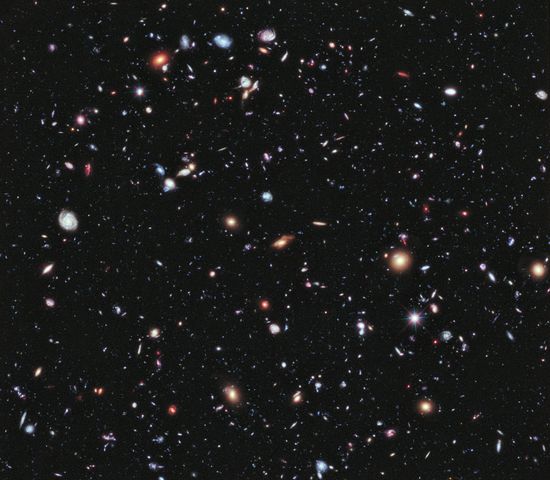
Space.com rounds up their favorite images from 2012, among them the farthest-ever view of the universe as captured by the Hubble Space Telescope, showing an incredible 5,500 galaxies:
Hubble-extreme-deep-field

Clara Moskowitz explained the image when it was released back in September:

The picture, called eXtreme Deep Field, or XDF [link], combines 10 years of Hubble telescope views of one patch of sky. Only the accumulated light gathered over so many observation sessions can reveal such distant objects, some of which are one ten-billionth the brightness that the human eye can see. The photo is a sequel to the original "Hubble Ultra Deep Field," a picture the Hubble Space Telescope took in 2003 and 2004 that collected light over many hours to reveal thousands of distant galaxies in what was the deepest view of the universe so far. The XDF goes even farther, peering back 13.2 billion years into the universe's past. The universe is thought to be about 13.7 billion years old.

Phil Plait marvels at the "variety of galaxies":

Some look like relatively normal spirals and ellipticals, but you can see some that are clearly distorted due to interactions – collisions on a galactic scale! – and others that look like galaxy fragments. These may very well be baby galaxies caught in the act of forming, growing. The most distant objects here are over 13 billion light years away, and we see them when they were only 500 million years old. In case your head is not asplodey from all this, I’ll note that the faintest objects in this picture are at 31st magnitude: the faintest star you can see with your naked eye is ten billion times brighter. …

We humans, our planet, our Sun, our galaxy, are so small as to be impossible to describe on this sort of scale, and that’s a good perspective to have. But never forget: we figured this out. Our curiosity led us to build bigger and better telescopes, to design computers and mathematics to analyze the images from those devices, and to better understand the Universe we live in.

Fizzy Physics

Fuck Yeah Fluid Dynamics sums up the science of champagne bubbles:

During secondary fermentation of champagne, yeast in the wine consume sugars and excrete carbon dioxide gas, which dissolves in the liquid. Since the bottle containing the wine is corked, this increases the pressure inside the bottle, and this pressure is released when the cork is popped. Once champagne is in the glass, the dissolved carbon dioxide will form bubbles on flaws in the glass, which may be due to dust, scratches, or even intentional marks from manufacturing. These bubbles rise to the surface, expanding as they do so because the hydrodynamic pressure of the surrounding wine decreases with decreasing depth. At the surface, the bubbles burst, creating tiny crowns that collapse into Worthington jets, which can propel droplets upward to be felt by the drinker.

Video here. Much more nerdiness here.

(Hat tip: Kasia Cieplak-Mayr von Baldegg)

Staying In Tonight

Conor Friedersdorf knocks NYE festivities:

On December 31, mediocre restaurants throughout America string absurd velvet ropes outside their doors, inflate black and white balloons as decoration, and charge three times the usual price for the same old fare plus bad champagne. Is it any wonder that our elders, as they grow older and wiser, opt to stay home and turn in before midnight? America's most iconic New Year's Eve celebration, the one that captures the attention of the whole country, has massive crowds gathering in New York City's most garish neighborhood, where they watch a large ball drop as C-list celebrities narrate on TV. The typical NYC dweller can't be lured to Times Square for dinner on an ordinary evening, so I can't imagine how pre-New Year's conversations go for those who attend. "Would you like to stand out in the freezing cold for hours with no place to sit or use the bathroom and drunks pressed against you on all sides?"

Even more bizarre is the fact that Californians watch a tape-delayed rebroadcast of the spectacle as the clock strikes midnight on the West Coast, with whole parties pausing to gather around the television. "Hey, quiet down," people actually say, "Ryan Seacrest is about to come on!" 

A Hearty New Year

2899729201_3c81e6192d_b (1)

Sara Davis considers the Southern roots of traditional New Year's fare and finds a range of disparate cultures:

Surely, for example, German immigrants brought their lucky pork and cabbage with them to their Southern settlements, although they found it easier to grow other members of the cabbage family such as kale or collards. (Tough, fibrous collards have a surprisingly cosmopolitan history, cultivated across multiple continents for the last millennia.) Black-eyed peas arrived by way of trade with West Africa and West Indies — as was okra, another Southern staple. The Native American crop corn put corn bread (and, later, bourbon) on the table. The mingling of these cultures created a culinary mix of belly-filling, rib-sticking foods that can no more be separated into distinct cultural classes than the hog jowl can be separated from the hoppin’ john after simmering together all day.

Despite the diversity of this bounty, nearly every source traces the symbolism of Southern New Years dishes to a specifically financial kind of luck. The greens represent paper money, as I had heard before; black-eyed peas represent coins; corn bread alludes to gold.

(Photo by Flickr user MzScarlett)

The Aspirational Alcohol

Becky Sue Epstein explains how champagne became a New Year's standard:

[As the marketing of the beverage first expanded beyond the courts of France and England], royal favor made champagne an easy sell to the nobility. But with the rise of industrialization in the 19th century, the nobles were no longer guaranteed to be the wealthiest consumers. Champagne producers dangled their products in front of the newly rich merchant class: an aspirational beverage. Of course, these new customers couldn’t afford to drink champagne every day, but they could afford it on special occasions. Soon they began ordering it for all celebrations. Champagne became de rigueur at festivities from weddings to ship christenings — to ringing in the New Year.

Meanwhile, Reema Khrais recounts various theories for why we clink glasses:

[T]he clinking of glasses? [Paul Dickson, author of Toasts: Over 1,500 of the Best Toasts, Sentiments, Blessings and Graces] says that toasting flair didn't popularize until the early days of Christianity. Many believed the bell-like noise would drive off the devil — which was most dangerous in times of drinking and reveling. But that's just one theory. Another legend contends that by adding the clink, toasters could get the greatest pleasure from a drink, Dickson says. Before the clink, toasts only satisfied four of the five senses.

The History Of The Ball Drop

158754084

The New Year's Eve tradition began when Alfred Adolph Ochs, the publisher of the New York Times, "successfully lobbied city leaders to change Longacre Square's name to Times Square":

[Ochs] resolved to throw a New Year's Eve celebration that would be the talk of the town. "An all-day street festival culminated in a fireworks display set off from the base of the tower," according to an official history published by the Times Square District Management Association, "and at midnight the joyful sound of cheering, rattles and noisemakers from the over 200,000 attendees could be heard, it was said, from as far away as Croton-on-Hudson, thirty miles north." An annual event was born — but two years later, the city prohibited the fireworks display. "Ochs was undaunted," the official history continues. "He arranged to have a large, illuminated seven-hundred-pound iron and wood ball lowered from the tower flagpole precisely at midnight to signal the end of 1907 and the beginning of 1908." Thus the origin of today's celebration.

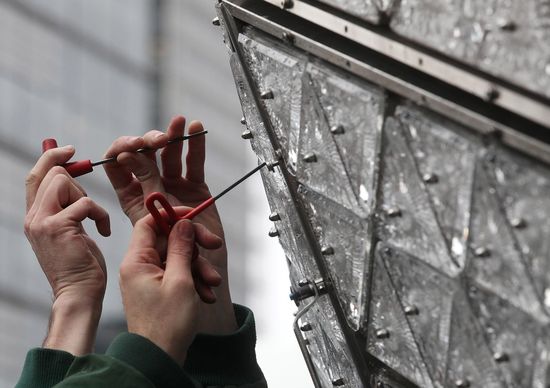
(Photo: Workers install new Waterford Crystal triangles on the Times Square New Years Eve Ball at a media event on December 27, 2012 in New York City. The ball will once again descend a 141-foot tall flagpole to mark the beginning of 2013. By Mario Tama/Getty Images)

Look Both Ways Tonight

Sarah Kliff warns that "New Year’s is the deadliest day for pedestrians":

Researchers in the journal Injury Prevention counted 99 pedestrian deaths on Jan. 1 between 1986 and 2002, making it the deadliest day for pedestrians in the calendar year. Those deaths were more likely to occur in the early hours of the morning, with 48 percent happening between midnight and 6 a.m. Overall, only 20 percent of pedestrian deaths happen in that time frame.