Over the weekend, President Morsi rescinded most of his controversial decree, but he refused to postpone the upcoming referendum on the constitution. In response, opposition groups have threatened to boycott the vote. Ashraf Khalil thinks that Morsi's "compromise" is meaningless:
Much of the motivation behind Morsi’s original decree was to place the Constituent Assembly — the body drafting the constitution — outside the authority of Egypt’s judiciary. Morsi and his Muslim Brotherhood believed Egypt’s Supreme Constitutional Court was about to dissolve the assembly. The ensuing controversy essentially bought the Constituent Assembly enough time to fast-track a draft and start the clock toward the referendum.
He says more contention is on the way:
Theoretically, even if the protesters maintain their numbers, Morsi could still ram the constitution through by sheer force of will, momentum and the Brotherhood’s legendary grassroots-mobilization machine. Despite the broad nature of the opposing coalition, opposition members are still not optimistic of their ability to defeat the constitution at the ballot box. But even if it does pass, the lingering bitterness and mistrust born of this controversy could come back to haunt the Brotherhood at parliamentary elections — which will gear up once there’s a constitution in place.
Juan Cole believes that, whether opposition groups like it or not, at least Morsi is giving the people a choice:
Very cleverly Morsi changed the character of the referendum. Egyptians will be free to vote for the constitution, in which case it will pass and become the law of the land. New parliamentary elections would follow in February. The voters may, however, vote the constitution down. In that case, a new constituent assembly will be elected in March, and will have six months to craft a new constitution. Referendums with a single question are hard to lose. Could it have passed with 48% ‘yes’ votes if the "no" votes were even fewer– and even though 48% is not a majority? Now, however, the electorate will have a real choice. Vote for the constitution as it is, or defeat it and elect a new drafting committee.
Cole agrees the referendum should be delayed, but that it would be mistake to mount a boycott:
[T]he left-liberal strategy of boycotting the referendum and pursuing street protests is a disaster in the making. If they are going to win, they will have to get out the vote against Morsi’s constitution. Staying home and sulking will just hand Morsi a victory.
Issandr El Amrani is on the same page:
I can understand there is concern with legitimizing what has become an illegitimate process, but I expect campaigning for no will be the only recourse left if protests, strikes, legal maneuvers and getting the backing of judges and other constituencies involved in the referendum's administration does not work. A postponement of the referendum (not a cancellation) is what makes the most sense here, and if Morsi was not stubbornly stuck on an insane process he started he could do that easily without losing face.
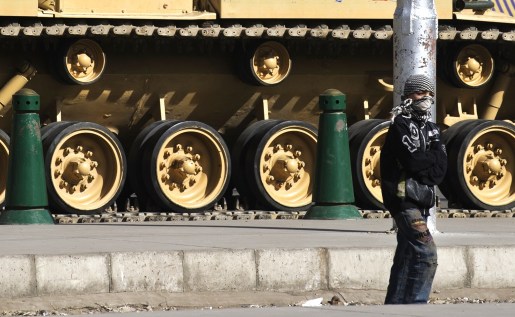
In another worrying development, today Morsi ordered the military to help quell the unrest and secure the referendum vote, granting them the power to arrest civilians:
Amnesty International called the decree a "dangerous loophole" that could once again lead to detainment of civilians. "Considering the track record of the army while they were in charge, with more than 120 protesters killed and in excess of 12,000 civilians unfairly tried before military courts, this sets a dangerous precedent," said Amnesty's deputy Middle East and north Africa director, Hassiba Hadj Sahraoui.
Previous coverage here and here.
(Photo: An Egyptian army Armored Personnel Carrier is stationed outside the Egyptian presidential palace, on December 10, 2012, in Cairo. President Mohamed Morsi has ordered Egypt's army to 'cooperate' with police and given it powers of arrest until the results of a referendum to be held this weekend, according to a decree obtained by AFP. By Gianluigi Guercia/AFP/Getty Images)
 The Dish