Ask Moynihan Anything: Why Do You Call Chomsky A Junk Historian?

Read Michael’s writing for the Beast here. Above he compares Chomsky’s revisionist history to Oliver Stone’s work, which he critiqued here:

Stone and [Peter] Kuznick helpfully explain that the “objective [of] this project” is to provoke a “much-needed conversation about the direction our country needs to go in to counter a century-plus, and we believe disastrous, course of empire, war, and domination. That is our objective in this project, which one would never know from reading Moynihan’s review.” What I said in my review, though, is that this book is activism masquerading as history. And I thank the authors for strengthening my point.

Watch Michael’s previous videos here, here, here, here and here.

Lincoln’s Last Words

Stephen Mansfield, author of Lincoln's Battle with God, details "the final, surprising words of Abraham Lincoln," spoken to his wife immediately prior to his assassination at Ford's Theater: "We will visit the Holy Land and see those places hallowed by the footsteps of the Savior. There is no place I so much desire to see as Jerusalem." For a president whose words are so studied, why aren't these last statements better known?

The words are rarely included in accounts of Lincoln’s assassination. Schoolchildren do not learn them as they do the other facts of Lincoln’s life. Indeed, the sentiments are too religious for most teachers to dare include in their lessons. Scholars tend to exclude this episode also, usually because of a similar hesitation about religion.

It is understandable. Lincoln was, after all, a religious oddity. He never joined a church. In fact, he went through periods in his life when he was openly antireligion—even anti-God. In his later years, he spoke often of God but rarely of Jesus Christ. That he was attending a bawdy play on Good Friday—the day Christians set aside to contemplate the crucifixion of their Savior—seems perfectly consistent with the image of Lincoln that has come to us through the years. It is reasonable to doubt that he would call Christ the Savior and declare himself eager to see the Holy Land in the last moments of his life.

Mansfield goes on to list the Lincoln scholars – a veritable who's who of the field – affirming the validity of the president's final remarks.

“A Mote Of Dust Suspended In A Sunbeam”

Another homage to Carl Sagan's Pale Blue Dot:

Joe Hanson celebrates the 40th anniversary of the "Blue Marble" photograph, shot by the crew of Apollo 17:

A human being hasn’t seen this sight with the naked eye since 1972. The International Space Station doesn’t orbit far enough from Earth to see anything but curved edges. Same with the shuttle. …

But I want another human being to see our Earth from this vantage point. When this image came back to Earth, people stopped for a moment, however brief, in the midst of wars Cold and hot, to realize this is our home. Our home. Maybe a military officer somewhere thought twice about dropping bombs that day. Maybe a parent showed it to their kids before bed instead of sitting silently in front of the TV. Maybe someone who was alive when the Wright brothers flew for the first time smiled at how far we’d come. I don’t want this to be the last time we feel those things. Let’s go take another picture.

Josh Jones highlights another short film:

To commemorate the fortieth anniversary of "The Blue Marble," Planetary Collective, a group of visual artists, philosophers, and scientists, released the short film Overview   at a screening at Harvard this past Friday.

Overview takes its title from author Frank White’s phrase for the perspective of the earth as seen from space: “The Overview Effect.” White’s book of the same name uses interviews and writings from thirty astronauts and cosmonauts to build a theory about the psychology of planetary perspectives. … Especially interesting is the interview with Apollo astronaut Edgar Mitchell; he comes to see his experience in mystical terms, as a kind of intense meditative state known in Sanskrit as savikalpa Samadhi, a union with the divine.

A Rerun With A New Conclusion

Sunny Sea Gold details a recent study of "reconsumption," or why people re-watch films or re-read books. One finding:

[P]eople gained insight into themselves and their own growth by going back for a do-over, subconsciously using the rerun or old book as a measuring stick for how their own lives had changed. One woman, for example, rewatched the romantic Kevin Costner movie Message in a Bottle more than once: “It was helping her work through having an engagement that hadn't worked out,” [Cristel Antonia Russell, a marketing professor at American University] says. Every time she watched that movie, it reminded her of her own failed relationship—and her reactions helped her see she was getting over it.

Faces Of The Day

158395699

People attend a prayer service to reflect on the violence at the Sandy Hook School at a church on December 15, 2012 in Newtown, Connecticut. Twenty six people were shot dead, including twenty children, after a gunman identified as Adam Lanza opened fire in the school. Lanza also reportedly had committed suicide at the scene. A 28th person, believed to be Nancy Lanza was found dead in a house in town, was also believed to have been shot by Adam Lanza. By Spencer Platt/Getty Images.

Ancient Dirty Talk

A Latin lesson gets spiced up thanks to Keith Verones:

The term testicle likely evolved from the Latin word testis, a term for someone that witnesses or gives testimony in a legal setting. Clitoris has its origin, you can probably guess if you are a fan of ancient languages, in Greek. Clitoris carries with it connotations for the Greek word for keykleis. There may be an attribution arising via the verb kleiein , meaning "to close" or "shut", as well. English use of the words vulva and vagina come from identical terms in Latin meaning "wrapper" and "scabbard", respectively.

Cool Ad Watch

Enhanced-buzz-22516-1355401553-0

Another Mayan apocalypse is slated for Friday. NASA is doing its best to debunk the myth:

Just as the calendar you have on your kitchen wall does not cease to exist after December 31, the Mayan calendar does not cease to exist on December 21, 2012. This date is the end of the Mayan long-count period but then — just as your calendar begins again on January 1 — another long-count period begins for the Mayan calendar.

Luckily only 2% of Americans believe it will happen:

To put this in context, if you went to small-town high school with 500 kids, two percent would mean 10 of your classmates actually believe they have only eight days left to live before the world goes up in a ball of flames as foretold by ancient Mayans. Chances are you would know those 10 kids, and you would think they were all nuts. 10 kids would probably seem like more at your school than you’d expect.

On the other hand, 15% of those surveyed—the equivalent to 47 million Americans—think that the world will end with Jesus returning for the rapture as told by the bible’s Book of Revelation in their lifetime. So there’s that.

Update from a reader:

I know I can't be the only person pointing out that if the world's ending, you're not using a condom.

(Hat tip: Copyranter)

The Drunken States Of America

The upcoming issue of Lapham's Quarterly tackles the theme of intoxication:

The oceangoing Pilgrims in colonial Massachusetts and Rhode Island delighted in both the taste and trade in rum. The founders of the republic in Philadelphia in 1787 were in the habit of consuming prodigious quantities of liquor as an expression of their faith in their fellow men—pots of ale or cider at midday, two or more bottles of claret at dinner followed by an amiable passing around the table of the Madeira. Among the tobacco planters in Virginia, the moneychangers in New York, the stalwart yeomen in western Pennsylvania busy at the task of making whiskey, the maintaining of a high blood-alcohol level was the mark of civilized behavior. The lyrics of the Star-Spangled Banner were fitted to the melody of an eighteenth-century British tavern song. The excise taxes collected from the sale of liquor paid for the War of 1812, and by 1830 the tolling of the town bell (at 11 a.m., and again at 4 p.m.) announced the daily pauses for spirited refreshment.

A Poem For Saturday

Colemanpoem

“the history of my body” by Wanda Coleman:

a crushed rose
the workings seem obtuse
indigenous harmonies, all glittery
rubble & love blazing white teeth
the portrait of a sunburnt face
dayblooming pickaninnies
exploding hips/ encantados de la luna
pavement by night
from ashy to bone dry
flying houses and thunder palms
penny-candy memories
violent eruptions of beauty
wailing sirens into the deep pink
just a dream of cities
ample-voiced  harbinger
mouth made for sloppy kisses
(goodness gracious she’s bodacious)
question mark, forever haunted
tenderly fiercely fleshed

(From Ostinato Vamps: Poems by Wanda Coleman © 2003 by Wanda Coleman. Used by permission of the University of Pittsburgh Press. Photo by Flickr user quinn.anya)

Creativity Lab

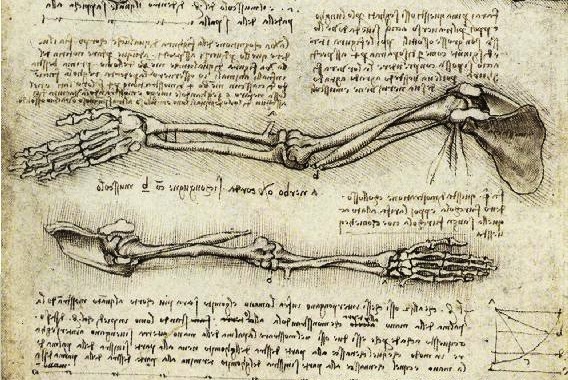
Leonardo_Arms

Leonard A. Jason finds the overlap between artist and scientist:

[L]earning, experimentation, feedback, and refinement are the backbone of both the sciences and the arts. Decades of painstaking analysis and observation were critical in the development of Darwin’s grand theory of evolution. The dissection of corpses and countless sketches polished and unleashed Michelangelo’s genius in capturing the human spirit in exquisite detail. Sweat and toil nurture the fertile imagination and fine tune the ability to peer through nature’s veil and uncover eternal truths that lead to Eureka moments of exhilarating discovery. … True research has a soul of an artist.

Along the same lines, Priscilla Long argues that science and poetry are related. One big difference:

Poets love words for their sound and shape and feel on the tongue.  They rub words together and watch the resulting conflagration. The word fire emits heat and light. The word energy is dead as a dead dog. Poets want fire, not energy. They want the poems they write to burn. They want the layers of meanings, the visions, the connotations.

For the sciences, Holub continues, "[W]ords are an auxiliary tool." In the science paper or report, each word must mean as close to one and only one thing as possible. It has a function. That’s why hard science can be so terrible to read. Dry and replete with necessary terms, figures, charts, and diagrams.

(Image: Detail from Leonardo da Vinci's sketches of arm anatomy from Wikimedia Commons)