Stuffed With Memories

Eating at your desk has its disadvantages:

We've known for a while that people who are distracted while eating — such as by watching TV or typing — are not really thinking about what they're eating. They're not making memories of the food, and may be setting themselves up for later hunger. This area of research is helping scientists to better understand "how our memory for food comes to influence the decisions we make and the amount of food we eat," says Jeffrey Brunstrom, an experimental psychologist at the University of Bristol in the U.K.

More on this effect:

Further evidence that memory matters for satiation comes from amnesiacs who suffer from a condition called hyperphagia, in which they cannot remember what they've eaten. In those patients, Brunstrom says, "if they eat lots of meals, they tend to feel just bloated, but they don't necessarily feel full. We think that they can't actually attribute [the signals from their bodies] to what has taken place." Brunstrom says, "the memory was dominating hunger," not the actual number of calories consumed.

Were The Gays Responsible For Obama’s Reelection?

Gay_Vote

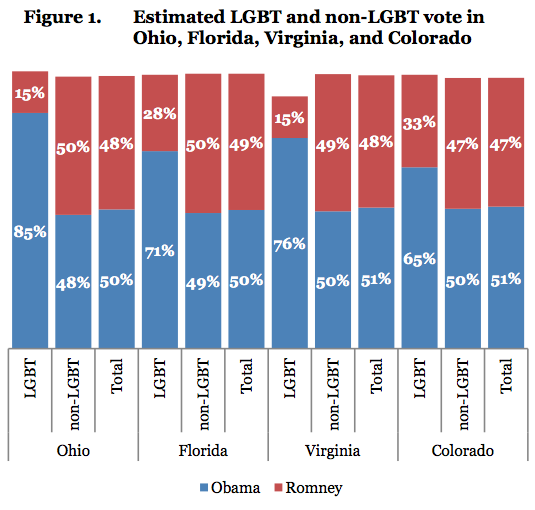
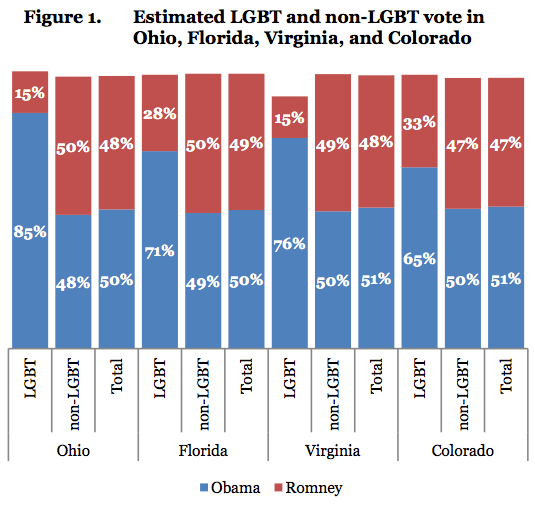
Gary Gates points to evidence suggesting yes:

Had LGBT voters not cast their ballots in Ohio and Florida, Governor Romney would have won those states. If the LGBT vote in Virginia had been less lopsided in President Obama's favor and more evenly split between the two candidates, Governor Romney would have also won that state.

He adds:

All three states have sufficiently large LGBT populations to influence a close election, but none have sexual orientation or gender identity anti-discrimination laws nor any relationship recognition rights for same-sex couples.

(Image from the Williams Institute (pdf))

What Do Republicans Want To Cut?

Suderman studies recent polling on spending and taxes:

Unlike the overall polling sample, a majority of the poll’s Republicans do not support raising taxes on the wealthy. But they don’t support any of the  spending cuts mentioned in the poll either. Not to Medicare or Medicaid, and not to the tax loopholes surveyed either. Republicans, in other words, don't support much of anything except leaving things the way they are now. Which is exactly what we can’t do.

Waldman unpacks the GOP strategy:

[I]f you're a Republican and you want to rail against spending, the safest way to get specific is to talk about programs that almost no one knows or cares about. If you can make them sound a little silly, all the better. That way you can convince the ideologically conservative public that you're fighting for the "small government" they support, while not hinting to that same operationally liberal public that you'll take away the programs they also support.

Chait goes further:

When the only cuts on the table would inflict real harm on people with modest incomes and save small amounts of money, that is a sign that there’s just not much money to save. It’s not just that Republicans disagree with this; they don’t seem to understand it. The absence of a Republican spending proposal is not just a negotiating tactic but a howling void where a specific grasp of the role of government ought to be. And negotiating around that void is extremely hard to do. The spending cuts aren’t there because they can’t be found.

Barro disagrees:

The Republicans' main problem in this negotiation is that they know President Barack Obama will not agree to cut in the area they want to cut: aid to the poor. The signal Obama has sent is that he is willing to make a deal that cuts old-age entitlements, meaning Medicare and Social Security, and Republicans are internally conflicted over those programs.

A Souvenir Under The Skin

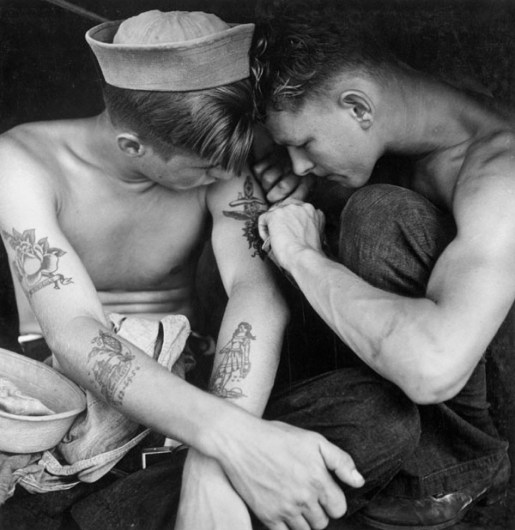
Tattooed sailor aboard the USS New Jersey

In a long look at the history of tattoos, Hunter Oatman-Stanford details their naval origins:

Body art was particularly well-suited to the transient and dangerous nature of life at sea. "These sailors were traveling the world, and wanted to bring back souvenirs from places they had visited," explains [Tattoo Archive founder C.W.] Eldridge. "Aboard a ship, you don’t have much room to carry fancy souvenirs, so you end up getting tattoos as travel marks." By the late 18th century, navy records show that around a third of British and a fifth of American sailors had at least one tattoo, while other accounts reveal that French, German, and Scandinavian navies were also fond of getting inked.

(Hat tip: Neatorama. Photo: Tattooed sailor aboard the USS New Jersey, December 1944. By Lt. Comdr. Charles Fenno Jacobs from Wikimedia Commons)

The GOP’s Denial

Larison suspects 2014 will only strengthen it:

It’s likely that Republicans will make gains in 2014 by virtue of being the party not controlling the White House, and it’s always possible that they could win 2016 because the public wants to put a different party in power. The GOP may be in danger of becoming the party that wins only in off-year elections, but the party’s electoral weaknesses are normally not as great in midterm elections. The danger for the Republicans in that scenario is that they interpret success in 2014 as proof that they can ignore their weaknesses and still win elections.

The Daily Wrap


Screen shot 2012-12-12 at 1.26.07 PM

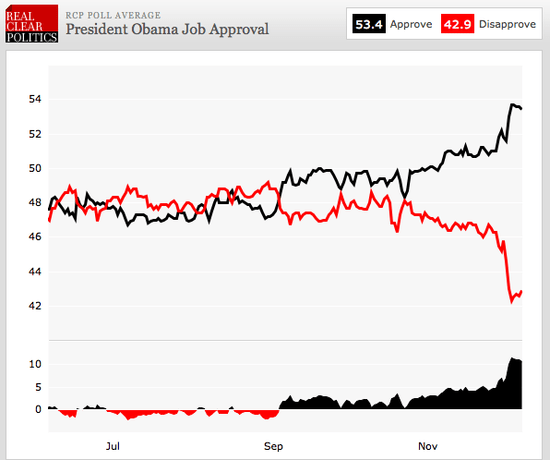
Today on the Dish, Andrew laid out his ideal fiscal cliff solution, noting that he now believes an additional stimulus should be included. He also continued to take on the torture in Zero Dark Thirty’s plot, pointed out that Obama definitely has a mandate to wield against the GOP on tax rates, spoke with Carl Swanson about adjusting to NYC, and stood by his Federalist ideals — even when it came to marriage equality.

In political coverage, we published more letters from millennial voters, this time weighing in on their generation’s economic and employment concerns, while other readers responded to Mitch Daniels’ Federalism, R.M. reminded us how little an effect tax rates or the Medicare eligibility age will actually have on the debt, Michael “pre-chalkboard” Moynihan reviewed Glenn Beck’s business prowess, and Bouie and Bernstein wondered if the GOP could get by with only a superficial makeover. Also, David Frum pwned Marc Thiessen, Dylan Matthews suggested more sensible “scheduling” of illegal drugs, Aaron Carroll did a life-expectancy reality check regarding the Medicare eligibility age discussion, and we again considered the economics of having children, as well as tried to guess which SCOTUS judges were itching to take on Prop 8. Looking overseas, Millman dismissed any possible one-state solution for Israel and Palestine, Melanie Kirkpatrick reported on the setup of North Korea’s underground railroad, and the (translated) Prime Minster of Cambodia supported gay and lesbian speed-limit adherence.

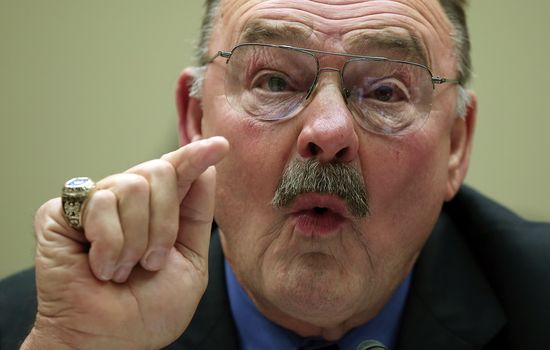
In assorted coverage, Mark Hertsgaard sounded the alarm over climate change’s impact on wheat, Bill Nye proved climate change was real, a reader pushed back on the idea of micropayments for journalism, Roben Farzad broke down the success of the fund manager Vanguard, Penn Jillette defended the use of “Happy Holidays”, and Judith Shulevitz worried about the fewer years parents who delay having kids will be able to give those kids once they become adults. Vaclav Smil debunked the dream of the electric car, Laura Beck called out Weight Watchers for being ineffective, Louis Menand offered his take on the prevalence and importance of homework, Kirsten Hively explained the magic of classic neon signs (and hoped we would help her preserve them), and more readers wrote in to join our Roid Age discussion about the modern bodies of men and women. We also aired more debate about the prospects of tablet-only journalism, discovered that algorithms have biases, and loved to hate how well a toilet handled not only hot dogs, but a surprisingly-specific number of chicken nuggets. Buzzfeed rounded up the year in perfectly-timed photographs in our MHB, Dick Butkus went to Washington in our FOTD, and it was pleasant in Pleasanton through the VFYW.

Don’t forget to help us decide what to ask David Kuo here.

– C. D.
Climate Change Is Coming For Your Carbs

Mark Hertsgaard previews the endangered food list of the future:

Three grains—wheat, corn, and rice—account for most of the food humans consume. All three are already suffering from climate change, but wheat stands to fare the worst in the years ahead, for it is the grain most vulnerable to high temperatures. That spells trouble not only for pasta but also for bread, the most basic food of all.

Since wheat is a cool-season crop, the data doesn't look good:

By 2050, scientists project, the world’s leading wheat belts—the U.S. and Canadian Midwest, northern China, India, Russia, and Australia—on average will experience, every other year, a hotter summer than the hottest summer now on record. Wheat production in that period could decline between 23 and 27 percent, reports the International Food Policy Research Institute (IFPRI), unless swift action is taken to limit temperature rise and develop crop varieties that can tolerate a hotter world.

Hertsgaard also explains how the fossil fuel industry is gobbling up American farmland for fracking, which may be poisoning our water supply as well.

Which Justices Wanted To Hear Prop 8?

Andrew Koppelman suspects it was the conservatives:

My guess is that the court agreed to hear the California case because the four conservative members — Antonin Scalia, Clarence Thomas, Samuel Alito and Chief Justice John Roberts — hoped to overrule the lower court’s decision that the state had to recognize such marriages. It only takes four votes to put a case on the court’s docket, and they may be hoping that they can win Kennedy’s vote, while discounting the danger that he will go the other way. This would be a sensible call, since it is far from clear that any of the liberal members of the court are now willing to hold that same-sex couples have a right to marry.

Yet Kennedy could foil this strategy by declining, in the end, to review the case. Four votes are all it takes to hear a case, but five votes are sufficient to then dismiss that decision as improvidently granted.

Jeffrey Rosen is also focused on Kennedy:

In the most hotly contested previous cases, he has voted with the conservatives to strike down laws on the most sweeping possible grounds—such as his holding in the Citizens United case that corporations are persons, and his vote to strike the Affordable Care Act as a violation of Congress’s power to regulate interstate commerce. But Justice Kennedy is also deeply attached to the previous jurisprudence of … Justice Kennedy. Because his earlier cases give him and the liberals an easy way to strike down the Defense of Marriage Act and California’s Proposition 8 without resolving the status of gay marriage across the nation, there’s no reason to expect he won’t at least go that far. If Kennedy does write a narrow opinion, it’s not beyond the realm of possibility that he could attract a vote like that of Chief Justice John Roberts, who might not want to be on the wrong side of history.