Will Readers Finally Pay For Content? Ctd

A reader writes:

The problem with micropayments is that users hate them, probably because they don't want to continually make a decision about whether a not a purchase is worth making.  That is why many systems that used to use micropayments, like Internet usage (remember hourly fees?), have moved over to simpler pricing schemes.  The things that still use micropayments, like utilities or toll roads, tend to be monopolies that (1) do not turn much of a profit and (2) are disliked by the people that use them.  To put in some realistic numbers, if the NYT charges about $10/month for ~100 articles, do you really want to make the judgement call about whether any particular headline is worth a dime?

Another:

Way back in 2000, Clay Shirky predicted that micropayments wouldn’t work way, and I’m pretty sure by now he is right or somebody would have done it.

Conservatism, States’ Rights And Marijuana, Ctd

A reader writes:

I'm so glad you posted that Mitch Daniels quote. Initially, it brought a smile to my face because as we all know, Governor Daniels was busted with a large amount of pot back when he was in college and got off scot-free. Had he been pinched several years later, well, that would have been it for good ol' Mitch.

Another:

I’m sympathetic to Daniels’ position, but Federalism is "a protection of liberty"?  Come on, that’s a meaningless statement.  Do we really think that the individual has more liberty under state government than under Federal government? Clearly, states can be, and often are, more repressive and constraining that the Federal government.

To my knowledge, small business owners complain more about state or local regulations than about those promulgated by the Federal government.  And, as we all learned from the ACA judicial debates, there are many more things that states can do to regulate individual and business activity than can be done by the Federal government.

Another adds:

As a resident of Colorado and devoted Dish reader, I share Daniels’ hope that the federal government lets us blaze a new trail to legalization. However, reading his quote makes me realize my belief in states’ rights is highly dependent on the issue. On desegregation and abortion, I think we’re better off as a country that federal action overruled the policies of individual states. And running a business that operates throughout the country, I can vouch that it is an absolute pain in the ass to comply with 50 different sets of laws on contracts, immigration, employment issues, and sales tax. So I’m all for it if the feds want to enforce a single law of the land, except when I don’t agree with it, and then I’m all for states rights. Just like most everything in our politics today, issues seem to trump philosophy.

I don't think it's wise or sane to take an absolutist position on this either way. But my instinct would always be toward more local control than central organization – especially in a country where federalism is perhaps more successful than anywhere else.

Previous Dish on the subject here.

Two States Or Bust

E1_Settlement_Israel

Millman believes that a one-state solution is a pipe dream:

The same people who argue for a one-state bi-national solution frequently assert that because of Israeli settlement activity, a two-state solution is “impossible.” But this impossibility depends entirely on the assumption that Israel will be allowed to get its way in keeping whatever territory it has substantially settled. And that assumption logically precludes a one-state bi-national solution as well. After all, if Israel cannot be pressured into surrendering Ma’ale Adumim to a future Palestinian state, then why should we assume it can be pressured into surrendering Tel Aviv? Wouldn’t the former be much more acceptable in any plausible universe?

Yes, but Netanyahu does not live in a plausible universe. And neither alas does the American Jewish Establishment who consistently refuse to take the settlements on.

(Photo: The E1 settlement area (L) is seen across from the Israeli settlement of Maale Adumim, on December 9, 2012. Israel has approved the building of 3,000 settler homes on the patch of land; a development that has been on hold for years due to pressure from the US and EU. Should the construction go ahead it would close off East Jerusalem from the West Bank. By Uriel Sinai/Getty Images)

New York Not So Shitty, Ctd

GT WTCSPIREONROUTE 20121211

Carl Swanson asked me about my move to the city:

[CS:] I loved the guy who wrote in to your blog saying that you have to change your expectations when you live here—its not a customer-service experience like most suburbanized cities are. There’s something nearly theological about that idea—God’s will is the inchoate Manhattan you must just let happen.

[AS:] Manhattan has nothing to do with God. It is, in some ways, a spectacular rejection of Christian values—specifically in its worship of money, fame, and success—but mainly money. I really don’t want to submit to that. But what I am learning to submit to is letting the city teach me how to live in it, rather than trying to wrestle New York City into my rural-suburban mind-set.

The entire "New York Shitty/Not So Shitty" thread is here.

(Photo: Parts of the spire for the Freedom Tower make their way on a barge from Port Newark to lower Manhattan, where they will be unloaded and installed on top of the Freedom Tower starting on December 11, 2012. The barge is carrying nine pieces of steel that will eventually top off One World Trade Center at a symbolic 1,776 feet, becoming the tallest building in the Western Hemisphere. By Chris Pedota-Pool/Getty Images)

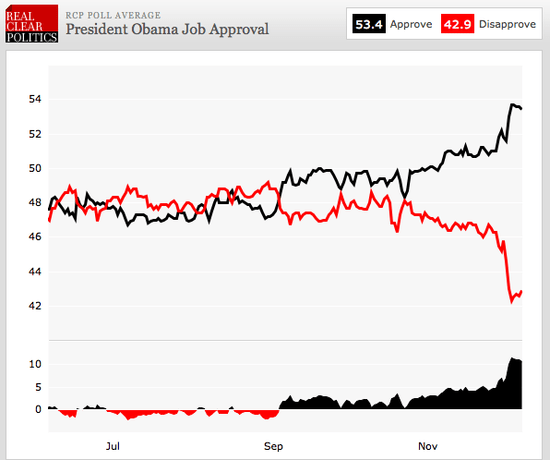
Yes, He Has A Mandate

Screen shot 2012-12-12 at 1.26.07 PM

That’s the overwhelming conclusion from the polling out there. Just look at the RCP graph above. The Bloomberg poll is also stunning in its view of how most Americans understood the election to be exactly a choice between one approach – Bush/Cheney/Romney – and another – Obama/Clinton – and chose the latter decisively. Money quote:

Sixty-five percent of Americans say the Nov. 6 results gave Obama a “mandate” on his proposal to raise tax rates on income over $250,000 and “to get it done.” Forty-five percent of Republicans agree.

My italics. The longer the Congressional Republicans remain in denial about this, the more isolated they will become. These quotes from voters leapt out at me:

The election “was basically a referendum that wealthy people could and would pay more,” said poll respondent Jim Johnson, 66, of Littleton, Colorado, a retired telecommunications executive and a Republican who voted for Mitt Romney. “It was perfectly clear. That was Obama’s stance throughout the election.” Poll respondent Gerald Watts, 75, of Lake Quivira, Kansas, a retired engineer and another Republican who voted for Romney, read the election results the same way. “Every time we listened to him on TV, he’d start talking about raising taxes on the rich — every news conference, every time he went up in front of a group,” said Watts. “He didn’t want to talk about anything else.”

These two men are smack in the middle of the GOP’s current demographics. And, unlike the foam-flecked mouth-pieces on Fox, they are admirably civic in their understanding of politics. Listen to them, Mr Speaker. And lead.

Dear SCOTUS, Do As Little As Possible

Jon Rauch makes the case for restraint:

Here is a movie plot you have never seen and never will see: a disadvantaged athlete struggles against the odds, makes it to the Olympics by sheer force of grit and talent, and is ahead in the race for gold—when, with the finish line in sight, the referee calls off the competition, hands the hero a medal, and everybody goes home.

Gay Americans are in sight of winning marriage not merely as a gift of five referees but in public competition against the all the arguments and money our opponents can throw at us. A Supreme Court intervention now would deprive us of that victory. Our right to marry would never enjoy the deep legitimacy that only a popular mandate can bring.

As I have said before, I am conflicted on this issue. Like Jon, I fear success at the Supreme Court almost as much as I fear failure. The fact that the right to marry is constitutionally understood to be more basic a right than even the right to vote in constitutional history makes the Boies/Olson case very powerful. But as a prudential matter, I agree with Jon that minimalism would be the best way forward. And I can say that with even more personal history in this struggle than Jon.

WeddingaisleLook: federalism is the only way to maintain some kind of cohesion in a country that is, in many ways, several countries. I love the fact that America can have both Seattle and New Orleans, Mississippi and Vermont. And I don't want that diversity, and its opportunity for experimentation to be diluted or flattened. That diversity must include cultural and religious difference, and the opposition to marriage equality is not all bigotry. There are genuine arguments that require rebuttal not suppression. And boy, have we succesfully rebutted them and made progress in a staggeringly fast process.

Yes, that deference to federalism requires constant adjustment – and absolutism on this is unwise on either side. I am well aware of what "states' rights" have meant in the past. But on the marriage issue, a single federal court decision now troubles for me several reasons. The first, as Jon argues, is that we are winning the public debate, and when a tiny minority has already won 50 percent support for something nationally, imposing that view on those states that are not there yet (but moving in our direction) seems unnecessary, divisive and coercive.

Marriage is a state issue – always was until DOMA came long. Federal institutions should, in my view, simply respect the states' decisions, not try to rationalize or coerce them. Allowing marriage equality to resume in California, and simply mandating that the federal government should treat all of a state's legal civil marriages equally would be my ideal outcome. And by making this argument, we can also begin to appeal to federalist conservatives, helping to broaden the coalition for equality, rather than imposing a premature national decision that would provoke an unnecessary backlash. Yes, Jon and I are gay conservatives/independents. Being gay does not mandate a position on federalism.

But I will not lie. If SCOTUS were to make a grand and large statement about the unalienable equality of gay citizens, I'd cry. My heart says one thing, but my head says another. We're winning the argument, because we have the truth on our side. When that is happening, why stop the process in its tracks?


Hathos Alert

Laura Northrup dug up the oddly meditative video: 

This gem has been lurking on YouTube for the world to discover. You might have this model of toilet in your home right now, and yet it never occurred to you to flush a pile of water wigglers or an entire pack of hot dogs. Because you are a sane person.

The key scene of American ridiculousness and excess of this video isn’t the kitty litter or the hot dogs, but has to be the chicken nuggets flushed to demonstrate the toilet’s superiority. They dump 56 chicken nuggets in. Not 50, and not even 55: 56.

I can’t quite get past the image of the large-size hot dogs heading into oblivion. But I may be revealing more than I want to …

Cliff Notes, Ctd

158260739

Noam Scheiber wants to jump off the fiscal cliff. He expects the GOP to suffer the consequences:

[T]hey will see that they have been completely repudiated by the public in a way that even the election didn’t impress on them. It will, in other words, be as close as you get in politics to a total victory for one side. It will highlight the perils of following one’s base too slavishly, a lesson that will come in handy not just on future fiscal policy fights (there will in all likelihood still be a debt ceiling to raise next year), but, one can imagine, also on an issue like immigration. Which is to say, it’s only by forcing the GOP off the cliff that Obama will find the space he needs to govern.

Unless his strategy permanently embitters them and prompts them to use the debt ceiling – once again – as a cudgel. I think the strategy in these negotiations is necessarily beyond our direct eye-sight. So it's foolish to keep trying to infer from speeches, body-language, and on and on. Here's what I hope for: a Grand Bargain that raises the top rate permanently, and commits to a serious outline of a tax and entitlement reform package by this time next year. I'd also favor the new stimulus. Yes, upon reviewing the evidence here and abroad, especially that of my friends in the Coalition government in Britain, I now see the recession continuing as the greatest immediate threat to long-term fiscal health. A short boost now could lead to take-off next year, which would make the fiscal compromise a little easier. 

I'd love Obama to be the president we wanted and be able to make a centrist deal before December 31 along these lines. There's a danger if he can't – the chance of a double-dip that would define his second term. I don't buy the argument that he has all the leverage, just most of it. My fear that his greatest strength as president is the long view; and his greatest weakness is being able to negotiate effectively. He's being tested now as never before.

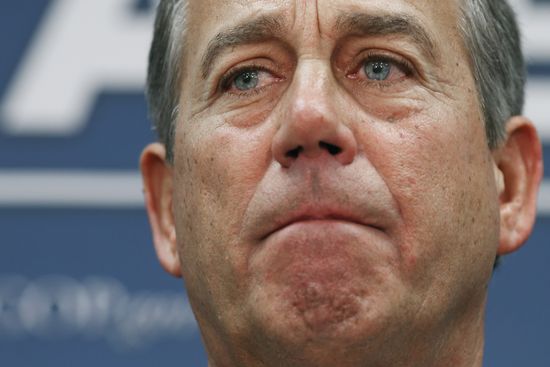
(Photo: Speaker of the House John Boehner  talks with reporters after the weekly House GOP caucus meeting at the U.S. Capitol December 12, 2012 in Washington, DC. Boehner described a phone conversation with President Barack Obama as 'tense' after they exchanged proposals to avoid the 'fiscal cliff' earlier this week. House GOP leaders said they doubt that a resolution will be reached before Christmas. By Chip Somodevilla/Getty Images. )