Letters From Millennial Voters

153840958

A reader writes:

There is one big thing that has been missing from the Millennial thread. I was born in 1979 so I'm sort of right in the middle between Gen X and the Millennials. The generation of Americans a little bit older than me had their formative years conditioned by the Cold War; who they were as Americans was defined in large part by opposition to the USSR. Being American meant being anti-communist.

Those Americans a little bit younger than me had their formative years defined by the "war on terror." I consider myself lucky that my most formative years were during a time of relative peace and lacked an easy enemy to tell us who we were. After the fall of the Berlin Wall and before 9-11 there was no real overarching boogeyman to define ourselves in opposition too. The Lewinsky scandal could only take root in such an interim. In a way, it was boring.

Millennials are the first post-Cold War generation and as such have not had their formative years influenced by a mixture of nationalism and anti-communism.

We need to get some distance from historical communism in order to understand the objective reality of capitalism better. The Millennial generation can see much more clearly than Cold War generations the multitude of ways in which capitalism diverges from and is counter to true democracy. This is a HUGE shift between how Millennial voters see the world and the generation that watches Fox News. To even question the virtue of capitalism is a new and important event and question it we do.

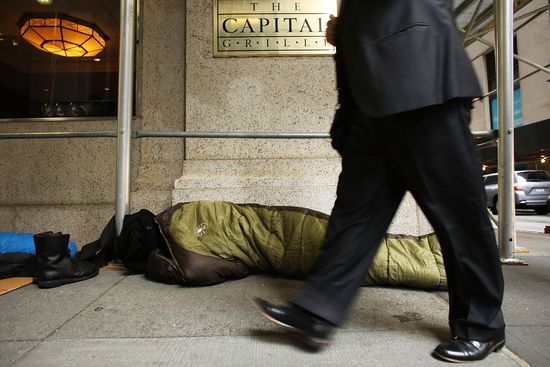
(Photo: A man walks by a sleeping 'Occupy Wall Street' protester in the financial district of Manhattan on October 9, 2012. State Comptroller Thomas DiNapoli today will release his annual report on employment and earnings in New York' City's financial industry, one of the worlds largest. While employment is still down thousands of positions since the economic crisis of 2008, DiNapoli has said that last year the sector employed 166,600 people in hedge funds, investment banks and securities trading firms. By Spencer Platt/Getty Images)
How Eaters Of The Dead Can Keep You Alive

Paul Gabrielsen explores the medical history of maggots:

Physicians in Napoleon’s army used the larvae to clean wounds. In World War I, American surgeon William Baer noticed that soldiers with maggot-infested gashes didn’t have the expected infection or swelling seen in other patients. The rise of penicillin in the 1940s made clinical maggots less useful, but they bounced back in the 1990s when antibiotic-resistant bacteria created a new demand for alternative treatments. In 2004, the U.S. Food and Drug Administration approved maggot therapy as a prescription treatment.

A recent study investigated the healing properties of maggot secretions, documenting how they limit the host body's inflammatory response:

It’s not surprising that maggot secretions would suppress the immune system, [researcher Gwendolyn] Cazander says. Otherwise, the larvae would probably be attacked by the body. She says she hasn’t yet seen such a reaction, even in patients treated with maggots for more than a year. Cazander’s team is now working to isolate the complement-inhibiting compounds. A clinical drug featuring maggot secretions may be several years away—but if you can’t wait, the maggots themselves are available now.

Conservatism, States’ Rights And Marijuana

Micah Cohen studies a recent poll (pdf) on the subject:

While polls have found that half, or close to half, of American adults generally oppose legalization, the YouGov poll found that only about a third of respondents favored enforcing federal law in states that had decided to legalize use. Kush_closeInstead, 20 percent of respondents in the YouGov poll said that they were not sure what the federal government should do, more than double the percentage of adults that polls have usually found to be undecided on the overall question of legalization.

The YouGov poll is just one data point, and more polling will yield a fuller picture. But a portion of American adults who oppose the legalization of marijuana may also be partial to states’ rights, and those two impulses are in tension here.

Allahpundit sees "a rather sweet political opportunity for the GOP":

They’re desperate for ways to earn some goodwill with young voters and minorities. Opposing prosecutions for weed is an easy way to do it, and thanks to Washington and Colorado voters, they wouldn’t have to do it on the merits if they so chose. They could do it purely on federalism grounds — i.e. while opinions on marijuana may differ, it’s disgraceful that Congress would trump the considered judgment of a sovereign state on what its citizens should and shouldn’t be allowed to ingest. I doubt you’d lose many anti-marijuana seniors with a principled argument like that and it would change the framework of this debate enough that it might allow for a bolder decriminalization debate later.

Nate Cohn basically agrees:

If Republicans don’t seize the middle ground on marijuana legalization, Democrats will eventually use the issue to their advantage. Not only will Democratic primary voters demand it, they will have a lot to gain. As more younger, pro-marijuana voters enter the electorate and replace their elders, support for marijuana legalization will continue to increase, absent intervening events that reshape public opinion, like a disastrous ending to the experiments in Colorado and Washington. If marijuana becomes another partisan social issue, like gay marriage or abortion, it will make it even more difficult for Republicans to appeal to millennial voters.

For the longest time, libertarians on the right were among the most anti-Prohibition of all our political factions. William F Buckley himself favored legalizing weed decades ago on the grounds of personal freedom and federalism. This really is an issue which Republicans could and should champion on federalism and freedom grounds, especially if the Obama administration foolishly decides to ramp up the drug war in this case. Go for it, GOP. You have an entire generation to win back.

Clinton’s Keystone Ties

Bill McKibben turns up the heat on Hillary:

[T]he rumor is that Clinton’s State Department is nonetheless about to recommend approval of the Keystone XL Pipeline, which the top climate scientists in the nation have unanimously called a terrible idea. As far as I know, though, Clinton’s subordinates haven’t reached out to ask them why. For more than a year now, it’s been one of Washington’s worst-kept secrets that Clinton wants the pipeline approved. And why not? Its builder, TransCanada, hired her old deputy campaign manager as its chief lobbyist and gave lobbying contracts to several of her big bundlers. Leaked emails show embassy officials rooting on the project; it’s classic D.C. insiderism. (And, weirdly, her rumored successor is just as involved—Susan Rice has millions in stock in TransCanada and other Canadian energy companies.)

However, "in the end, [the Keystone decision] will come down to President Obama." McKibben made his case against the pipeline in a recent "Ask Anything".

Will Obama Raise The Medicare Eligibility Age?

Ezra Klein reported a few days ago that the Medicare eligibility age is part of the fiscal cliff negotiations. He follows up today. 

Progressives have reacted to the prospect of an increase in the Medicare eligibility age with fury. If that policy is included in the final agreement, then the White House is going to have to be able to persuade its base that the trophy of an increased Medicare eligibility age really did forestall much worse cuts in programs, and really did unlock more revenues and more stimulus than would’ve been available otherwise. The politics of that explanation are difficult, though, as it’s tough to sell a deal in terms of what wasn’t in it.

If we are going to raise the age, Ezra suggests "graduated eligibility," which would grant poorer Americans Medicare access at 65 but not give Medicare to richer Americans until later ages. Waldman's objection to raising the age for anyone:

Medicare is the least expensive way to insure these people. Or anybody, for that matter. In all this talk of the bloated entitlement system, you'd be forgiven for thinking Medicare was some kind of inefficient, overpriced big government program. But the opposite is true, and that's why raising the eligibility age is such a dreadful idea.

Chait is taking flak from the left for being open to raising the eligibility age. His argument:

Many of my liberal wonk friends have been making the case against raising the Medicare retirement age — see Sarah KliffMatthew Yglesias, and Jonathan Cohn. Their basic case is that raising the Medicare retirement age is a really stupid way to save money because it just forces people to stop buying health care through Medicare, which is relatively cheap, and start buying it through private insurance, which costs way more. They’re all totally right about this. Still, when the question comes to what concessions the Democrats are going to have to accept, rather than what policy makes the most sense, raising the Medicare age seems like a sensible bone to throw the right. For one thing, it has weirdly disproportionate symbolic power, both among Republicans in Congress and establishmentarian fiscal scolds. 

Michael D. Tanner, who supports cuts to Medicare, notes that raising the Medicare age won't fix our fiscal problems by itself:

Proposals such as raising the eligibility age to 67 reduce spending by less than most people realize in the short term (approximately $150 billion over ten years, in this case), but do lock in substantial savings over the longer term. Still, Republican plans fall far short of the restructuring envisioned under, say, the Ryan budget. That may simply be facing up to political reality, but it won't come close to making the program solvent.

Suderman is on the same page

Raising the retirement age is a good idea, but it wouldn't save that much money. The Congressional Budget Office says it would save about $125 billion over the next decade. That's something, but in the context of $1 trillion deficits and $16 trillion and debt, it's hardly a debt-reduction game changer. Medicare itself is on track to spend roughly $1 trillion a year by the next decade. Yes, there would be bigger savings down the road, but even then the impact of raising Medicare eligibility age is fairly limited because the highest cost beneficiaries are the oldest. Raising the retirement sounds drastic and therefore serious to some because it affects a lot of people over the long term. But fiscally, removing the youngest and healthiest age cohort from the system is small potatoes, and probably shouldn't qualify as a "truly real entitlement reform." 

And Jonathan Cohn suggests an alternative:

Obama might want to offer a different concession: an adjustment to the formula for Social Security benefits. Although Obama has not officially put forward this possibility during this round of negotiations, he has previously indicated a willingness to support it. And, unlike an increase in the Medicare age, it actually has policy merit.

Will Readers Finally Pay For Content? Ctd

Photo

Rod Dreher, for one, isn't buying the WaPo's subscription strategy:

[I] visit its site multiple times per day, and often come away with articles to link to and comment on. Would I pay for it? No, I wouldn’t. If I lived in Washington, or wrote mostly about politics on this blog, I would. But I live in Louisiana, and besides, I already pay a lot of money to subscribe to a quality national newspaper, The New York Times. I keep going back and forth about whether to subscribe to The Wall Street Journal’s digital edition, because I love the Weekend Review section so much. The problem is that subscribing to the Times costs over $400 a year. Do I have an extra $300 lying around to subscribe to the Journal too? I do not. It has to be one or the other. I need to rethink which one it’s going to be. One reason I’ve stuck with the Times is that it’s much easier to use their links in this blog.

One of Dreher's readers would prefer being freed from such choice:

[I] would appreciate many more paywalled sites. It would give me my life back… There is too much I like to read (and actually very little that I could not live without and thus would pay)…

TNC, unlike Dreher,"read[s] the Post online enough to say that I would pay for this". But:

The problem with the Post is that the paper has been so decimated that you wonder whether they still have a product they can sell. I wonder if the Post basically got it backwards–they tried to save by cutting, but in cutting damaged the product (and the brand), and now the Post is trying to get people pay a much less substantial product. It seems it would have been smarter to charge when you had something you knew you could charge for.

David Carr's inimitable take on the move toward subscriptions:

Behind the pay wall is a more loyal customer, one that a publisher has a deeper relationship with and can sell to at a premium. It is, in a sense, a renewal of the now-ancient magazine concept of "wantedness." Magazines charged more for their customers because they had chosen to subscribe. And you can’t buy the audience that paid to read, say, StarTribune.com, anywhere but StarTribune.com.

It’s been a weird evolution to watch. Pay walls, long the bête noir of evangelists of a free and open Internet, are almost sexy right now. Many of the experiments — and that’s really what they are — are bound to have brutal results. On a practical level, a subscription is both a convenience charge and a measure of the size of the core following for a given publication on the Web.

More food for thought from Emma Goodman:

Making readers pay more for content is a good start, but will it prove good enough? As the Tow report also notes, news organisations have always been subsidized in some way: selling journalism has never on its own comprised a business model. Digital distribution is undoubtedly cheaper than print distribution so means that circulation revenue can go further towards the cost of sustaining the newsroom, but further innovation in terms of bringing in revenue will be needed for many news organisations to survive.

Stay tuned. My overall thoughts on the subject are here.

The Continuing Unrest In Egypt, Ctd

GT EGYPTTANKOUTSIDEPRESIDENTIALPALACE 20121210

Over the weekend, President Morsi rescinded most of his controversial decree, but he refused to postpone the upcoming referendum on the constitution. In response, opposition groups have threatened to boycott the vote. Ashraf Khalil thinks that Morsi's "compromise" is meaningless:

Much of the motivation behind Morsi’s original decree was to place the Constituent Assembly — the body drafting the constitution — outside the authority of Egypt’s judiciary. Morsi and his Muslim Brotherhood believed Egypt’s Supreme Constitutional Court was about to dissolve the assembly. The ensuing controversy essentially bought the Constituent Assembly enough time to fast-track a draft and start the clock toward the referendum. 

He says more contention is on the way:

Theoretically, even if the protesters maintain their numbers, Morsi could still ram the constitution through by sheer force of will, momentum and the Brotherhood’s legendary grassroots-mobilization machine. Despite the broad nature of the opposing coalition, opposition members are still not optimistic of their ability to defeat the constitution at the ballot box. But even if it does pass, the lingering bitterness and mistrust born of this controversy could come back to haunt the Brotherhood at parliamentary elections — which will gear up once there’s a constitution in place.

Juan Cole believes that, whether opposition groups like it or not, at least Morsi is giving the people a choice:

Very cleverly Morsi changed the character of the referendum. Egyptians will be free to vote for the constitution, in which case it will pass and become the law of the land. New parliamentary elections would follow in February. The voters may, however, vote the constitution down. In that case, a new constituent assembly will be elected in March, and will have six months to craft a new constitution. Referendums with a single question are hard to lose. Could it have passed with 48% ‘yes’ votes if the "no" votes were even fewer– and even though 48% is not a majority? Now, however, the electorate will have a real choice. Vote for the constitution as it is, or defeat it and elect a new drafting committee. 

Cole agrees the referendum should be delayed, but that it would be mistake to mount a boycott:

[T]he left-liberal strategy of boycotting the referendum and pursuing street protests is a disaster in the making. If they are going to win, they will have to get out the vote against Morsi’s constitution. Staying home and sulking will just hand Morsi a victory.

Issandr El Amrani is on the same page:

I can understand there is concern with legitimizing what has become an illegitimate process, but I expect campaigning for no will be the only recourse left if protests, strikes, legal maneuvers and getting the backing of judges and other constituencies involved in the referendum's administration does not work. A postponement of the referendum (not a cancellation) is what makes the most sense here, and if Morsi was not stubbornly stuck on an insane process he started he could do that easily without losing face.

In another worrying development, today Morsi ordered the military to help quell the unrest and secure the referendum vote, granting them the power to arrest civilians:

Amnesty International called the decree a "dangerous loophole" that could once again lead to detainment of civilians. "Considering the track record of the army while they were in charge, with more than 120 protesters killed and in excess of 12,000 civilians unfairly tried before military courts, this sets a dangerous precedent," said Amnesty's deputy Middle East and north Africa director, Hassiba Hadj Sahraoui.

Previous coverage here and here.

(Photo: An Egyptian army Armored Personnel Carrier is stationed outside the Egyptian presidential palace, on December 10, 2012, in Cairo. President Mohamed Morsi has ordered Egypt's army to 'cooperate' with police and given it powers of arrest until the results of a referendum to be held this weekend, according to a decree obtained by AFP. By Gianluigi Guercia/AFP/Getty Images)

When Heroism Beckons, Ctd

A reader writes:

Regarding the reader who had to order a person down into the subway tracks, I have found that the vast majority of people do absolutely nothing in situations like these and it is only a very few that will react to save or help someone. My story:

My partner and I were frolicking in the waves at Santa Cruz beach just off the Boardwalk. We are both good swimmers, but seriously out of shape. There is a river that empties out into the ocean at the beach, and there were some people in it, but we were the only people in the ocean itself.

All of a sudden there was a young boy's head past us in the surf. While my brain was trying to figure out the logistics of how exactly he got there, it also registered the look of panic on his face.

Simultaneously without saying a word, both my partner and I dove and swam out to him as fast as we could. My partner reached the boy first and held him up out of the water, but he could not swim to shore with him. I reached them and held my partner's hand, but could not swim and pull them to shore either, as the receding current was too strong. So I swam around behind them and repeatedly pushed them towards shore.

During this long process of pushing, swimming back up to them and pushing again, I was facing the beach and saw the boy's mother on the shore screaming in absolute hysterics. She was utterly alone in a beach full of people – none of them were doing anything about the situation.

We all managed to get on dry land safely and my partner and I went to rest. After a bit, we went over to the mother, who thanked us. They were from the interior of the state and the boy did not know how to swim, and the current in that river was abnormally strong that day.

About five minutes later the lifeguard drove up.

My partner was furious that nobody else did anything and it scared him that if we weren't there when and where we were, that boy would probably have drowned. This incident affected him so much that he still refuses to go swimming in the ocean, lest something like this happens again.

You can read through all the previous posts in this thread here.