The Fiscal Something

Ryan Cooper covers failed attempts by liberals to re-name the fiscal cliff. Drum is unsurprised that alternate names have failed to catch on:

[T]he truth is that making up a new name for something is really, really hard. New names almost never catch on, period, and when they do it's usually organic. They don't catch on because someone runs a contest or because someone with a megaphone forces us into it. And they especially don't catch on when the new phrase sounds forced and artificial, as they almost always do.

Bernstein claims that "there's basically no evidence that it would make any difference at all that whether we call all of this the 'fiscal cliff' or something more accurate":

[P]ick an issue: it almost certainly didn't matter that people came to call the recent health care reforms "Obamacare," or that people called certain taxes a "death tax." If you can produce evidence, fine, but I'll warn you right now: showing that policies poll differently when you call them different things is not evidence that those different names have any effects on which policies are adopted. You need more than that, and I don't think you're going to find it.

Cool Ad Watch

It might take a second:

LEGO_Southpark_ibelieveinadv

More cartoon characters here. Copyranter adds:

Hamburg's Jung von Matt last week flooded the Internet with this admittedly very appealing campaign for Lego. But, was the idea was ripped right from a Google Image search? Who cares, right? That's what we do: appropriate, and call it our own.

Mr President, Don’t Even Think About It, Ctd

Sargent joins the chorus:

As Obama’s handling of gay marriage suggests, he firmly believes that one way to bring about lasting progress and change is to create an environment in which public opinion can continue to evolve in the right direction. Surely Obama wouldn’t want to actively interfere with public attitudes that are slowly marching forward, would he?

My take here.

America’s Weapon Of Choice

Ackerman reports that there have "been 447 drone strikes in Afghanistan this year":

Never before in Afghanistan have there been so many drone strikes. For the past three years, the strikes have never topped 300 annually, even during the height of the surge. Never mind 2014, when U.S. troops are supposed to take a diminished role in the war and focus largely on counterterrorism. Afghanistan’s past year, heavy on insurgent-hunting robots, shows that the war’s future has already been on display.

Kilgore adds that "the drone surge raises unsettling questions about the propensity of the United States to wage war in a future where robots do the work and nobody here but a handful of critics is paying much attention to the physical or diplomatic damage."

Toying Around With Gender

Toy_Ad

Christina Hoff Sommers believes that the "Swedes are treating gender-conforming children the way we once treated gender-variant children":

Is it discriminatory and degrading for toy catalogs to show girls playing with tea sets and boys with Nerf guns? A Swedish regulatory group says yes. The Reklamombudsmannen (RO) has reprimanded Top-Toy, a licensee of Toys"R"Us and one of the largest toy companies in Northern Europe, for its "outdated" advertisements and has pressured it to mend its "narrow-minded" ways. After receiving "training and guidance" from RO equity experts, Top-Toy introduced gender neutrality in its 2012 Christmas catalogue. The catalog shows little boys playing with a Barbie Dream House and girls with guns and gory action figures. As its marketing director explains, "For several years, we have found that the gender debate has grown so strong in the Swedish market that we have had to adjust."

Christina's bottom line:

There was a time when a boy who displayed a persistent aversion to trucks and rough play and a fixation on frilly dolls or princess paraphernalia would have been considered a candidate for behavior modification therapy. Today, most experts encourage tolerance, understanding, and acceptance: just leave him alone and let him play as he wants. The Swedes should extend the same tolerant understanding to the gender identity and preferences of the vast majority of children.

But if gender is as powerful as we think, most little boys and little girls will not change because of a marketing shift. They will play the way they want. I understand Christina's aversion to this rather creepy post-gender utopianism, but I have much more confidence that boys will be boys, whatever "Top-Toy" tries to change it. And by showing that gender non-conformism is not abhorrent, and even part of the childhood landscape, a little bit of freedom opens up for some children, and a little less stigma. I'm ok with that.

And the stigma does hurt. I remember my grandmother watching my younger brother run around the house with a toy truck at Christmas, while I was withdrawn and reading. "Well at least you have one normal son," she told my mother, who was, as I recall, speechless. And a little part of my 8-year-old self-esteem shattered.

Why Not Tax Charity?

Gleckman wants to reform the charity deduction:

Because only about 30 percent of taxpayers itemize, the vast majority of people give without getting any tax benefit, and thus would be indifferent to any form of deduction cap. For instance, TPC estimates that 80 percent of those making $40,000-$50,000 get no deduction for charitable giving (though many do give).

The congressional Joint Committee on Taxation figures that of about $180 billion in deductible contributions in 2011, the 3 percent of taxpayers making $200,000 or more gave nearly 45 percent.  TPC estimates that this group gets 55 percent of the total tax benefit. Does the tax subsidy increase giving? The research is mixed. The latest studies find the effects are small, especially over the long run. 

I think every single tax subsidy should be forced to justify its existence as our new budgetary reality sets in. Even for charity. A cleaner tax code is one critical part of restoring the popular legitimacy of the capitalist system. That’s why conservatives in particular should like this approach – as many do. I prefer it to raising rates in general, although I think the Clinton top rate is all bit essential if we are to move on to this vital, structural reform.

Jobs Report Reax: It Could Be Worse

Recovery_Calculated_Risk

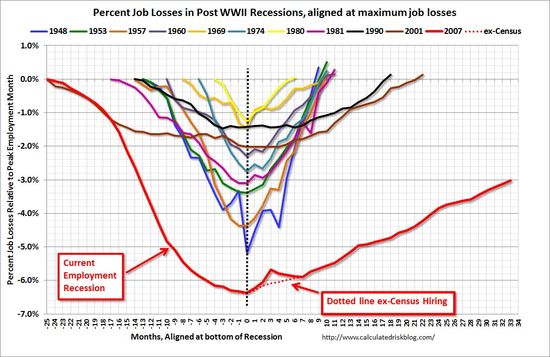
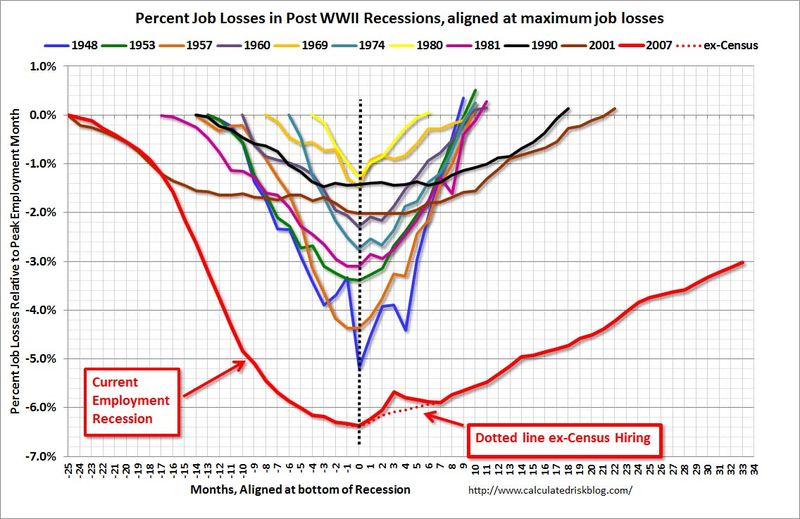
Unemployment hit a low of 7.7% in November - the lowest point since December 2008 – the Bureau of Labor Statistics announced this morning, down from 7.9% the previous month. Despite the impact of Sandy, November saw the creation of 146,000 new jobs, nearly two times more than what analysts expected. However, the long-term unemployment rate moved little, with nearly 4.8 million people out of work for 27 weeks or longer, making up 40% of the overall number of unemployed. Derek Thompson summarizes the data:

[T]his was a pretty average jobs report. But if the numbers hold — in light of Hurricane Sandy and the fiscal cliff and trouble with manufacturing in response to iffy global demand — this pretty-average report amounts to better-than-average news for the economy heading into 2013.

Felix Salmon argues that "the employment emergency is over":

America should have millions more people at work than it does, and there’s a very strong case, looking at levels alone, for further economic stimulus to help us further in the right direction. But there’s something oxymoronic about the concept of a permanent state of emergency. And in terms of how strong the recovery feels, first derivatives are just as important as levels: if unemployment has fallen from 8.7% to 7.7% in the past year, that feels better than an economy where unemployment has risen from, say, 6.1% to 7.1%.

James Pethokoukis underscores the anemic wage-growth trends:

In November, average hourly earnings for all employees on private nonfarm payrolls rose by 4 cents to $23.63. Over the past 12 months, average hourly earnings have risen by 1.7%. Unfortunately, inflation — as measured by the consumer price index — has risen by 2.2% over the past year, meaning average hourly earnings have fallen by 0.5% in real terms.

He adds that job creation is "far too slow to get the labor market back to pre-recession levels or boost wages."  Jared Bernstein's view:

[F]actoring in today’s report, the average pace of payroll growth over the past three months is about 140,000 overall and 150,000 in the private sector. That pace is consistent with an economy growing at a decent clip and with a slowly declining unemployment rate.  It is not, however, fast enough job growth to quickly reduce the large gaps in output, employment, and earnings that continue to hold back working families.

Greg Ip weighs in:

It seems likely that ongoing structural restraints are depressing the size of the labour force: early retirement, more of the unemployed giving up the job hunt, perhaps even shrinking immigration. As Jared Bernstein recently noted, this spells trouble not in the short term but in the long term, because it undermines America’s potential growth rate.

Phil Izzo wonders whether Sandy wasn't responsible for the lower-than-expected unemployment rate:

The definition of unemployed is that the person was was looking for a job and was available to work during the reference week. An unemployed person volunteering in Sandy cleanup may not tell a surveyor that he’s available for work, and is then counted as out of the labor force.

Tim Iacono breaks down sector trends in the report: 

[R]etail hiring was a major factor in the most recent payroll gains – up 53,000 overall paced by a surge of 33,000 at clothing stores – suggesting that seasonal adjustments are again playing an outsized role this holiday season. Retail employment has increased by 140,000 over just the last three months.

He also notes where the economy is shedding jobs:

Construction jobs declined by 20,000, manufacturing employment fell by 7,000, and a decline of 1,000 in government payrolls rounded out the declining categories as modest hiring at the state level was more than offset by job losses at the federal and local level.

Bill McBride homes in on the government data:

[A] key theme we've been discussing is that we are nearing the end of state and local government layoffs … This has been ongoing for over 3 years, and it appears the drag from state and local governments is mostly over. Of course, employment at the Federal level is still shrinking, and everyone expects more austerity in 2013.

Yglesias is baffled by the construction number:

[T]he divergence between new housing starts and residential construction employment looks to have been going on for months now…. So what's going on? Is something being mis-measured? Is the construction industry experiencing a productivity boom? Are hours per worker surging but firms aren't adding staff for some reason?

Brad Plumer notes the possible impact of Sandy behind the construction-jobs drop-off:

About a million workers said they were working part time rather than full time because of “bad weather.” And the economy lost 20,000 construction jobs. In theory, those jobs should come back as post-hurricane rebuilding gets underway. But it makes the underlying trend more difficult to pick out. 

Emphasizing that "untold numbers of Americans remain stranded in chronic joblessness," Greg Sargent spells out the significance the jobs report should have on the current political agenda:

Some Dems in Congress were planning to seize on today’s jobs numbers to renew the push for more stimulus in any fiscal cliff deal — an extension of unemployment insurance and the payroll tax cut, and more infrastructure spending to boost the economy. The fact that today’s jobs numbers were more decent than expected should not change this. Millions of Americans are still suffering.

(Chart from Calculated Risk.)

The Future Of Promiscuity

Ambers wonders about it:

Will promiscuity define young gays forever? I don't think so. But I also think that society will become more tolerant of what might be called dignified promiscuity: open relationships and marriages, where the negative externalities of promiscuity are dealt with at their source, and where safe sex is respected, even within an ethic that allows for a more interesting sex life. I'd guess that straights will become more promiscuous and gays will become less promiscuous, and some middle ground will be carved out.

That phrase "dignified promiscuity" is a beaut, but maybe a little de trop. What we're really talking about is more like "humane discretion" – along the kind of lines outlined by Jon Rauch in this brilliant essay on the "Hidden Law". This has long worked for heterosexual marriages, because it works for human beings. But I've also long argued that marriages between two men, two women or one man and a woman are inherently different in nature, because of the power of gender. They require different strategies to sustain themselves.

To wit: Lesbian marriages can become suffocating if not tended to; heterosexual marriages can become gulfs of misunderstanding when it comes to the two genders; gay male marriages may require some Weddingaislediscreet adjustments as time goes by in order to keep the union alive and healthy. I don't think the government should be peering into any of this – because the human mess behind the civil veneer is for those in it to understand and grapple with, and no one else. But the external model of life-long commitment to one another may be more durable if different dynamics are allowed to play out in different permutations. People will figure this out. In private. If we leave them alone.

As for the broader cultural impact, I think there's little doubt which group will be most influenced by which. Gay people, almost entirely brought up in straight households, will increasingly see their potential marriages as no different than their siblings' and peers'. And the cultural power of 95 percent of marriages over the 5 percent is much greater than the other way round. So chill. Let this social shift take its time. I'd add only one more thing: we really need a dialogue within the gay community of how better to support, celebrate and include married couples. Marriage is hard. We need to talk more about how to stay together, avoid the pitfalls of marriage and its high rate of divorce in the past, and air the unique issues a gay male couple and a lesbian couple inevitably face.

We are pioneers; and we need to discuss more clearly how to keep our marriages secure and safe and durable. That isn't political work; it's personal and social work. We're at the dawn of this new era, which is why the success of actual, durable marriages – in providing mutual security, fidelity and responsibility for life – is so important. Maybe we gays can lead the way in resuscitating this vital social institution for the 21st Century.

Maybe we already have.

Ask Massie Anything: Should The US Have A Parliamentary System?

Alex recently touched on the importance of proportion in politics:

The zero sum approach to politics in which everything the other mob did, does or proposes to do is invariably at best stupid and more probably wicked contributes to the public’s not unreasonable To hell with them all mood. Sensible people appreciate that it is statistically improbable that Labour could be in power for more than a dozen years without doing some good and sensible things. Similarly, sensible people understand that it is unlikely that everything this present government does can be motivated by the worst of intentions.

Watch his previous videos here, here, here, here, here and here.

Mr President, Don’t Even Think About It

157827488

Charlie Savage reports on the Obama administration's response to the legalization of marijuana in Colorado and Washington. Balko is discouraged:

Notice what words and phrases do not appear in the New York Times article: pivot, possibly ending the war on drugs, whether our drug laws are doing more harm than good, the drug war a failure, crime and misery [the drug war] creates. You'd think that if Obama were going to "pivot," simply leaving alone two states that overwhelmingly legalized pot and gave him their electoral votes would be the best place to start.

Pete Guither sees the article as a trial balloon:

The article goes on to explore some potentially extreme options with no indication that these specific options are being considered. This appears to be a blatant political trial balloon using the New York Times to see what kinds of reactions there are and what political fallout might come from action… or inaction.

Well, since they're asking: if they decide to treat the law-abiding citizens of Colorado and Washington as dangerous felons; if they decide to allocate their precious law enforcement powers to persecuting and arresting people for following a state law that they have themselves just passed by clear majorities; if they decide that opposing a near majority of Americans in continuing to prosecute the drug war on marijuana, even when the core of their own supporters want an end to Prohibition, and even when that Prohibition makes no sense … then we will give them hell.

And it will get personal. The president wasn't just once a pot-smoker, he was a very serious pothead. His own life and career prove that this substance is no more potentially damaginKush-trichome-closeupg to a human being than alcohol, which is not only legal but marketed to us with abandon. The future coalition he has built – especially its Millennial base – will splinter. Maybe even some libertarian Republicans will seize the issue and champion federalism consistently for a change.

But the main reason the president should instruct the Justice Department that this is not an area for discretionary prosecution is that choosing to focus on pot-prohibition in states that have legalized it defies reason. One of my core arguments for Obama has long been his adoption of what I consider pretty reasonable, if always debatable, policies. He is not an extremist, proposing laws and regulations that are designed to make a cultural point or wage a cultural war; he's a pragmatist, trying to fix existing problems.

Mr President, the electoral decisions of the citizens of two states are not an existing problem.

The personal legal use of marijuana in those states is not a problem.

The War on Drugs is the problem.

And the federal War on Marijuana is racist in its enforcement, ridiculous as a matter of science, outrageous in terms of personal liberty, and inimical to federalism. What we want – indeed demand – is the beginning of a review of whether the science justifies in any way the classification of cannabis as a Schedule One substance under federal law – making it as dangerous as heroin or cocaine. This didn't make any sense in 1970 when it took force; it makes even less sense today. Here is what defines a Schedule 1 substance:

The drug or other substance has a high potential for abuse.

The drug or other substance has no currently accepted medical use in treatment in the United States.

There is a lack of accepted safety for use of the drug or other substance under medical supervision.

Cannabis fails on all three counts. No currently acceptable medical use when 18 states and the District of Columbia now allow it for exactly such medical use? A lack of "accepted safety" even under medical supervision? How many overdoses have you heard of lately with marijuana – unless you count sleeping through American Horror Story an overdose? There is no case for marijuana under any sane, reasonable rubric to be classified as Schedule One. Instead of girding for tougher enforcement, the Obama administration should re-open the case for re-classifying marijuana, and leave the citizens of Washington and Colorado alone. There are precedents on a state level:

On Feb. 17, 2010, after reviewing testimony from four public hearings and reading through more than 10,000 pages of submitted material, members of the Iowa Board of Pharmacy unanimously voted to recommend that the Iowa legislature remove marijuana from Schedule I of the Iowa Controlled Substances Act.

Let's have this debate openly and honestly. Let the government prove that marijuana is as dangerous as heroin and should be treated as such. The very process will reveal the anachronism of the provision itself and the racial and cultural panic that created it. The very discussion will point to an inevitable, scientific conclusion that the current federal policy is based on nothing.

So do nothing, Mr president, with respect to these states and their legitimate decisions. Set the DEA's priorities so that this trivial, medically useful, pleasure is not in any way a priority for law enforcement. Let the states figure this out, as they are on marriage equality.

Lead from behind. An entire generation is ahead of you.

Update from a reader, who corrects me but underscores my broader point:

Cocaine is actually Schedule II (it has accepted medical uses and is on-hand in most ER's as a vaso-constrictor to stop bleeding) but it is not Schedule I as is implied.  So the Controlled Substances Act is saying cannabis is MORE dangerous than cocaine and even methamphetamine, which is also Schedule II and a prescription medication marketed under the brand "desoxyn".

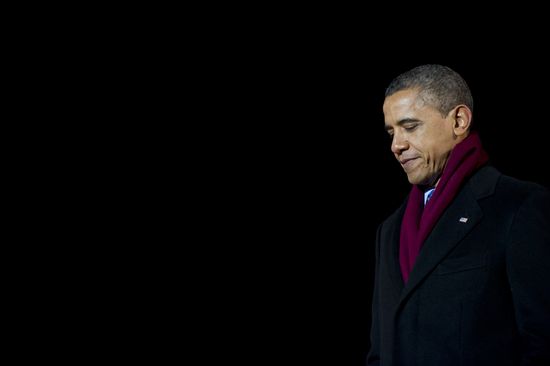
(Photos: Saul Loeb/Getty, and a close-up of a bud of Kush cannabis from Wiki)