Kottke rounds up the best photos-of-the-year lists.
Month: December 2012
The “Heavy Favorite” For 2016
If she runs, Harry Enten bets that Clinton will win the 2016 Democratic primary. He notes that she is polling at 61% already:
You might wonder how normal that is? It's in another stratosphere. I went into the Roper archives to examine races where no incumbent was running for re-election, and only Al Gore, at around 55% in early 1997 for the 2000 run, comes anywhere close. George HW Bush was only around 40% at this point in the 1988 cycle; Bob Dole was near 50% for 1996; and George W Bush was between 20% and 25% in 2000.
He goes on:
Some may be quick to dismiss early survey data, but almost always, those like Dole, Gore and now Clinton, who poll high this early and run, tend to march to the nomination.
The Reptilian Romney

John O'Sullivan Jonah Goldberg blurts out the bleeding obvious:
I think, Mitt Romney had, what I have been calling it for a long time, an authentic inauthenticity problem. He seems fake but that is actually him. When you see an alligator for the first time and you say there is no way that is real and then you lean over and you see it move, whoa, it is real. Alligators just look fake. Mitt Romney just looks fake. He seems unauthentic and it was a real problem for him in a way that I think if you had a different candidate who had the same wealth, maybe even the same business background but was a little bit more organic, you know did not refer to his love of sport without the “s” at the end, that sort of thing it would have helped.
Heh. He was also really, really, really white in a much more coffee-colored country. Update from a reader:
You mis-attributed a quote to John O’Sullivan. The quote is accurate, but it was Jonah Goldberg who said it.
(Photo: an albino alligator from Wiki)
The Death Knell For Football? Ctd
Travis Waldron shifts the narrative on the coverage of NFL linebacker Jovan Belcher's murder-suicide:
[W]hile it’s important to continue exploring the link between football and brain injuries and the societal effects those brain injuries can have, using concussions as a catch-all explainer of Belcher and Perkins’ death strikes me as a convenient way to gloss over the tougher-to-handle fact that this may have simply been a case of domestic violence. By using concussions or CTE as such a catch-all, we miss the chance to explore the prevalence of domestic violence in our society and the mores, norms, and gender roles that make that violence so prevalent. We miss the opportunity to examine policies we could enact (like the Violence Against Women Act, which will come in front of Congress again this month) and societal changes we need to make to ensure that domestic violence — and murder-suicide — is less likely to occur in the future.
I agree. But the two things are not mutually exclusive. Previous coverage here and here.
The Cannabis Closet Cracks Open
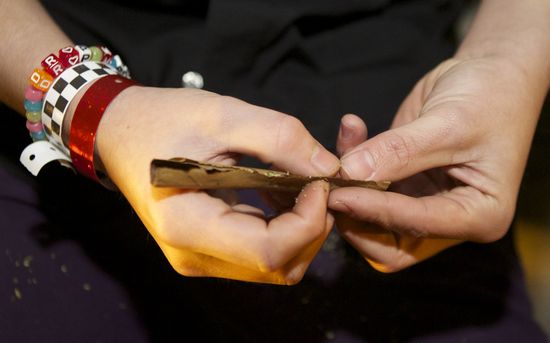
Marijuana is now legal in Washington state:
Today, for the first time in 89 years (Washington lawmakers initially outlawed cannabis in 1923, 14 years ahead of the enactment of federal prohibition.), an adult may possess up to one ounce cannabis (and/or up to 16 ounces of marijuana-infused product in solid form, and 72 ounces of marijuana-infused product in liquid form) for their own personal use in private — and they may do without being in violation of state law.
Sullum compares marijuana legalization and marriage equality:
Just as an individual’s attitude toward gay people depends to a large extent on how many he knows (or, more to the point, realizes he knows), his attitude toward pot smokers (in particular, his opinion about whether they should be treated like criminals) is apt to be influenced by his firsthand experience with them.
It is therefore not surprising that generational differences in opinions about marijuana legalization reflect generational differences in marijuana use. According to the 2011 National Survey on Drug Use and Health, most Americans between the ages of 12 and 60 have tried marijuana, while most Americans in their 60s or older have not. The highest rates of lifetime use (around 57 percent) are among people currently in their late 20s, late 40s, and early 50s, while recent use is most common among Americans of college age, about a third of whom admitted smoking pot in the previous year. People 65 and older have the lowest rates of lifetime and past-year use (12 percent and 1 percent, respectively). People younger than that, even if they have never smoked pot, probably know people who have, and that kind of personal experience provides an important reality check on the government’s anti-pot propaganda.
Our collection of reader testimonies about their own Prohibition-necessary Cannabis Closet can be purchased here. It's quite a document on our changing times.
(Photo: A Tacoma resident rolls a joint shortly after a law legalizing the recreational use of marijuana took effect on December 6, 2012 in Seattle, Washington. By Stephen Brashear/Getty Images)
Yglesias Award Nominee
"House Republicans are prepared to get to yes. House Republicans are not prepared to get to foolish, and it is foolish to reject President Obama’s own self-described architecture of $3 in spending cuts for every dollar in new revenue," - Illinois GOP congressman Peter Roskam, an aide to Speaker John Boehner.
Remember that primary debate when they all rejected even a 10-1 deal? That's the difference an election makes. And should make.
Ask McKibben Anything: Can Capitalism Help Combat Climate Change?
Bill recently wrote in the Washington Post about the Keystone pipeline and taxing carbon:
Those oil barons, certain they will prevail, have kept pouring money into Washington. Just last month, a New York Times profile of a presidential confidante, Anita Dunn, revealed that her lobbying firm was on the Keystone payroll. In other words, in Washington terms, the pipeline is still wired. One oil executive, the morning after Tuesday’s election, was quoted as saying, “We expect it will be approved.”
If that happens, it will mean the president doesn’t understand that his legacy requires dealing with climate change — and that dealing with climate change requires leaving carbon in the ground. There are lots of other actions that will be necessary, too: A serious tax on carbon, for instance, has long been the sine qua non of real progress. But that requires getting House Majority Leader John Boehner and the House Republicans on board. The truth is, we’ve got to do it all, and it will be hard, harder than anything else the administration is considering, since it runs straight up against the richest industry on Earth.
Bill’s previous videos are here, here, here, here, here, here, here, and here.Read some of his Sandy-related coverage featured on the Dish here, here and here. His campaign against the fossil fuel industry, Do The Math, is catching fire across the country.
Christmas Hathos Alert
Something to listen to when you're flying home for the holidays in your private jet:
The Loony Right
Quote For The Day II
“Reading isn’t the opposite of doing. It’s the opposite of dying,” – Will Schwalbe.
 The Dish