Worrying Over A Wonder Drug

Deborah Sontag reports (NYT) that a relatively new maintenance drug for opiate addicts has made its way to the streets:

Buprenorphine has become both medication and dope: a treatment with considerable successes and also failures, as well as a street and prison drug bedeviling local authorities. It has attracted unscrupulous doctors and caused more health complications and deaths than its advocates acknowledge. It has also become a lucrative commodity, creating moneymaking opportunities – for manufacturers, doctors, drug dealers and even patients – that have undermined a public health innovation meant for social good. And the drug’s problems have emboldened some insurers to limit coverage of the medication, which cost state Medicaid agencies at least $857 million over a three-year period through 2012, a New York Times survey found.

Alec MacGillis defends the treatment and slams its media coverage:

Buprenorphine – bupe for short – has proven so successful at allowing opiate addicts to feel normal and go about their lives that advocates hail it as something of a wonder drug.

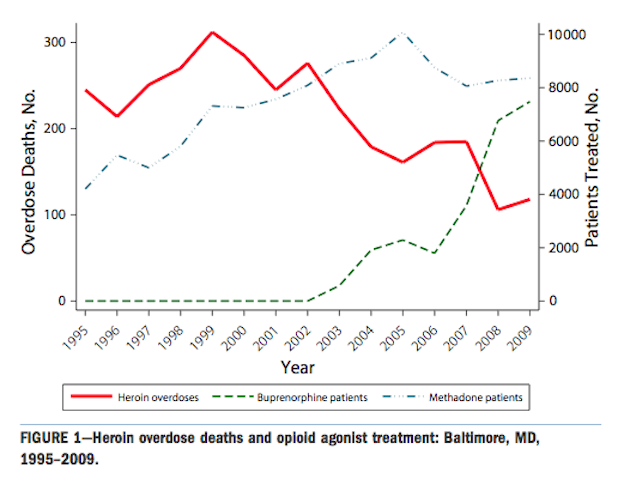
And the benefits multiply – less painkiller and heroin abuse means less HIV transmission, less hepatitis C, and, yes, fewer fatal overdoses. Check out the recent trends in buprenorphine use and heroin overdoses in Baltimore, which has embraced bupe as a weapon against its deeply entrenched heroin problem. No, correlation does not equal causation—for one thing, Baltimore was over the same period also expanding the use of naloxone, medication used by drug users and EMTs to reverse overdoses as they’re occurring. Still, it’s hard not to draw certain conclusions from these lines displayed in a recent article in the American Journal of Public Health, which echo the plunge in overdoses in France, an early adopter of buprenorphine.

overdose-chart

So what’s not to like? Why are we not shipping as much buprenorphine as possible into small towns in Maine and eastern Oregon and eastern Kentucky and all the other places reporting surges in abuse of painkillers and now, increasingly, heroin? Well, partly because bupe has gotten stuck with its own stigma—not as strong as methadone’s, but damaging nonetheless. … The Times cites data showing 402 fatal overdoses linked to buprenorphine in the United States reported to the F.D.A. from spring 2003 through September. As the article notes, this pales in comparison with the 2,826 attributed to methadone over roughly the same period and the more than 19,000 fatal overdoses from opioids overall in 2010 alone.

The fact is, there is no silver bullet for the country’s growing opiate addiction problem. And any approach is going to seem tainted, to bourgeois eyes, by the inherently chaotic and desperate nature of the milieu in which opiate addiction is rooted (though not confined to – painkiller abuse has been on the rise in tony suburbs, too). It would be deeply unfortunate if fraught portrayals in the media with decidedly oversimplified, alarmist headlines had the side effect of dulling one of the best tools we have in this fight.

Acting Your Age Is An Act

Lynne Segal, author of Out of Time: The Pleasures and the Perils of Aging, observes that the most predictable part of life always manages to take us by surprise:

Perhaps the oddest part of getting older is that few ever feel their age – a disconnect that increases with time. Writing in her late 60s, Ms. Segal marvels at the way her age feels somehow separate from her core self. She describes “lurching around between the decades, writing the wrong date on cheques,” wondering, in essence, how old she is. She is hardly alone. In a 2009 survey of Americans, those over 50 claimed to feel at least ten years younger than their chronological age; many over 65 said they felt up to 20 years younger. “Acting our age,” observes Will Self, an English writer, “is something that requires an enormous suspension of disbelief.”

What Will Obamacare Cost Small Businesses?

What Laszewski is hearing:

The first small group renewals are now occurring––the January 1 renewals that typically have to be delivered during the month of November under state law.

Many employers are facing significant changes in order to comply with Obamacare and therefore price increases. One Maryland broker I spoke to this week has 90 small group accounts and he reports his smallest increase was 15%, his largest was 69%, and most are in the 30% – 40% range. (By comparison, Mercer just announced the average large employer health care cost increase for 2014 will be 5.2%, meaning small groups could have reasonably expected an increase under 10% without Obamacare.) The biggest rate increases are generally going to those employers with the youngest groups the most impacted by the new “age compression” rules.

Ask Charles Camosy Anything: Why Don’t We Eat Our Pets?

In our latest video from Christian theologian Charles Camosy, he explores the moral hypocrisy of treating dogs as companions while treating pigs as food:

His book, For Love of Animals: Christian Ethics, Consistent Action, came out last month. In a recent interview, Camosy suggested that at the very least, meat-eaters should choose where their meat comes from. He also offered some advice on how individual Catholic parishes might encourage such behavior:

[B]uying meat from local farms [instead of factory farms] is a much, much better option. No question. In general, we do much better buying locally rather than simply rolling over for consumerism and picking the cheapest price. We absolutely must become more connected to the processes by which food and other products come to us–not least to make sure that we are not formally participating in grave evil. This is a great opportunity for the Church to be the Church, and create structures of community to resist consumerism. Perhaps more parishes and dioceses could have formal programs where locally grown and raised food could be for sale? And these places should absolutely refuse to serve factory farmed meat.

Our recent thread on the cruelty of factory farming is here. Previous Dish on eating pigs vs dogs here. Camosy’s previous videos are here. Our full Ask Anything archive is here.

Mike Allen, Busted, Ctd

Chait reflects on the new Mike Allen take-down:

Playbook goes beyond the routine and wildly promiscuous use of native advertising. Indeed, the behavior Wemple documents would ordinarily amount to a scandal and a likely firing offense, except that it seems to be Allen’s essential job description. As Wemple points out, some of the advertisers are also Allen’s friends. And, of course, his sources also consist significantly of his friends.

The intermingling of media, business, and elected officials that is on gross display once a year during the White House Correspondents’ Dinner, and which Politico both covers and participates in with peerless enthusiasm, is Allen’s vision of how journalism is supposed to function normally. Sources, friends, and sponsors all blur into one mutually protective circle. Last year, Allen gave breathless, PR-esque coverage to Fix the Debt, the pillar of respectable establishmentarian lobbying, and then, within days, announced that the group was sponsoring Playbook. …

The Mike Allen scandal is not that advertisers purchased favorable coverage in Playbook. The scandal is that, at this point, such corruption is unnecessary.

Drum sees the story as the “latest example of the press going into full stonewall mode whenever they’re the ones a story is about”:

Of course [Editor-in-Chief John] Harris refused to say anything. It’s standard journalistic practice. It’s only other people who have to answer questions. It’s outrageous to expect news organizations themselves to do the same.

If the corruption is no longer a scandal, then surely a paper’s refusal to answer serious questions about its ethics is. By what right does Politico demand accountability from those in power, while refusing to engage in even a modicum of accountability itself? The lack of response must lead any objective person to believe the worst: that Playbook is neither ethical nor journalism. More from the Columbia Journalism Review:

Allen is DC’s access journalist par excellence, which is saying something in that town. Most beat journalists toss off the occasional beat sweetener/source greaser to gain access to a newsmaker and soft-pedal negative news to maintain that access. Access is a kind of currency: Get it and you can break news and rub elbows with important people. Allen makes this ugly sausage-making process more corrupt by mixing access currency with actual currency. Buy native ads in Playbook, get embarrassingly favorable news coverage in Playbook.

It stinks to high heaven.

Should Bikers Be Forced To Wear A Helmet?

Motorcycle Laws

The Economist argues yes:

When states repeal or weaken motorcycle-helmet laws, as dozens have, helmet use falls, fatalities rise and head-injury hospitalisations soar. Biker deaths rose 18% after Michigan repealed its all-rider helmet law in 2012. A rule obliges unhelmeted Michigan riders to carry at least $20,000 in medical-payments coverage. That does not even cover initial stabilisation in intensive care after a nasty crash.

Helmet-haters claim that increased deaths merely reflect a jump in miles ridden after laws are repealed, as bikers enjoy the wind in their hair. Not so. Some studies measure death rates by motorcycle-miles travelled: deaths-per-bike-mile rose 25% when Texas scrapped helmets, for instance.

But Ben Richmond feels that “statistics just don’t work against an emotional appeal of comparing laws to tyranny”:

[T]he trend as of late is against mandatory helmet laws. Today, 19 states and the District of Columbia have universal helmet laws. Only three states have no helmet requirements—Illinois, Iowa, and New Hampshire—while the rest have age-specified requirements. The American Journal of Public Health points to the laws that protect minors, saying that they prove “that legislators and some antihelmet law forces have accepted a role for paternalism in this debate.”

Some but not much, it seems. Since 1997 seven states have repealed their universal helmet laws. No state has enacted a universal helmet law since Louisiana reinstated the law in 2004.

Why The Nuclear Option Is On The Table

Last week, Bouie argued that Democrats “can nuke the filibuster and defend the president’s prerogative, or, they can let the GOP establish a new precedent, where the Senate only confirms Republicans nominees”:

Yes, at several points during George W. Bush’s tenure, Democrats filibustered his judicial nominees. But the issue isn’t filibustering as much as it is the GOP’s categorical opposition to Obama’s nominees. His nominations have faced an unprecedented level of obstruction, leading to widespread vacancies and judicial emergencies. Overall, Obama has had fewer federal judges confirmed than either Bush or Clinton.

Beutler weighed in:

Republicans could just agree to confirm some of Obama’s judges. I think Democrats would probably drop the nuclear threat if Republicans cleared two of Obama’s three D.C. circuit nominees. Maybe Republicans could secure the confirmation of a third, more conservative judge, or get the remaining seat on the court eliminated legislatively.
But their current position — daring Dems to go all the way nuclear or cave completely — gives Dems almost no choice but to pull the trigger. If Republicans had meritorious objections to any of these nominees, the nuclear threat would be a disproportional escalation. Obama could find other judges. What they’re doing instead is a judicial replay of their unacceptable bid to unilaterally gut Wall Street’s consumer watchdog office and void the National Labor Relations Board. Democrats didn’t stand for that, and won. Republicans caved and confirmed several waylaid executive branch nominees over the course of just a few days. They should run the same play again. And if Republicans don’t fold, they should go nuclear.

Ramesh pushed back:

One of the vacancies Democrats are trying to fill used to be held by John Roberts. After he became chief justice, Bush nominated the impeccably qualified Peter Keisler for the spot. The Democrats filibustered him, and the seat has gone empty ever since. A reasonable case can be made against filibustering judicial nominations, or for it. What can’t reasonably be argued is that Democrats should be able to use the tactic to keep a judgeship open until they have the power to fill it with a liberal, at which point Republicans have to stand down.

Chait countered:

The judicial war, like the Israeli-Arab conflict, can be dated back to nearly any starting point, but as good a place to begin as any is 2005. That year, Senate Democrats began dramatically ramping up the use of the filibuster to block George W. Bush’s judicial nominations, whom they deemed ideologically extreme. That is the episode National Review’s Ramesh Ponnuru refers to recently in his defense of the current Republican Senate: “So when Democrats mounted an unprecedented series of filibusters against Bush’s appeals-court nominees,” Ponnuru writes sarcastically, “that was just normal politics.”
But Ponnuru omits what happened next. Republicans, outraged over the tactics, threatened to use the “nuclear option,” to change Senate rules and end the judicial filibuster. The two parties huddled and agreed that Democrats would stop filibustering judges except in the case of “extraordinary circumstances.” The Democrats then dropped filibusters even for highly ideologically nominees, like Janice Rogers Brown. That agreement held, more or less, ever since. As recently as this past June, Republican senators like John McCain agreed that Republicans would not filibuster Obama’s nominees, because “There has to be extraordinary circumstances to vote against them.”
For reasons that remain unclear, Senate Republicans have since decided to block Obama’s nominees to the D.C. Circuit Court, the country’s second-most-powerful court, en masse.

Sarah Binder looks at a larger data set:

First, most observers note that the GOP’s judicial blockade is unprecedented. I’m not so sure. Jonathan Chait observed in New York magazine on Wednesday that the Republican filibusters represent a “difference of degree that amounts to a difference of kind: They [the GOP] have declared their intent to impose permanent vacancies in Obama’s administration and in three swing seats in the crucial D.C. Circuit Court.” Others are bolder: Brian Beutler argues in Salon that the GOP’s “nullification strategy is radical, and entirely new.” The GOP’s rationales for blocking Obama’s D.C. Circuit appointees are certainly brash (and arguments about the circuit’s caseload have been effectively challenged). But along one dimension at least, GOP targeting of the D.C. Circuit reflects a more enduring partisan tactic in the wars over bench: Both parties for years have aggressively opposed nominees slated for appellate courts that are “balanced” between the two parties’ appointees.

Since 1981, 70 percent of nominees for circuits bending in favor of either Democratic or Republican appointees have been confirmed; over the same period, only 58 percent of nominees to evenly or near-evenly split courts have made it to the bench. Even if we control for the other forces that tend to depress the chances of confirmation (such as divided party government or the run up to a presidential election), nominations to split circuits are still less likely to be confirmed.

Selfie Defense

Silvia Killingsworth responds to Oxford Dictionaries choosing “selfie” as “Word of the Year”:

photo-35Strictly speaking, the modern-day selfie is a digital affair, but it’s a novel iteration of an old form: the self-portrait (a friend on Twitter joked, “was Lascaux the first selfie?”). As Kate Losse points out in her excellent primer, a notable point of inflection in the selfie’s recent meteoric rise was the addition of a front-facing camera to the iPhone 4. A selfie doesn’t even have to be of one’s face; my colleague Emily Greenhouse described Anthony Weiner as “a distributor of below-the-waist selfies.” Jack Dorsey, arguably the pioneer of the mass-distributed selfie, also introduced us to selfie Vines, six-second videos shareable on Twitter. Indeed, the selfie is nothing if not a visual shorthand for Dorsey’s initial vision for Twitter as a status updater—“here’s where I am, here’s what I’m doing.”

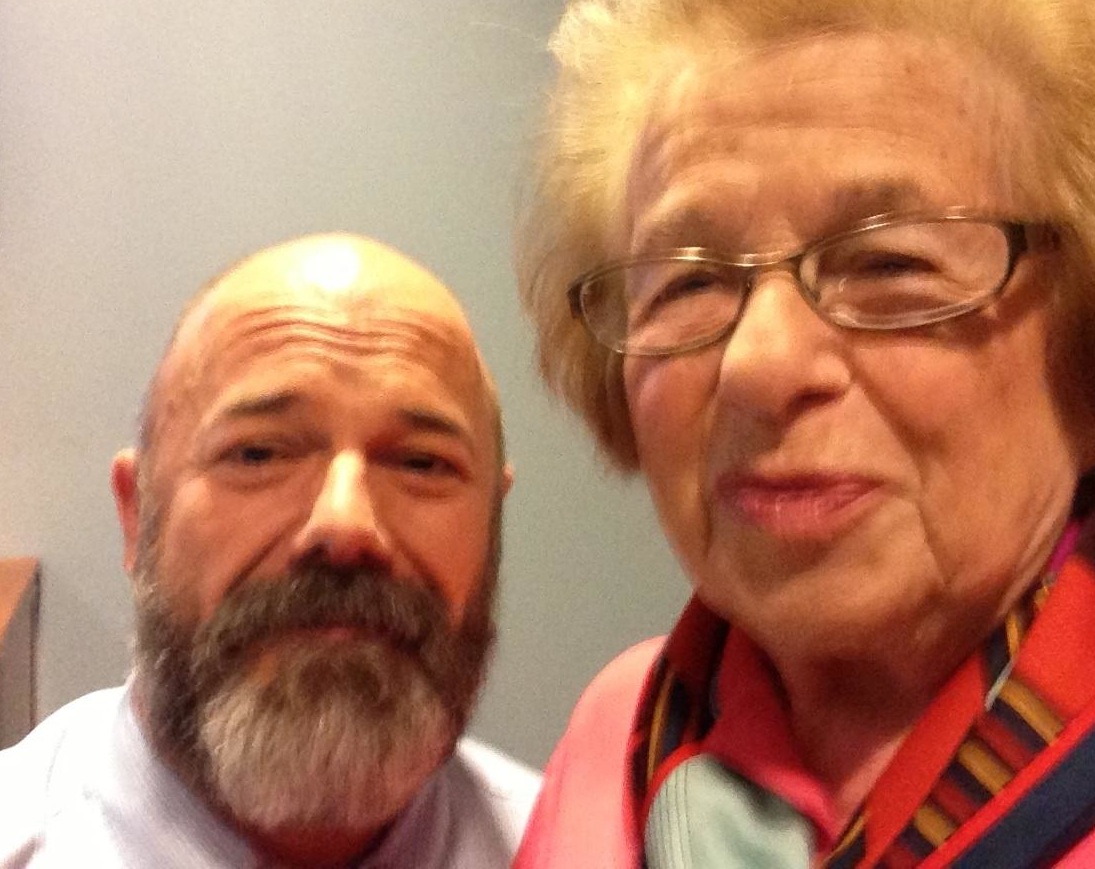
That selfie with Dr Ruth was taken last night in the green room of AC360 Later. Good times. OUPblog rounds up various scholarly reactions to the concept of the selfie. From José van Dijck, author of The Culture of Connectivity: A Critical History of Social Media:

Are all selfies the same? I don’t think so. There is quite a difference in taste and message between selfies on various social media platforms. Facebook selfies tend to be the most ordinary self-portraitures; they are pictures posted by people who want to look normal, happy, nice. Instagram is for ‘stylish’ selfies or ‘stylies’. On Instagram, you don’t portray yourself; you paint a desirable persona.

The apex of good taste may not be a self-portrait but an artistic picture of your most coveted object, such as an expensive bracelet on your wrist or four pairs of shoes representing you, your trendy husband, and your two adorable kids. Snapchat selfies are more like funny postcards: look at me, see how waggish I am, how abrasive I look, you’re not going to catch me in a snapshot. Snapchat selfies are meant to fade away like a dream as they vanish in less than ten seconds. So each selfie peculiarly reflects the flair and function of the platform through which it is posted, perhaps even more so than its sender’s taste. The medium is a big part of the message.

Poulos suggests that selfies “beam our conscious self-regard back at ourselves”:

[W]hat is it we see when we look back at ourselves again and again? Have you tried staring in the mirror for five minutes? (I have.) Try it. It’s like staring into a stranger’s eyes … much in the way that staring into a stranger’s eyes, nose to nose, quickly becomes strangely similar to staring into … your own.

Yep, it’s true. The deeper you look at anyone, including yourself, the more you see just another human. It might take a while, but selfies are on track to restore for us some of Narcissus’s innocent love for humanity. He was so gorgeous he couldn’t get on with his life. But that’s not true of any of us. And the longer we stare that fact in the face, the more our selfies will come to reflect what they so often already contain: the simple joy of being alive.

Or the eternal urge to get laid. Just keeping it real here. Update from a reader:

Ah, your “selfie” with Doctor Ruth brought back some funny memories. Before she became famous, Dr Ruth had a live call-in sex advice radio show in NYC, on Sunday night at 10 pm. I remember listening to her show with the volume turned way low so my mother wouldn’t catch me listening. Dr Ruth took her role as an educator so seriously, and knew how important it was in a suppressed society such as ours. And she would handle the people who called in as a goof with such grace. I recall a teenage girl who called in saying her boyfriend was pressuring her to perform oral sex, but she was afraid because she thought that boys ejaculated a gallon and she would choke. Dr Ruth calmly assured her that it would only be a teaspoon or so. The caller sounded so relieved, I’m guessing the boyfriend got his blowjob soon after.

Previous Dish on selfies here, here, and here.

The Political Threat Of Soaring Inequality

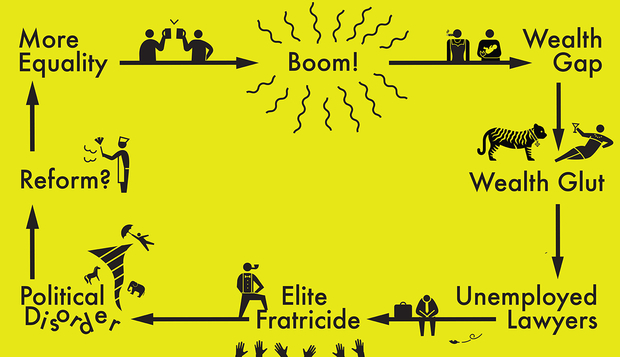
I read several pieces today that, together, were a somewhat grim insight into the acute social and economic crisis of our time. The first is a challenging and persuasive historical account by historian Peter Turchin of what Aristotle first observed in The Politics. The graphic (by Jennifer Daniel) is a crude but powerful summary of an historical pattern we see again and again in human history:

iedj9axTRNMI

In this cycle, I’d say the US is roughly in the elite fratricide moment, which means very choppy waters ahead. Turchin’s thesis is basically the following: the eternal tension between liberty and equality has a recognizable shape in historical and economic cycles, which are perhaps better understood today. The optimal moment for successful societies is when the middle class dominates, where political institutions reflect a mass interest in governing the society well, because everyone feels they have a stake (so more people than usual want and need collective success), and because they share some basic commonalities in experience, and so can find a way to compromise.

When societies grow more unequal, commonalities fray. Wealth accumulates among the few, who begin to see the polity as something to be used for private interests rather than engaged in for public-spirited reform. But as wealth at the top grows and grows, and as more and more of the middle class attempt to become part of the super-wealthy club, the loss of economic demand among the increasingly struggling majority puts a crimp in the social mobility of the wannabe elites. So we have a wealth glut: hugely wealthy one-percenters and a larger group of under-employed or unemployed professionals. It’s from these disgruntled elites that you will get the tribunes of the new plebeians. And they will be guided by revenge just as destructively as the top one percent is now guided by naked self-interest.

What disappears in this moment of the cycle is the lubricant for all successful polities: a sense that we are all in this together. When that crashes into economic stagnation, and the fight for a slice of the pie gets even more frenzied, you’re in for some serious social unrest – which will either lead to a period of reform or to further social and economic disintegration.

So do we have elite fratricide? When a Harvard and Princeton alum like Ted Cruz emerges as a wildly swinging wrecking ball for the entire global economy, you bet we do. When Republicans up the ante on judicial appointments by trying to prevent a president from filling any vacancies and when the filibuster has become much more common than, you know, actual legislation, ditto. When the response to that is to scrap one of the last remaining mechanisms for legislative balance and compromise, ditto. When a major political party offers nothing on a major social and fiscal problem, like our grotesquely inefficient form of socialized medicine, but is content merely to attack, attack and attack the law of the land and sabotage it, ditto. When a former Tory prime minister breaks ranks and accuses his elite successors of ignoring the impact of growing social immobility, ditto. When news channels decide to become propaganda channels, and when there are close to no major media institutions retaining trust as neutral arbiters of our national debate, ditto. When elite sister breaks with elite sister over an appeal to the masses, ditto.

You can probably add a whole litany of additional data points yourselves. But to my mind, what matters now in politics is finding a party or a candidate that recognizes this core problem and tries to ameliorate it.

Obama was and is such a person, but the response to his moderate reforms shows how deeply intractable this crisis now is. It may have to get worse before it gets better – and that may mean a dangerous period of unrest and dysfunction. But the challenge remains: how do we reverse this centrifugal force on the polity, especially when it has been put on steroids by the globalized economy? At some point, someone among the sane Republicans and sane Democrats is going to have to run on a robust and aggressive platform of reform that can – yes – begin sharing the wealth and tackling the entrenched and destabilizing perquisites of the super-rich, as well as tackling the populists who engage in selfish and dangerous exploitation of the resentments of our time.

For now, though, we actually have a figure in the middle of this polarizing vortex still straining to forge a middle ground. He’s our president. If he doesn’t succeed, someone else more radical will follow him. That’s why I, as a conservative, continue to support him. It’s time to leave ideology in the dust and see our predicament with unblinking eyes. It’s time for a conservatism that can grasp the necessity for reform – despite the ideology that made sense thirty years ago but has obviously become incapable of adjusting to our time – and build a new majority from the center on out. That small-c conservatism – the type that cares about the coherence and stability of the polity above all other considerations – can take shape among Democrats and Republicans. If Obama cannot succeed in it, more radical options will present themselves. But if real reform cannot find an anchor in this society anywhere, we will all face the consequences.