400 – 175 For Marriage Equality In Britain, Ctd

A gay Tory MP’s speech prior to the vote on marriage:

Yes, his name is Mike Freer. And he soon will be. In the crazed frenzy of this week’s transition, I realized last night that something truly profound had just happened. The country I grew up in – where I never heard the word homosexuality in my home and barely in the culture, except in hushes and shudders – is now on the brink of bringing actual equality and dignity to all its gay citizens. I remember touring Britain with “Virtually Normal” almost two decades ago and finding both Tories and lefties uncomprehending, if not actively hostile. The culture has changed beyond recognition. And undoutbtedly, clearly, unequivocally, for the better. And the argument was made even stronger by the fact that there are over a dozen openly gay Conservative members of parliament – an indication of how conservatism as a governing philosophy can and must include everyone in its ranks, or die a deserved and bigoted death.

How Massie frames the passage of marriage equality in the House of Commons:

[T]he battle for British Gay Marriage was in fact a rout. True, half the parliamentary Conservative party voted against the measure. True too, this is now being considered further evidence that David Cameron’s leadership skills – or, rather, since they are not the same thing – his party management skills are less than they might be.

But, for once, I think focusing on Tory divisions misses the rather bigger, simpler story. Nearly half the Conservative parliamentary party endorsed gay marriage in the House of Commons. And they did it on a free vote. That is quite a thing.

Joe My God rounds up more speeches by gay MPs.

Face Of The Day

ISRAEL-PALESTINIAN-CONFLICT-DEMOLITION

Members of a Palestinian family react after Israeli bulldozers demolished their family house in the Arab east Jerusalem neighborhood of Beit Hanina on February 5, 2013. Palestinian homes built without a construction permit are often demolished by order of the Jerusalem municipality. By Ahmad Gharabli/AFP/Getty Images.

More context:

Arab residents complain that it is nearly impossible to receive construction permits. The 33-member family displaced Tuesday said it was waiting to receive a permit. Jerusalem city councilor Meir Margalit, a critic of the demolitions, said he has seen a small increase in recent months.

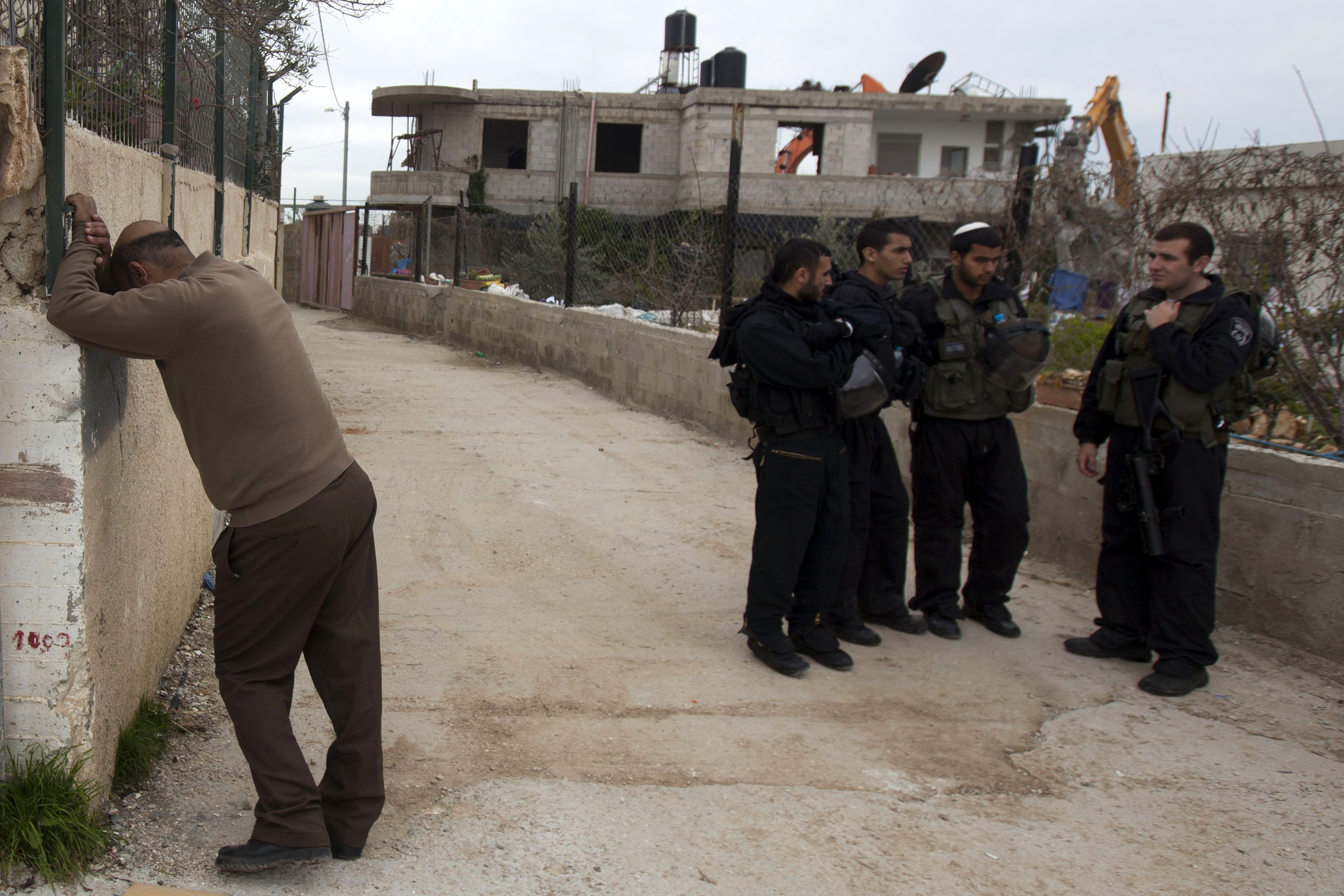
Another iconic image of the relationship between Israelis and Palestinians today after the jump. I’ve found it hard to get over the physical postures on both sides. They tell you so much:

ISRAEL-PALESTINIAN-CONFLICT-DEMOLITION

(Photo: A Palestinian man reacts near Israeli security forces after Israeli bulldozers demolished his family house in the Arab east Jerusalem neighborhood of Beit Hanina on February 5, 2013. By Ahmad Gharabli/AFP/Getty Images.)

Bittersweet Brokenness

[youtube http://www.youtube.com/watch?v=SVHYyrsW_Ok]

Commenting on the films of Wes Anderson, Michael Chabon reflects on the origins of the artistic impulse:

Everyone, sooner or later, gets a thorough schooling in brokenness. The question becomes: What to do with the pieces? Some people hunker down atop the local pile of ruins and make do, Bedouin tending their goats in the shade of shattered giants. Others set about breaking what remains of the world into bits ever smaller and more jagged, kicking through the rubble like kids running through piles of leaves. And some people, passing among the scattered pieces of that great overturned jigsaw puzzle, start to pick up a piece here, a piece there, with a vague yet irresistible notion that perhaps something might be done about putting the thing back together again.

Two difficulties with this latter scheme at once present themselves. First of all, we have only ever glimpsed, as if through half-closed lids, the picture on the lid of the jigsaw puzzle box. Second, no matter how diligent we have been about picking up pieces along the way, we will never have anywhere near enough of them to finish the job. The most we can hope to accomplish with our handful of salvaged bits—the bittersweet harvest of observation and experience—is to build a little world of our own.

Engineering A Bigger Crisis

Seth Baum worries that, in an attempt to geoengineer a solution to climate change, we may end up vulnerable to multiple global catastrophes happening at once:

[I]f we stop putting particles into the atmosphere, we get a very rapid temperature increase, until temperatures finally stabilize at where they would have been without the particles. This rapid temperature increase is many times faster than that of climate change alone and would be very damaging. ..

We’d be fools to impose that rapid temperature increase upon ourselves. However, if a big enough catastrophe occurred, then we could lose the capacity to continue the climate engineering. The catastrophe could be something like a major war or disease outbreak. If this causes society to stop climate engineering, then the rapid temperature increase would hit a population already very vulnerable from the initial catastrophe. The result is a double catastrophe that could be very devastating for humanity.

Return To Sender, Eventually

USPS

Sarah Kliff finds one place where the USPS excels:

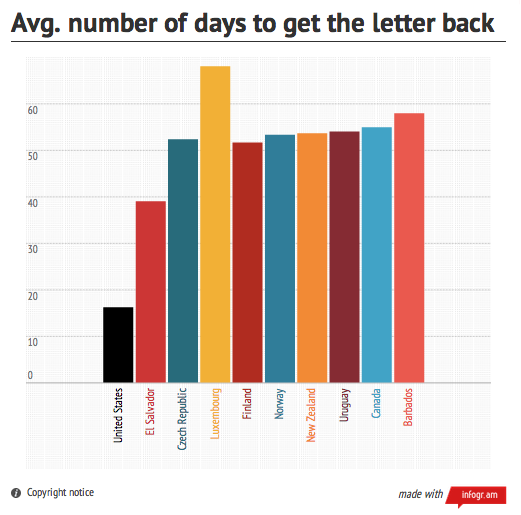
Researchers Alberto Chong, Rafael La Porta, Florencio Lopez-de-Silanes, and Andrei Shleifer sent letters to 10 fake addresses in 159 countries. The whole idea was to test government efficiency, by seeing how long it took to return the letters to the senders. All these countries, the researchers note, subscribe to an international postal convention (the Universal Postal Union, coordinated by the United Nations), which requires them to return letters they cannot deliver.

Not all are that great at it: Only 60 percent of the letters actually came back to the researchers. Among the countries that returned all 10 letters, the USPS was far and away the fastest to do so.

Spoilers Are Getting Harder To Avoid

Brian Stelter asks, “how can viewers who binged on all 13 episodes [of House Of Cards] in one sitting talk about the show without ruining the season for others who might wait weeks or months to watch it?” Joshua Gans ponders the dilemma:

This is actually the extreme manifestation of a problem that has been growing for decades. As I outlined in a paper presented last month at a BBC Workshop on the economics of broadcasting, there has always been a social component in the demand for television. It was strengthened because television was, in many ways, a non-storable good. But with time shifting and now on-demand, it can be stored. That is something many people want but the cost of that is that people watch television shows at different times. That means that it is harder to talk about those shows with your friends — which was a ‘water cooler’ benefit of watching television and coordinating viewing habits.

Astronaut Cuisine

Space Food

Amy Teitel examines it:

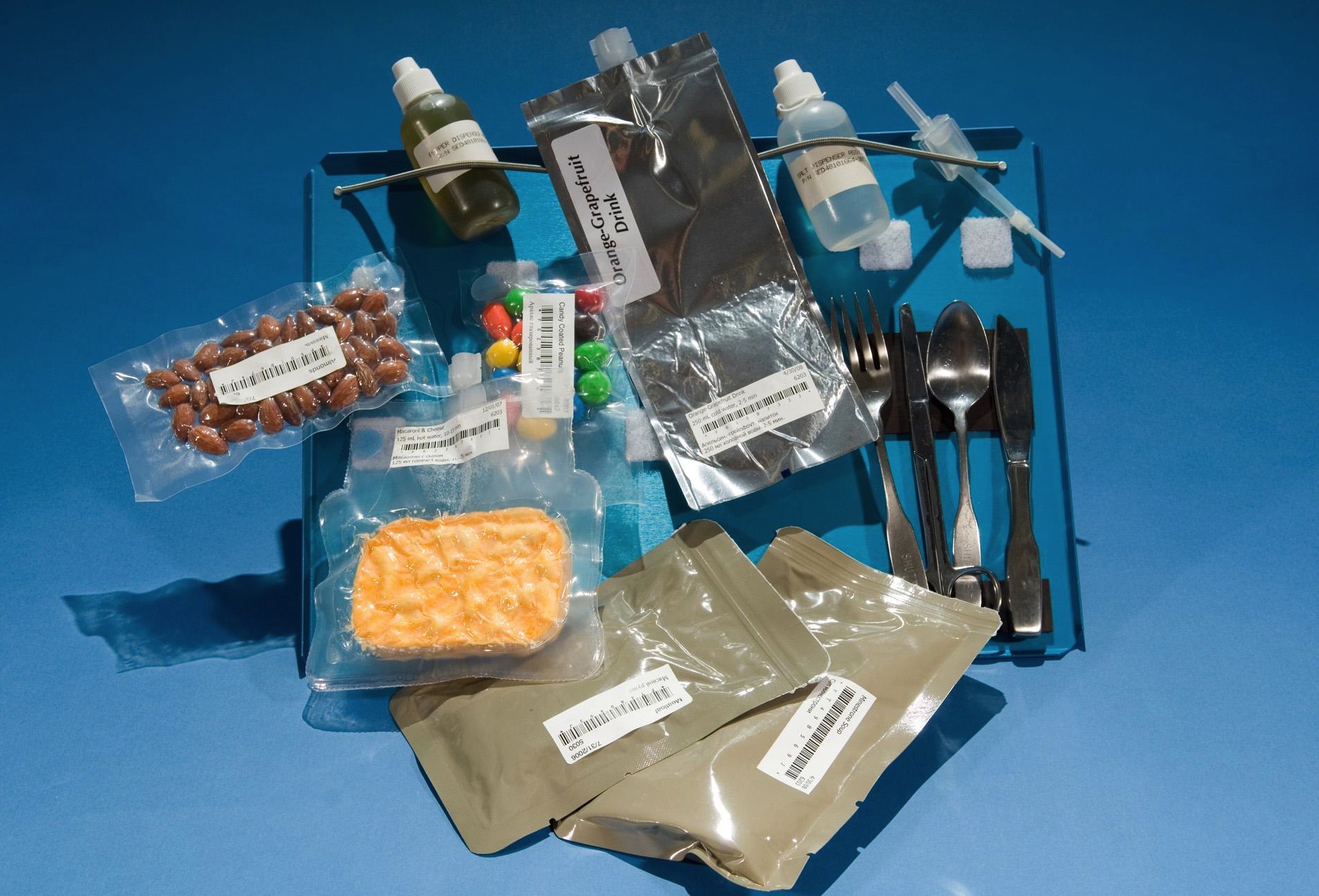
It turns out that a completely prepackaged menu is more than twice as heavy as the bioregenerative alternative, even with a significant fraction of the foods freeze-dried. The prepackaged diet was also found to have lower nutritional value; the light and heat used in sterilization does have some negative effects on the foods. But having food ready to eat does shorten the time crew have to devote to meals, freeing up more time for the things that burn calories like space walks.

(Image: Shuttle food tray from NASA.)

Will Robots Take Our Jobs?

Derek Thompson sees no reason to fixate on the question:

40 years from now, grappling with the fallout of an automated economy might be the most important economic issue of our time Today, however, worrying about robots taking over the economy feels more like an intellectual exercise. There’s no need for an artificial crisis over artificial intelligence.

Freddie’s perspective:

I’m mostly interested in these issues because they seem like a useful frame to discuss the long-term trend of less and less income going to labor, and in broader strokes, the way in which our society has become a massive machine for generating wealth for those at the top. I find the “income inequality” conversation to be frustrating on a variety of levels, in large part because it is so well worn. I’m trying to address how we think our society is supposed to function, and what happens when one of the basic planks starts to degrade. Contrary to Thompson and Yglesias, I don’t think it’s too early to think things through, even if these problems don’t start to affect us in mass in the near future. We have a habit of deciding problems are problems too late rather than too soon.

Previous Dish on the question here.