Ambers sizes up the Democrats’ presidential hopefuls:
The Democratic Party has two tiers of candidates. In order for the second tier of candidates to even conceive of running, then the first tier has to step aside. That first tier, of course, is occupied by Clinton. Her intentions are unknowable, but trust me when I tell you that, to the extent that the Democratic Party still has reliable donors and committed activists, the lion’s share are hoping Clinton runs and are ready to endorse her immediately. She is the 800-pound gorilla in a pantsuit. No one moves until she does.
I’m glad I didn’t use that metaphor. Update from a reader:
So am I crazy or is this pretty much exactly where the Democratic Party was heading into 2008? It was going to be a Hillary coronation, remember? Barack Obama was certainly a rising star, but nobody thought the idea of him getting the nomination was plausible, especially this far away from the election. At this point, there are many legitimate reasons that Clinton has earned the nomination, more so then before 2008. But if I were her, the parallels would make me uneasy. Particularly if she runs the same textbook frontrunner campaign she did in 2008. Presumably she has learned a thing or two since then.
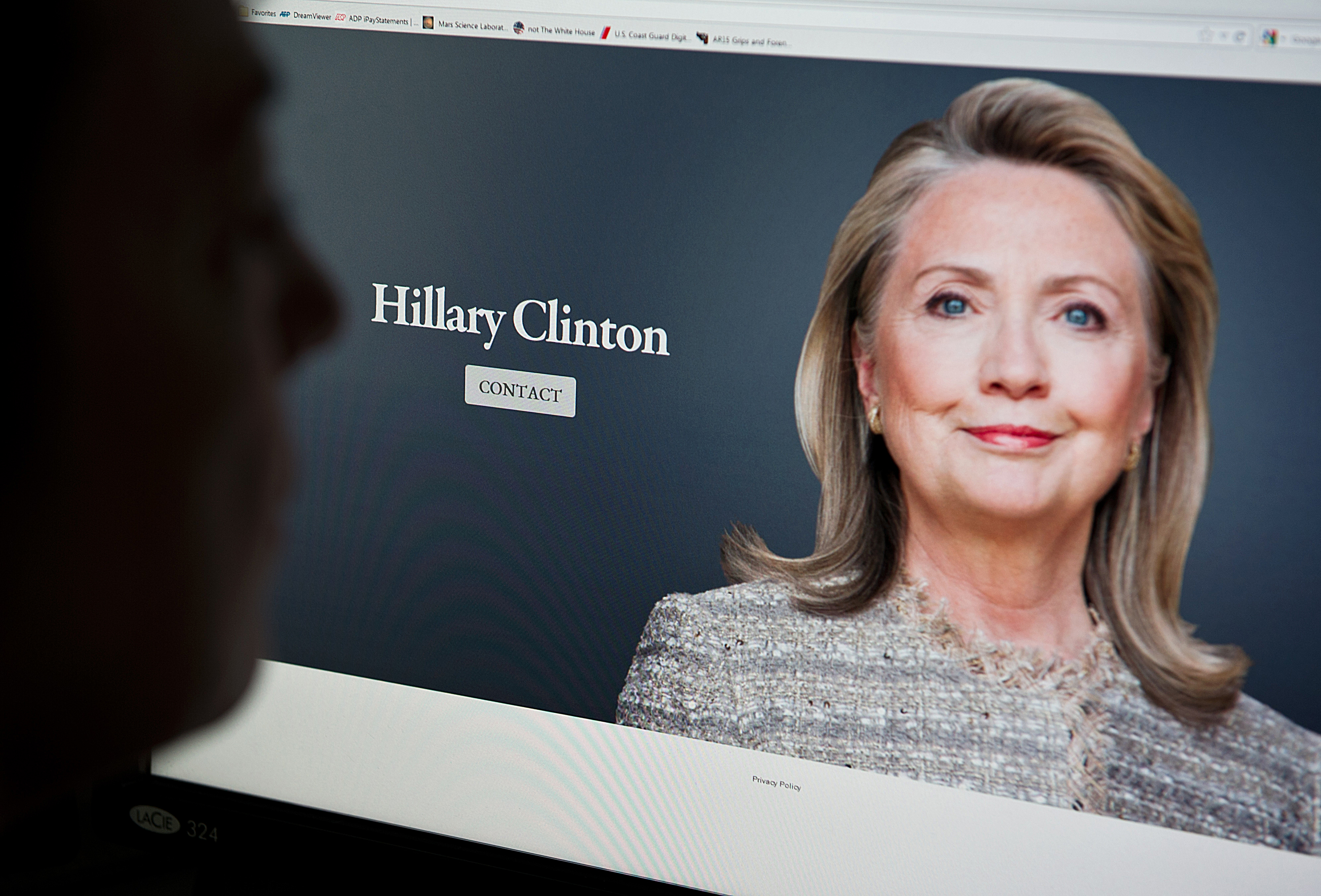
(Photo: This February 6, 2013 photo illustration shows a woman viewing the new website of Hillary Clinton in Washington, DC. Once again fueling speculation about whether she will run for president in 2016, Clinton launched a new website even before she officially stepped down as secretary of state. According to news reports, the website was registered on Thursday, just 24 hours before Clinton stepped down as America’s top diplomat, handing the baton to John Kerry. By Karen Bleier/AFP/Getty Images)
Eric Zorn makes a key observation about our ad-free, subscription-supported site:
[The second big test for Sullivan after he makes his initial fundraising nut will be whether he can sustain his operation without incessant pledge drives. After consulting with several journalists who cover online media I could identify only one other significant ad-free media site, Reader Supported News, an aggregator of liberal commentary that for at least two weeks every month bombards subscribers to its email newsletter with urgent appeals for money (21 such entreaties from Jan. 12 to Jan. 28 of this year, for example, with such subject headers as “Pick Up the Donation Pace, We Implore You”).
The site, a spinoff of the similarly themed but advertiser-backed TruthOut, has survived since the fall of 2009 purely by banging the cyber tin cup. Founder Marc Ash told me via email that he raises $65,000 a month this way and supports a staff of 14, though he declined to answer my questions about what this large staff does, given that nearly everything on his site simply links elsewhere, or to allay my suspicions that it’s far smaller or even nonexistent given that he posts no staff directory.
Sullivan, in contrast, has been striving for transparency, updating his readers frequently on his plans and progress, and avoiding the piteous hard sell that can make funding appeals more irritating than a thousand pop-up ads.
I mean, he was one, wasn’t he? The Reformation had not yet taken place. He’s already suffered various indignities – Shakespeare’s Tudor propaganda, stigmatized for scoliosis, then having his skull split open with an ax. He now has to be buried in a church he didn’t belong to? Maybe the parking lot wasn’t so bad, after all.
I have a bias here. I still think of many of the great cathedrals in Britain as essentially stolen from my church (and their own rich, English Catholic history) in an act of monarchical larceny. And Dick 3.0 is simply one of my favorite Shakespearean monarchs, even through the slant. His wooing of Lady Anne is one of the most amazing scenes in world drama – the sight of pure evil seducing the weakness and naivete of good – in which you simply cannot help but admire the sheer charm of pure wickedness. And laugh and laugh. This is a tragedy, but also, at so many points, an uproarious comedy. You realize just how deeply Shakespeare had read his Machiavelli.
I learned that opening monologue above by heart – as well as Clarence’s astonishing speech later. Shakespeare shows us the tyrant’s mesmerizing charisma on the surface, and the pain and resentment within that fuel it. To intuit the psychic impact of the stigma that the disabled once always lived with is another of Shakespeare’s human, almost super-human, achievements. But Shakespeare wasn’t trying to get the audience to empathize – killing two innocent children in cold blood will tend to put a stop to that. He was trying to show how glittering and alluring sociopaths can be. And he had a huge amount of fun with it. As Philip Hensher once observed,
Shakespeare’s delight in creating a Richard III is unmistakable. Richard is ingenious in his evil, plotting several steps ahead. He is, oddly, rather sexy – the scenes with Anne have a touch of Benedick’s banter with Beatrice. He is, above all, extremely funny.
In short, Richard has charisma. The great villains of literature draw us in with their charm, their intelligence, their wit, and their sheer sexual magnetism. Who has not thought that Jane Austen’s Emma is really much less fun – less sexy, more strait-laced, more boring all round – than dear old Mrs Elton, slagging off all her neighbours? Which would be more fun – dinner with Saruman in his tower, served by orcs in white tie, or horrid warm beer and folk songs with those Bagginses in their burrow?
Blake, observing the magnetism, eloquence and charm of Milton’s Satan, said that Milton was a “true poet, and of the devil’s party without knowing it”. The very best villains all share this quality of charm – even, alluringly, of comedy. I’ve seen a production of The Jew of Malta brought to a standstill by Barabas’s comment, after mass-poisoning a convent, “How sweet the bells ring, now the nuns are dead.”
I love the fact that McKellen, eschewing the usual ham-acting of the opening scene, actually pisses into a urinal while his interior monologue continues and the truth emerges, like urine from his bladder. But no performance in my life matched that of Anthony Sher, who somehow managed to turn Richard’s disability into a riveting ability – using his crutches as a spider uses its legs, sprinting fast across the stage, and lethally. He was half-man, half insect. It was one of those performances that never ever leave you, one that reminds you that live theater is simply indispensable sometimes in conveying the rawest truth of our twisted, crooked but also hilarious human nature.
Laura Entis can’t decide if the proposals of Danish Professor James Vaupel are “crazy or brilliant”:
The 40-hour work week is an outdated model, according to [the] head of the new Danish Max Planck research center. Instead, he argues, we should only work 25 hours a week–but keep working until we’re octogenarians. … Spreading out working hours over the full course of a person’s life, Vaupel argues, is both psychologically and physically beneficial at all stages of life.
Vaupel hopes the 21st-century will herald big changes in our working habits:
The important thing is that we all put in a certain amount of work – not at what point in our lives we do it. In the 20th century we had a redistribution of wealth. I believe that in this century, the great redistribution will be in terms of working hours.
Well at some point, something will have to give. Automation, new technology, a new universe of global competition, soaring healthcare costs for the elderly … I’m sure we’ll muddle through somehow. But the global force of these changes, their acceleration, and the generational inequities that are soaring means we will have to adjust at some point – and it will be hard not to do so without reinventing the parameters of work somehow.
Jennifer Vanasco notes that, with the Boy Scouts thinking of ending their ban on gays, fear-mongering about gay pedophiles has spiked. Tony Woodlief attempts to justify the Boy Scouts ban with a nuanced version of the pedophilia argument:
I’m not acquainted with research comparing the rates of child molestation between homosexual and straight men, but I’m certain it doesn’t matter; this is about dogma, not data. That is why we shouldn’t expect a journalist to state the obvious, which is that if it defies good sense to send teenaged girls off into the woods with heterosexual men, it likely defies good sense to send teenaged boys off with homosexual men.
This is no aspersion against homosexuals, except insofar as they are men, and we know enough about men to understand that some of them find teenagers sexually attractive, and the older and more mature-looking these teenagers, the easier it becomes for seemingly decent men to violate them while pretending the act is consensual. It’s no slander, except that it disputes ground that is within the grasp of homosexual activists, and hence must be proof of homophobia, and therefore unreason, and should thus be disregarded.
The trouble is: the Girl Scouts already allow male troop leaders. According (pdf) to the Girl Scout Council of the Nation’s Capital (GSCNC), to “avoid even the appearance of impropriety and for the protection of leaders/advisors as well as the girls, it is GSCNC practice that at all Girl Scout sponsored activities there will be at least two adults, one of whom must be a female registered as a Girl Scout adult volunteer.” Safeguarding children from any adult alone is one thing – and certainly sensible. I don’t see why, on the same principle, any gay male or lesbian Scout leader should not equally be accompanied by a straight one of either gender.
The truth, I suspect, is that the closeted pedophile is the real danger. And out-of-the-closet adjusted gay men act like Kryptonite on that atmosphere of secrecy, shame and control. An outright ban on gay troop leaders and gay scouts merely encourages and helps legitimize the closet, which facilitates, as in the church, child-rape or abuse.
Honesty and sunlight and solid rules to make sure that no single Scout leader is left alone with boys or girls seems to me the most effective way to help sustain this admirable institution. It’s about ethical conduct, regardless of sexual orientation.
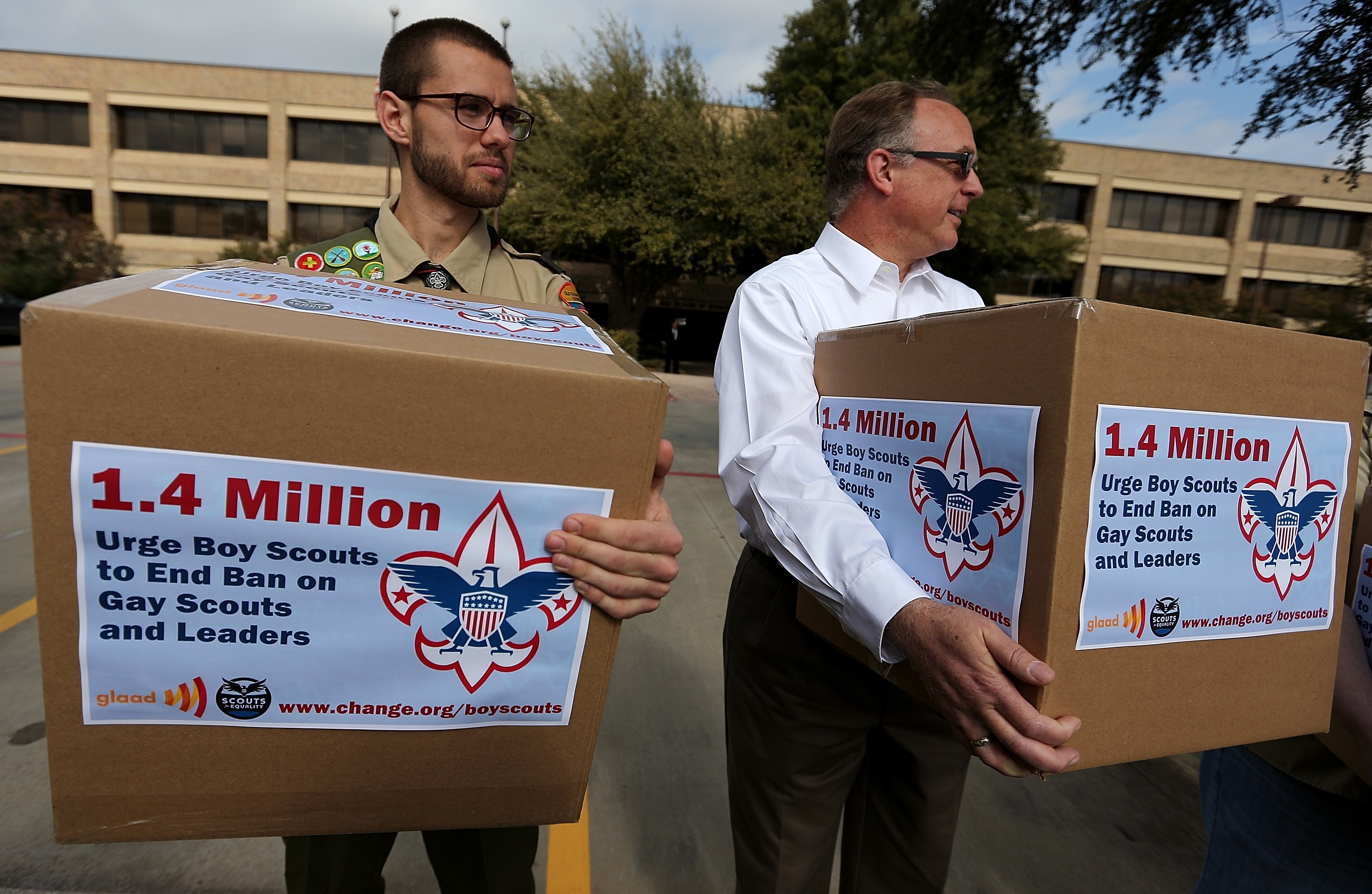
(Photo: Will Oliver, Eagle Scout , and Eric Andresen, former Scout leader, deliver boxes containing 1.4 million signatures urging the Boy Scouts of America to reverse the organization’s ban on LGBT Scouts on February 4, 2013 in Irving, Texas. By Tom Pennington/Getty Images)
Kevin Charles Redmon points to new research indicating that “marijuana may be a ‘gateway drug’ to cigarettes”:
The recent [National Institute on Drug Abuse] study is important because it demonstrates that, even if THC doesn’t promote a neurochemical gateway for heroin and cocaine addiction, it does for nicotine.
The popularity of e-cigs may be changing that. And newly popular vaporizers to inhale THC act similarly: call them e-joints.
We promised to keep you updated and here’s the latest. We don’t really have any solid data yet on how effective the meter will be in bringing in revenue, since it’s only been up a couple of days, and 140,000 readers have yet to set off the meter by clicking a read-on. Of all the other readers, only 117 – less than .001% – are now at seven, and about to trigger the pay-button. That’s too small a data set to tell anything meaningful yet. We’ll have a much better sense in a week or so, and a better one in a month. But traffic is robust; and the roll-out, while completely exhausting for all involved, has been much more glitch-free than these things usually are. We’re really encouraged so far by the experiment and especially by reader input on the changes.
If you’re new today, check out our infinite scroll, our new search function (most cool), our new Reader Threads section, and new, easily searchable archive going all the way back to January 2001. I hope reading is also quicker and more responsive, now we’ve removed the ad clutter.
After the finale of 30 Rock (sob), Emily Nussbaum contemplatesGirls:
[T]he most significant thing about “Girls” may be that it’s not a book, a play, a song, or a poem. And not a movie, either; since women rarely control production, there are few movies of this type, and even fewer that have mass impact. “Girls” is television. It’s in the tradition of sitcoms in which comics play humbled versions of themselves: Lucy, Roseanne, Raymond, Seinfeld. But it’s also TV in a more modern mode: spiky, raw, and auteurist. During the past fifteen years, the medium has been transformed by bad boys like Walter White and sad sacks like Louis C.K.
“Girls” is the crest of a second, female-centered wave of change, on both cable and network, of shows that are not for everyone, that make viewers uncomfortable. It helps that the show’s creator has her own roguish, troublemaking quality, a Molly Brown air that lets Dunham wade into controversy without drowning.
In that sense, I think, as Dunham herself explained, that the new wave of television is related to the impact of the web. We’re slowly breaking up the blockbusters for mass audiences (although there will always remain a place for them) and actually providing more options for more audience segments with more varied and specific and niche interests and experiences.
As long as we can find a way to finance these projects, we are slowly turning TV into more of a web experience, with options to watch a huge amount at once in your own time – binge-viewing – or track your favorite shows by DVR to watch when you see fit – and on and on. TV will always have live events to make it unique – the Super Bowl, the Grammies, Campaign debates, game-show finales – but it’s merging with web culture before our eyes. And not just in form but in content.
Readers push back against my view of customer service:
Andrew, you’re one of the lucky ones who is actually encouraged to say what you think whenever you think it. It’s part of your brand. And kudos to you for building a career that fits you. But imagine that you worked in a retail or service position where revealing what you really thought of your customers could get you fired. Wouldn’t that take its toll on you? If the threat of bankruptcy forced you to pretend to be nice to people you hated, wouldn’t that drive you crazy? And since when do you prefer faked sycophancy to honesty?
And if I responded to every critical email with a Cheneyism, you’d feel the same way. Or if I never published dissents that routinely take me and my arguments apart? We try very hard to be civil and accommodating to our readers here, even though there sure are days when I want to tell them to take a running jump. A wounding of my dignity? Please. Another asks, “What if I showed up in your blog cave and looked over your shoulder all day making sure you were SMILING SMILING SMILING?” That’s called Christmas – and its totalitarian mood-enforcement is, I agree, a blight upon humanity.
But the right to work and be paid in a store and insult customers or never hide your actual mood for professional reasons? I’m not sure that’s a human right. Another has been in that kind of situation:
I used to work for a hospital call center and my boss was constantly complaining that her employees did not love working there like she did. We made a fraction of what she made. Our bathroom breaks were timed and if they went over 5 minutes we were written up. We were all temp workers with no benefits. They fired people every Tuesday. If you had failed to treat a caller like royalty, and they complained, you were cut.
Sometimes a job is just a paycheck, and that should be ok. For slightly above minimum wage and no benefits you don’t get to own someone’s soul. Have you given any thought to what kind of impact that has on those workers?
I don’t think being cheerful to customers is a violation of someone’s soul. Another:
It amazes me, considering the overall quality of your blog, how often you use words like “smug” or “condescension” as an excuse not to engage those of us to your left. That may sound harsh, but when you go so far as to actually quote the word you’ve missed, I figure I can call it an honest mistake on your part. No, Timothy Noah isn’t talking about the overall pleasantness of customer’s experiences, nor “better” service, nor “how well” employees interact with customers, nor “fascism.” You’ve missed the point. It’s right there in your quote: “fawning.” Please try again.
Appealing to an increasingly stratified customer base is driving compulsory servile behavior, even if they are accessorizing it with Marxist jargon. That’s my idea of hell. I won’t patronize a business that requires employees to check their self-respect at the door. I have to wonder why you like them. I rely on a business’ employees for accessible competence, not to blow smoke up my ass.
You’ve never had one of these jobs, have you, Andrew? I’ve had more than one. And I’ve been to Pret A Manger. And I’ve been to France a couple times and always received great service, in Paris and out in the countryside. If there’s one thing I can’t stand, it’s phony people. If there’s one thing that will keep me from patronizing a business, it’s the kind of forced or fake cheeriness you describe. You may associate this kind of work ethic or atmosphere with the US, but it’s not one of our better angels. We should encourage people who work for a living to demand dignity.
You have every right to patronize only those establishments that do not require their employees to be polite or accommodating or fawning. And the more people who do that, the quicker things will change. But obviously, you’re in a minority. Most people enjoy fawning treatment when being asked to spend money. What always struck me about America was the ubiquity of that ethic and how much more agreeable the consumer process was here. It was an actual virtue inculcated by capitalism.
 The Dish