Megan Garber highlights a novel tactic from Grand Central Terminal in New York:
The times displayed on Grand Central’s departure boards are wrong — by a full minute. This is permanent. It is also purposeful. The idea is that passengers rushing to catch trains they’re about to miss can actually be dangerous — to themselves, and to each other. So conductors will pull out of the station exactly one minute after their trains’ posted departure times.
Today on the Dish, Andrew introduced everyone to the new, ad-free site and its fresh features, and also peered into other mediums where independent voices are pushing the envelope. He contemplated the degeneration of the Catholic Church, from the guardian of innocents to protector of criminals. Elsewhere, Andrew exposed McCain’s false dichotomy between civil liberty and border security, and cut to the core meaning of his exchange with Hagel last week during the latter’s hectic hearing. After breathing a sigh of relief over Obama’s decision to veto intervention in Syria, he also explored the distinction between love and sexual desire in the case of Manti Te’o and rejoiced at the latest breakthrough for gluten-free sweets.
In political news, Michael Moynihan interviewed the filmmaker behind HBO’s Mea Maxima Culpa, Michael Lewis prepared the wrecking ball for banks that are too big to fail, and Ackerman totaled up the handful of Muslim terrorist acts in the country since 9/11. Kevin Harnett explained the generosity-factor of wealthy black families in America while Lisa Wade reported the growing androgyny of generation X and Y. We rounded up more thoughts on Ed Koch’s handling of NYC’s AIDS crisis and studied whether redistricting really changes politician’s attitudes.
On the foreign affairs beat, Stephen Walt delivered some home truth about U.S. foreign policy, we weighed the costs and benefits of the conscript army and Greenwald raised alarm over academic freedom when the subject is Israel-Palestine. Also, Richard J. Evans recalled Mussolini’s little-known ban on caffeine and Ahmadinejad shot the moon.
In assorted coverage, Kevin Stevens singled out Duke Ellington as a the jazz master par excellence, Eliza Strickland laid out one man’s plan to integrate the senses online, and Rebecca Solnit saw parallels good and bad between San Francisco’s tech boom and the Gold Rush. We checked in with the health risks of Big Football, Jennifer Hollands measured the medical value of venom, Donald Hutcherson added up the prison premium and Jacob Sullum handed back Eli Lake his e-cigarettes. Meanwhile, Mark Dery took a deeper look at the tentacled-titan of the ocean as Randall Monroe scanned our solar system for the perfect avian experience.
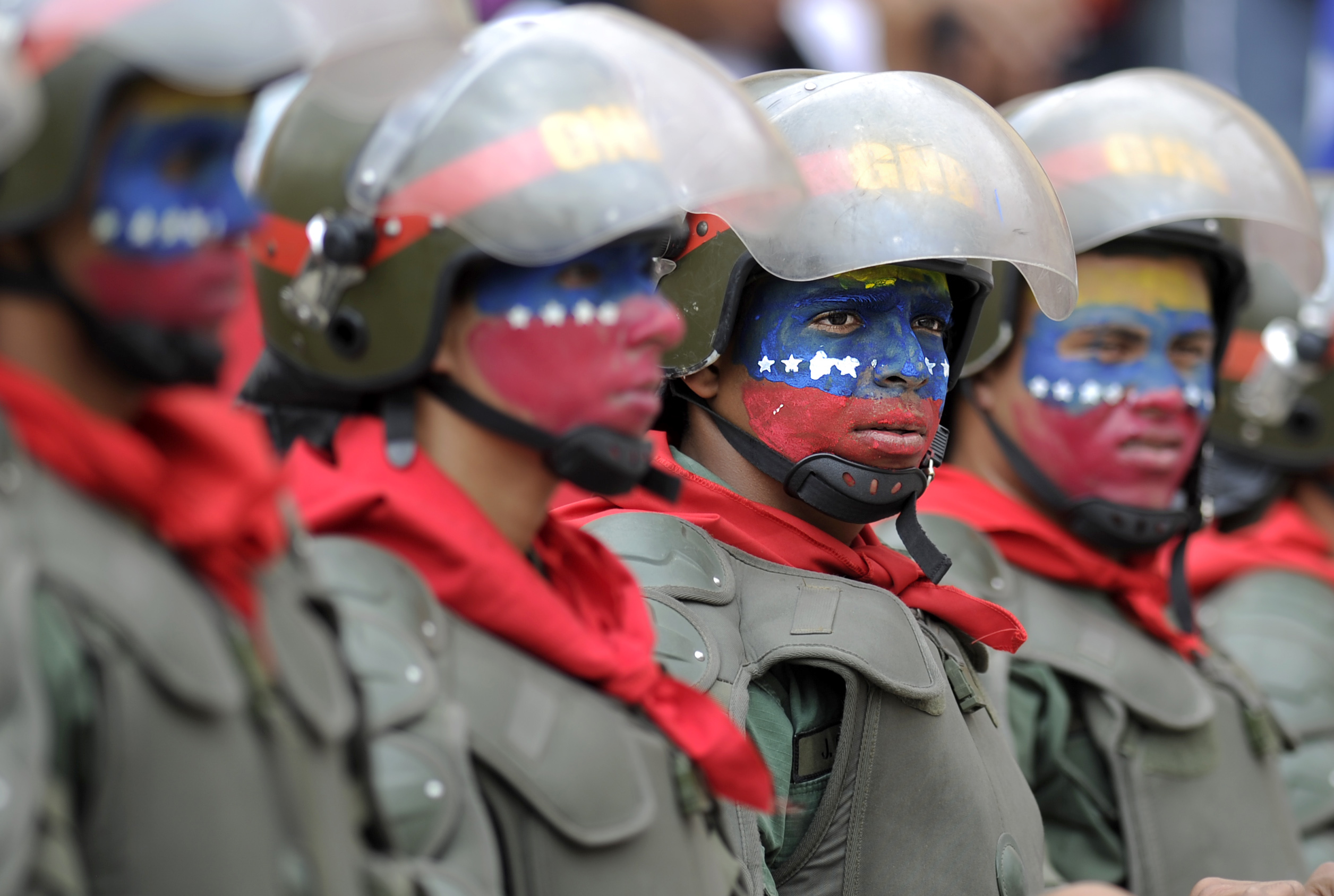
Finally, we gazed across Los Angeles, California in the VFYW, inspected a row of Venezuelan soldiers during the Face of the Day, and dropped a serious beat in the MHB.
Alex Gibney’s new documentary on the child-rape epidemic in the Catholic Church that raged for decades (and maybe centuries), Mea Maxima Culpa, debuted tonight on HBO. I’ve watched it twice. It is both an inspiring testament to faith and truth – as well as a devastating indictment of pride, power, and lies. The former come from four boys who attended St John’s School for the Deaf in Milwaukee in the 1970s. The latter comes from the Vatican and everyone in its power structure then and ever since. It really is a story about how the real church finally stood up to a hierarchy that has betrayed us and committed crimes of such gravity and magnitude they beggar belief.
The story begins as long ago as 1974 when four boys put fliers on the windshields of the cars in the parking lot of the church run by the man who raped them. They simply said “Wanted” with the priest’s name (the more explicit flyer in the video above came later). Instead of being listened to, the kids were disciplined. Eventually, in Murphy’s psychiatric record, Gibney finds Father Lawrence Murphy confessing to raping over 200 boys over a long period of time. He raped them in their dorm rooms; he raped them in the confessional, using the small window as a glory hole and granting absolution based on rape or masturbation. The detail I cannot quite recover from is that he picked out for abuse those deaf boys who had parents who could not use sign language – so that even if the boys had the courage to say what had happened to them, their parents would not understand. It’s things like that that simply chill you, haunt you, force you to confront the pre-meditated, profound assault on human souls that the Catholic Church, from the Pope on down, enabled, perpetuated, and lied about for so long – and still hasn’t been held fully accountable for.
And what this documentary proves beyond any reasonable doubt (like Gibney’s examination of the Bush-Cheney administration’s decision to torture prisoners in “Taxi To The Dark Side”) is that all of it was known throughout the hierarchy for decades. There is even a network of Church-operated “psychiatric” clinics for serial child rapists that don’t use traditional psychotherapy or report criminals to the cops or sequester the rapists from the public (let alone defrock them). These clinics simply enforce spiritual discipline and then recycle the priests to rape more children. We know from public documents that as far back as the 1940s, pedophile priests were showing up at these centers. Father Gerald Fitzgerald founded the order. And he was not yet corrupted by the Vatican’s insistence that no scandal ever become public and no priest sacrificed for the sake of mere children. As early as 1947, he is writing letters to his superiors about the problem:
“I myself would be inclined to favor laicization for any priest, upon objective evidence, for tampering with the virtue of the young, my argument being, from this point onward the charity to the Mystical Body should take precedence over charity to the individual, […] Moreover, in practice, real conversions will be found to be extremely rare […] Hence, leaving them on duty or wandering from diocese to diocese is contributing to scandal or at least to the approximate danger of scandal.”
Or in 1957, this letter to his Bishop:
“We are amazed to find how often a man who would be behind bars if he were not a priest is entrusted with the cura animarum (guardian of souls).”
The systematic rape of children was then obviously not a function of some kind of major cultural shift in the 1960s and 1970s, although that era might have sent a permissive signal to the global network of child rapists the Vatican was already hiding and enabling. It has been a core problem with the “celibate” priesthood in the US for decades, and every single bishop and every single Pope knew it. Fitzgerald personally met with Pope Paul VI to try and get him to act. Yes, the good folks in the church tried to do something as early as the 1950s and were stopped in their tracks … by the Vatican. The number of souls violated by child-rape in the coming decades would not have happened if all the Popes since Paul VI had acted with more moral sense than most maximum security murderers. (Even the worst prisoners regard child-rapists as the lowest of the low. Popes? Not so much). We’re not talking about priests who are drunks, or priests who fall in love, or break their vows in fallible, victimless ways; we’re talking here about priests committing one of the most heinous felonies imaginable: the systematic rape of children using the authority of the Church as cover.
John Paul II emphatically cannot be somehow removed from this picture. He personally protected one of the worst offenders, Marcial Maciel, who was a serial rapist, drug trafficker, bigamist and rapist of his own son. In fact, John Paul II elevated Maciel to the highest honors of the church – backed by the theocon wing of the American church, from Richard John Neuhaus to Bill Bennett and Mary Ann Glendon. They all adamantly denied that Maciel was anything but a living saint – and he was never prosecuted, merely allowed a gentle retirement from running his order, The Legion of Christ, which continues.
Joseph Ratzinger, when he was Archbishop of Munich, personally signed off on sending a priest to therapy, after that priest had raped several children, never notified the police, never told the parents of the children at the parish the priest was then assigned to, and because of this negligence, was, in my view, complicit in the rape of several more children before the priest was finally caught, arrested and sent to jail. Let me repeat that: the current Pope enabled and abetted the rape of children – and his only way out was to blame a lower official, who subsequently said he’d been pressured. More than that, no one else in the church knows more about this long record of child-rape than Ratzinger. From 2001 onwards, all cases of child rape or abuse were ordered to be sent to his personal office, the Congregation for the Doctrine of the Faith. And all of it had to be kept completely hidden from the outside world. In the words of Hans Kung, Ratzinger’s former modernizing ally in the Second Vatican Council,
Ratzinger himself, in a letter on “grave sexual crimes” addressed to all the bishops under the date of 18 May, 2001, warned the bishops, under threat of ecclesiastical punishment, to observe “papal secrecy” in such cases.
He knew everything – and had the goods on every Cardinal, in whose dioceses thousands of complaints had been filed. And one wonders why it was a surprise he was elected Pope. When you’re the J Edgar Hoover of the Vatican, who is going to challenge you?
If those of us are asked why we still believe in the salvation of Christ in the Catholic community, in the midst of all this, we do not have a good answer. All we can say is that we are, in some ways, trying to live in a parallel church, finding those many, many good priests who have been unfairly tarred by the pedophile brush, and living by one simple moral standard that the Pope himself does not agree with and has not done: if you find out someone is raping children, you call the cops.
But, for me, the most powerful moments in the documentary come from one simple fact. The four primary victims are deaf. They are grown men now and when they express themselves on film, they do so with sign and sounds of anguish and grief. One of the victims, now dead, sat down in front of a video camera and laboriously recounted every single act of abuse Father Murphy committed against him. He knew he was dying, and wanted to leave a record of the crimes and the corruption. Then in the most riveting raw footage of the film, he goes to confront the mass-rapist, whose crimes were by then beyond the statute of limitations. He finds him in the backyard. He signs and yells as coherently as a deaf person can; the priest seems utterly unmoved, telling the man he serially raped that “That’s all over now.” And disappears into his modest house, with a deaf-house-cleaner who had previously worked at St John’s. In the Catholic Church, mass rapists get retirement homes with maids. She confronts the rape victim. She keeps asking him: “Are you a Catholic?” He keeps replying that this has nothing to do with Catholicism and everything to do with rape. She just comes back at him with rapid-fire repetitions of “Are you a Catholic?” “Are you a Catholic?” “Are you a Catholic?”
It’s a good question.
I can hear my devout Irish grandmother – who also worked as a cleaning lady for priests, scrubbing her floors day after day till they looked like glass – asking the same question whenever I questioned ecclesiastical authority. It’s a question that simply tells you: do not disobey a priest; do not malign a priest; do not question a priest. And it is that deference, that lingering, profound subservience to the priestly office that also allowed this to happen. Where, after all, were the nuns at St John’s School? Did they seriously not know what was going on? Where were the parents of the deaf boys, when they warned them about Father Murphy as early as 1974? Where are we now as a church if we vaunt one of the biggest enablers of child-rape, John Paul II, to the status of sainthood without a thorough investigation of these matters?
For me, Jesus must always be with the victims. He is the victim. When a priest rapes a child, Jesus is raped. When an archbishop covers up the crime, Jesus is raped. When successive Popes are told of the problem and assign total secrecy to it and fail to prevent future abuse of children, Jesus is raped. And there is a particularly appropriate ending to the tale of Father Murphy: faced with the possibility of a church trial for a canon law crime which has no statute of limitations – abusing the sacrament of reconciliation by raping children as absolution, he appealed to Pope Benedict XVI himself. And this Pope granted him a reprieve because of failing health. We have the documents to prove all this. Many argue – and it is undeniable – that this Pope has done more than any predecessor to investigate the horror. But he did so only as the abuse stories began to break into the open and his first response was to blame the media. This quote is from 2002 when Ratzinger was head of the CDF:
In the church, priests are also sinners. But I am personally convinced that the constant presence in the press of the sins of Catholic priests, especially in the United States, is a planned campaign, as the percentage of these offenses among priests is not higher than in other categories, and perhaps it is even lower. In the United States, there is constant news on this topic, but less than one percent of priests are guilty of acts of this type. The constant presence of these news items does not correspond to the objectivity of the information or to the statistical objectivity of the facts. Therefore, one comes to the conclusion that it is intentional, manipulated, that there is a desire to discredit the church.
Again, you notice one thing: his first priority then and now was to protect the institution, not protect the children. This is not an old story either. Just last week, the former Cardinal of Los Angeles, Roger Mahony, was stripped of his duties for enabling and abetting the rapes of countless children. This was proven by key documents finally pried out of the church’s hands by a legal case. What we need access to is the entire Vatican archive of priestly sex abuse of children. But perhaps, case by case, we will begin to understand better the nexus of authority and accountability that made this global conspiracy to hide and abet rapists so durable and so horrifying.
There was a slogan in the years of AIDS. It was Silence = Death. What is unforgettable about this documentary is that the loudest voices come from the most vulnerable of all – deaf children who are now deaf adults. The loudest voices were those who could not speak. If I have hope for my church – and I sincerely believe Jesus will never finally abandon us, however corrupt and sinful we become – it is because of this fact. The power of the powerless is what helped stop this mass violation of the souls of children. The change came not from the top, which remains foully corrupted, but from the very margins of the margins: the consciences and courage of those who could not hear evil until it was upon them, but who were surrounded by it. And spoke up. As children. And, then, as adults.
When will the rest of us do the same? When will we Catholics insist in the prosecution of this Pope and this hierarchy for what can only be called – given its duration and gravity and sheer scale – a crime against humanity. When will we lose the deference to a clerical elite that has become its own self-perpetuating clique of sexual dysfunction, that has lost even the most basic moral authority, that even now refuses to hold itself to account.
What, one wonders, would Jesus do? My answer to that ultimately unanswerable question is simple: listen to the survivors. Even those who can only speak in silence and sign:
So the last shall be first, and the first last: for many be called, but few chosen.
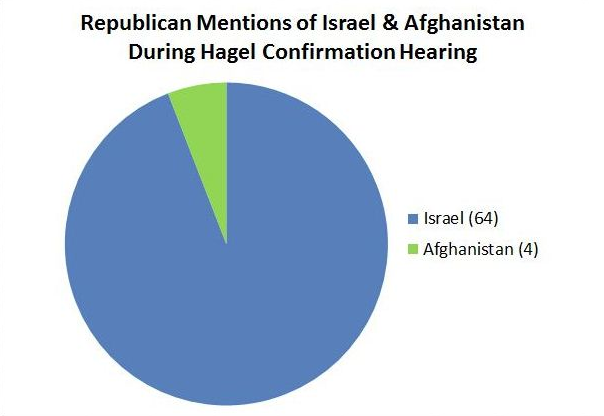
We noted last week how much time and energy Israel and Iran got in the Senate hearings for the nomination of Chuck Hagel to the Pentagon. The word cloud was powerful evidence enough. But get a load of this:
Among Democrats there were twice as many mentions of Israel, a foreign country not in NATO, as of Afghanistan, where US servicemembers even now are risking and losing their lives. Brandon Friedman, an Iraq and Afghanistan vet, asks the following question:
Just Who Do They Represent: At Hagel Hearing, Concern for Israel Tops U.S. Troops in Combat
The answer is: not the troops, and not the American people.
The ad is meant to make you feel better about watching football. It’s meant to show how the NFL has made the game safer, with pads and and helmets and rules. Instead, it shows how it’s made the game more dangerous, making it easier for the players to hit harder, last longer, endure more trauma. And it shows how we’re complicit, too. Even as the ad is meant to assuage our guilt about the game’s violence, it’s all about the game’s violence — it’s one big hit after another, because that’s why we tune in, that’s why we like to watch. The ad celebrates the NFL’s sobriety by ordering everyone a round of shots.
The NFL hasn’t evolved to be safer. It’s evolved to be more lucrative, which means being more fun to watch, which means having bigger and more spectacular hits.
The Dish’s long-running thread asking “Is Football The Next Big Tobacco?” is here.
Michael Lewis finds Greg Smith’s Why I Left Goldman Sachs “conflicted, and a little tone-deaf.” How Michael understands America’s problem with the big banks:
Goldman Sachs, like the other too-big-to-fail firms, has been handed tens of billions in government subsidies, on the theory that we cannot live without them. They were then permitted to pay politicians to prevent laws being passed to change their business, and bribe public officials (with the implicit promise of future employment) to neuter the laws that were passed—so that they might continue to behave in more or less the same way that brought ruin on us all. And after all this has been done, a Goldman Sachs employee steps forward to say that the people at the top of his former firm need to see the error of their ways, and become more decent, socially responsible human beings. Right. How exactly is that going to happen?
If Goldman Sachs is going to change, it will be only if change is imposed upon it from the outside—either by the market’s decision that it is no longer viable in its current form or by the government’s decision that we can no longer afford it.
Venezuelan soldiers during the conmemoration of the 1992 failed coup led by Chavez, who was an army lieutenant colonel, against then president Carlos Andres Perez, in Caracas, on February 4, 2013. Ailing President Hugo Chavez, who had cancer surgery in December, is doing much better and recovering, Cuban leader Fidel Castro said in remarks published Monday. By Juan Barreto/AFP/Getty Images.
Lev Grossman imagines a world where drones are ubiquitous:
This technology will inevitably flow from the military sphere into the civilian, and it’s very hard to say what the consequences will be, except that they’ll be unexpected. Drones will carry pizzas across towns and drugs across borders. They’ll spot criminals on the run and naked celebrities in their homes. They’ll get cheaper to buy and easier to use. What will the country look like when anybody with $50 and an iPhone can run a surveillance drone?
Seth Godin wishes for better airports, listing all the ways in which “these organizations dehumanize everything, pretending it will increase profits, when it actually does exactly the opposite”:
By removing slack, airlines create failure. In order to increase profit, airlines work hard to get the maximum number of flights out of each plane, each day. As a result, there are no spares, no downtime and no resilience. By assuming that their customer base prefers to save money, not anxiety, they create an anxiety-filled system.
Steven Soderbergh recently suggested that a movie studio could run the country better and more efficiently than the government. Drum pushes back:
Does Soderbergh seriously think that Hollywood is a poster child for the efficient use of budget dollars? Does he really believe that Hollywood is ideology free? Is he aware, for example, that our copyright law is the shambles it is largely because of Hollywood lobbying? Does he realize that governments deal with problems just a wee more important and less tractable than which green-screen technology works best? Does he have the slightest idea how the real world works? Apparently not.
Millman thinks Soderbergh’s reasoning isn’t exclusive to Hollywood:
[S]uccessful businessmen, who have run large organizations very effectively according to management principles that don’t seem to be applied very effectively in government, almost always think they could run things better than the clowns in Congress. And they are right! The American government is not designed to run things well – it is designed to prevent civil war or violent revolution by mediating irreconcilable differences between regional and other large interests. Effectiveness is an important secondary consideration.
It’s possible that Washington will resolve its internal disagreements more slowly than Hollywood will, but that’s precisely because Washington is democratically run. It resolves differences through roll call votes and through elections, which are inherently slow and messy. If Hollywood is more efficient, that’s because its key decisions are usually made by studio executives, producers, or directors — that is, dictators. We could certainly try that approach in government, but there are probably some down sides.
 The Dish