In our dreams.
Year: 2013
The Self-Appointed Policemen Of The Israel Debate
Glenn Greenwald is alarmed that Brooklyn College’s Political Science department is taking flack for sponsoring “an event, scheduled for 7 February, featuring two advocates of the Boycott, Divestment and Sanctions movement (BDS).” How Greenwald sees the foofaraw:
Manifestly, this controversy has nothing whatsoever to do with objecting to one-sided academic events sponsored by academic institutions. Such events occur constantly without anyone uttering a peep of protest. This has to do with one thing and one thing only: trying to create specially oppressive rules that govern only critics of Israel and criticisms of that nation’s government. As Lemieux put it: “So, apparently, colleges have a moral obligation to have ‘balanced’ panels . . . in cases where the speakers might disagree with Alan Dershowitz.”
In a follow-up post, Greenwald grows ever-more concerned:
The threat to academic freedom posed by this growing lynch mob is obvious: if universities are permitted to hold only those events which do not offend state officials and “pro-Israel” fanatics such as Alan Dershowitz, then “academic freedom” is illusory. But on Sunday, that threat significantly intensified, as a ranking member of the New York City Council explicitly threatened to cut off funding for the college if his extortionate demands regarding this event are not met.
Scott Lemieux’s perspective:
No sponsorship implies anything like a complete endorsement, and this is so obvious the arguments to the contrary are plainly being offered in bad faith. If Brooklyn College were to deny a similar panel to critics of BDS there would be ample reason for criticism, but there’s no evidence whatsoever that this is the case.
(Above: an interview with Omar Barghouti, one of the academics scheduled to speak at Brooklyn College)
The View From Your Window

Los Angeles, California, 1.41 pm
The All-Volunteer Army
Andrew Bacevich sees downsides to it:
Relieving citizens of any obligation to contribute to the country’s defense has allowed an immense gap to open up between the US military and American society. Here lies one explanation for Washington’s disturbing propensity to instigate unnecessary wars (like Iraq) and to persist in unwinnable ones (like Afghanistan). Some might hope that equipping women soldiers with assault rifles and allowing them to engage in close combat will reverse this trend. Don’t bet on it.
James Joyner counters:
[W]ith the dispassionate hindsight of history, the vast majority of America’s wars were unnecessary; whether we relied on volunteers or conscripts seems wholly unconnected to our propensity for bad wars. The difference, then, is one of choice: Anyone serving in Iraq or Afghanistan damn well volunteered to be there and was at least able to command a reasonable wage and premium benefits for their sacrifice.
Chart Of The Day
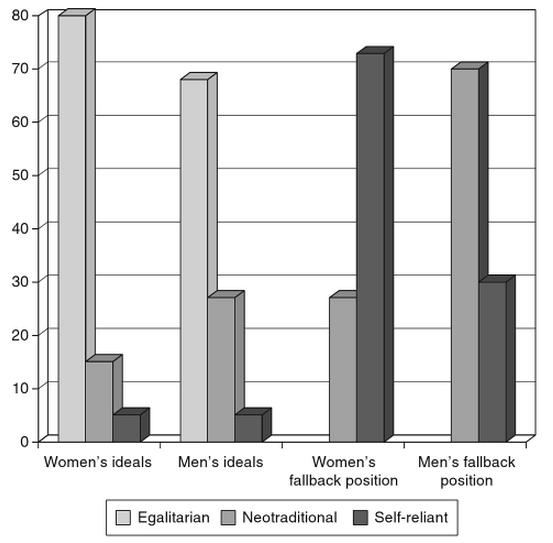
Lisa Wade parses the above chart for insight into gender roles at home:
Here’s some great news. The vast majority of young people – about 80% of women and 70% of men across all races, classes, and family backgrounds — desire an egalitarian marriage in which both partners share breadwinning, housekeeping, and child rearing. The data come from Kathleen Gerson‘s fabulous 2010 book, The Unfinished Revolution.
But:
Gerson asked her respondents what type of family they would like if, for whatever reason, they couldn’t sustain an equal partnership. She discovered that, while men’s and women’s ideals are very similar, their fallback positions deviate dramatically.
The House Of Unrepresentatives
John Sides argues that gerrymandering didn’t kill bipartisanship:
The most important influence on how members of Congress vote is not their constituents, but their party. This makes them out-of-step not only with the average American — the “broad-based public opinion” that Obama mentioned — but also, and ironically, with even their base. Members are more partisan than even voters in their party.
On the other hand, looking at immigration reform, Micah Cohen finds reason to believe that a Congressman’s constituents do make a difference:
[T]here is no guarantee that Republicans with a greater share of Hispanic constituents will necessarily favor reform. But three of the four Republicans in the House already negotiating an immigration bill with Democrats — Representatives John Carter and Sam Johnson, both of Texas, and Mario Diaz-Balart, of Florida — come from districts that are more Hispanic than the average Republican-held Congressional district.
What Muslim-American Threat?
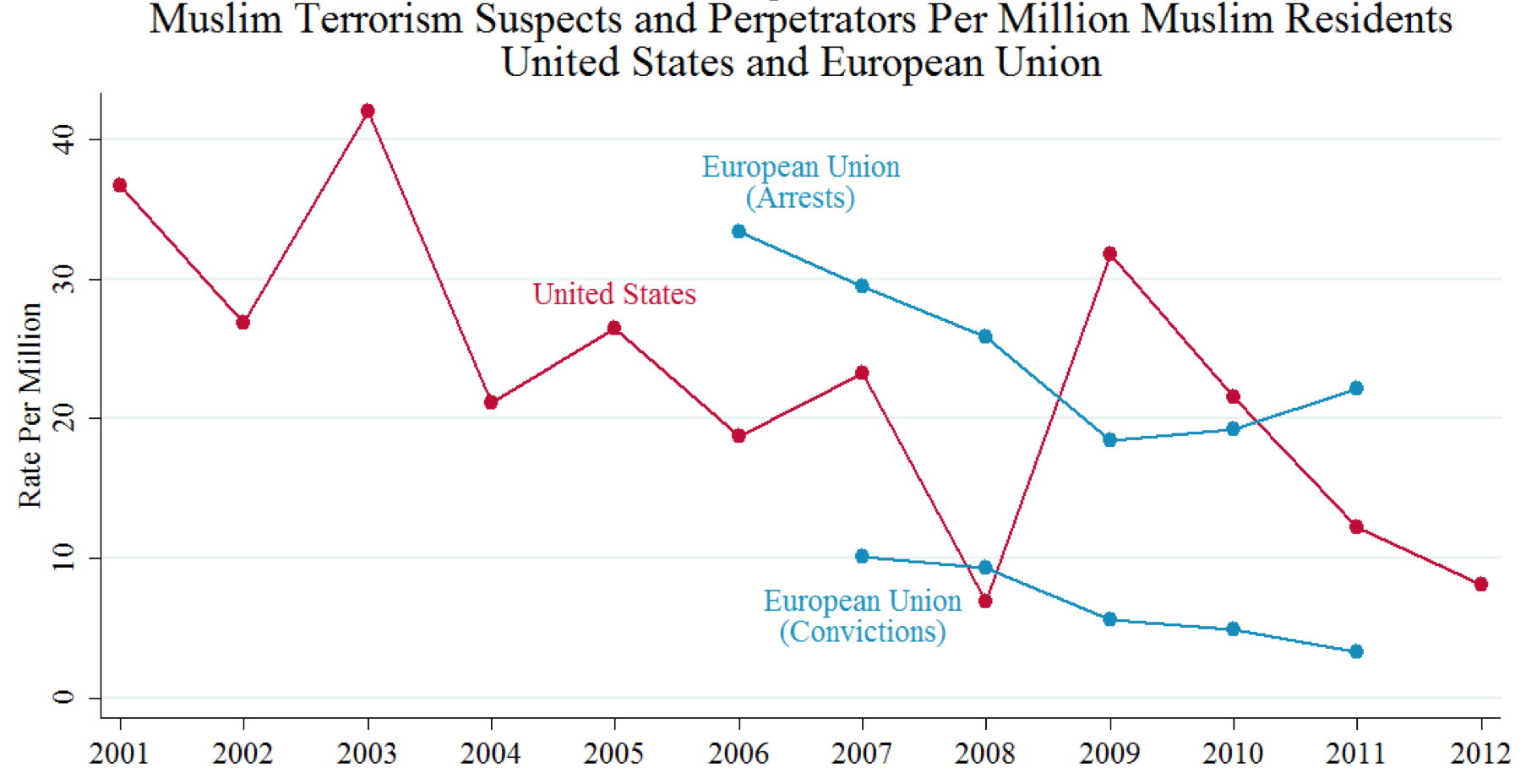
Ackerman summarizes Charles Kurzman’s new report (pdf) on the decline of Muslim-American terrorism:
Since 9/11, Kurzman and his team tallies, 33 Americans have died as a result of terrorism launched by their Muslim neighbors. During that period, 180,000 Americans were murdered for reasons unrelated to terrorism. In just the past year, the mass shootings that have captivated America’s attention killed 66 Americans, “twice as many fatalities as from Muslim-American terrorism in all 11 years since 9/11,” notes Kurzman’s team.
Your New Dish
Many of the new features are described here, if you want a little guidance to help you explore the place. If you have already subscribed but can’t remember your password, click here. If you can’t remember what email you used to subscribe, send us a message at support@andrewsullivan.com with “Forgot Email Address” in the subject line.
In Front Of One’s Nose
Some home truths from Stephen Walt as he lists the “Top Five Truths You Won’t Hear Any U.S. Official Admit.” My primary concern? Number 3:
“There’s not going to be a two-state solution.” For official Washington insiders, the politically-correct answer to any question about the Israel-Palestine conflict is that we favor a two-state solution based on negotiations between the two parties, preferably done under U.S. auspices. Never mind that there’s not much support for creating a viable Palestinian state in Israel (surveys in Israel sometimes show slim majorities in favor of a 2SS, but support drops sharply when you spell out the details of what a viable state would mean).
Never mind that the Palestinians are too weak and divided to negotiate properly, and the failure of the long Oslo process has diminished Fatah’s legitimacy and strengthened the more hardline Hamas. Never mind that the latest Israeli election, while it weakened Netanyahu, did not strengthen the peace camp at all. And never mind that the United States has had twenty-plus years to pull of the deal and has blown it every time, mostly because it never acted like a genuine mediator. But nobody in official-dom is going to say this out loud, because they have no idea what U.S. policy would be once the 2SS was kaput.
That would be a good thing to be working on, don’t you think? Or are we going to end up like Sean Hannity on the last election night, when reality finally hits home.
“Clearly Beyond Partisan Malice”
Dorothy Rabinowitz rhapsodizes the aggressive and contemptuous treatment Chuck Hagel got from McCain and those who still believe in the policies that gave us two unwinnable wars and torture. But then she adds:
It has been a long time since Republicans showed a fighting temper of this kind, unyielding in its contempt for what the choice of a Hagel represents about core values like the national defense, our stance regarding the most dangerous of our enemies in the world.
If the Hagel hearings had done nothing else—they had in fact done everything else in their revelations, if not the final outcome—they had, in this time of postelection dreariness, shown Republicans come roaring to life. They had been moved to do so by Mr. Obama’s nomination of Mr. Hagel—a gift to the Republicans, though perhaps not to the national defense.
Does that not strike you as a little at odds? Apparently, the great thing about the McCain-Butters grilling was that it was clearly beyond partisan malice but worthwhile mainly to revive partisan zeal in favor of neoconservatism.
The core truth is that the entire hearings were about whether we really, seriously want to to start a new war in the Middle East to postpone Iran’s inevitable nuclear capacity. Or, rather, about whether it would be helpful to have a defense secretary who might add a strong voice of skepticism toward the perils of a new land war in the Middle East. I favor having that voice at the table. The neocons don’t. And at some point, they may have to come to terms with the fact that they lost the election.
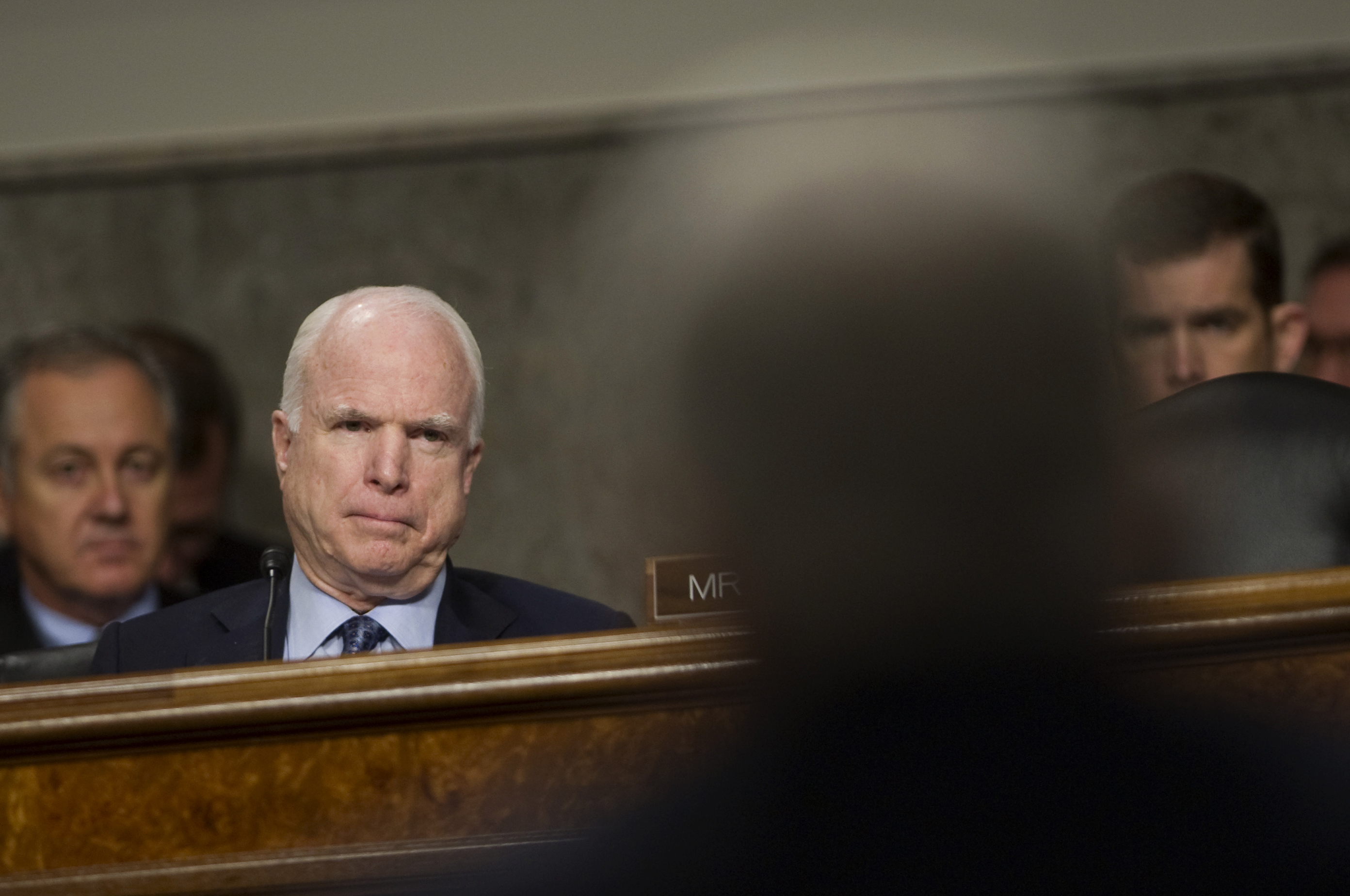
(Photo: Sen. John McCain, R-Ariz., questions former Sen. Chuck Hagel, R-Neb., at a Senate Armed Services Committee hearing on Hagel’s nomination to be Secretary of Defense. By Chris Maddaloni/CQ Roll Call/via Getty.)
 The Dish