A Pack Of E-Cigs A Day, Ctd

Jacob Sullum dismisses Eli Lake’s e-cig fears:

E-cigarettes indisputably deliver nicotine without the myriad toxins and carcinogens generated by burning tobacco. Whatever long-term risk propylene glycol vapor may pose is bound to pale in comparison with the well-established hazards of inhaling all of the chemicals you get from cigarettes (which, by the way, include propylene glycol). The bottom line is that Lake is much better off, in terms of the health risks he faces, for having switched from Marlboro Lights to e-cigarettes. Public health officials and anti-smoking activists who obscure that point are endangering smokers’ lives by discouraging them from switching to a much safer alternative.

Migration Explained

How a blog transitions from one URL to another:

The real story of four of us at my apartment tonight was slightly different. It looked like an out-take from The Walking Dead, as we trouble-shot, called developers, checked with servers, noticed new glitches, made last minute fixes to bugs and on and on (including breaking up a rare beagle fight). But at midnight all of the old URLs for the Dish automatically redirected you to this, our new home: dish.andrewsullivan.com. If you do not see the new site immediately, try refreshing the page after a few minutes. It may take a minute or two for your browser’s cache to refresh.

Starting Monday morning, some posts will have a blue “Read On” button. If you click that button, the post will expand for continued reading, just as in the past. If you’re a subscriber, you will always be able to access all read-on material. If you are a non-subscriber, you will be limited to seven read-on clicks during a 30-day period. If you open a read-on post in a new window, that will also count against the read-on meter. If non-subscribers max out the read-on meter, all content above a read-on will still be free and accessible – but the deeper dish won’t be.

Incoming links from other blogs and websites will never, ever count toward the meter; other bloggers need not fear that their readers won’t be able to see content they link to. I want to personally soothe Dan Savage’s concern on this point.

If you are already a subscriber, first thanks! Second, there are two ways you can log in:

The first is to just click the red button in the upper-right corner of the Dish that says “Already subscribed? Sign In”, then click the blue “Sign In” button on the page that pops up, and then enter the email address and password you selected when you subscribed. If you have already subscribed but can’t remember your password, click here. If you can’t remember what email you used to subscribe, send us a message at support@andrewsullivan.com with “Forgot Email Address” in the subject line.

The other way is to wait until after you click your eighth read-on. At that point a page will pop up containing a “Sign In” button; click that to enter your email address and password.

You can use the same e-mail address and password on multiple devices. Once you have logged-in from a device or browser, you will not be required to login again on that device or browser again for several months.

As with any site launch, compatibility across all different browsers – Safari, Firefox, Explorer, Chrome, etc – and their various versions in different devices can cause design and layout glitches. If anything looks dramatically off kilter, please email at support@andrewsullivan.com with the following info: browser name (e.g. Safari), browser version (e.g Version 6.0.1), operating system (OS X Version 10.8.2), the device you are using (e.g. MacbookPro Retina), and, if applicable, a screenshot of the problem. Also, cookies will need to be enabled in your browser or else you may be unable to log in.

If you have any issues not discussed above, please send a description of your problem to support@andrewsullivan.com and we will get back to you as soon as possible. But phew. We made it. We couldn’t have done it without your early financial support. And I couldn’t have done it without the Dish team’s staggering work-ethic, professionalism and personal hygiene.

We’ll be sharing some of the new features of the site in the morning. But feel free to poke around and let us know what you think (the new address for the main account is andrew@andrewsullivan.com). This is a work in progress. It always has been. And it always will.

Face Of The Day

Clowns Gather For The Joseph Grimaldi Memorial Service

Clowns in full costume have a meal before attending the annual Clowns Church Service at Holy Trinity Church in Dalston on February 3, 2013 in London, England. Clowns attend the service in memory of Joseph Grimaldi (1778-1837), the most celebrated English clown who was born in London. The service has been an annual tradition since 1946 with the attending clowns usually performing for the public afterwards. By Oli Scarff/Getty Images.

Fact-Checking A Church

Dan Duray details the long and arduous process Lawrence Wright and his team underwent to get the facts right in Going ClearIn 2010 the church sent flacks and lawyers to the New Yorker offices to dissuade the magazine from publishing the long profile that led to Wright’s book:

“[Tommy Davis, the church’s lead spokesman at the time] had a pie chart of the 971 questions we’d sent him,” Mr. Wright said, recalling the meeting during a recent interview at the Random House offices. “The pie chart showed that 59 percent of them were false.” He let that sink in. “They’re questions! How do they fall into the true-false category? It was bizarre to me.”

In an interview with CNN’s Belief Blog, Lawrence Wright looks to the future of the “religion”:

Personally, whatever people want to believe is fine with me. Why people gravitate to different expressions of faith is quite intriguing to me, and I don’t condemn them for what they choose to believe.

But the behavior of the church towards its critics, towards reporters, towards defectors, and especially towards members who are inside the clergy – in particular children who are recruited at appallingly young ages to sign these billion-year contracts and surrender their alternative lives to a life of poverty and isolation – those practices worry me considerably. And I think there’s an accounting the church of Scientology is going to have to face, if it wants to survive.

You can read an excerpt of the book here and highlights from Terry Gross’ interview with Wright here.

There’s A Reason It’s On A Sunday

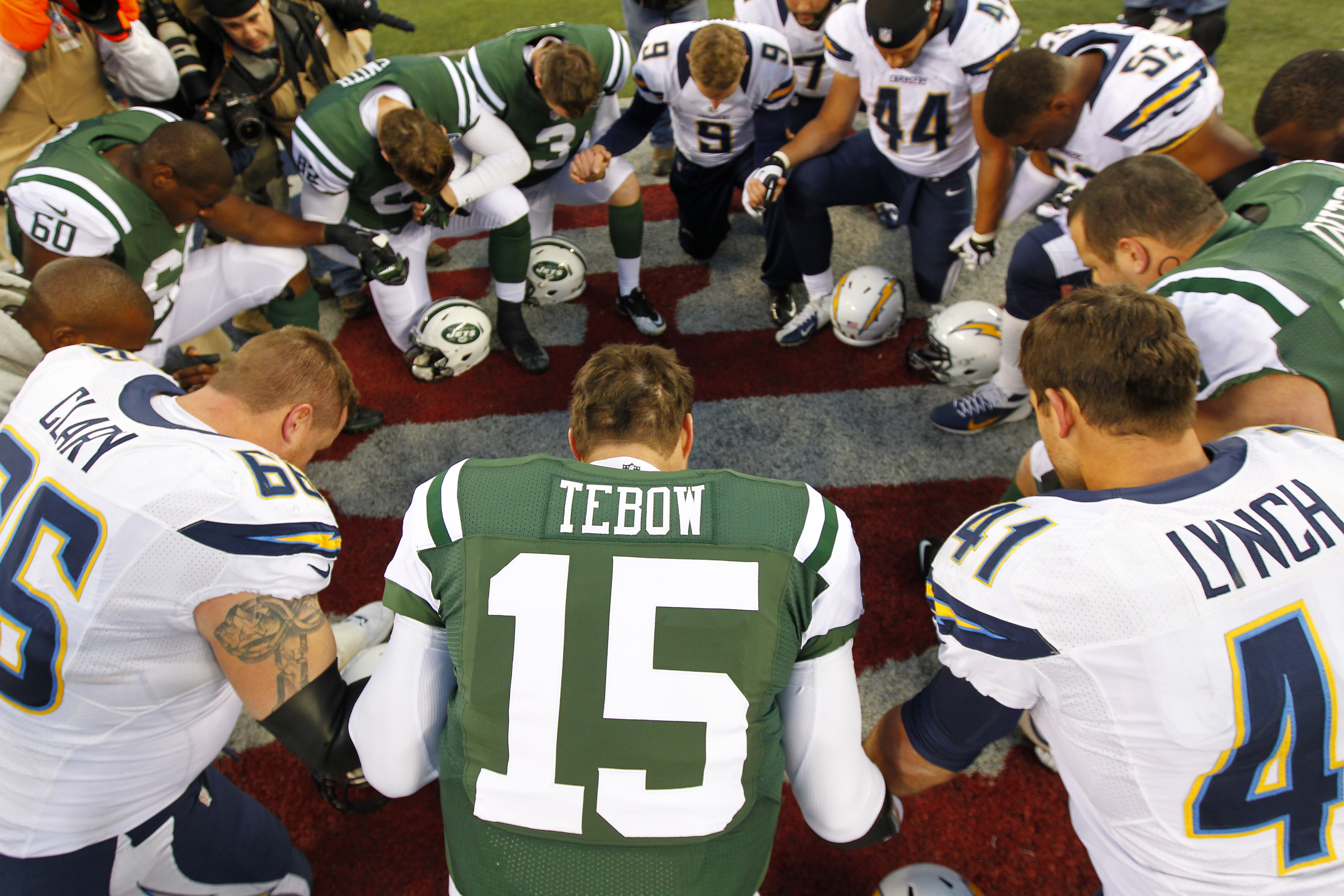
San Diego Chargers v New York Jets

Michael Serazio argues that “if you look hard at sports, you can’t help but see contours of religion”:

The notion that sports remain our civic religion is truer than we often let on: In fandom, as in religious worship, our social connections are brought to life, in the stands as in the pews. It serves as a reminder of our interconnectedness and dependency; it materially indexes belonging. Like others, I indulge the royal “we” when speaking of my team, though there is little evidence they need me much beyond ticket sales, merchandise, and advertising impressions. Nonetheless, as Durkheim long ago noticed, “Members of each clan try to give themselves the external appearance of their totem … When the totem is a bird, the individuals wear feathers on their heads.” Ravens fans surely understand this.

(Photo: Quarterback Tim Tebow #15 the New York Jets leads a players prayer after their game against the San Diego Chargers at MetLife Stadium on December 23, 2012 in East Rutherford, New Jersey. By Rich Schultz /Getty Images.)

Only Cold Turkey Allowed

Reviewing Anne Fletcher’s Inside Rehab, Sacha Scoblic explains one reason why addiction treatment often fails:

[A]s Fletcher masterfully shows, rehab culture has created a deep schism between science and its twelve-step methods. There is now a vast body of research on addiction treatment, including groundbreaking medications that can quell urges, safely fulfill an addict’s need for dopamine, and often prevent relapse. And yet, Fletcher finds that some 80 percent of rehabs in the United States dispense no medication at all. In fact, many rehabs consider the use of opiate-replacement drugs and other medications—like naltrexone, Suboxone, and buprenorphine—as equivalent to drinking or using heroin, despite the overwhelming scientific evidence of their positive effects. In other words, you’re not truly sober if you’re “on” something. To that end, many rehabs kick addicts out for secretly using—that is, for being addicts.

Linguistic Xenophobia

movement is afoot in Russia to ban the use of foreign words in public:

‘We’re tormented with Americanisms,’ the leader of Russia’s Liberal Democratic Party, Vladimir Zhirinovsky, complained last week. ‘We need to liberate our language from foreign words.’ He is drawing up a list of 100 words which he would like it to be illegal for broadcasters, writers and academics to use in public. Fines and unemployment could face anyone caught saying cafébarrestaurantsalemoutonperformance or trader. Some of the words have come into use since the fall of the Soviet Union; others have been around for decades, if not centuries. ‘There are perfectly good Russian words you can use,’ Zhirinovsky says. ‘Why say boutique when we have lavka?’ (Lavka is usually translated into English as something like ‘stall’.)

Meanwhile, France trying to replace “hashtag” with “mot-dièse,” which means “sharp word”:

This isn’t the first time France has changed up its vocabulary to avoid English words creeping into the language. In 2003, France replaced the word “email” with “courriel,” and attempted to create new terms for Wi-Fi and blog.

The Wing Bump

Wing_Consumption

Dan Charles eyes the Super Bowl snack table:

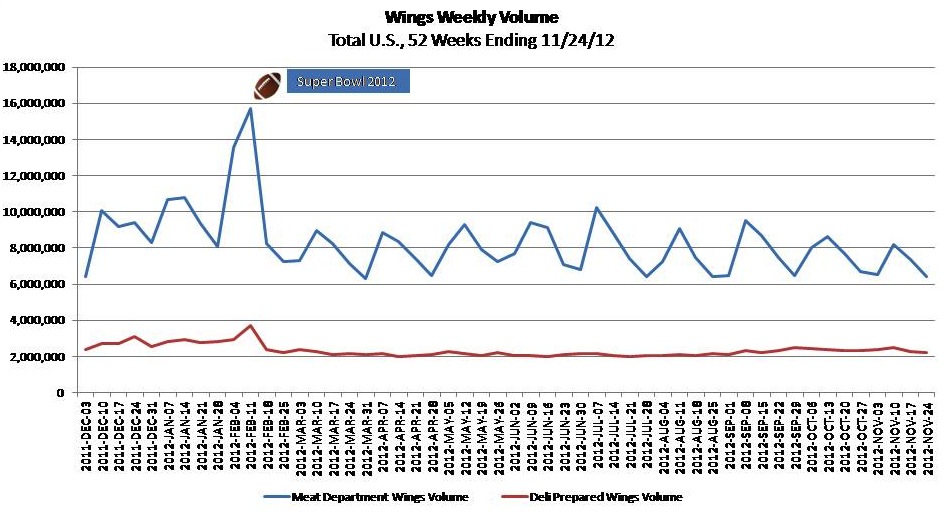
According to the 2013 Wing Report, Americans will eat 1.23 billion wings [this] weekend. … In an odd twist, the once-cheap wing has become the most desirable and expensive part of the chicken. Per pound, chicken wings are now pricier than bone-in chicken breasts, perhaps inspiring this epic wing heist.

Bill Roenigk, the National Chicken Council’s chief economist, breaks it down by region:

When you look at all chicken consumption, the Mid-Atlantic states are about 5 to 6 percent above average. The West Coast is just 1 to 2 percent above average. Cowboy country—Wyoming, Montana, cattle country—is the softest consumption area. Super Bowl weekend is nearly 5 percent of annual consumption.

Collective Memory

Oliver Sacks finds a silver lining in our tendency to misremember events:

We, as human beings, are landed with memory systems that have fallibilities, frailties, and imperfections—but also great flexibility and creativity. Confusion over sources or indifference to them can be a paradoxical strength: if we could tag the sources of all our knowledge, we would be overwhelmed with often irrelevant information.

Indifference to source allows us to assimilate what we read, what we are told, what others say and think and write and paint, as intensely and richly as if they were primary experiences. It allows us to see and hear with other eyes and ears, to enter into other minds, to assimilate the art and science and religion of the whole culture, to enter into and contribute to the common mind, the general commonwealth of knowledge. This sort of sharing and participation, this communion, would not be possible if all our knowledge, our memories, were tagged and identified, seen as private, exclusively ours. Memory is dialogic and arises not only from direct experience but from the intercourse of many minds.