Colossal captions:
Armed with little more than standard garden rake, environmental artist Tony Plant transforms the breathtakingly scenic beaches of England into temporary canvases for his swirling sand drawings.
Colossal captions:
Armed with little more than standard garden rake, environmental artist Tony Plant transforms the breathtakingly scenic beaches of England into temporary canvases for his swirling sand drawings.
There were some great scenes at the nudity protest in San Francisco today. But one photo (hat tip: Petrelis) somehow brought all the elements together:

(Photo by Justin Sullivan/Getty Images)
Nate Cohn imagines the consequences:
If coaches begin to adopt the lessons of advanced football statistics, the changes would be noticeable to even a casual fan: Teams would go for it on fourth down, stop running so much on first down, go for the jugular with a late lead, and take big risks as an underdog in the first quarter. In that sense, statistics might promise more fundamental changes to football than baseball. Fans watching a data-driven baseball manager might not notice any big changes at all, unless they were fans of bunting.
Ruminating on competing interpretations of Robert Frost, Joshua Rothman finds himself compelled by Joseph Brodsky’s darker, brooding portrait of the poet:
Frost, Brodsky writes, in “On Grief and Reason,” his 1994 essay for The New Yorker, “is generally regarded as the poet of the countryside, of rural settings—as a folksy, crusty, wisecracking old gentleman farmer, generally of positive disposition.” He “greatly enhanced this notion by projecting precisely this image of himself in numerous public appearance and interviews”… In reality, Brodsky writes, Frost was a dark, “terrifying” poet, as Lionel Trilling had called him. He was a poet animated by “anticipation,” by a knowledge of “what he is capable of,” by a sense “of his own negative potential.” Frost’s life contained much besides contemplative strolls through the New England countryside, but Brodsky argued that in that countryside, Frost had seen the most profound part of himself. In nature, Frost had painted his “terrifying self-portrait.”
Brent Cox crunches the Super Bowl numbers, adjusting for inflation, on ticket prices and advertising revenues:
From the data, it’s pretty clear that the increasing popularity of football, as it slowly equaled and then surpassed the popularity of that most American of American games, baseball, is reflected in the inflation of associated costs. In the case of the television spots, you can throw in two other factors, first the growth in size and sophistication of the advertising industry over the past forty years, and second, and probably more importantly, the splintering of the television industry. At the time of the first game in 1967, there were three (or two and a half, some would say) national television networks on which to advertise. Additionally, there were no home-use devices that could record television, let alone skip the commercials. As the television industry developed into thousands of channels, and a decreasing audience willing to watch it in real time, the value of advertising on the Super Bowl increased, in terms of the audience it would draw, and in terms of the actual amount of that audience that would sit willingly through the commercials.

Ruth Krause and Helen Whittle lament that the German language “is littered with what some people view as derogatory or discriminatory words,” often connected to antiquated racial or ethnic terms:
In pubs across Bavaria, people order “Negroes” or “Russians,” and receive a wheat beer mixed with cola or lemonade. A traditional restaurant in Kiel is proudly called Zum Mohrenkopf, which translates as The Moor’s Head.
Words such as “negro” and “Moor” have been disdained by the politically correct crowd for years. But “negro kisses” or “Moor heads,” a German adaptation from the Frenchtête de nègre, or “negro head” – referring to candies made from marshmallows, chocolate and wafers – remain firm favorites at children’s birthday parties.
(Photo by Janet McKnight)
Peter Gajdics describes his horrific experiences with the reparative therapy aimed at “curing” his homosexuality:
Three years into the therapy I suffered a physical and mental breakdown precipitated by prolonged, near-fatal doses of five concurrent psychotropic medications, one of the many ways Alfonzo “helped” suppress my libido so that I could “flip over to the other side” (to heterosexuality). When it became clear, despite the medications and near-daily “feeling therapy,” that my same-sex erotic desires were not diminishing, Alfonzo ordered me to bottle my feces and to sniff it whenever I was attracted to a man. “You need to be reminded where homosexual men stick their penis,” he said. “You need to be reminded that homosexual relations are not pleasurable.” When none of that worked—I was still attracted to men, only now all erotic desire seemed to elicit the smell of feces—Alfonzo threatened to hook my genitals up to electrodes. “Without my help,” he told me weeks later, “you’ll probably just get AIDS and die.”

Claire Cameron celebrates Colm Tóibín’s The Testament of Mary, praising the way the novelist “fit his story in between what we know and how we feel,” resulting in a story about Jesus and his followers that powerfully resonates with our own experiences of grief and tragedy:
We know the Bible. In Tóibín’s telling, the writers of the gospel were attempting to tell a story about redemption. When they hear Mary’s version of the crucifixion, they discount it and go on to write about a resurrection instead. We feel a mother who has lost her son. Tóibín’s intimate approach makes Mary feel more credible and human than the other versions of her we’ve come across before, whether they be in a crèche, a church or on a piece of toast. To her, the crucifixion was a horrific tragedy and this intuitively feels right. No parent could see the torture and death of his or her child in any other way.
(Image: “The Madonna in Sorrow” by Giovanni Battista Salvi, via Wikimedia Commons)
Reviewing Elie Wiesel’s latest book, Open Heart, Stefan Kanfer points to the intractable question that animates the Holocaust survivor:
[T]he essential theme of Wiesel’s 57th book is the role of theology in a secular age. If he were allowed one question to God, asks an interviewer, what would it be? Wiesel answers with one syllable: “Why?” The survivor belongs, he continues, “to a generation that has often felt abandoned by God and betrayed by mankind.” And yet, “I believe that we must not give up on either.”
In essence, this means that as a Jew who has seen the worst that history has to offer—and who notes the genocidal acts that go on unabated in Africa and the Middle East—Wiesel still sees the glass as half-full. And as a writer who saw how the perversion of language could contribute to genocide, he still believes in the power of prose and poetry to redeem humanity despite its inhumanity. “I continue to cling to words because it is up to us to transform them into instruments of comprehension rather than contempt. It is up to us to choose whether we wish to use them to curse or to heal, to wound or to console.” The author’s choice manifests itself on every page.
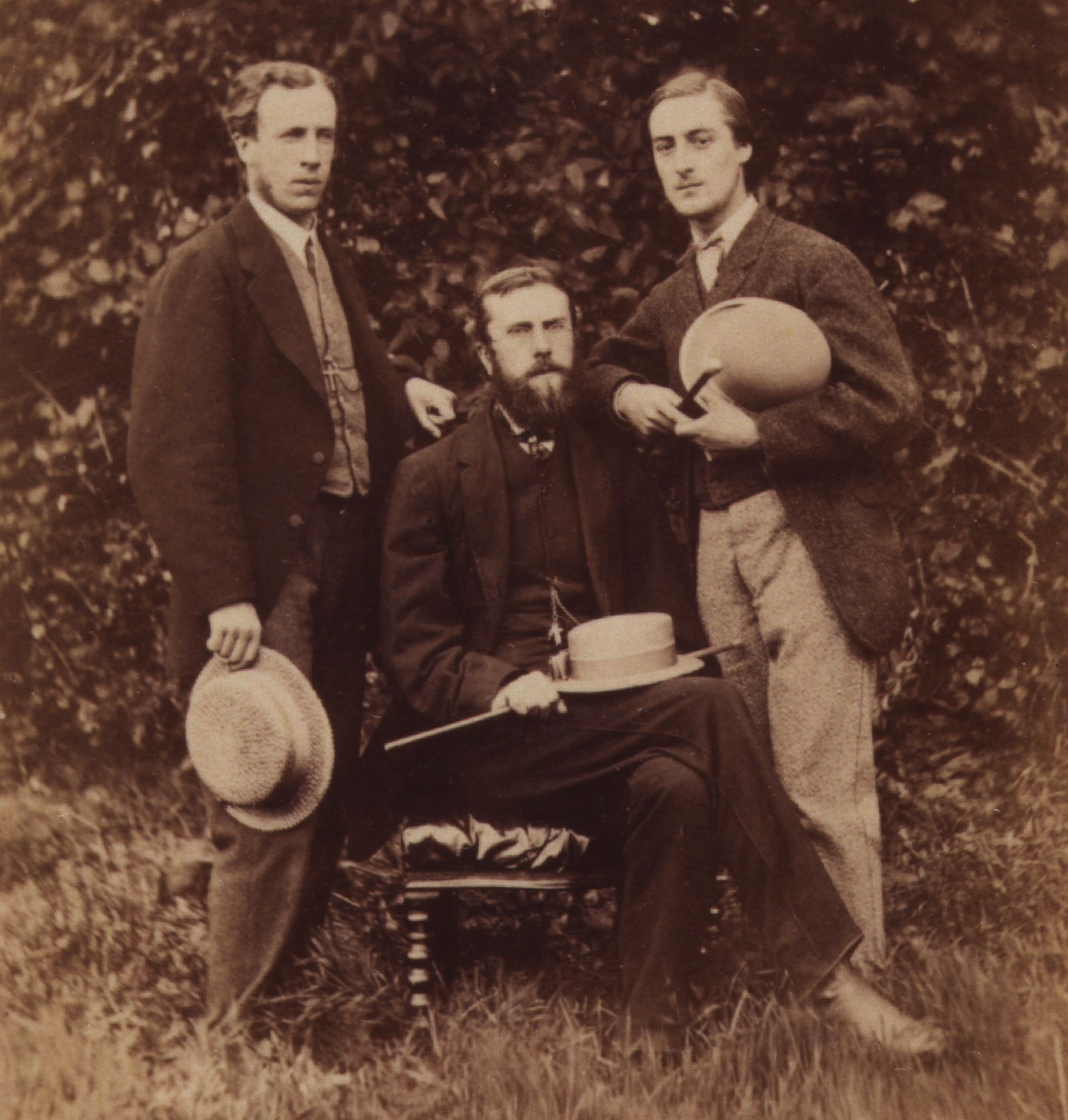
“In the Valley of the Elwy” by Gerard Manley Hopkins (1844-1899):
I remember a house where all were good
To me, God knows, deserving no such thing:
Comforting smell breathed at very entering,
Fetched fresh, as I suppose, off some sweet wood.That cordial air made those kind people a hood
All over, as a bevy of eggs the mothering wing
Will, or mild nights the new morsels of Spring:
Why, it seemed of course; seemed of right it should.Lovely the woods, waters, meadows, combes, vales,
All the air things wear that build this world of Wales
Only the inmate does not correspond:God, lover of souls, swaying considerate scales,
Complete thy creature dear O where it fails,
Being mighty a master, being a father and fond.
(Photo including Hopkins, on the far right, circa 1866, via Wikimedia Commons)
 The Dish