So Why Isn’t Bob Woodward In Jail Then?

Amy Davidson is troubled by the implications of the prosecution’s claims against Bradley Manning:

According to the AP, prosecutors singled out an 1863 case in which a soldier named Henry Vanderwater was convicted of giving a command roster to a Virginia newspaper, which printed the information. “Publishing information in a newspaper [can] indirectly convey information to the enemy,” a prosecutor quoted by Politico argued. Can anyone aid the enemy by giving information to a reporter? Are reporters aiding the enemy if they publish it—and who, by the way, is “the enemy”?

[A]iding the enemy is a charge of a different degree than simply exposing classified information. It involves intent and carries heavier penalties. It is also the sort of charge that, in wartime, or anytime, almost invites overreach.

Greenwald asks why “Bob Woodward’s [White House] sources” aren’t on trial under this reasoning:

Bob Woodward [has] become one of America’s richest reporters, if not the richest, by obtaining and publishing classified information far more sensitive than anything WikiLeaks has ever published. For that reason, one of Woodward’s most enthusiastic readers was Osama bin Laden asthis 2011 report from AFP demonstrates

If bin Laden’s interest in the WikiLeaks cables proves that Manning aided al-Qaida, why isn’t bin Laden’s enthusaism for Woodward’s book proof that Woodwood’s leakers – and Woodward himself – are guilty of the same capital offense? This question is even more compelling given that Woodward has repeatedly published some of the nation’s most sensitive secrets, including information designated “Top Secret” – unlike WikiLeaks and Manning, which never did.

Fuck Old Media, Ctd

Dad's Flight Crew

A reader can relate to this story:

As I found out when my 98-year-old mother died in May 2012, obituaries are billed like classified ads. My mother was very frugal and would have been outraged if we spent hundreds of dollars her obituary. We did want all of her friends to know that she had died, so I spent hours editing and re-editing until everything we wanted to say had been deleted and we were left with little more than the relevant names and dates. A large city paper was totally unhelpful, but the obituary sales person at the smaller paper was a sympathetic, helpful editor. Since then I read long obituaries quite differently.

Another:

My parents passed in 2010, three months apart. My dad’s obit was $1,100 and my mom’s $900. And this was in a small coastal New England city of about 30K. We also placed the obits online. It was free and there was a comment option. You had the choice of keeping the comments up for free for 90 days, or longer for a price.

The online option was amazing. Hundreds of comments were written. The outpouring of kindness and memories was wonderful. The number of comments from far away was interesting as well. People who had moved away and heard from friends or family regarding our loss, and many who simply still followed the local news online.

Another asks:

How about posting that war hero’s obituary on the Dish so it’s read by hundreds of thousands of people? That would bless the socks off that reader of yours – and probably the old man, too, wherever he is.

Well, I contacted the reader and asked permission (including the photograph of a member of the greatest generation’s flight crew). Below is the obit in full. It reminds me why I love America:

Carmen Grasso, 90, passed away on Friday December 28 at Veterans Hospital in Syracuse, NY after a brief illness, surrounded by his family. He was born on April 13, 1922 in Rome, NY, one of eight children of Joseph and Antonina Grasso. After graduating from Rome Free Academy, he volunteered for the U.S. Army Air Corp. He served as a B-24 pilot in World War II and flew 35 missions over Germany, France and North Africa. He earned the rank of Captain and was awarded a Service Medal with three bronze stars and an Air Medal with Silver Oak Leaf Clusters. He resigned from reserve duty with a rank of Major.

He earned a B.A. from Syracuse University and a J.D. from New York Law School. Upon graduation, he established a successful law practice in Syracuse, NY and was a partner of the firm Rizzo, Aloi, Grasso and Urchioli. Throughout his career, he served on numerous boards and committees, including the Onondaga County Bar Association Grievance Committee. In 1961, he and a group of friends founded the Pompey Hills Golf and Country Club, where he established the annual Father Charles Borgognoni Golf Tournament, a charity fundraiser. Later, he became a member of the Cavalry Club.

He was active in local Syracuse politics and was a member of the Lincoln Republican Club and Young Republicans Club, where he met his wife, Ida Antonazzi, in 1957. He served on the Town of DeWitt Zoning Board and belonged to the Rotary Club. He sang with the Berlitz Choral Group and a local barbershop quartet; served on the boards of Civic Morning Musicals and the Syracuse Opera Club; and was a long-time supporter of the Syracuse Symphony.

He raised his family in Manlius, NY, then, in 1997, retired to Annapolis, MD and later Lexington, VA in order to be close to his sons and grandchildren. In 2008, he returned to Fayetteville, NY with his wife.

His family and friends will remember Carmen for his sense of humor, charm, creativity and always-optimistic outlook on life. He is survived by his wife, Ida; sister Natalie Malone; sons Joseph, Thomas and Christopher; and four grandchildren. A family memorial stone will be placed at Immaculate Conception Cemetery in Fayetteville, NY. A memorial mass will be held in the spring.

(Photo: Carmen Grasso’s Flight Crew V2. He’s on the far left, back row.)

Advanced Search

Gary Marcus imagines the future of search:

As machines come to better comprehend the pages they read, their utility to us will increase by orders of magnitude. It won’t be just “find me a recipe for chicken noodle soup,” it will be “analyze one hundred recipes for chicken soup and give me the ones with best taste rating among a subset that uses less added salt, and tell me which nearby shops stock the ingredients I don’t already have.” Instead of search being a hit-or-miss proposition, the best search engines will find what you need, when you need it.

Are We Making Ourselves Obsolete?

Noah Smith worries that automation is increasing inequality:

For most of modern history, two-thirds of the income of most rich nations has gone to pay salaries and wages for people who work, while one-third has gone to pay dividends, capital gains, interest, rent, etc. to the people who own capital. This two-thirds/one-third division was so stable that people began to believe it would last forever. But in the past ten years, something has changed. Labor’s share of income has steadily declined, falling by several percentage points since 2000. It now sits at around 60% or lower. The fall of labor income, and the rise of capital income, has contributed to America’s growing inequality.

The Economist‘s more optimistic view:

Roughly a century lapsed between the first commercial deployments of James Watt’s steam engine and steam’s peak contribution to British growth. Some four decades separated the critical innovations in electrical engineering of the 1880s and the broad influence of electrification on economic growth. [Economist Robert Gordon] himself notes that the innovations of the late 19th century drove productivity growth until the early 1970s; it is rather uncharitable of him to assume that the post-2004 slump represents the full exhaustion of potential gains from information technology.

Hathos Alert

Hathos_Alert_1.17

David Atkins plays the world’s smallest violin:

So this is apparently a real thing from the Wall Street JournalThe Onion couldn’t top this. Whether it’s the sad faces of all these put-upon dejected rich people, or the elderly minority couple who is depressed despite not paying extra taxes (or was that the point?), or the distressed single Asian lady making $230,000 who might not be able to buy that extra designer pantsuit this year, or the “single mother” making $260,000 whose kids presumably have a deadbeat, indigent dad just like any other poor family, or that struggling family of six making $650,000 including $180,000 of pure passive income and wondering how to make ends meet, mockery is almost superfluous. The thing mocks itself.

Perpetrator Or Victim?

As more details about the Manti Te’o hoax surface, Gene Wojciechowski summarizes the knowns and unknowns:

[U]ntil the mushroom cloud of a Deadspin report enveloped his life Wednesday, Te’o was considered to be all that was right and good about college football. He was more than an All-American linebacker from Notre Dame; he was an ideal, a template for integrity, compassion and humility. Te’o might still be all of those things. Or none of them. We still don’t know for sure.

We do know he issued a statement saying that he was the victim of an elaborate online and telephonic deception. We know that his “girlfriend,” and her death from leukemia, were the figments of someone’s depraved imagination. What we don’t know is whether Te’o’s imagination was involved in the deception.

Alexander Abad-Santos is puzzled:

Buzzfeed’s video Svengali, Andrew Kaczynski, found a Te’o interview from December 8 — two days after he allegedly found out this was a hoax — wherein Te’o acknowledged that his “girlfriend” died from cancer. “I don’t like cancer at all. I lost my grandparents and my girlfriend to cancer,” Te’o said. Te’o here is, at the very least, perpetuating his girlfriend’s leukemia saga.

Gridlock Isn’t Forever

Douthat warns both parties:

The idea that the G.O.P.’s House majority is so secure that perpetual brinksmanship (today debt ceiling threats, tomorrow a government shutdown, rinse and repeat) carries no political costs has seduced some Republicans, but it’s quite likely wrong, and the idea that the Obama majority can be recreated easily enough in 2016 by a lesser political talent absent much stronger economic growth isn’t any more self-evident. Demographics and district lines are powerful, but so long as public satisfaction with the country’s direction remains twenty points below its Reagan-era levels, it seems wiser to bet on further upheaval than to expect the status quo.

The Dish Meter’s Mechanics, Ctd

A reader writes:

I started reading your blog about two years ago and subscribing to your new model was an easy decision for me. Regarding your meter discussion, I have to disagree with many of your readers. I think metering the original long-form writing by you and your staff is counterproductive. Your long-form blogging is the very best part of the site, so putting it in a place where non-paying readers can’t see it will decrease your ability to attract new subscribers. If when I first came to the site all I saw was the content aggregation, I would have quickly taken the Dish off of my RSS feed. Why take away from potential new customers the very thing that is going to convince them to sign up?

Even if all of my longer posts are metered, only a portion of my writing will go behind the read-on, thus allowing all readers to get the gist of the post, regardless of subscription. Another reader:

I’m not quite sure why there is so much hand-wringing about whether your links to other people are in front or behind the meter. If you chose to fund your website with advertising instead of subscriptions, you’d still be making money from linking to other sites. You currently don’t pay for the privilege of linking to the various sites you post every day, do you?  So why does it matter where the links are on your site?

I guess I don’t see your use of “read on” being the trigger of the site meter as necessarily the most effective way of getting more subscribers. I view it more as just your community of loyal readers/subscribers subsidizing everyone else’s being able to share in the value we see in The Dish. But I guess it will all depend on whether you can get enough subscribers to meet your revenue goal.

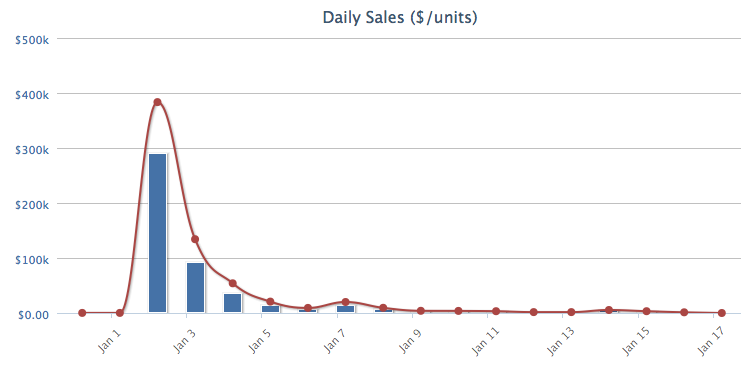
The first big wave of subscribers and their high percentage of donations were likely driven by that feeling of “loyalty”, but that initial wave of support has dropped off significantly:

TinyPass_Screenshopt

So we presume – hope! – that a much larger swathe of fence-sitters will only subscribe once they are nudged by the meter. That theory is reinforced by many emails we are receiving, such as this one:

Although I haven’t subscribed yet, I love the Dish and can’t imagine my day without unhindered access to it. So when the meter hits, I will almost certainly sign up. I’m just waiting to see the site first.

Regarding your discussion about the meter’s mechanics, I have a suggestion and a plea.

My suggestion: do not put reader dissents behind the meter (as someone else suggested.) The high-quality vigorous push-back you include from readers is one of the best and most distinctive things about your blog and will help lure new readers. Also, the dissents will tweak people’s interest in the commentaries that are behind the meter. In doing so, they may encourage new subscriptions.

My plea: It makes sense to put reader-generated threads behind the meter. But if you do, can you make them freely available after a certain amount of time has passed? The bioethics professor who shares the “It’s So Personal” link with his or her students would no longer be able to if it’s behind the meter.  The content of some of these threads remains just as valuable and relevant over time. So why not allow delayed free sharing? Readers who want to follow or contribute to the threads in real time would still have an incentive to subscribe. But those bioethics students would also benefit from the content, down the road – and may become followers of the Dish as a result.

Another bit of brainstorming:

When presenting a longer piece that includes aggregated content, I think you should alter the format you currently use. Right now, you frequently have quoted content in the middle of a longer piece. Going forward, why not put all that stuff up top as a “jumping off point,” give a brief summary of where you’re going, and then the meter kicks in for your full thoughts?

Previous feedback from readers here. To help keep this community alive and innovating, sign up for the new Dish here.

(Chart from TinyPass)