Our Vivid Planet

dish_Edmaier

Megan Gambino talked to photographer and geologist-by-training Bernhard Edmaier about how he captures his aerial shots of Earth, such as the above photo of Landeyarsandur, Iceland:

“I do a lot of internet research, including Google Earth [searches], study satellite images of planned destinations, maintain close contact with local scientists and commercial pilots, deal with various authorities and negotiate flight permits,” says Edmaier. “It can take months of research until the moment of shooting has arrived.”

Then, on that long-awaited day, the German photographer boards a small plane or helicopter and instructs the pilot to position him in just the right spot over the landform. He often has that perfect shot in mind, thanks to his planning, and he captures it out of the side of the side of the aircraft with his 60-megapixel digital Hasselblad camera.

From a logistical standpoint, Edmaier explains, “As my favorite motifs, geological structures, are mostly very large, I need to shoot my images from a greater distance. Only from a bird’s eye view can I manage to capture these phenomena and to visualize them in a certain ‘ideal’ composition.”

(Photo by Bernhard Edmaier. More of his work is available in his new book, EarthART, published by Phaidon.)

Brevity Is The Soul Of Twitter

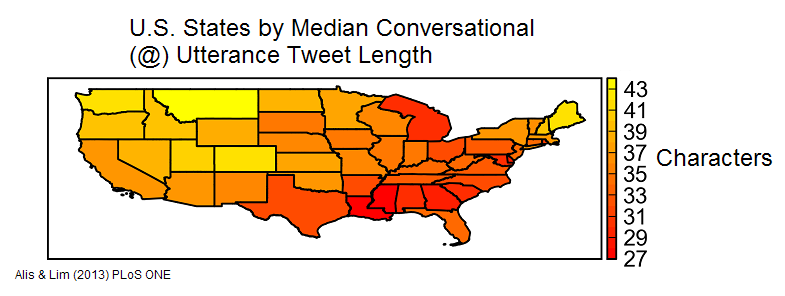
Neuroskeptic comments on new study findings that suggest “conversational” tweets (tweets that begin with “@”) are getting shorter:

The difference is mainly due to people using fewer words. The length of the most-used words didn’t change very much, but the number of words per tweet fell… So tweeters are dish_state_tweets becoming less verbose (within any given tweet), which the authors suggest might represent the development of more economical linguistic conventions adapted to Twitter. But is this true of everyone?

Broadly speaking, yes – at least in terms of English-language tweets. The slope of the decline was similar in the USA and in tweets originating from the rest of the world. However within the US, [researchers Christian M.] Alis and [May T.] Lim found a remarkable state-by-state variability (Bear in mind however that few tweets have geolocatable info, so the sample sizes,and representativeness, of these data here are lower)… The average @ utterence from Louisiana is just 27 characters, compared to 43 in Montana.

Why? State average income and educational attainment were weak predictors of length, but Alis and Lim say that the biggest factor they found was… race. States with more African-Americans produced shorter tweets.

Remembering Moms Mabley

Lisa Derrick recommends the new HBO documentary “Whoopi Goldberg Presents Moms Mabley,” about the first female comedian to make a living in stand-up:

Born Loretta Mary Aitken, Mabley began working as a stand-up in the late 1920s, and made a living on the Chitlin’ Circuit—the vaudeville clubs, speakeasies and theaters throughout the eastern, southern, and upper mid-west areas of the United States where African-American performers were able to perform during segregation. In the early days of her performances, Mabley wore androgynous clothes on stage and worked blue, performing XXX-rated routines. As she developed her act, Mabley took on the persona of granny or great auntie, wearing a floral house dress and a drooping hat. She took out her dentures for her stand-up routine—at the time dentures were common—and riffed on her character’s desire for young men and her distaste of old ones, addressing the imbalance of sexual power, as well as hitting on politics, race, war, and other social issues.

Neil Drumming explains that Mabley’s “broke-down hat, old housedress, and ill-fitting shoes” were “more than a visual gag”:

[T]his entire “Moms” persona was Mabley’s method of making herself non-threatening — a tactic that even the most successful female comedians utilize in order to deliver their unique message in a male-dominated field. “People don’t want to hear the truth,” [Joan] Rivers elaborates. “And if you are going to hear the truth, it’s got to come from a homely lady, a lady that’s no competition, a lady that ain’t gonna take your husband, a lady that is okay, that you can trust because she’s harmless.” This insight strikes home as soon as you hear Mabley’s subtle, irreverent commentary on Civil Rights and the political climate of the ’60s.

Diana Anderson-Minshall says that “Mabley’s stage persona reflected her core political values, but did little to suggest she was a lesbian”:

According to Keith Stern’s Queers in History, Mabley came out as a lesbian in her act when she was 79, and worked the lesbian club circuit until her death a couple of years later. … “I had always heard rumors and had never seen any proof,” Goldberg says. “People said, ‘Well, I saw her at [a lesbian club] or I saw her here and I saw her there.’ But there was never anything where you could say, ‘Look, here you go.’” That is, until Goldberg stumbled onto a card picturing Mabley decked out in a man’s suit. It was signed “Mr. Moms.” “Baby, when we found that,” Goldberg recalls, “I was like, Hey, I can say it now!”

Previous Dish on female comedians here and here.

Childcare Across State Lines

Jordan Weissmann examines it:

Child care is a carefully regulated industry. States lay down rules about how many children each employee is allowed to watch over, the square footage centers need per child, and other minute details. And the stricter the regs, the higher the costs. If a center is required by law to have 25 square feet of space for every kid in a program, it can’t ever downsize its building when rents rise. If it has to hire a care giver for every two children, it can’t really achieve any economies of scale on labor to save money when other expenses go up.

A comparative case in point: in Massachusetts, where child care centers must hire one teacher for every three infants, the price of care averaged more than $16,000 per year. In Mississippi, where centers must hire one teacher for every five infants, the price of care averaged less than $5,000.

Previous Dish on the costs of childcare here.

“Germany Has Turned Into A Giant Brothel”

1418768893_75bb6eccb2_b

In sharp contrast with the Swedes:

[In 2001, Germany’s Social Democrats and Greens] wanted to raise the legal and social status of prostitutes. So they enacted a law to remove the stigma from sex work by, for example, giving prostitutes full rights to health insurance, pensions and other benefits. “Exploiting” sex workers remained criminal, but merely employing them or providing them with a venue became legal. The idea was that responsible employers running safe and clean brothels would drive pimps out of the market.

Germany thus embarked on an experiment in liberalization just as Sweden, a country culturally similar in many ways, was going in the opposite direction. In 1999 the Swedes had made it criminal to pay for sex (pimping was already a crime). By stigmatizing not the prostitutes but the men who paid them, even putting them in jail, the Swedes hoped to come close to eliminating prostitution.

The results?

Prostitution seems to have declined in Sweden (unless it has merely gone deep underground), whereas Germany has turned into a giant brothel and even a destination for European sex tourism. The best guess is that Germany has about 400,000 prostitutes catering to 1m men a day. Mocking the spirit of the 2001 law, exactly 44 of them, including four men, have registered for welfare benefits.

Update from a reader:

You should link to sources that are skeptical of the Swedish model bullshit. Start here and go on to the Australian Prostitution Licensing Authority’s analysis of the Swedish model. No one outside of radical circles and the Swedish government believes their model is working. In the meantime, charges of trafficking in Germany have fallen in half in the last ten years.

Another:

Your reader mentioned the Queensland Prostitution Licensing Authority analysis; if you’d like to read, link, or download a copy of that, the pdf is here. If you would rather just read a synopsis, that would be here.

(Photo: Exterior of a Frankfurt brothel by Chris Pirillo)

The Taste Of Patriotism

dish_boxcheese

Sky Dylan-Robbins and Matt Buchanan link the persistent popularity of powdered cheese to American war history:

Cheese may be “milk’s leap toward immortality,” as the writer Clifton Fadiman once put it, but until the development of processed cheese in the early twentieth century, it still readily spoiled. Processed cheese is made by heating and melting regular cheese and adding emulsifying salts, leaving it, as James L. Kraft stated in his patent application in 1916, in “such condition that it may be kept indefinitely without spoiling.” Kraft had great initial success selling some six million pounds of processed cheese to the U.S. government during the First World War; our taste for less than natural cheese products has thus been intertwined with war since the beginning.

But it turns out that an even better way to keep cheese from spoiling is to dehydrate it. In the most popular method, “spray-drying,” liquid is sprayed into a chamber and blasted with hot air. The liquid evaporates, and the remaining solid, a dry particle, is left behind. … Spray-drying first saw extensive use during the Second World War, granting near-immortality to otherwise perishable food products, from eggs to ice cream. So-called dehydrated cheese products, a category that includes both cheese powders and dried, grated cheese, “were developed for the U.S. Army … as a means of preserving cheese solids under conditions to which natural cheese would not normally be subjected,” according to “The Fundamentals of Cheese Science.” (The rations of German soldiers also included powdered cheese.) Gradually, dehydrated cheese and packaged macaroni and cheese became staples over the course of the war.

(Photo of boxed mac & cheese by D. Sharon Pruitt)

The Best Of The Dish This Weekend

eddybowie

I found out about the wonderfully named “Soylent” only a week ago. It’s a meal replacement drink created and funded like a crowd-sourced app. Let me say upfront: I long for it. I’m one of those people who are food-indifferent. I find cooking boring beyond belief and eating a duty rather than a pleasure. Obviously, not all the time, although my few British foodie passions – like rhubarb crumble or steak and kidney pudding – have long since been ruled out of bounds by my allergy to wheat. But a lot of the time, it just takes up time I’d much rather be doing something else. You can watch a good short doc about it here, and ponder how it could alleviate global hunger and environmental destruction. I think it’s cool to watch someone replace food entirely with it, but I don’t see why it has to be that extreme. As a way for me to eat breakfast and lunch while blogging, it appeals. Too many days, in the hours and hours of intense interaction with my laptop, I forget to eat either. And that’s no good. I’ll try to get some and report back.

On the other hand, Buzzfeed continues its relentlessly thorough campaign to turn all journalism into advertizing, with its no-negative-reviews book-review policy. Even those companies actually selling books, like Amazon, are unafraid of blistering critiques. Now, I understand the desire not to engage in trolling hatchet-jobs – that can be left in the capable hands of the culture police at, say The New Republic‘s back of the book. But no trenchant criticism at all? It doesn’t get more whorish to book advertisers than that. I guess we’re lucky we don’t yet have “native advertising” book “reviews” by the publishing houses. Takes out that irritatingly unpredictable character called the independent critic.

Some acute observations: Kurt Vonnegut on plot; James Baldwin’s piercing sanity; Wittgenstein on what religion really is; Saint Paul, who turned Christianity into a theology; a neuroscientist reflects on his own Parkinson’s; and a rare insight into what faith really means – and how it is given shape and nutrition and substance by doubt. After all, if you’ve never doubted something, have you ever truly believed it?

We spent the weekend introducing Bowie to Eddy. A few growls, some snarls, but also: play! At one point, all four of us were curled up, passed out on the bed, like a pack. Never used to happen with aloof Dusty. I can’t help feeling I’m being taught how to live by these creatures. Which makes sense, when you think about it.

The most popular Dish post of the weekend was Yes, Alec Baldwin Is A Homophobic Bigot. Next up was, er, Alec Baldwin Is A Homophobic Bigot.

See you in the morning.

An Emblem Of The End

dish_gravestoneangel

In Russell Banks’s office is the plaster cast of a gravestone angel, its only inscription “Remember Death.” He discusses its significance:

It was a memento mori. I don’t think I even knew what a memento mori was exactly, although growing up in New Hampshire and eastern Massachusetts, I’d certainly seen plenty of them in old cemeteries and churchyards. Mostly, they struck me as unpleasant reminders of Puritanism, the wages of sin and the flames of hell, more creepy than religious. This was 1963. I was pointedly irreligious and whatever the opposite of puritanical is. But something about this particular reminder got through to me, as if I had never linked the two words together before, had never probed the meaning of either one alone or truly considered the imperative mood, and I had to own it, had to bring it home to our little apartment and hang it above my writing table, so that every time I looked up from my struggle to write my first poems and stories, I would see it, and I would remember death. Which is not all that easy to do when you are still in your early 20s, in excellent health, have not been to war, and have not yet lost to death anyone close to you. Even Jack Kennedy was still alive and well in Washington, D.C. …

For half a century I have carried that memento mori with me—from New Hampshire to North Carolina in the mid- and late-’60s, back to New Hampshire, to Jamaica in the mid-1970s, to New York City and Princeton, New Jersey, to upstate New York where I have lived in recent years, and now to Miami where I spend winters. Wherever I have set up my desk and sat myself down to write, my angel has looked down and murmured, Remember Death.

(Photo by Mel B.)

“The Zen Predator Of The Upper East Side”

That’s the title of Mark Oppenheimer’s new e-book, detailing the troubling life and times of Eido Shimano, the Zen Buddhist monk with a history of exploiting the women who came to him for spiritual guidance. A teaser from the book:

Eido Shimano, the Japanese Zen Buddhist monk whose exploitative relationships with female followers over a fifty-year period were to tear apart the American Buddhist community, arrived in the United States in August 1960, at the age of 27, to study at the University of Hawaii. He moved in with Bob Aitken, a Zen teacher who had first been exposed to Zen as a prisoner of war in a Japanese camp, afterwards studying with leading Japanese masters. Shimano stayed in Hawaii for four years, then left for New York City, promptly to organize one of the country’s great sanghas, or Zen communities. Until the women he serially abused finally began to speak out, in the last two years or so, Shimano was a pillar—the pillar—of the New York City community of Zen Buddhists.

Jay Michaelson reviews the book:

As with many religious sex scandals, this is old news to insiders. Other Zen roshis with similar allegations against them include Richard Baker, Joshu Sasaki, Taizan Maezumi—the list goes on, really. The pattern is disturbingly familiar from Catholic, Ultra-Orthodox Jewish, and similar systematic abuse scandals: insiders made aware, positive values of spiritual teacher stressed, abuse hushed up, abuse repeated.

Yet in Shimano’s case, the facts are murkier.

First, all of his “victims,” if that’s even the right word, were adults; this was not a case of predation of teenagers, as in the Catholic Church. Second, none were raped, in the narrowest (and legal) sense of the term. And while some sexual acts are alleged to have been coerced, most of Shimano’s reported liaisons were consensual—that is, if there can ever be consent within a power relationship such as that between guru and disciple, which perhaps there cannot. Finally, while Shimano was married, it’s not known what his wife made of the allegations, or when she knew of them.

Then there’s the matter of culture. Shimano’s actions are inexcusable by Japanese, American, or any other cultural standard. Yet they did take place within a system of power and patriarchy that includes male sexual philandering within it. How different was Shimano’s behavior from that of a typical Japanese businessman? This is neither to excuse his conduct nor make generalizations about other cultures – but it is to recognize that Western terms such as “sex offender” may not completely fit.

James Ford praises Oppenheimer’s treatment of a complicated subject:

I don’t think it will prove to be the last word, it’s really too early for that. And the book, at sixty-seven pages really more an essay, is brief. So brief he doesn’t even mention the efforts on the part of Reverend Shimano’s Dharma successor the Reverend Genjo Marinello to address the issue, which would be required in any comprehensive review of what had transpired. But it shows enough, and it is devastating. …

And [Oppenheimer] avoids some of the possible traps for the unwary. For instance much has been made in some corners of the fact Reverend Shimano, who received his formal authorization in a public ceremony witnessed by perhaps a hundred people, turned out not to have been registered at the home temple in Japan. This is significant. But people have gone on to suggest therefore he didn’t actually have Dharma transmission, the critical authorization for a Zen teacher. Oppenheimer simply cuts through this as “arcane controversies…” And, instead, keeps his focus on the confusions of the heart that allow such things to happen, both for victim and perpetrator.

Faces Of The Day

dish_fotdsun17

Jordan G. Teicher captions the above image by Scott Dalton:

In Mexico, curanderos, or traditional healers, have long served an important role in peoples’ medical and spiritual lives. A select few have even become celebrities. In the early 20th century, El Niño Fidencio became one of the country’s most famous curanderos and was considered a miracle worker. Today he is regarded as a folk saint by thousands of his devotees, or fidencistas.

In the 1990s, photographer Scott Dalton heard about a pilgrimage of Fidencio followers in Espinazo, Mexico, from friends and decided to check it out. He returned to Espinazo again in 2006 and 2009 to document the festival for his series “Faith Healers.” … At the pilgrimage, Dalton said, thousands of followers gather to commemorate important dates in Fidencio’s life as well as participate in religious services and healings. Fidencistas believe that modern-day curanderos can channel the spirit of Fidencio and that under his influence they can use his powers to perform healings. Dalton said he witnessed these transformations, in which the eyes of curanderos would roll back and they’d assume a high-pitched voice. “Obviously, there is a strong following,” Dalton said. “I think in Mexico people have a very strong sense of faith and religion plays an important part in their lives, but like anywhere there are varying degrees of belief. These events attract followers from all over the region, so for many this pilgrimage is an important part of their faith.”