The Italian Nietzsche

Adam Kirsch reviews the newly translated, mammoth diary of Giacomo Leopardi, Zibaldone, and finds the poet presaged Nietzsche with his dark meditations on modernity:

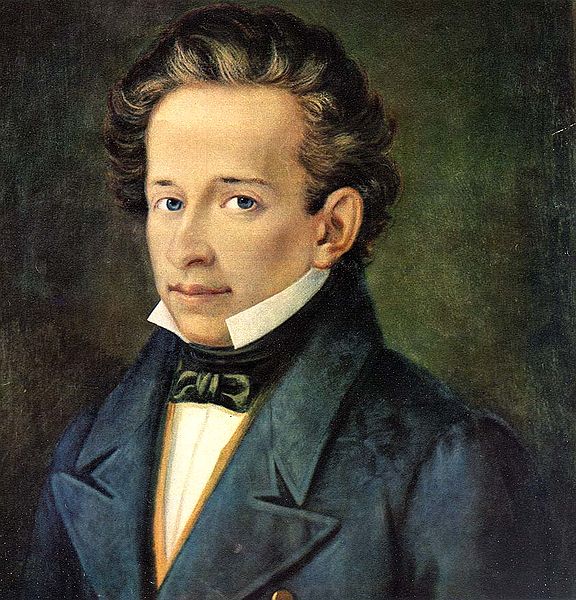
Leopardi envies the ancients, who were history’s children. The young Leopardi, who dish_Leopardi had seen little of life and did not at all like what he saw, took the Greek epics and the Latin orations as evidence that there was once a time when men lived heroically and single-mindedly. The cruelty of the ancients, as we see it in the Iliad, was not for Leopardi a reason to prefer the moderns. On the contrary, the belligerence of antiquity was a sign of its greater authenticity and capacity for faith. At moments Leopardi suggests that the xenophobic patriotism of the ancient Greeks, their capacity for utterly dehumanizing and exterminating their foes, was a technique of thought that the moderns would do well to cultivate: “Society cannot subsist without love of the homeland, and hatred of foreigners.”

Here Leopardi strikes a note that would become familiar from Nietzsche, and later from fascism:
the belief that the modern world must re-barbarize itself. Yet this is Leopardi’s view only at rare moments, when he seems carried away by his own speculations. Temperamentally he is anything but violent, and far from being contemptuous of the mind, he is in his own way absolutely pious toward it—in just the way that Nietzsche would observe that the nihilist remains pious toward one thing, which is the truth. And the truth, for Leopardi as for Nietzsche, is that there is no truth. This is the revolutionary insight that enlightened thought has brought us, overturning in the process two thousand years of Christian and Platonic thought about the nature of the good. “The truth about good and evil, that one thing is good and the other is bad, is believed to be naturally absolute, when in fact it is only relative…. There is almost no other absolute truth, except that All is relative. This must be the basis for all metaphysics.”

Previous Dish on Zibaldone here and here.

(Image of Leopardi c. 1820 via Wikimedia Commons)

If Only We Were Dogs …

Neuroscientist Christof Koch talks to Wired about human and animal consciousness:

WIRED: Does a lack of self-consciousness mean an animal has no sense of itself?

Koch: Many mammals don’t pass the mirror self-recognition test, including dogs. But I suspect dogs have an olfactory form of self-recognition. You notice that dogs smell other dog’s poop a lot, but they don’t smell their own so much. So they probably have some sense of their own smell, a primitive form of self-consciousness. Now, I have no evidence to suggest that a dog sits there and reflects upon itself; I don’t think dogs have that level of complexity. But I think dogs can see, and smell, and hear sounds, and be happy and excited, just like children and some adults.

Self-consciousness is something that humans have excessively, and that other animals have much less of, though apes have it to some extent. We have a hugely developed prefrontal cortex. We can ponder.

WIRED: How can a creature be happy without self-consciousness?

Koch: When I’m climbing a mountain or a wall, my inner voice is totally silent. Instead, I’m hyperaware of the world around me. I don’t worry too much about a fight with my wife, or about a tax return. I can’t afford to get lost in my inner self. I’ll fall. Same thing if I’m traveling at high speed on a bike. It’s not like I have no sense of self in that situation, but it’s certainly reduced. And I can be very happy.

Previous Dish on the subject here, here, and here.

A Speech That Defined America – For Good And Ill

Richard Gamble rethinks Lincoln’s Gettysburg Address, describing it as when “the wartime president fused his epoch’s most powerful and disruptive tendencies—nationalism, democratism, and German idealism—into a civil religion indebted to the language of Christianity but devoid of its content”:

For anyone who does not already know something specific about the Civil War, the speech creates no picture in the mind. It could be adapted to almost any battlefield in any war for “freedom” in the 19th century or thereafter. Perhaps the speech’s vacancies account for its longevity and proven usefulness beyond 1863—even beyond America’s borders. Lincoln’s speech can be interpreted as a highly compressed Periclean funeral oration, as Garry Wills showed definitively in his 1992 book Lincoln at Gettysburg. But unlike Pericles’ performance, this speech names no Athens, no Sparta, no actual time, place, people, or circumstances at all.

Into this empty vessel Lincoln poured the 19th-century’s potent ideologies of nationalism, democratism, and romantic idealism. Together, these movements have become inseparable from the modern American self-understanding. They have become part of our civil religion and what we likewise ought to call our “civil history” and “civil philosophy”—that is, religion, history, and philosophy pursued not for their own sake, not for the truth, but deployed as instruments of government to tell useful stories about a people and their identity and mission.

Gamble goes on to argue that all this amounted to redefining America, as Lincoln put in his speech, as a nation dedicated to a “proposition” – that all men were created equal – and that this proved problematic:

Embedded in the Gettysburg Address, the proposition defined the making of America and why it fought a costly war. We cannot know how Lincoln would have wielded the proposition in pursuit of America’s postwar domestic and foreign policy; his death in 1865 left that question open, as Republicans and even Democrats used the martyred president and his words to endorse everything from limited government to consolidated power, from anti-imperialism to overseas expansion. Under all this confusion, however, Lincoln’s propositional nation helped move America from the old exceptionalism to the new. He helped America become less like itself and more like the emerging European nation-states of mid-century, each pursuing its God-given benevolent mission.

A propositional nation like Lincoln’s is “teleocratic,” in philosopher Michael Oakeshott’s use of the word, as distinct from “nomocratic.” That is, it governs itself by the never-ending pursuit of an abstract “idea” rather than by a regime of law that allows individuals and local communities to live ordinary lives and to find their highest calling in causes other than the nation-state. Lincoln left all Americans, North and South, with a purpose-driven nation.

But, at the time, not everyone understood the greatness of the speech. The Patriot-News printed this correction last week:

In the editorial about President Abraham Lincoln’s speech delivered Nov. 19, 1863, in Gettysburg, the Patriot & Union failed to recognize its momentous importance, timeless eloquence, and lasting significance. The Patriot-News regrets the error.

You can read Lincoln’s speech here.

Afraid To Be Healed

Dreher, reaching the end of Dante’s Purgatorio, is moved by what awaits the poet at the summit of the Mount of Purgatory – Beatrice in the Garden of Eden:

Dante saw the light of God in Beatrice, but by his own weakness, lost that vision, and fell into darkness and despair. We learn here that it took many tears and prayers of Beatrice in heaven, as well as the devotion of Virgil, to get Dante to the top of that mountain. As he told the shades in Purgatory, “I climb from here no longer to be blind.” He desires to see. When Beatrice asks him why he “condescended” to approach joy, she means that everlasting joy only comes to those who sacrifice their all-too-human pride humble themselves in profound repentance, so that they can at last see God, or to put it in more theological terms, attain the Beatific Vision.

I am thinking of the incident in the Gospel of John, Chapter 5, in which Jesus approaches the chronically ill man at the Bethesda pool. He asks the man, “Do you want to be healed?” It’s a strange thing to ask; of course the man wants to be healed, right? But on second thought, it is by no means clear that we really want to be healed. Many of us think we want to be healed of our afflictions — I’m speaking in the spiritual sense here — but the truth is, we have made icons of our passions, and even our brokenness, and are frightened by the prospect of life without them. The sicker we are, the stronger the medicine to restore us must be. Dante is not sentimental about this. We face an arduous climb to overcome ourselves and our passions. Longing for Divine Grace — in the Divine Comedy, represented by the figure of Beatrice — propels us forward; note that in Purgatory, we can only move as fast as we desire to move. God, in His infinite love for us, will not compel us to come to him. We have free will. We have to have within our own breasts the desire to see ourselves as we really are, and God as He really is, so that we can at last renounce that which separates us from Him.

We must climb so that we will no longer be blind.

Quote For The Day

James_Baldwin_Allan_Warren

 
“About my interests: I don’t know if I have any, unless the morbid desire to own a sixteen-millimeter camera and make experimental movies can be so classified. Otherwise, I love to eat and drink — it’s my melancholy conviction that I’ve scarcely ever had enough to eat (this is because it’s impossible to eat enough if you’re worried about the next meal) — and I love to argue with people who do not disagree with me too profoundly, and I love to laugh. I do not like bohemia, or bohemians, I do not like people whose principal aim is pleasure, and I do not like people who are earnest about anything. I don’t like people who like me because I’m a Negro; neither do I like people who find in the same accident grounds for contempt. I love America more than any other country in the world, and, exactly for this reason, I insist on the right to criticize her perpetually. I think all theories are suspect, that the finest principles may have to be modified, or may even be pulverized by the demands of life, and that one must find, therefore, one’s own moral center and move through the world hoping that this center will guide one aright. I consider that I have many responsibilities, but none greater than this: to last, as Hemingway says, and get my work done. I want to be an honest man and a good writer,” – James Baldwin, Notes of a Native Son.

(Portrait of Baldwin in 1969 by Allan Warren via Wikimedia Commons)