Why Faith Has No Formula

Wittgenstein once wrote that “Christianity is not a doctrine, not, I mean, a theory about what has happened and will happen to the human soul, but a description of something that actually takes place in human life.” Reviewing Nathan Schneider’s God in Proof, Robert Bolger believes the statement captures how arguments for the divine actually function:

Assenting to a proof for God is similar; it is couched in the language of rationality — it argues for the existence of something. Yet, as I hint at in my own book, Kneeling at the Altar of Science, the impetus behind accepting a religious proof as valid comes from a person’s gut (or soul) and not merely from her mind. The proofs are only meaningful for certain people; whether they mean anything has more to do with what we bring to the proofs rather than what the proofs brings to us. Isn’t this odd? It certainly is because it is odd to say that proofs “prove” only if we are in a position to see them as proofs. But the oddity disappears when we realize that this is actually what we mean by “proof” in a religious context. Schneider writes, “Assent, like this, is a convergence — a meeting of circumstances, choices, and the best of one’s knowledge.”

What the book might teach us about the search for God:

[T]his leads to another radical claim, namely, that the truth of a religious proof cannot be known except by those who accept it. This is an important point to make since it lets us see that searching for God is not simply searching for some thing among others, a being among other beings, or a creature that is strong and powerful but lives far away. If God could be found at the end of a logical proof, then finding God would be like finding a solution to a math problem or surmising a previously unknown planet by the laws of physics. It is only in the failure of the religious proofs to function in the way other proofs do that we learn something about the meaning of the word “God.”
A Poem For Sunday

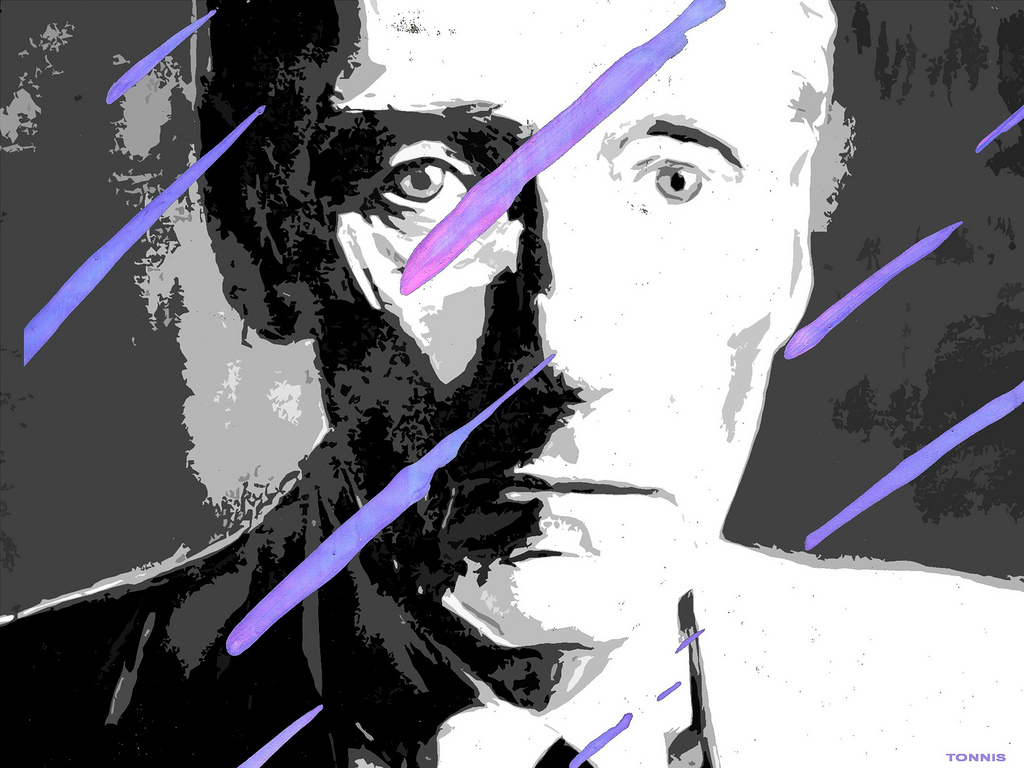
William_S_Burroughs

“I Dreamed I Met William Burroughs” by Franz Wright:

I met William Burroughs in a dream.
It was some sort of bohemian farmhouse,
and he was enthroned, small and skeletal,
in a truly gigantic red armchair.

When I asked him how he was, he replied,
Well, you know what they say—for best results
always mock and frighten lobster before boiling.
Franz—I like that name, Franz.  Childe Franz

to the dark tower something or other . . . Hey,
got a smoke? And quit worrying so much:
they can’t help themselves, they’re like abused dogs
and they’re going to react to affection and kindness

with uncontrollable savagery. Just tell them,
You’re out of my mind, pal. You’re out
of my mind.  Either that or, I’m out of yours.
That’ll keep them brain-chained to their trees.

(From F/poems © 2013 by Franz Wright. Reprinted by kind permission of Alfred A. Knopf. Image of Burroughs by Christiaan Tonnis, via Wikimedia Commons)

Breaking Faith In Science

Jerry Coyne rejects the arguments of those “who claim that science and religion are compatible” because, supposedly, “science, like religion, rests on faith: faith in the accuracy of what we observe, in the laws of nature, or in the value of reason.” Not so fast, he says:

The conflation of faith as “unevidenced belief” with faith as “justified confidence” is simply a word trick used to buttress religion. In fact, you’ll never hear a scientist saying, “I have faith in evolution” or “I have faith in electrons.” Not only is such language alien to us, but we know full well how those words can be misused in the name of religion.

What about the public and other scientists’ respect for authority? Isn’t that a kind of faith? Not really. When Richard Dawkins talks or writes about evolution, or Lisa Randall about physics, scientists in other fields—and the public—have confidence that they’re right. But that, too, is based on the doubt and criticism inherent in science (but not religion): the understanding that their expertise has been continuously vetted by other biologists or physicists. In contrast, a priest’s claims about God are no more demonstrable than anyone else’s. We know no more now about the divine than we did 1,000 years ago.

Why scientists don’t have “faith” in the laws of nature or in reason:

The orderliness of nature—the set of so-called natural laws—is not an assumption but an observation. It is logically possible that the speed of light could vary from place to place, and while we’d have to adjust our theories to account for that, or dispense with certain theories altogether, it wouldn’t be a disaster. Other natural laws, such as the relative masses of neutrons and protons, probably can’t be violated in our universe. We wouldn’t be here to observe them if they were—our bodies depend on regularities of chemistry and physics. We take nature as we find it, and sometimes it behaves predictably.

What about faith in reason? Wrong again. Reason—the habit of being critical, logical, and of learning from experience—is not an a priori assumption but a tool that’s been shown to work. It’s what produced antibiotics, computers, and our ability to sequence DNA. We don’t have faith in reason; we use reason because, unlike revelation, it produces results and understanding. Even discussing why we should use reason employs reason!

A Godless Gathering

Alice Robb visited the church for atheists founded by Sanderson Jones and Pippa Evans, known as The Sunday Assembly, when it recently passed through Washington, DC:

British comedians Sanderson Jones and Pippa Evans … are hipper, gentler, and less intellectual than your typical secularist preachers. And they’re working from a very different premise—that non-theists are missing out on the benefits of being part of a spiritual community. By providing skeptics with a non-religious place to sing, socialize, and discuss values—they’ve described the assembly as “part foot-stomping show, part atheist church”—they want to reach people who may be turned off by more strident or academic streams of atheism.

“We don’t really use many labels to describe ourselves,” Jones told me. “We do this in a way that appeals to normal people.” Unlike activists like [Manual for Creating Atheists author Peter] Boghossian, Jones and Evans say they’re not out to convert anyone. “We want to make sure everyone is welcome,” said Jones.

Sounds nice, but Evans and Jones are so wary of giving offense or excluding anyone that it’s unclear what, if anything, they do believe.

Robb notes that the group’s “lack of boundaries makes for a muddled, or even nonexistent, message”:

We sang songs by Queen and Bon Jovi. We closed our eyes for a minute of silent reflection. Jones talked about gratitude. Upon command, we introduced ourselves to our neighbors and played an awkward clapping game. My partner, who found the event on meetup.com, told me he wouldn’t be coming back. A fan of Dawkins and Daniel Dennett, he said he’s looking for something more cerebral.

Jones told the assembled they were witnessing the birth of a local community, but I’m not so sure. Religious institutions breed communities because their members share a background or at least some core beliefs and values; they perform rituals together and define themselves in opposition to other groups. The only thing the people sitting around me agreed on was that they’re all human. They had diverse and sometimes incongruent beliefs. One woman identified herself to me as agnostic, while a middle-aged man called himself a “praying atheist”; a recovering food addict, he said he invented a female deity to help him through his 12-step program. It was all very inoffensive, but is a shared belief in being human enough of a foundation for a community? Why congregate if there’s nothing to bind the congregation but our membership of the same species?

Previous Dish on the Sunday Assembly here.

Evangelizing The Inner City

In an interview, Detroit pastor Christopher Brooks, author of the forthcoming Urban Apologetics, discusses how he tries to overcome the “disconnection” between typical arguments for Christianity and the realities faced by urban minorities:

Many people in our community are simply asking, “How do we make it in this country right now?” Unfortunately, traditional Protestant apologetics has rarely addressed questions of justice. Pick up a Catholic catechism, and you will find a section on social consciousness, social responsibility, and social justice. But in the average evangelical systematic theology, it’s not there. Sadly, in the black community, we have conceded these issues either to liberation theology or to black nationalist groups like the Nation of Islam. There needs to be a strong evangelical voice in our urban areas that says, “Here is what the gospel has to say about justice.”

White evangelicals typically are drawn to the righteousness of God—the importance of right doctrine and right practices—whereas African Americans and minorities are drawn more to the justice of God. Yet Psalm 89 says the foundations of God’s throne are righteousness and justice. We can’t bifurcate the ethics of God into categories of righteousness—issues like abortion and human sexuality—or justice—issues like educational and economic equality.

One way his congregation is living that message:

Our church has embraced adoption and foster care in a huge way. The foster-care system is disproportionately populated by minority children. There has been an antagonistic relationship with the state because of the perception that the state somehow profits from pulling our children out of our homes.

But as we were studying Scripture, talking about the Father God, we encountered the language of adoption in Ephesians 1 and the orphan and the widow in James 1:27. We had to ask, “What is our obligation to the orphans in our community?”

We have a goal that there would be no children in our community waiting for a home. There are about 2,000 children waiting, and our goal is to be able to find 2,000 homes for them. We have 3,000 churches in Detroit. So if each church can get just one family to adopt, we can eliminate the need for children to wait. That is a matter of praxis and apologetics: showing how the gospel makes a difference.

The Father Of Christian Theology

dish_paul

N.T. Wright, the Anglican clergyman and scholar, just published a 1700 page, groundbreaking exploration of St. Paul and the origins of Christianity, Paul and the Faithfulness of God. One point the book makes, and that Wright emphasizes in an interview about his book, is that Paul basically invented the notion of “Christian theology”:

For me, as for many people, ‘theology’ used to have a rather dry, abstract sound – arranging ideas in clever patterns but without much linkage to real life. With Paul all that is different. Paul was a man of action, believing that it was his God-given vocation to found and maintain communities loyal to Jesus right across a world owing allegiance to Caesar. But these communities were bound together by no social ties and indeed cut across normal social divisions. How could they be united and holy? Paul’s answer was: through prayerful, scriptural meditation on who God actually is, who God’s people are, and what God’s future is for the world. That is a kind of working definition (though I come at it in the book from several angles). These were essentially Jewish questions, but ‘theology’ in the new way Paul was doing it was something the Jewish people hadn’t needed to do – and something the non-Jewish world (for whom ‘theology’ was simply a branch of ‘physics’, the world of ‘nature’) hadn’t needed to do either. This kind of theology is a never-ending exploration – each generation has to do it afresh in its own context, and Paul gives us the tools for that rather than a set of pat ‘answers’ which mean that people don’t thereafter have to think.

Peter J. Leithart, who is making his way through the text, picks up on the same theme:

[O]ne of [Wright’s] most interesting suggestions … is that Paul gives a place to “theology” – to prayerful reflection on the nature of God and His works – that is unprecedented in either Judaism or paganism. The reason, he claims, is that Paul set about the redefine everything he inherited in terms of Jesus (this another theme from earlier work): He preached a Christological monotheism, retold Israel’s story in terms of its fulfillment in Jesus, redefined the people of God around Jesus and the Spirit, hoped for a future shaped by the death and resurrection of Jesus. In order to achieve this redefinition, he had to give a more thorough and “systematic” account of God than was common in the religions around him. Theology takes on a “symbolic role” in Paul that it never had before.

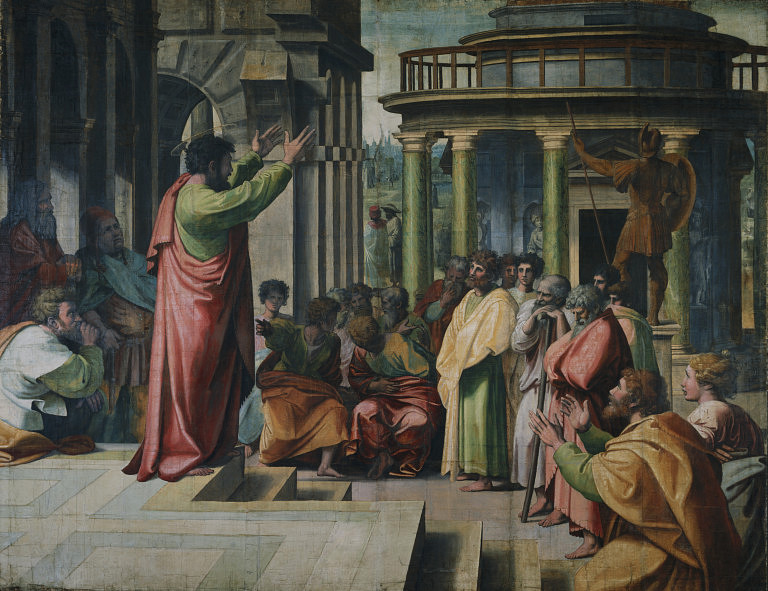
(Image of Raphael’s St. Paul Preaching in Athens, 1515, via Wikimedia Commons)

At Peace With Doubt

Kyle Cupp, author of the new book Living by Faith, Dwelling in Doubt, describes how he’s come to be thankful for his religious doubts, holding that they can “become the building blocks of faith, giving to faith its structure, shape, and power”:

I have my doubts about God, still, especially in stillness and in quietude. I probably wouldn’t make a good monk. There are times when I feel the close presence of a being I want to call God, but these experiences tend to come when I’m not looking for them, when I’ve forgotten myself: chasing my giggling children around the house, scouring one bathroom of mold and rotting caulk while my wife cleans the other, lying down with closed eyes listening to her read poetry. It’s in these simple moments that I sometimes feel as though the love I experience is bigger than I am, almost as though I’m bathed in a spirit that unites me to every love across the universe. Later I’ll make the mistake of getting all theological about God, a point at which God seems to vanish and I’m left with cold formulas that sound lofty but say almost nothing to me.

I’m not sure I’d have it any other way. God is described, ironically, with the term “ineffable,” a word that deconstructs every doctrine we formulate. It indicates the infinite distance between the words and formulas we use to describe God and whatever it is to which they refer. Between our finite words and an infinite God there’s a lot a room for uncertainty. A lot of room for doubts. An endless space for questions and conflicts of interpretation.

In a Q&A about his book, Cupp mentions that he learned early on to deal with religious ambiguity and uncertainty – he was the product of a mixed faith marriage, one parent Buddhist, the other Catholic:

If I were a character in a novel, talking a lot about the uncertainty at the heart of my faith life, the early childhood experiences of a mixed religion household and divorce would make a credible back story. The world of my home began as place of irreconcilable differences. I learned the behavior of trust from my parents, but this trust always meant believing in two people who didn’t agree on matters heavenly and earthly.  Trusting them meant living in tension. Looking back, I think I made peace with this tension. As an adult, when I’ve had my moments of doubting God’s existence or wondering whether any of the stuff said about God really corresponds to something out there, I haven’t felt an overwhelming need to get hold of final answers. You might say I’m at peace with my doubts—with the tension between belief and unbelief in my faith. It’s not that I don’t struggle, but that I feel at home in the struggle.

STD Uncertainty

A short rom-com tackles the sensitive subject of STDs:

This embed is invalid

When Hairpin writer “An HSV-Negative Lady” was 22, she was diagnosed with herpes.  Four years later, her gynecologist told her she tested “negative for everything.”  So why the confusion?

Right now, a visual diagnosis—no tests, just a “you have herpes”—is the standard route for practitioners to diagnose a herpes outbreak. The CDC endorses “visual inspection” as a valid form of diagnosis on their website. Somewhere between 60-85 percent of the time, clinicians make a correct visual diagnosis, [medical director of North Carolina HIV/STD Prevention and Control Branch] Dr. [Peter] Leone said, but that leaves a pretty big possibility that it’s something else. Patients and their doctors can confuse irritated genital symptoms like herpes, yeast infections, and allergic reactions to vaginal hygiene products, [STD expert] Dr. [H. Hunter] Handsfield said.

Most people wouldn’t want to take a 20 percent chance that they’ve wrongly diagnosed a lifelong disease. So why wouldn’t doctors just conduct a simple test?

“They’re lazy, they’re ignorant, and they don’t like talking about sex,” Dr. Leone said. That reticence is especially alarming when it comes to oral sex, since more people are getting herpes through head than ever. “We’ve seen a decline in the number of kids growing up who acquire herpes labialis (of the mouth) in childhood,” Dr. Leone explained. Because these kids lack HSV antibodies, more and more are acquiring HSV-1 through oral sex in adolescence and early adulthood—and yet nobody talks about it. “That’s why I don’t necessarily hate to hear Michael Douglas talk about his cunnilingus in a macho, championship way,” he said. “It is good that there’s someone now who is bringing up oral sex in the general population dialogue, because we don’t discuss it.”

Blockbusted, Ctd

A reader writes:

The thread on the closing of Blockbuster is missing one crucial element in the drama of big-box stores v. mom-and-pop stores v. the Internet.  It’s actually a double death spiral all swirling around the biggest category in movies: pornography.

Blockbuster’s puritanical ethos actually kept small local video stores in business for a very long time, because people who wanted to rent porn could not get it at Blockbuster (or Hollywood Video or other chains). But down the street at the small place with a back room separated from the main room by a curtain, you could get those naughty movies.

What drove the small stores out of business was not Blockbuster, but the Internet.  Why have the potentially embarrassing rental moment in person when you can just download or stream porn online (often for zero dollars), or if you’re a collector, order the DVD via keyboard? The online streaming services put both the big box and the mom-and-pop out of business.

(Video: NSFW scene from Clerks)

30 Days Without Food — Or Hunger

In the above short film, Brian Merchant documents his month-long abstinence from food as a beta tester for Soylent, a liquid food substitute:

After I got back to New York, I didn’t lust after food. I didn’t go hungry, and I didn’t curse Soylent. I was still anxious, sure, as I missed lunch hours and dinner dates and nights out drinking. I found that my new Soylent-fueled body wasn’t well-equipped for drinking. I’d get dizzy, a little ill, but not exactly drunk, if I downed more than two or three drinks. Long, intensive physical activity seemed an undue strain, and I started to lose weight.

A few of the packets were infested with mold, but that didn’t bother me; I was a beta tester after all, and the packaging hadn’t been finalized yet. It’d gotten punctured en route somehow, and moisture had got in—which did highlight its vulnerability to mold, an important point given that [Soylent creator] Rob [Rhinehart] touts its non-spoiling benefits as a solution to sending nutritious food to far-flung places.

Yet I felt fine—even good. Some days I was downright grateful I was on Soylent; a packed day with deadlines, interviews, and edits to finish blew by seamlessly, and I never had to leave my desk. Those days, I embraced Soylent wholeheartedly.

Soylent has a new liquid-food competitor in Ambro:

“Soylent’s goal is to be synthetic and affordable,” argues [Ambro co-founder Mikko] Ikola[.] “Ambro is organic and premium”. … Ambro has a very different customer target to Soylent: the busy entrepreneur, the overworked employee, the constantly moving field rep and the conscious healthy eater. “It is about getting over hunger five minutes before your meeting, but doing it in a way which completes all your nutritional needs,” says Ikola.