When Is Public Data Private?

In the wake of the Newtown shooting, The Westchester Journal News put together a map, using publicly available data, showing the addresses of gun permit holders in Westchester, Rockland and Putnam counties in New York. Jack Shafer describes the backlash, which included a "crowdsourced map of the home addresses of Journal News employees — including their home and work phone numbers when found." He also considers the implications for privacy concerns more broadly:

Exactly how publishing public-record data constitutes privacy invasion is a topic worthy of a Poynter Institute seminar. By its very definition, the public record is not private. Under New York state law, the information the Journal News obtained from Westchester and Rockland county authorities can be obtained by anybody who asks for it. And even though it will deflate the sails of the boycotters, their protest is futile. No law prevents individuals from making the same pistol permit request from the counties and posting their own maps if Gannett and the Journal News surrender and delete theirs. I’d wager that somebody has already scraped the data from the Journal News site and will repost it if the paper goes wobbly.
What Can We Learn From Latvia?

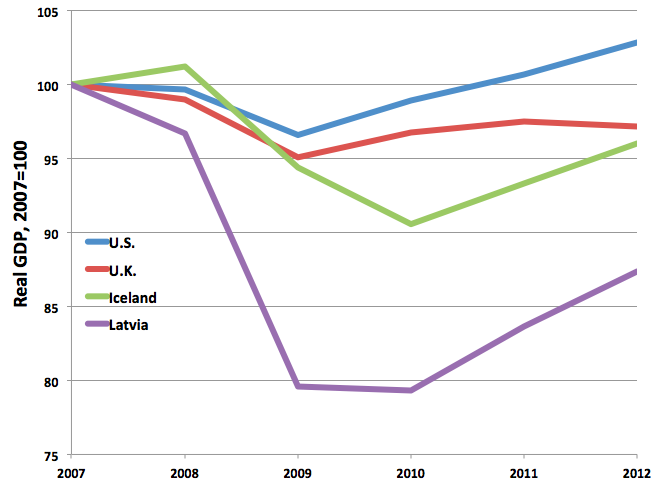
Latvia_GDP_Comparison

The Baltic state is sometimes touted as proof that austerity works. Derek Thompson, who provides the above chart, tackles the claim:

First, Latvia had a massive bubble financed by massive foreign borrowing, with its current account deficit hitting a mind-blowing 22 percent of GDP in 2006-07 before the debt music stopped following Lehman's bankruptcy. And second, Latvia didn't do anything to cushion its subsequent crash. It didn't devalue its currency, and it didn't increase government spending. Instead, it kept its currency pegged to the euro, and actually gashed its budget. Now, it didn't have much of a choice when it came to austerity — that was the condition for its €7.5 billion IMF-led bailout — but it could have chosen depreciation over deflation. It did not.

He goes on:

The combination of tight money and tight budgets took Latvia's economy from "calamity" to "historical calamity"; its GDP fell by over 17 percent in 2009 alone. That's Great Depression territory.

Yglesias chips in two cents.

Facebook Flirts With Sexting

The social networking giant just released its own version of Snapchat, called Poke, which allows users to send photos or videos that quickly self-delete. Amanda Hess favors the original:

This is Snapchat’s cultural triumph over Facebook: It is a social network where sex is comfortably integrated into a user's wider digital life. On Snapchat, sexual identity isn’t cemented through a series of boxes and menus. User profiles are nearly nonexistent, and even private messages are fleeting (though the app has some loopholes yet to close). That’s a winning formula for teenagers, who are highly invested in exploring their sexualities, but face strong cultural shaming from both peers and adults for doing so. Snapchat allows users to behave sexually without that behavior defining them—not for more than a few seconds, anyway.

While acknowledging its myriad flaws, Mark Wilson offers a defense of Facebook's new app:

[F]or whatever Poke may lack in polish, it makes up for in acknowledging the failures of social networking–namely, that social networks lack one of the most important parts of socializing: The safe spontaneity that stems from the forgetfulness of the human mind. 

The Internet is designed to remember everything, to perfectly catalog and update every piece of information you could possibly need at any moment. And while that’s great for researching penguin migrational patterns and getting the best deal on Bounty Select-a-Size, it’s agonizing for socialization. How long do you spend composing a quip on Twitter? 30 seconds? A minute? Several minutes? How long do you spend composing a quip in person? A split second? Why is there such a difference?

One major problem with Poke compared to Snapchat is Facebook's vast social network: "Because if there’s anything on the Internet that’s the anti-sext, it’s probably the place where your conservative extended family is hanging out." But such self-deleting services aren't only being used to flirt with people; Todd Wasserman previews how the frozen yogurt chain 16Handles is using Snapchat:

If you snap a pic of you or your friends at a 16Handles location tasting one of their flavors, you can send it to Love16Handles on Snapchat. In return, you'll get a coupon for anywhere from 16% to 100% off on your purchase. You have 10 seconds to let the cashier scan the coupon, though.

The Decline Of Tinkering

Blue_Box_Jobs

Alec Foege mourns the loss of "making something genuinely new out of the things that already surround us":

For many generations in the postindustrial age, puttering around with the mechanical devices that surrounded us was practically a rite of passage, and for many, a way of life. It tethered us to our machines and reaffirmed our notions of modern civilization. Deeply probing how things worked also provided children and adults alike with endless hours of enjoyment. It saved enterprising souls hundreds if not thousands of dollars on repair bills. It also often resulted in new and startling discoveries that sometimes led to fresh innovations.

The first gadget Steve Jobs cobbled together while still in high school with his geeky older college buddy Steve Wozniak was a “blue box” that enabled free long-distance phone calls by duplicating the appropriate digital tones. Sure, the blue box was illegal, but that didn’t stop the mismatched pair of “phone phreaks” from selling a bunch of the units to college students and other intrepid pranksters. The blue box grew out of a simple love for playing around with gadgets and making them bend to the will of a few individuals.

(Photo: Blue Box at the Computer History Museum. Photo taken by RaD man. Image cropped by The Dish. Permission from RaD man under GFDL license via Wikipedia.)

The Dish Model, Ctd

Ann Friedman joins the discussion:

Whether or not the phrase "personal brand" grosses you out, it’s something any journalist who wants to be employed in another 10 years should be thinking about. Andrewmug Having a direct, dedicated following—a readership invested in you, not just the publication you’re primarily associated with—is like a career insurance policy. While there are many fine journalists who never bring even the lightest detail about their personal lives into their professional narrative—no tweets about their kids, no first-person anecdotal ledes, no opinion-tinged asides in reported features—they are an increasingly small group. I cringe every time I read a New York Times story in which the reporter awkwardly refers to herself as "a visitor." Really? You can’t just say "provided me with directions to her Craftsman bungalow"? Please. …

[J]ournalists were always a part of the story. Why not just own up to the fact that three-dimensional humans are doing this work?

All of the posts in the Dish Model thread can be read here. A reader sent the above photo:

My mother-in-law, after years of me talking about "Andrew" and her asking "Who?" and me responding "My favorite blogger", got the jump on you re: Dish merch.  I received a one-of-a-kind coffee mug for Christmas, replete with your face on it (courtesy of the George Stephanopoulos show).

Of course the Dish has grown to be much bigger than one blogger – four other staffers, two paid interns (new ones started this week: Doug Allen and Brendan James), a poetry savant and a million-strong readership, which provides about a third of our content.

The Dish Model, Ctd

PM Carpenter argues that being completely reliant on subscribers may restrict the Dish's editorial freedom:

Just know that with every strong opinion you write, you'll be risking half of your readership, and therefore, potentially, half of your subscription base. And when finances get tight, the temptation to retract one's opinionated claws might become irresistible. In short, you may find that corporate-free editorializing is far more tyrannical than being free from corporations might seem.

This has occurred to me. I lost a third of my readers in 2003 when I turned against the Iraq war. But somehow I think my lack of a filter is not related to its potential impact on my life, career or income. So I'll trust my own psychological tic. I wish it were an act of moral courage. But it's just who I am. And if you think I have no filter, you should meet my mother.

The Slowly Shrinking Prison Population

Incarceration_Changes

Keith Humphreys points out that the number of Americans in prison has gone down the past few years. One reason you don't hear about this more:

Issue advocates, funnily enough, have an interest in downplaying news that the problem they address is lessening. When the Non-Profit Center to Combat X (where X is anything from hate crimes to spitting on the sidewalk) gives a quote to a reporter about their issue, they will virtually always say that things have never been worse/the problem is exploding/the window to act is closing rapidly etc. It’s not that advocates truly want their problem of interest to get worse, but that their fundraising and profile will suffer if the general public knows that the problem they address is declining in severity.

Kevin Drum singles out one cause of the crime drop: lead.

(Chart from the BJS (pdf))

Covering The Middle Kingdom

Evan Osnos pushes for greater protection of American journalists covering Chinese politics. A slew of journalists, from the NYT to Al Jazeera, have been kicked out, delayed entry, or tangled in red tape:

That is a pattern of pressure that the United States government cannot ignore. These kinds of reports, as well as stories on the downfall of Bo Xilai, have become a vital part of the world’s understanding of China’s political strengths and weaknesses. It informs how the U.S. government understands the men on the other side of its most critical foreign-policy relationship. As Elizabeth M. Lynch, of the China Law & Policy blog, wrote this week, the U.S. has been quiet on the pressure facing American reporters. “In Melissa Chan’s case, the State Department, through a press person, just said that it was ‘disappointed’ with what happened. If ever you wanted to give the Chinese government a signal to continue to harass foreign reporters, such a tepid response was likely the way.”

Drunk With Brando

Douglas McCollam recounts how Truman Capote scored an intimate session with Marlon Brando, in order to write his famous New Yorker profile of the actor:

It was the subject of Brando’s mother that apparently came out as the interview stretched past 1 a.m. As Capote wrote in his piece, “I poured some vodka; Brando declined to join me. However, he subsequently reached for my glass, sipped from it, set it down between us, and suddenly said in an offhand way that nonetheless conveyed feeling, ‘My mother. She broke apart like a piece of porcelain. . . . My father was indifferent to me. Nothing I could do interested him, or pleased him. I’ve accepted that now. We’re friends now. We get along.’ ”

Brando then went on to describe how growing up he’d come home to an empty house and an empty icebox. “The telephone would ring. Somebody calling from the bar. And they’d say, ‘We’ve got a lady down here. You better come get her.’” Later, when Brando was on Broadway, his mother came to live with him in New York. “I thought if she loved me enough, trusted me enough, I thought then we can be together, in New York; we’ll live together and I’ll take care of her. . . . I tried so hard. But my love wasn’t enough. . . . And one day, I didn’t care anymore. She was there. In a room. Holding onto me. And I let her fall. Because I couldn’t take it any more—watch her breaking apart, in front of me, like a piece of porcelain. I stepped right over her. I walked right out. I was indifferent.”

… Never before had the inner psyche of a star of Brando’s magnitude been served up for public consumption, much less by a writer of Capote’s stature. This was something new.

Previous Dish on Capote and the book that ended his career, here.