The Dish Model, Ctd

Donation

Tyler Cowen worries that the new metered Dish foreshadows the end of "a golden age for the blogosphere":

I wish him well with it, but I also hope no one else tries too hard.  (Note by the way that Sullivan will allow a free RSS feed, with complete posts, and free links from other blogs, so this is hardly a full gate.)  In the limiting case, imagine a blogosphere where everything is gated for some price.  What could we at [Marginal Revolution] link to?

Razib Khan has similar concerns:

$19.99 is a pittance. But if I give Andrew Sullivan his due, who else should I “tip.” How about Tyler Cowen? Or Maria Popova? I consume more of Tyler’s content directly than Andrew’s, and Maria’s even more indirectly and in a diffuse fashion. In terms of media consumption I’m currently a subscriber to The New York Times, contribute to Wikipedia, try and support bloggers who I read and have fund drives, and also have a Netflix account. This isn’t much. But it starts to add up. The content universe of the internet is vast for the infovore, especially for one who relies a great deal on intermediating technologies to sift and filter the stream of content.

But this was always the case with old media. You paid for your New Yorker and New Republic and Wired and the Economist. And we paid more, relatively speaking, for each – because we were also paying for paper, print and physical distribution. Dan Gilmor proposes one possible solution:

One thing I'd bet on is alliances among bloggers where we can pay a lot less for a grab-bag of sites, on the theory that many more people will be willing to join that way, creating win-win-win situations. Again – and I can't use this word enough – the more experimenting and innovation the better.

Yglesias thinks along the same lines:

[I]f subscription models succeed, I'd expect them to evolve in the direction of big bundles. That might be because there are eight or nine giant content conglomerates selling subscriptions. Or it might be because of cross-marketing deals. Either way you'd get something that looks less like "the Internet" as we know it today and more like the adjacent series of walled gardens that CompuServe, Prodigy, AOL, etc. originally promoted as the vision of online existence.

At the Dish, we are not so much proud of our agnosticism as resigned to it. We do not know what the future will bring. What I do know is that this medium is still very young, in the grand scheme of things, and that the only way to survive is to experiment in line with what the web seems to be telling us it wants. That last thing is a little hard to gauge precisely: it's hitting a moving target as you are in transit as well. Which is why innovating this medium is as much art as science – and full of wrong turns and surprises. After a while, you relax and enjoy the ride. But I have to admit I was really anxious this past week; last night, as some of it sunk in, I couldn't sleep at all. One hour in the end. So I may be crashing soon …

Reagan’s Digest

Jordan Michael Smith recounts the history of Reader’s Digest:

Reagan was a lifetime reader of the Digest. He once used an article from the magazine to slur the nuclear freeze movement as being comprised partly of Soviet agents. It was terrifying to contemplate the most powerful man in the world getting foreign policy ideas from a pocket-sized general-interest family magazine, but Reagan was not alone. For decades, Reader’s Digest was the primary source of information and opinions about international affairs for tens of millions of Americans. The magazine did not just run any articles about foreign policy, however; the Digest had a clear right-wing perspective, which had a tremendous, though often ignored, influence during the Cold War.

I have fond memories of Reader's Digest – as a freelancer. One tiny excerpt of your prose in that little booklet and you were set for a month of rent. Back in the day when I was struggling to make ends meet in graduate school, it was 500 words for Reader's Digest that got me through. Now it's TinyPass.

Dissent Of The Day

Among a growing chorus in the in-tray:

Amen to the reader whose comment you posted saying you should make it 20 bucks, not $19.99. I had already sent in my $20 contribution when I read the comment. Being a quantitatively literate person, I hate that .99 stuff.  It's a way to try to fool people, and that is exactly the opposite of the honesty that has attracted me to your site over the years (I’ve been reading you since almost the very beginning).  And it is inefficient: it takes much longer to say and write 19.99 than 20.  I would be happy to see us abolish the penny and even happier if every merchant and gas station in the country would stop with their ridiculous .99s and just round up to the next dollar.  Truth in advertising.

That's a good point. I wonder if there's strong evidence that using the whole .99 thing works. And by "work", I simply mean brings in more money than all those extra pennies put together. Is it a myth? Or is it real? We're happy to adjust, but figure Dishheads will know the answer to this empirical issue beforehand. Anyone?

Quote For The Day II

"There's no sugar daddies anymore," – yours truly, in a Q and A with the NYT's inimitable David Carr on the new independent Dish.

And as of this post, as I write, we passed the $400K mark. That's $400K in 48 hours. "Thanks" seems like such a puny response. But you've offered us a serious challenge. We'll do all we can to meet it.

(Bonus coverage of the move in Italy's La Reppublica here and the UK's Guardian here.)

Quote For The Day

"It is easy to understand why even the most generous person might be averse to paying taxes: Our legislative process has been hostage to short-term political interests and other perverse incentives for as long as anyone can remember. Consequently, our government wastes an extraordinary amount of money.  It also seems uncontroversial to say that whatever can be best accomplished in the private sector should be. Our tax code must also be reformed—and it might even be true that the income tax should be lowered on everyone, provided we find a better source of revenue to pay our bills.

But I can’t imagine that anyone seriously believes that the current level of wealth inequality in the United States is good and worth maintaining, or that our government’s first priority should be to spare a privileged person like myself the slightest hardship as this once great nation falls into ruin," – Sam Harris.

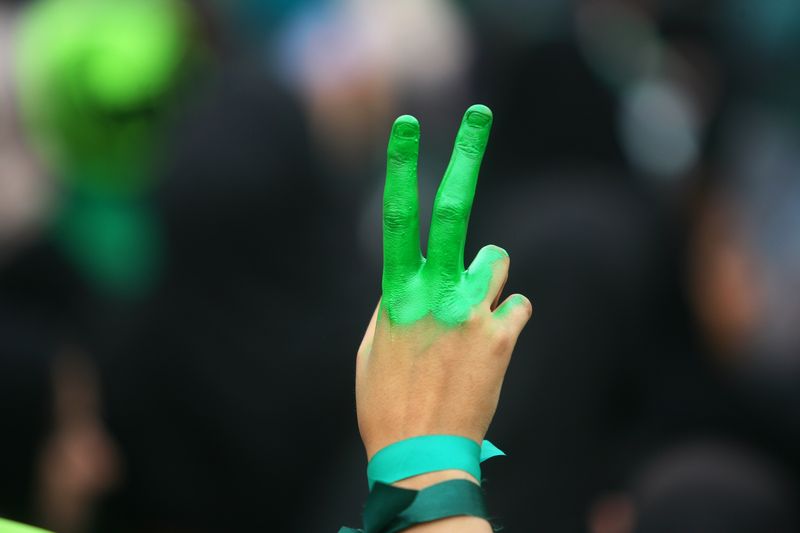
Will Iran Turn Green In 2013?

Iran_Fingers_GT

At Tehran Bureau, Alireza Nader writes that that 2013 Iranian election "may be more tightly scripted than any earlier presidential race to prevent serious debates or competition." Mark Katz agrees:

If indeed the only candidates allowed to run for president are just those few approved by the regime, the Iranian public may come to regard the entire presidential election process as illegitimate. With the downfall of long-ruling leaders in Tunisia, Egypt, Libya, and Yemen (and possibly Syria by mid-2013) providing role models for what popular uprisings can accomplish, the Iranian public may launch a more concerted effort in response to what it regards as an illegitimate presidential election outcome in 2013 than it did in 2009.

Here's hoping – as long as we don't push the opposition into the regime's hands by a new war.

(Photo by Majid/Getty Images)

Arizonans Self-Report

Arizona_Dish

A reader writes:

I read with interest the statistics regarding sign-ups by country and state.  When I saw Arizona, though, I was surprised, because I had subscribed yesterday evening and I live in Goodyear, AZ.  (Our zip is 85395, in case you're looking for it.)  Perhaps it's just that the statistics were captured before I signed up. So, even though Arizona is pretty hopeless in its politics, there are a few of us here who appreciate your point of view and this Arizonan is proud to be a Dishhead.

Another:

PLEASE, PLEASE let us know if we are the first subscribers in Arizona! Can we be the only Dishheads in the state?

Not nearly so, since more than two dozen Arizonans wrote the Dish to announce their formal support. According to the most recent data, we have 181 subscribers in Arizona. The subscriber numbers on the world and state maps were added manually. In our rush to get the statistics up as soon as possible, subscribers in The Grand Canyon State must have inadvertently been left off the map. But the error had at least one good effect:

I've been putting off buying my membership, but the empty space on the enrollment map over my home state of Arizona moved me to action. If there's a "1" over it now, that's me.

In fact, four other readers emailed to say the same thing. Join them in subscribing to the new Dish here.

(Modified Dish subscriber chart from The Atlantic Wire)