“I never drink water. Dick Cheney tortures people with it, which gives it an awkward taste,” – Grover Norquist.
Year: 2013
Tats For Technophiles?
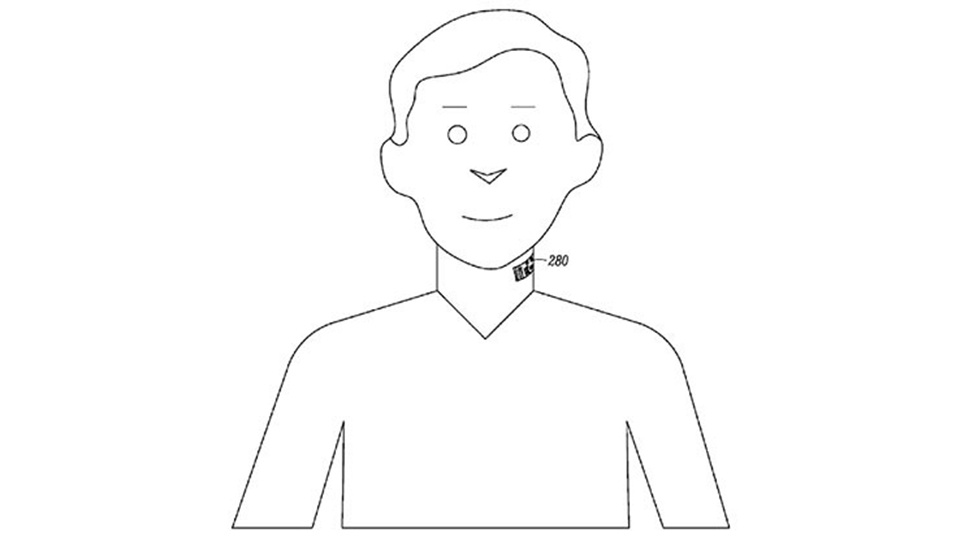
A futuristic project from Google is in the works: electronic skin tattoos. Last week, Google’s Motorola Mobility applied for a patent that would link the tattoos with mobile devices:
The patent, titled “Coupling an Electronic Skin Tattoo to a Mobile Communication Device,” explains that the device would sit on the user’s neck and serve as a supplemental phone microphone. With its close proximity to a user’s mouth, the tattoo would cut down calls’ background noise and produce clearer audio. Equipped with a transceiver, the device would allow for wireless communication with a paired mobile device; this means voice commands on your phone would get even easier, without the need to press a “talk” button before speaking.
The tattoo can also be used as a lie-detector test. The patent says the device will have a “galvanic skin response detector to detect skin resistance of a user” and explains that a user who is nervous or telling a lie might have a different skin-related response than someone who is confident and telling the truth. … The oddest part of the patent: The word “remove” doesn’t show up at all in the document.
Jim Edwards clarifies: “The tattoo isn’t permanent — it’s applied to a sticky substance on the skin.” Derek Mead surveys reaction to the idea:
At TechCrunch, Chris Velazco writes that “before you start freaking out at the mental visual of a tattoo artist weaving electronic components into your neck flesh, know that Motorola has a history of playing fast and loose with its interpretation of the word ‘tattoo.'” Alexis Madrigal called it Google’s “creepiest patent yet.” Steve Dent at Engadget huffs, “Okay, where to start with this one?”
We’re collectively at a strange point in our relationship with technology: Many of us have come to rely on gadgets so much that we’re simply not the same without them, and yet we also don’t admit we have such a techno-dependence. The integration of man and machine is a central tenet of futurism, and yet as folks like Kevin Warwick have argued, the tight integration of technology into our daily lives means we’re already there.
Jason Bittel is skeptical about the lie detector component:
By detecting skin resistance (read: sweat), Google’s skin tattoo may be able to determine whether its wearer is “nervous or engaging in speaking falsehoods.” Since I can’t imagine why the Sam Hill someone would opt to wear such incriminating technology, I think we have to assume the tattoo would either be applied clandestinely or against the wearer’s will. Let’s not even get into the dubious quality of truth-telling based on “skin resistance” alone. … One thing’s for sure, this is unlikely to help Google’s ongoing issues with privacy and consumer trust.
(Image from Google’s patent application)
Quote For The Day II
“Done.” – Hawaii Gov. Neil Abercrombie pic.twitter.com/vzbLA2hV68
— Chris Geidner (@chrisgeidner) November 13, 2013
There Are No Easy Fixes
Barro analyzes the Obamacare bills moving through Congress:
[Sen. Mary Landrieu’s] bill would obligate insurers to continue offering all the plans they offer today unless they entirely exit the health insurance business in a state. What will Republicans do with this proposal? Do they really want a federal law that says health insurers can’t enter or exit specific lines of business?
Rep. Fred Upton (R-Mich.) has introduced a bill in the House that would allow insurers to continue offering plans that would have been prohibited under the Affordable Care Act, but his bill is vulnerable to the criticism that it will still lead to a raft of plan cancellations as insurers choose to discontinue plans because the ACA has changed the financial incentives they face.
If Congress really wants to make sure people can take their plans, it will need to use the heavy-handed Landrieu approach; the light-touch Upton approach won’t work.
Ezra Klein is against Landrieu’s bill:
The bill Landrieu is offering could really harm the law. It would mean millions of people who would’ve left the individual insurance market and gone to the exchanges will stay right where they are. Assuming those people skew younger, healthier, and richer — and they do — Obamacare’s premiums will rise. Meanwhile, many people who could’ve gotten better insurance on the exchanges will stay in bad plans that will leave them bankrupt when they get sick.
Erick Erickson sees the Landrieu bill as a trap for Republicans:
Here’s what is going to happen.
The House, with the help of a good number of Democrats, will pass the Upton plan and send it to the Senate. Harry Reid will substitute the Landrieu plan and send it back to the House. The House will be forced to either vote for the Landrieu plan or be characterized as siding with insurance companies against people.
In one fell swoop, the Democrats will have the GOP on record saving Mary Landrieu’s re-election in Louisiana by casting her as the one who saved Americans’ health care plans, and also getting on record as really being in favor of fixing Obamacare with the use of mandates.
Sargent checks in on House Democrats:
A senior Democratic aide tells me opposition to the Upton plan will be increasingly difficult to maintain among House Dems if the administration doesn’t offer a workable fix of its own. The aide adds the need to maintain House Dem opposition has been made more urgent by another problem: Senate Dems (the latest being Dianne Feinstein) supporting their own politically expedient “fixes” that could also undermine the law.
Though he thinks it’s bad policy, Jon Walker doubts the Upton bill would do much damage to Obamacare:
[I]nsurance companies have spent months preparing for the switch over to the exchanges. They have already cancelled many of these plans and tried to move people to new ones. Trying to undo that in only a few weeks it a lot of work for just another year. There is a good chance many insurance companies will simply choose not to offer these plans any more.
This law would probably result in a few hundred thousand healthier and wealthier people not joining the exchanges next year. While that would impact the actuarial models the insurance companies were using to set premiums on the exchanges, I think the impact would be modest and not of great concern. I feel the danger is being greatly overstated.
But Sarah Lueck foresees major problems with the bill:
While the Upton bill would extend the availability of non-ACA-compliant plans only through 2014, there would be pressure next summer and fall to extend their availability through 2015 or (more likely) permanently. That would permanently raise premiums in marketplace plans, further discouraging healthy people from enrolling and threatening the marketplaces’ long-term viability and, hence, the extension of coverage to millions of uninsured near-poor and middle-income Americans.
Mental Health Break
Straight Out Of Dickens, Ctd
A reader writes:
I’m glad you’ve brought to light the resurgence of pertussis (whooping cough). Julia Ioffe’s description of what it’s like to have the disease is right on, but your readers need to know that it’s even worse for babies to get pertussis. It can kill them. Immunity does wane over time, but there’s something you can do to decrease your risk of getting pertussis, as well as helping to protect those around you: make sure you’ve gotten a booster shot called Tdap (which includes a booster for tetanus and diptheria as well) that’s been available for adults since 2005. Please use your large readership to spread the word.
Another:
I teach at Ohio State University, where we’ve had a low-level pertussis pandemic for several years now. I caught it myself in 2007, along with several of my friends. My doctor told me it’s common at the university because small kids get it and pass it on to their college-age siblings (whose vaccinations have worn off) and they bring it back to campus with them. As it turns out, I’ve been afflicted with a chronic cough since then, and it appears this will be with me for the rest of my life (I’m now 64). Pertussis has a side effect called bronchiectasis that is permanent damage to the bronchia. I spend the first hour of every day coughing.
When I complain to my engineering students that we live in a society that no longer believes in science, they always assume I’m talking about the GOP. I quickly remind them that there are as many lunatics on the left as there are on the right.
On that note:
A lesser recognized culprit in all of this is Robert F. Kennedy, Jr.
No matter your politics, the name Kennedy carries a certain intellectual heft that, when combined with Jenny McCarthy’s celebrity, creates a perfect storm of legitimacy given to bunk science. This Slate article sums it up nicely.
Another looks to the right:
Rep. Darrell Issa (R-CA) has promised a hearing in the Congressional Oversight and Reform Committee to address “the government’s failure to address the autism epidemic.” The last time Issa’s committee gave voice to Jenny McCarthy’s angry mob was in November 2012, when witnesses and congressman made inaccurate and unscientific claims about the safety of vaccines. Why again? Maybe because Issa received $40,000 in donations from Jennifer Larson, a Minnesota business owner and member of the anti-vaccine Canary Party.
Issa also appeared at Jenny McCarthy’s annual Autism One conference in Chicago, where a Who’s Who of medical quacks blame autism on vaccines, and aim to cure it with unproven remedies such as bleach enemas, chemical castration drugs, and chelation. Yes, bleach enemas.
The reader follows up:
Somebody just sent this [pdf] to me. It’s the agenda from last week’s congressional briefing, which paved the way for Issa’s anti-vaccine hearing in December. Issa’s flirtation with anti-vaccine crazies has escaped major media attention so far. I hope you can help bring this travesty to light.
The View From Your Window

Sandwich, Massachusetts, 1.03 pm
If Healthcare.gov Misses Its Deadline
Despite reports to the contrary, the White House still claims that Healthcare.gov will work well by the end of the month. Ezra suspects that “that no one knows for sure whether the Web site will be repaired by the end of the month.” How much damage would missing the deadline do?
The answer depends on two things. First, does the White House’s evident inability to repair the Web site in a timely fashion (or even, at this point, an untimely fashion) lead congressional Democrats to panic and support bills — like a yearlong delay in the individual mandate — that make it harder for the law to succeed even once its digital infrastructure is fixed?
The second question, of course, is how far off-schedule the White House really is. If HealthCare.gov is working smoothly for the majority of users on December 1st but it only works smoothly for the “vast majority” of users on December 15th, that won’t matter much. If the Web site remains more or less unusable into 2014, that’s obviously a much bigger problem for the law.
Cohn outlines contingency plans:
For starters, the marketplaces could rely more heavily on alternative methods of enrollment, particularly “direct enrollment” from insurers and through online brokers like ehealthinsurance.com. From the get-go, Obama Administration officials assumed that at least some people would get insurance this way. And they designed healthcare.gov with that possibility in mind. It is supposed to have a special portal—in effect, a side door into the federal online system for people buying insurance directly from insurer websites. As I understand it, the idea is that you’d apply for insurance at a company website or broker, you’d get sent over to healthcare.gov to figure out whatever financial assistance was available to you, and then you would take that determination back to the insurer or online broker—where you’d be able to enroll and buy a policy, potentially at a discounted price.
Why this hasn’t already been done:
The danger with direct enrollment through insurers is that applicants will check out one company’s options and never realize other companies might have better alternatives. That’s obviously not such a problem with the online brokers, but officials had separate worries about relying too heavily on those sites. For example, could they be counted upon to make sure consumers understood what they were buying?
At this point, however, transforming the existing, opqaue market into a more competitive, transparent one must come second to making sure everybody can get coverage on time. That’s why administration officials have been huddling with insurers about how to make more use of direct enrollment.
Club Tripod, Ctd

More members write in:
We rescued Harry, a harrier hound that closely resembles a beagle, from a road accident when he was one. He stayed with us (and ran “like the wind”) for 15 years. He lacked a right-rear leg but he was the envy of the other male dogs – he could whizz on the fly! Gotta love them tripods!
Another:
As the owner of a three-legged kitty, I thought I’d give you a heads up on a term a friend of mine taught me (she had a speedy three-legged dog). It’s “Tripawd” instead of tripod. It’s a little cutesy – but, well, it’s really cute too!
Another:
I am totally beside myself to have my favorite blogger now join the three-leg club! Ruby was found living behind a dumpster with an injured leg back in 2008. We took her in, hoping to find her owner or a new home. After two surgeries the vet said Ruby would be better off if we just amputated the injured leg. By this time, finding a new owner for her was out of the picture and if I was at all uncertain, seeing her post-surgery in the vet’s office made it clear that I would throw myself in front of a bus for this dog.
It took about a year of very short walks around the block to build up her strength but she was soon running, jumping, chasing, etc. all over the neighborhood. We moved to Minneapolis several years ago and Ruby and I (well, really just Ruby; I just became the guy with the 3-legged dog) became minor celebrities around the hood.
I can’t tell you how many wonderful experiences this has given me.
Children are totally in awe of Ruby and often run right up to her and crush her with affection. There was a public housing project down the street that had a number of older guys who had clearly lived hard lives and who hung out on the building’s patio every day. When we’d walk by they’d call out “Ruby!” and we’d hustle over where they would crowd around her and love on her and I would spend hours chatting and hearing their life stories. With these guys, it was hard not to notice the quick bond they had with Ruby and equate this with the fact that they had various internal and external wounds of their own. I got to know all of these people through their interest in Ruby and cherish that I got to interact with people I otherwise wouldn’t have.
Ruby and I recently moved to a new city and I cried my eyes out when leaving because of all the relationships we had to leave behind that we had built up through these chance encounters. Mostly because they were not people that I will likely keep in touch with or probably ever see again … just neighborhood folks, some quite old and not with much time left, but no less meaningful than lots of other relationships.
But as with anything, the curiosity factor continues here in Portland as people are constantly stopping and asking what happened to Ruby or wondering if they can pet her. I’ve already met dozens of people whom I’m now friendly with this way. As for your life with a 3-legger, you will soon notice that peoples’ inquiries are so standard it’s comical. Basically, I can almost guarantee that strangers will come up to you and say one of the following:
1. “Oh, they do so well, don’t they?”
2. “It’s like they don’t even know”
3. “Was she hit by a car?”
4. (child to parent) “That dog only has one leg!” – something cognitively deceptive going on with kidsSo get used to your stock response to these …
Another:
Welcome to the 3-legged dog club! We got ours a couple summers ago:
She is awesome and her story is pretty incredible. A lot of people came together to rescue her.

Another:
When I was growing up, my family inherited Missy, a young yellow pup, from my uncle when we moved into his old house. Missy had lost one of her rear legs due to two separate accidents in the span of a year or so. Aside from the initial recovery, you would have never known that Missy was down a limb, as she was as quick and as active as any four-legged farm dog. Missy’s remaining rear leg grew quite powerful and she learned how to use it well as she was particularly adept at helping us wrangle hogs at full speed. I have vivid memories of watching Missy traverse our farm on her three legs, finding her way across creeks, under fences, generally wherever she needed to be.
While I don’t remember exactly how old she was when she passed, Missy lived a good fifteen years or more after her accident, outliving countless cats and at least one pup who was a good ten years her junior. Best of luck to you and Bowie and may you have many many years with each other.
Another flags an amazing video we’ve posted before:
Three legs? Pshaw, try two:
Another reader:
Yet another niche Dish community! My dog, Miss Jack, isn’t a tripod, but she is terribly gimpy due to abuse when she was two months old. We were living in Sierra Leone at the time where I was working on a maternal and child health project. After I had taken her into my home and while she was still using only three of her legs, I invited a fellow dog-lover and colleague over to meet her. My colleague took one look Jack, turned to me and said, “Blech! How could you love a dog like that?” Ironic, considering she worked on poverty alleviation in a post-conflict country known for its amputee soccer teams! Needless to say, Jack never seems to notice her limp and attracts far more love on the streets because of it.
Another shifts focus:
I went out with a few friends this past weekend and one of the couples told us about the dog they had just adopted, Flo. When Flo was younger (I think a few weeks old) her owners neglected her, which resulted in her eyes getting extremely infected and eventually removed. Look at this awesome pup:

Can Francis End The Church’s Civil War?
Ross Douthat hopes so:
Ever since the Second Vatican Council, the church has (as most people know) been locked in a kind of low-grade institutional civil war, between a liberal/progressive/modernizing viewpoint that had its moment in the 1960s and 1970s, and the more neoconservative perspective that set the tone for John Paul II and Benedict’s papacies. (I say neoconservative because this was essentially a quarrel over the meaning and implications of Vatican II’s liberalizing reforms, between factions that had both supported them, with critics of Vatican II confined to the sidelines and the fringe.)
For my generation of Catholics, wherever our specific sympathies lie, this inheritance of conflict has created a hunger for synthesis – for a way forward that doesn’t compromise Catholic doctrine or Catholic moral teaching or transform the Church into a secular N.G.O. with fancy vestments, but also succeeds in making it clear that the Catholic message is much bigger than the culture war, that theological correctness is not the only test of Christian faith, and that the church is not just an adjunct (or, worse, a needy client, seeking protection) of American right-wing politics. This desire has been palpable in the Catholic blogosphere for some time, and I think you can see it percolating in many of the publications in whose pages the old intra-Catholic battles were so often fought.
Me too. And that is why Francis’ insistent emphasis on the faith as a way of life – and not an ideology – is so brilliant a way out of this debilitating conflict. And that way of life demands a humility that is simply not consonant with the harsh rhetoric of, say, Cardinal Dolan, over comparatively trivial matters, or, for that matter, the iconoclastic over-reach of some reformers in the wake of the Second Council. Would a humble faith like Saint Francis’ be aligning with the Republican right in a culture war? Is the calm gentleness of Jesus compatible by the rigid enforcement of total obedience to a set of increasingly detailed doctrinal non-negotiables that we are somehow supposed to will ourselves into believing, even when our own lives belie them? The questions answer themselves.
I see Francis increasingly like Jesus in the Gospel story of the woman caught in adultery. I wrote about this last year in this way:
She is about to be stoned. Does Jesus uphold the law he came to fulfill against the woman? No. He demands that those without sin cast the first stones. And he forgives the woman – while insisting she not sin again. Actually, he does more than forgive. He says: “Neither do I condemn thee: go, and sin no more.”
This is the Christian model of sexual morality, it seems to me, as it is of morality in general. Jesus poses an impossible standard and then refuses to condemn an actual tangible human being who fails to reach it. Since we are all completely ridden with sin, we equally have no right to condemn anyone else, even if we are living the most upright lives according to the law.
Forgive us our trespasses, as we forgive those who trespass against us.
And in this classic scene in which religious authorities stand ready to deploy their power to punish sin, Jesus does something strange. He physically defuses the dynamic. She is cowering; they are threatening; they demand he uphold the law. What does he do? He sits on the ground and doodles in the dust. He is neither condemned nor condemner. He breaks that circle. He does not condemn. He forgives.
So I am a sinner.
Francis is defusing the binary dynamic and the authoritarian dynamic. His first words in the America interview were: “I am a sinner.” In the standing-only battle lines of the church’s civil war, Francis has sat on the ground, breaking the cycle, neither condemned nor condemner, just a sinner.
And it is increasingly clear this is not just public relations. The Papal Nuncio to the US just told the US bishops the following:
Pope Francis, Vigano said, “wants bishops in tune with their people.” The pope “is giving us by, his own witness, an example of how to live a life attuned to the values of the gospel. While each of us must take into consideration our adaptability to the many different circumstances and cultures in which we live and the people whom we serve, there has to be a noticeable life style characterized by simplicity and holiness of life. This is a sure way to bring our people to an awareness of the truth of our message.” Vigano quoted liberally from Pope Paul VI’s Evangelii Nuntiandi, which, he noted, Francis has called “the greatest pastoral document written to date.” It was promulgated in 1975.
“The first means of evangelization,” Paul VI wrote, “is the witness of an authentically Christian life, given over to God in a communion that nothing should destroy and at the same time given to one’s neighbor with limitless zeal. As we said recently to a group of lay people, ‘Modern man listens more willingly to witnesses than to teachers. and if it does listen to teachers, it is because they are witnesses.”
Or in the words of Saint Francis: “Preach the Gospel everywhere. If necessary, with words.”
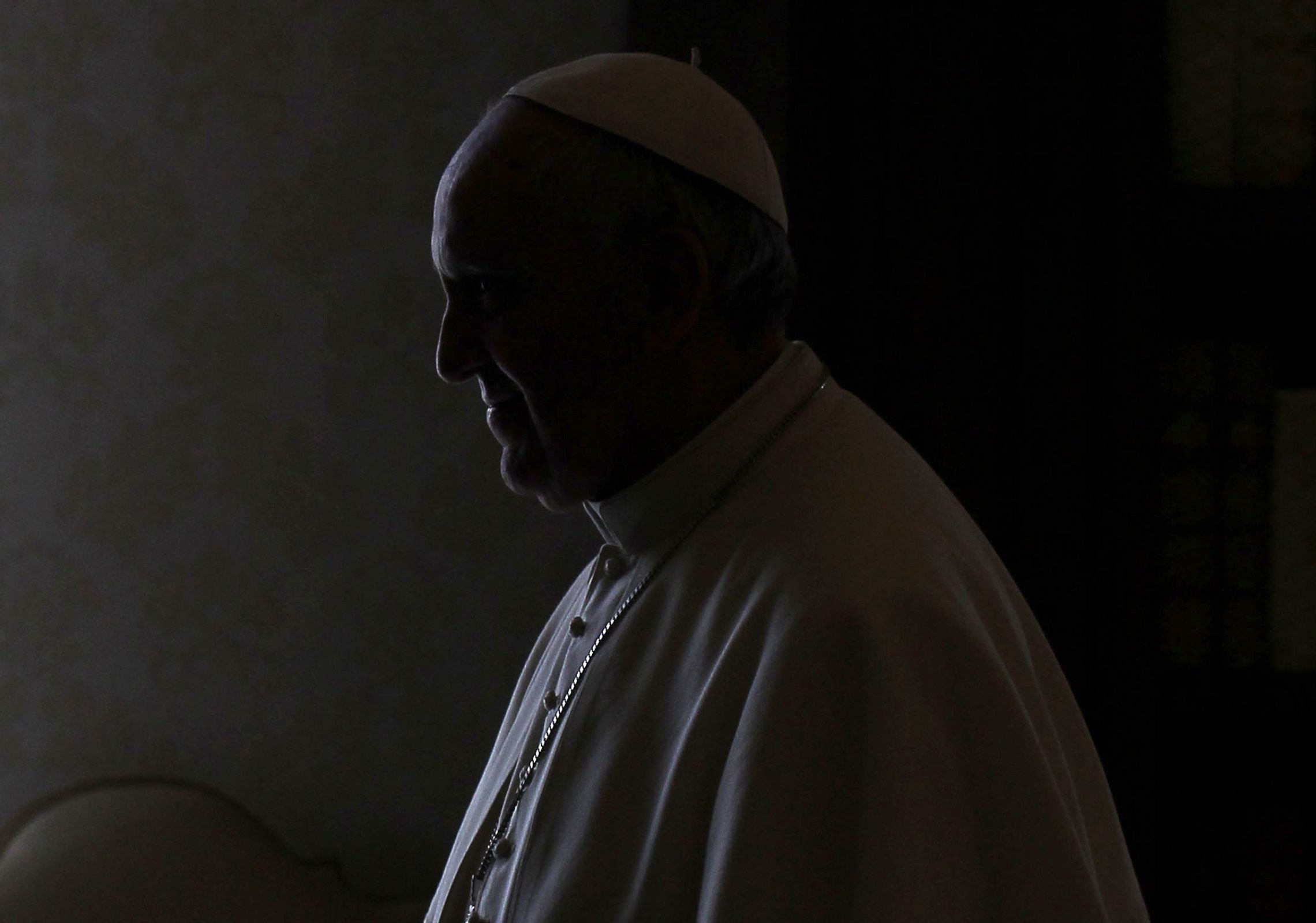
(Photo: Alessandro Di Meo/AFP/Getty Images)

