In Britain, H owes its name to the Normans, who brought their letter “hache” with them in 1066. Hache is the source of our word “hatchet”: probably because a lower-case H looks a lot like an axe. It has certainly caused a lot of trouble over the years. A century ago people dropping their h’s were described in the Times as “h-less socialists.” In ancient Rome, they were snooty not about people who dropped their Hs but about those who picked up extra ones. Catullus wrote a nasty little poem about Arrius (H’arrius he called him), who littered his sentences with Hs because he wanted to sound more Greek. Almost two thousand years later we are still split, and pronouncing H two ways: “aitch”, which is posh and “right”; and “haitch”, which is not posh and thus “wrong”. The two variants used to mark the religious divide in Northern Ireland – aitch was Protestant, haitch was Catholic, and getting it wrong could be a dangerous business.
Perhaps the letter H was doomed from the start: given that the sound we associate with H is so slight (a little outbreath), there has been debate since at least AD 500 whether it was a true letter or not. In England, the most up-to-date research suggests that some 13th-century dialects were h-dropping, but by the time elocution experts came along in the 18th century, they were pointing out what a crime it is. And then received wisdom shifted, again: by 1858, if I wanted to speak correctly, I should have said “erb”, “ospital” and “umble”.
Last week, Ezra Klein argued that Americans with individual market health insurance are more dissatisfied with their plans because the insurance “doesn’t cover them when it’s most necessary.” Barro counters:
I suspect the higher levels of dissatisfaction come from a different source, one that has different policy implications: Unlike people on Medicare, Medicaid and employer-based insurance, people who buy coverage in the individual market know exactly how much they’re paying for it. A plan that you would only rate “fair” when you have to pay $5,000 for it might merit an “excellent” if its apparent cost to you were only $1,000.
Almost all of us should be dissatisfied with our health plans, because the American health care system involves paying twice as much as people in other rich countries do to achieve similar health outcomes. People who buy in the individual market are especially likely to understand how expensive American health care is.
It’s worth remembering that private healthcare in the US is one of the most inefficient industries on the planet. This is what has long frustrated me by GOP defense of it (with a little trivial tinkering, like tort reform). Since when are Republicans supposed to celebrate grotesque inefficiency, poor outcomes, and fathomless waste?
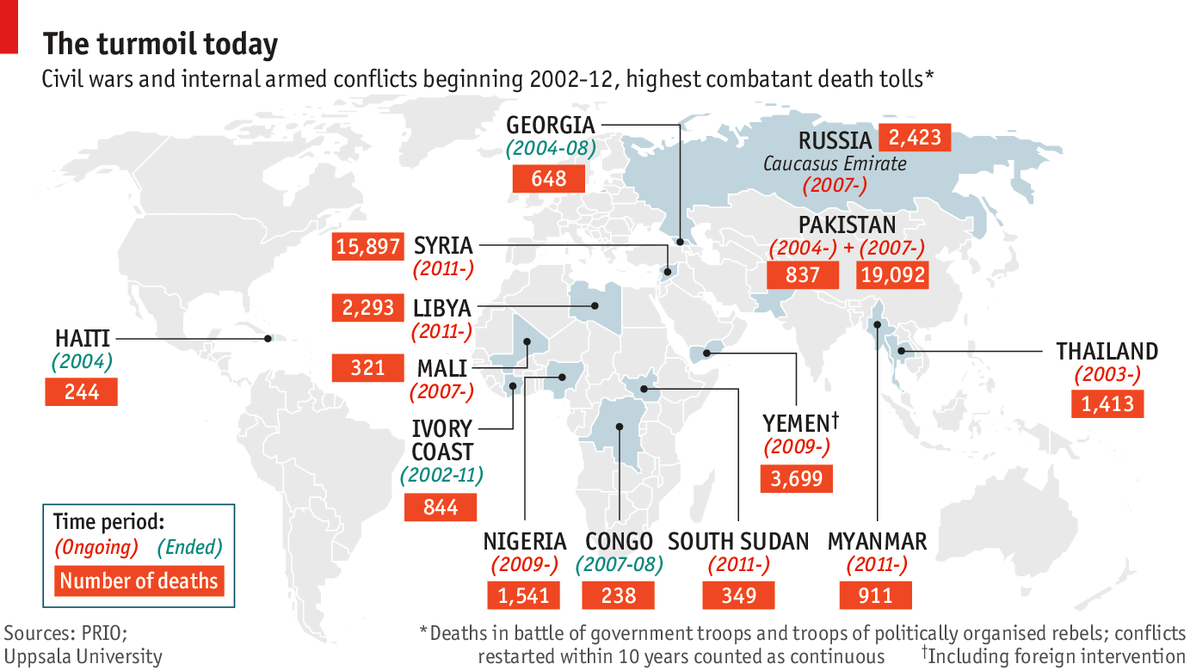
Of 150 large intrastate wars since 1945, fewer than 10 are ongoing. Angola, Chad, Sri Lanka and other places long known for bloodletting are now at peace, though hardly democratic. And recently civil wars have been ending sooner. The rate at which they start is the same today as it has been for 60 years; they kick off every year in 1 to 2 percent of countries. But the number of medium-to-large civil wars under way – there are six in which more than 1,000 people died last year – is low by the standards of the period. This is because they are coming to an end a little sooner. The average length of civil wars dropped from 4.6 to 3.7 years after 1991, according to Kristian Skrede Gleditsch, a professor at the University of Essex.
So far, nothing has done more to end the world’s hot little wars than winding up its big cold one.
From 1945 to 1989 the number of civil wars rose by leaps and bounds, as America and the Soviet Union fueled internecine fighting in weak young states, either to gain advantage or to stop the other doing so. By the end of the period, civil war afflicted 18 percent of the world’s nations, according to the tally kept by the Centre for the Study of Civil War, established at the Peace Research Institute Oslo, a decade ago. When the cold war ended, the two enemies stopped most of their sponsorship of foreign proxies, and without it, the combatants folded. More conflicts ended in the 15 years after the fall of the Berlin Wall than in the preceding half-century. The proportion of countries fighting civil wars had declined to about 12 percent by 1995.
Carney claims that the president agrees with Bill Clinton’s recent remarks:
But Jonathan Cohn sees few ways to help those on the individual market who’ve lost their insurance:
Rhetorically, Clinton’s statement actually isn’t that different from what Obama said in his interview with NBC’s Chuck Todd the other night—that he’d like to find a way to let more people keep their coverage. But it wouldn’t be easy to do. Attempting to rewrite the grandfather clause, so that it applies to more existing plans, could cause insurers to raise prices in 2014 for 2015. It’s also not clear that insurers could or would quickly renew existing policies at existing prices. Clinton mentioned specifically that something should be done only for those people facing higher prices—another echo of Obama’s statement. But distinguishing between groups wouldn’t be easy.
Maybe there’s some muddled, half-solution that will ease the transition without causing real damage. Or maybe there’s some brilliant administrative or legislative fix the experts can’t see. But absent an infusion of extra money—say, to create some kind of transitional assistance fund—any effort to slow changes to the non-group market might not just stop the bad things from happening. It might also stop the good. The latter might outweigh the former, by quite a lot.
After a traffic stop, David Eckert was repeatedly violated by police. Balko suspects that Eckert has little recourse:
Police officers are protected from lawsuits by the doctrine of qualified immunity. It isn’t enough to show that a law enforcement officer violated your rights. You must also show that the rights the officer violated were “well established” at the time he violated them. In other words, the violation needs to be pretty egregious before you can even get in front of a jury. Oddly, qualified immunity actually provides an incentive for police officials to avoid keeping officers informed on the most recent relevant court ruling in constitutional law.
John Wesley Hall says that in this case, the fact that both a judge and a prosecutor were also wrong on the law, and that forced anal probes, enemas and colonoscopies aren’t an issue that have yet been addressed by the U.S. Supreme Court, the cops in New Mexico will likely be protected from any liability. “Because the police were acting under a warrant signed by a judge, it seems unlikely that the plaintiffs will be able to get around qualified immunity,” Hall says. And what about the judge and the prosecutor? They’re protected by absolute immunity, which — just as it sounds — makes it nearly impossible to sue them for damages, even when they’re flat wrong on the laws they’re paid to know, and even when police officers then rely on a judge or prosecutor’s mistaken views on the law in the course of egregiously violating someone’s rights.
Earlier Dish on the legal ramifications of the Eckert case here.
So far, Republicans have yet to unearth a grand political conspiracy or cover-up by the Obama administration involving Benghazi. This week, they’ll interrogate Central Intelligence Agency security officers who were on site. That will shine more light on some decisions that, absent the fog of war, might have been made differently. Yet if something truly damaging was likely to surface, it surely would have done so by now. Put another way, could the architects of the current health-care debacle really engineer a cover-up capable of withstanding the frantic digging of five congressional committees?
What Congress could do, if it really cared about preventing future attacks:
Congress should be making sure the State Department actually implements the review board’s recommendations, which cover knotty areas from language training and building security to threat analysis. Past experience suggests compliance will be spotty at best.
But that is not, I suspect, what it’s about. This story thrives on the far right – i.e. most of the right – because it advances a couple of memes. The first is that Obama failed as commander-in-chief because an al Qaeda group in North Africa used the anniversary of 9/11 to attack a diplomatic compound disguising a CIA base. So he tried to cover it up, by claiming it was a response to an incendiary video. But the trouble with this argument, it seems to me, is that it cannot connect to a broader theme about the president. He has done far more damage to al Qaeda than his predecessor, decimated their ranks in the region whence 9/11 came, ramped up surveillance, and killed Osama bin Laden. So the political logic of the Benghazi obsession is weirdly off-track. But it’s what they always intended to say about the first black president whose middle name is Hussein from the get-go: that he’s soft on terrorism, so they stick with it, even though it’s patently untrue.
The real force behind the powerful meme, I’d wager, is the usual (usual!) argument that the president is a covert traitor and ally to al Qaeda.
So he deliberately left American diplomats to be gunned down by Jihadists in Benghazi, barely lifted a finger to help them, lied about it to cover his tracks, and generally cares more about foreign people with dark skin than those on sovereign American soil. They need to prove this horrifying truth because it would blow up this presidency and render it totally illegitimate. And they still dream of erasing the first black president from the history books as an asterisk. The whole thing is eerily similar to the way the far right in the 1950s believed Eisenhower was a Communist sympathizer and ally. (That meme now extends to FDR as well in the fever swamps!)
I have no problems with endless hearings if that’s what the GOP wants. But we should have few illusions about the paranoid fantasies that fuel this foul stuff. I’d be offended and enraged by their disgusting insinuations of treason – “and where was the president that night?” etc – but seriously, after six years of this stuff, my rage buttons are worn down.
A new, ridiculously early NBC poll finds Christie trailing Clinton by 10 points. Aaron Blake thinks the top-line numbers are misleading:
The most telling numbers in the NBC poll … are Christie’s deficit in the South (43-35) and slim lead among white voters (41-37). Regardless of who the GOP nominee is in 2016, he or she isn’t going to lose the South or come close to losing white voters. Christie’s under-performance in the NBC poll is all about people not knowing who he is.
And a closer look at the NBC numbers above suggests Christie is actually better-positioned than Mitt Romney was in 2012. While Romney lost the Hispanic vote by 44 points, Christie trails by just 11 (and is notably already ahead of Romney’s 27 percent showing, despite a about a quarter of Latino voters being undecided). And while Romney lost young voters by 23 points, Christie trails by just 14. All of this despite Christie’s name ID deficit.
If Christie could lose by only those margins among those demographics, he would probably win.
I stick to my view that Christie would be a formidable opponent to Clinton. I just can’t see how he gets past the primaries. And his total vacuousness on national policy is a sight to behold. He’s not a candidate right now; he’s a walking attitude.
Noah Rothman flags a “fabulously cringe-inducing” series of ads to raise awareness about the ACA among young people. And no, it’s not a parody:
Got Insurance is a project of the Thanks Obamacare campaign, created by the Colorado Consumer Health Initiative and ProgressNow Colorado Education to educate everyone about the benefits of the Affordable Care Act.
It’s noteworthy that, in his piece, Scheiber doesn’t say much about Warren’s signature on a secret letter urging Clinton to run for the Democratic nomination. At most, he argues, it’s a pledge that won’t stand if Warren decides the presidency is key to advancing her policy agenda.
But, to my eyes, that letter says everything about where Clinton stands vis a vis the rest of the Democratic Party. In short, 2016 won’t be 2008, where Clinton was a powerful but contentious figure in the party, and a well-organized challenger could capitalize on grassroots anger and establishment discontent to derail her path to the nomination. Now, Clinton is a wildly popular figure, with one of the highest statures in American politics. Among Democrats, 67 percent favor her for the nomination (compared to 4 percent for Warren) , and in an early poll of potential New Hampshire primary voters, she has the highest favorability ratings—near 80 percent—of any potential candidate. This is a far cry from 2006, where—at most—she had support from a plurality of Democrats.
One thing to add is that the younger voters who are more supportive of economic populism are also the least likely to vote in primaries, which will make it harder to break Clinton’s hold on the party’s base. And as admirable as Warren is as a public figure, given that she ran 7 points behind Obama in Massachusetts whether she can appeal to a broad enough based of Democratic voters in a wide enough variety of states to pose a serious threat to Clinton is an open question.
Drum thinks, in Scheiber’s piece, that Warren comes across as “a novelty candidate, the kind who enter the race mostly because they want the exposure it gives their cause, not because they have any chance of winning—or even of seriously affecting who does win”:
Now, maybe Scheiber is being unfair to Warren. Maybe she’s not quite as messianic as all that, and maybe over the next few years she’ll start to develop considered views on non-banking subjects at the same time that she develops shrewder political skills. That would make her a more dangerous contender. But if Scheiber is right about her, I think he’s pretty much undermined his own case.



 The Dish