The Underground Organ Market

A documentary on it premiered Monday night on HBO:

Jennifer Block reviews it:

[Director Ric Esther] Bienstock has screened the film in several cities and began informally polling the audiences. She says about 75 percent consistently say they would consider buying a kidney overseas or selling a kidney. A recent NBC poll had similar results. At a 2007 meeting of the American Society of Transplant Surgeons, after Matas and a colleague each presented opposing arguments, a majority of the audience said they would support a trial of an open organ market.

One logical compromise would be for governments to reimburse altruistic donors for lost wages, child support, and short-term life insurance. That doesn’t exist in the U.S. or Canada, though Australia recently instituted a system in which compensation goes directly to a donor’s employer, who keeps sending paychecks through recovery. “That’s removal of disincentives, and I have no problem with that,” [Gabriel] Danovitch [medical director at UCLA’s Kidney and Pancreas Transplant Program] says. “Even the current law permits payment of all these things, but it just doesn’t happen.”

Ilya Somin wants to let people sell their organs:

If we must ban kidney markets because allowing poor people to take the risk of living with only one kidney is “exploitive,” why should we not also ban poor people from taking dangerous jobs as loggers, coal miners, police officers, firefighters, and NFL players? These and other occupations involve far greater health risks than donating a kidney. And they are often especially attractive to “the desperate poor,” precisely because poor people are more likely to be willing to take risks in order to increase their wealth than the relatively affluent. Furthermore, if “exploitation” of the poor is really the reason for banning organ sales, why not ban such sales by people below a certain income threshold, but permit them if the sellers are middle class or above? This could still save many lives, among the thousands people who die because they cannot get kidney transplants in time.

Earlier Dish on the ethics of selling kidneys here, here, here, here, and here.

Woody Allen’s Infancy

Ayun Halliday points to footage of a 30-year-old Woody Allen performing on British TV in 1965:

It does a body good to see him at this ‘childlike’ stage of his career. … As [Allen] told journalist Eric Lax in Conversations with Woody Allen:

“…comics are childlike and they are suing for the approval of the adults. Something goes on in a theater when you’re fourteen years old and you want to get up onstage and make the audience laugh. You’re always the supplicant, wanting to please and to get warm laughs. Then what happens to comics — they make it and they become a thousand times more wealthy than their audience, more famous, more idolized, more traveled, more cultivated, more experienced, more sophisticated, and they’re no longer the supplicant. They can buy and sell their audience, they know so much more than their audience, they have lived and traveled around the world a hundred times, they’ve dined at Buckingham Palace and the White House, they have chauffeured cars and they’re rich and they’ve made love to the world’s most beautiful women — and suddenly it becomes difficult to play that loser character, because they don’t feel it. Being a supplicant has become much harder to sell. If you’re not careful, you can easily become less amusing, less funny. Many become pompous… A strange thing occurs: You go from court jester to king.”

For another piece of obscure footage, below is a reel of bizarre ads Woody did for Seibu, a Japanese department store, in 1982:

Amber Frost captions:

From what I can tell from Seibu’s original press statements, Japan wasn’t even particularly aware of Woody Allen at the time! Seibu’s executives said they wanted someone who was an “adult” to represent their brand. One said “being good-looking is not enough.” You’ll note that Allen’s name is never mentioned in the spots. It’s amusing to wonder if he was hired more for being a “funny looking white guy” than for being Woody Allen.

Grieving In The Public Eye

Lisa Miller checks in on Newtown. A glimpse of the inevitable infighting that follows such tragedies:

As grief settled on the town, so did money.

Cash poured in from everywhere, arriving in envelopes addressed to no one. To Newtown. The town of Newtown. The families of Newtown. There were stories of cheerleaders, having sponsored fund-­raisers, walking around with $30,000 in their pockets. A guidance counselor at Newtown High School reportedly opened the mail to find $1,000 in cash. Around the country, people sold ribbons, bracelets, cupcakes, and sent in the proceeds, five and ten dollars at a time. The Davenport West honor society in Iowa sent in a check for $226.69, and the parents of a 3-year-old named Lillian sent $290.94, donations from her birthday party. According to the Connecticut attorney general, about $22 million has flooded the town since December 14, finding its way into about 70 different charities set up in the wake of the massacre. Very quickly, the matter of disbursing these funds became something else, a proxy fight over how to evaluate grief. …

The biggest fund by far was the one set up by 9 p.m. the day of the attack, under the auspices of the United Way of Western Connecticut. By April, it held $11 million, and local psychiatrist Chuck Herrick was named president of the board of the fund, a position that has made him one of the most unpopular men in town. It was Herrick, along with a handful of others, who had to help calculate the disbursements to the parents of murdered children, and who had to defend those calculations when the bereaved accused the United Way of being unfair, insensitive, condescending, elitist, paternalistic and, in a mantra recited by the grieving, of “raising money on the backs of our dead.”

Face Of The Day

GREECE-FINANCE-ECONOMY-EU-IMF

A protester faces police under the rain on November 6, 2013 in front of the Greek Parliament in Athens during a 24-hour strike. A general strike hit Greece on November 6, paralyzing public services and disrupting transport as EU-IMF auditors worked to finalize the recession-hit country’s next budget, looking to eliminate a fiscal shortfall that could bring more unpopular cuts. By Louisa Gouliamaki/AFP/Getty Images.

18th-Century Sock Puppets

As Nicholas Mason tells it, authors were publishing rave reviews of their own works nearly three centuries before Amazon and Goodreads:

The first widespread reports of puffery came in 1730s England, where a number of journalists and wits remarked on the recent shift from straightforward, unembellished announcements of goods for sale to elaborate schemes to trick consumers into buying shoddy merchandise. Two trades in particular were seen as the foremost practitioners of puffery: quack medicines and books. In fact, the first known commercial usage of the term “puff” (the May 27, 1732 issue of London’s Weekly Register) pinned the practice squarely on booksellers: “Puff is become a cant Word to signify the Applause that Writers or Booksellers give to what they write or publish, in Order to increase its Reputation and Sale.”

In fact, the book review from the beginning was “a compromised form”:

Nearly every British writer of the late eighteenth and early nineteenth centuries either participated in or benefitted from ginned-up book reviews.

Mary Wollstonecraft reviewed her own translation of a French book in the Analytical Review. … In an 1817 issue of the Quarterly Review, Walter Scott anonymously reviewed his own Tales of My Landlord, slyly noting “none have been more ready than ourselves to offer our applause.” Other famous Romantic-era puffers included William Hazlitt, who lauded his own Characters of Shakespear’s Plays in the Edinburgh Review; Percy Shelley, who wrote a glowing (but ultimately unpublished) review of his wife’s Frankenstein for the Examiner; and Mary Shelley, who attempted to revive the reputation of her father, William Godwin, by puffing his novel Cloudesley in Blackwood’s Magazine.

Mason adds that “in many respects, the age of Fielding and Richardson is a remarkable analog to our own”:

Just as we grapple with the information overload resulting from the explosion of new media, these writers and their contemporaries were frequently bewildered by the new mores, codes, and ethics of the first great age of print. And just as many now are quick to blame the Internet for the rise of “astroturfing,” several eighteenth-century commentators saw puffery as the direct outgrowth of print culture.

Quote For The Day II

“In politics, when you have to eat shit, you don’t nibble,” – Democratic strategist Chris Kofinis, quoted by CBS News, on president Obama’s attempt to parse and finesse his statements on keeping your insurance plan.

I gave the same unsolicited advice today but without the turd metaphor. A rare moment of restraint.

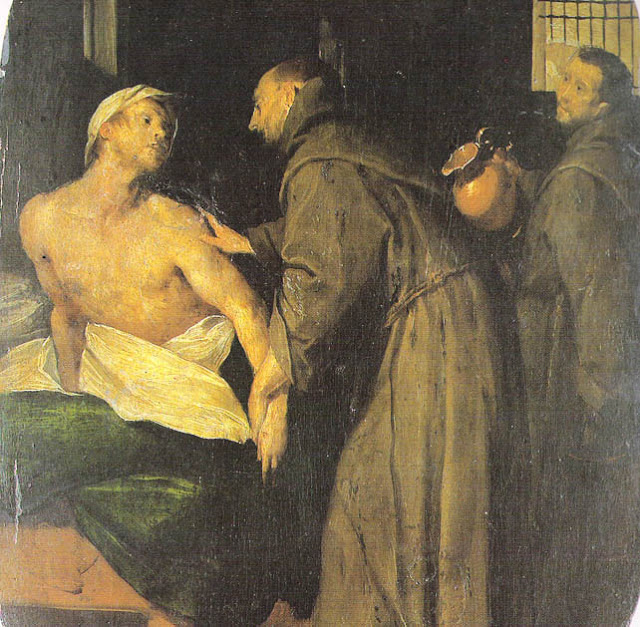
Pope Francis As Saint Francis

crespi leproso

These images say more than a thousand encyclicals. It’s worth recalling that Saint Francis, after a brutal time spent as a prisoner of war, emerged a broken man and on his way back home came across a group of lepers. Previously a wealthy young scion of Assisi, fastidious and fancy, he entered the leper colony and began washing their bodies and living among them. It was the beginning of his ministry. And so it begins again …

A reader adds:

This is the first time I’ve ever been compelled to write you about a non-political issue, but your link to the article about Pope Francis embracing a horribly disfigured man really hit me.

I’m a complete and thorough atheist. I was raised religious, but went away from it very consciously and actively as I rejected the entire logical foundation of religion. I am still as confident in my atheism as I’ve ever been. I preface my thoughts this way merely to put into context the unalloyed awe and admiration I have at the actions this Pope has taken. Acts of profound and sincere compassion are all too rare in this world, and whether those acts come from an atheist or a pope, they are to be treasured and cherish.

The reality of horrible disfigurement has always been something which has struck me very hard.

On one level, its simply the pity one feels looking upon the decrepit, and imagining the difficulty of their lives. On another level, I can’t help but feel of overbearing sense of guilt at my own visceral disgust upon looking at disfigured people; it’s a disgust rooted in evolution and natural instincts, not a moral revulsion, but its an undeserved disgust all the same. I’m not going to pretend that seeing the actions of Pope Francis today is going to be able to change that; human instinct is what it is. But it gave me a little more appreciation for the profound acts of kindness that people are capable of when they truly embrace compassion as an ethos. For that, this man is worthy of intense admiration.

In 6 months, Pope Francis has lifted the image of his faith far above anything I’d thought possible in my 28 years of life. May he continue to do so.

Or as Saint Francis once put it: “Preach the Gospel everywhere. If necessary, with words.”

(Painting: Giovanni Battista Crespi, called Cerano, ‘Saint Francis healing the leper’, 1630.)

Obamacare’s Losers, Ctd

Chait asks why the media is so focused on rate-shock victims:

Why has their plight attained such singular prominence? Several factors have come together. The news media has a natural attraction to bad news over good. “Millions Set to Gain Low-Cost Insurance” is a less attractive story than “Florida Woman Facing Higher Costs.” Obama overstated the case when he repeatedly assured Americans that nobody would lose their current health-care plan. There’s also an economic bias at work. Victims of rate shock are middle-class, and their travails, in general, tend to attract far more lavish coverage than the problems of the poor. (Did you know that on November 1, millions of Americans suffered painful cuts to nutritional assistance? Not a single Sunday-morning talk-show mentioned it.)

Frum counters:

Chait is right that some degree of redistribution is inherent in the very concept of insurance. Redistribution is not the core design flaw in Obamacare. The core design flaw is that Obamacare had its priorities upside down: it put coverage expansion first; cost control a very distant second. What we are discovering now is that without cost control, coverage expansion quickly devours itself.

That self-devouring is the process dramatized by the price shock on the exchanges…but the real harm will come in the months ahead, less visibly, as employers confront the same stark shock that the individual purchasers are confronting today. Employers can’t shirk the fines as easily as individual purchasers can. But they can still make the rational choice to pay the fine and dump their employees into the exchanges, where they will encounter the same hostile math that I faced last week. The sick will sign up; the well will drop out; and the prices will keep rising and rising and rising—until either the system crashes or else the government steps in to assume an ever-expanding role as cost controller and price subsidizer.

The Rape Double-Standard, Ctd

Readers continue one of our most popular threads of late:

While I agree that rape prevention is never the responsibility of those who might have been victimized, the same is true of those who might be victims of false accusations. And that is the all-important flip side of this question. It is difficult to subject the claims of rape and sexual harassment victims to close scrutiny, because if they have indeed been victimized, it only adds to their trauma. At the same time, plenty of people are falsely accused of rape, sexual harassment, etc, and their lives have been ruined thereby. This goes especially for people in positions of responsibility over young people, like public school teachers. An accusation of rape can end a carefully cultivated career for years, sometimes forever.

While we are teaching people, especially young men, not to rape, and to act as allies when women are threatened with rape (a role I’ve played, BTW, preventing what certainly would have been a rape if I hadn’t acted), we should also teach young people how lives are ruined by careless and misleading accusations.

Sometimes we encourage young people to be open about how a situation makes them “uncomfortable,” when they are too young to judge the possible effects of an accusation. And sometimes the accuser is encouraged by well-meaning adults who are far too credulous and give adolescents too much credit for knowing things they don’t, in fact, know. A few leading questions, an easily-led adolescent with a grievance, and you’re in court, and your family has lost its sole support.

Another:

A reader stated about rape: “Typically, it’s an assertion of power on the part of the male, not a desire to get off sexually without seeking the consent of the other.” I know that you cannot extract power from sex at all (male potency or power may be men’s most erotic trait), but I cannot conceive of how lust can be taken out of the motivation behind most rapes. Statements about how “rape is about power, not sex” seem to want to keep sex as this all benevolent, all natural, all safe part of life … and not concede that sex is an animal instinct that can drive us towards extreme selfishness and harm unless we exert control over it.

Another adds:

One of your readers repeats the durable old feminist chestnut that “male-on-female rape is rarely about sex.” Sometimes this thesis is trotted out to explain male-on-male rape and child molestation as well.  But this notion – originated by activist Susan Brownmiller in the 1970s and never supported by any actual science – was essentially a political assertion arising from the zeitgeist of a bygone era.  And the notion was criticized early (by D. Symons in The Evolution of Human Sexuality (1979)) and late (by R. Thornhill and C. Palmer in A Natural History of Rape (2000)).