Orono, Minnesota, 8.21 am
Orono, Minnesota, 8.21 am
A reader adds her story to the thread:
My daughter is a carrier of an X-linked metabolic disorder, Adrenoleukodystrophy. It’s quite rare, thus receiving little attention and has no treatment or cure, but it’s best known for the movie it inspired, Lorenzo’s Oil. I know my daughter is a carrier only because her father died at age 32 after having been diagnosed three years earlier. Normally, this genetic glitch isn’t considered life-threatening if a young male makes it out of his childhood and teens, but my late husband had the misfortune of being one of the unlucky adult males who’s brain is literally stripped of its protective coating and eventually dies.
Had we known about his status when our daughter was conceived – via IVF just two years earlier – we would have certainly screened for it, and this would have meant gender selection, because being X-linked, a son couldn’t possibly have inherited the bad gene. Only my late husband’s daughters would inherit the tainted X because he had only one to give.
Someday, I will have to tell my daughter that she is the carrier of a potentially deadly disease that could kill any son she might have, and which carries the added indignity of disability for her because 20% of female carriers experience dorsal nerve damage and a very unlucky few will have brain involvement leading to dementia.
As much as I love her, I would never have given birth to her if I had known. People talk about playing God but isn’t bringing a child into the world with a known disability or potentially fatal illness playing God too?
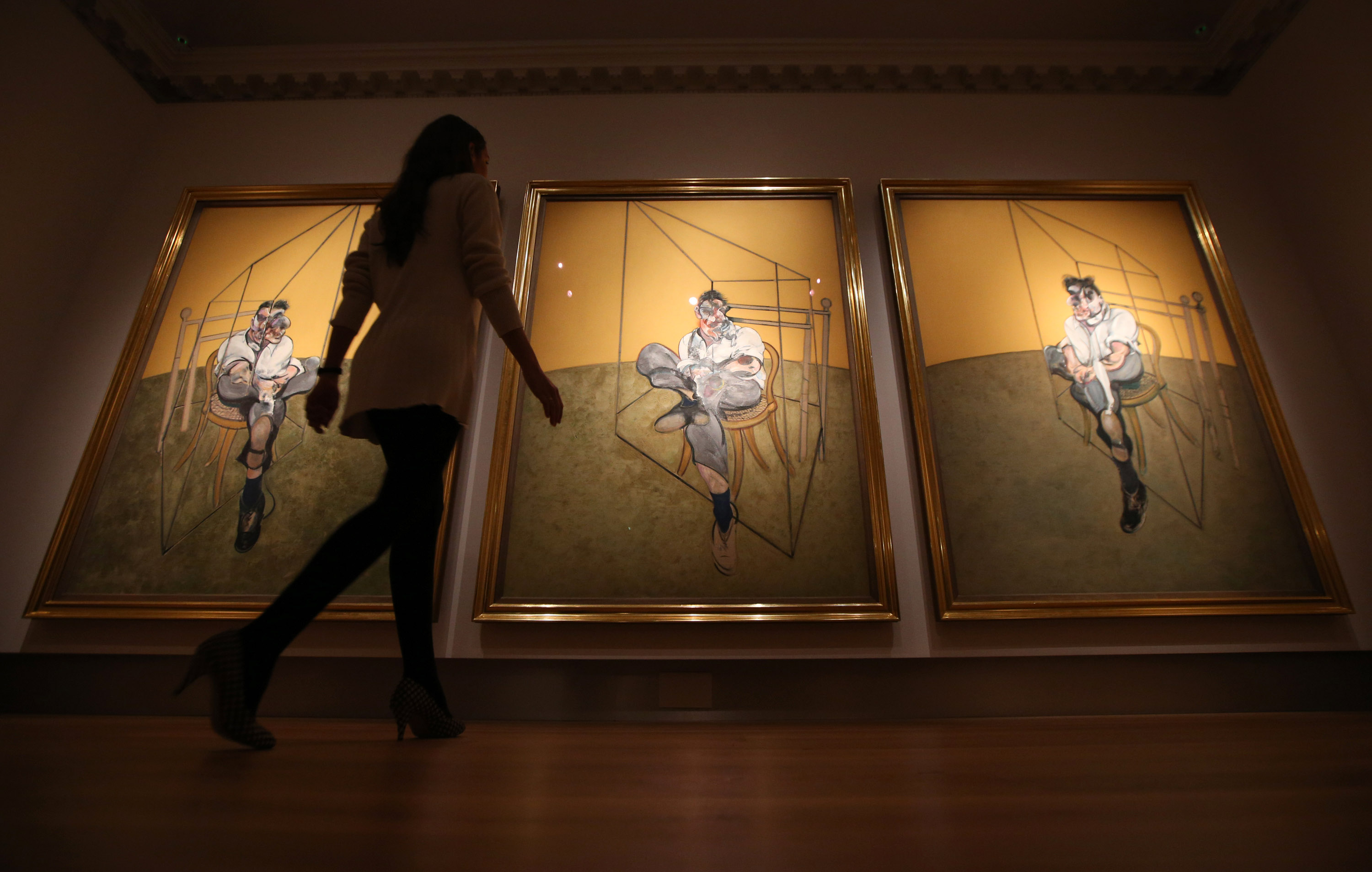
Felix Salmon sees trouble in the art world:
If you look at this month’s big contemporary art auctions, you’ll see quite a lot of art being flipped, including art being flipped by one of the biggest collectors of them all, Stevie Cohen. According to Carol Vogel and Peter Lattman in the NYT, Cohen is selling a Gerhard Richter which he bought from the Pace Gallery last year, along with “about a dozen other pieces, mostly at Sotheby’s, that he acquired in recent years at art fairs and auctions.”
On top of Cohen’s works, Vogel has found other pieces being flipped this month, including Three Studies of Lucian Freud, by Francis Bacon, which “was purchased by a consortium from a private collector in Italy within the past 12 months”; and Apocalypse Now, by Christopher Wool, which was sold by David Ganek very recently. Between them, the Richter, the Bacon, and the Wool are going to account for a substantial percentage of the total amount of money spent at auction this season, which means that auction totals are increasingly comprised of short-term trades, as opposed to sales from individuals and families who have owned the objects for many years.
Kathryn Tully counters that the bubble has already burst:
Take the big contemporary auctions held in London last month while the Frieze art fair was in town. As ArtTactic reports, combined sales at the main post-war and contemporary evening auctions at Sotheby’s, Christie’s and Phillips in London in October were £52.1 million ($82.9 million), excluding buyers’ premiums. The auction houses estimated these sales would bring in a combined £56.5 million to £80.7 million, so £52.1 million was 8 percent below the bottom of that range and 24 percent lower than the total raised during the same sales last year. … There’s no way of knowing how this month’s New York auctions will go, but if recent London sales are anything to go by, the sellers lining up to flip their pricey art works for a profit may have already left it too late.
But Art Market Monitor editor Marion Maneker isn’t wholly convinced:
Felix Salmon has been calling the buyers at the very top end of the art market chumps for many years. So it hardly makes sense for him to claim this is a sign of a qualitative change in the composition of buyers.
(Photo: A member of Christie’s staff walks towards Francis Bacon’s Three Studies of Lucien Freud on October 14. Photo by Peter Macdiarmid/Getty Images)
Following up on his post on young polyglots, Robert Lane Greene explores why some multilingual people associate different languages with different identities:
Significantly, most people are not symmetrically bilingual. Many have learned one language at home from parents, and another later in life, usually at school. So bilinguals usually have different strengths and weaknesses in their different languages—and they are not always best in their first language. For example, when tested in a foreign language, people are less likely to fall into a cognitive trap (answering a test question with an obvious-seeming but wrong answer) than when tested in their native language. In part this is because working in a second language slows down the thinking. No wonder people feel different when speaking them. And no wonder they feel looser, more spontaneous, perhaps more assertive or funnier or blunter, in the language they were reared in from childhood.
What of “crib” bilinguals, raised in two languages?
Even they do not usually have perfectly symmetrical competence in their two languages. But even for a speaker whose two languages are very nearly the same in ability, there is another big reason that person will feel different in the two languages. This is because there is an important distinction between bilingualism and biculturalism.
Many bilinguals are not bicultural. But some are. And of those bicultural bilinguals, we should be little surprised that they feel different in their two languages. Experiments in psychology have shown the power of “priming”—small unnoticed factors that can affect behavior in big ways. Asking people to tell a happy story, for example, will put them in a better mood. The choice between two languages is a huge prime. Speaking Spanish rather than English, for a bilingual and bicultural Puerto Rican in New York, might conjure feelings of family and home. Switching to English might prime the same person to think of school and work.

Researchers at MIT investigated how the brain processes subway maps:
The team put current transit maps through a computer model designed to mimic the brain’s ability—or lack thereof—to absorb a map’s information with just one glance. The resulting visualizations are called mongrels, and they look sort of like what you’d see if you squinted your eyes and focused on one part of the map. But they highlight where the maps confuse us most—what actually just doesn’t make it through to our brains—by showing how our peripheral vision perceives the colored lines and other data.
Streamlining routes makes maps easier to read:
By putting alternate versions of the New York and Boston subway maps through the computer model, the researchers showed that abstract versions of the maps (as opposed to geographically accurate versions) were more likely to be easily understood in a single, passing glance. You can see this in the researcher’s comparison of these two maps of Lower Manhattan’s subway system. The top two images are the maps; the bottom two are the mongrels … The current map on the left, dissolves into a confusing tangle. The more abstract one is almost as clear on the bottom image as the top one.
(Map via Ruth Rosenholtz, MIT)
It takes some getting used to:
China, a country that is of roughly similar size to the continental United States, has one time zone: Beijing Standard Time. This means that when it’s 6 o’clock in the nation’s capital, it’s 6 o’clock almost 3,000 miles further west, in Kashgar. Allison Schrager, in her widely circulated article from last week advocating that the continental U.S. reduce its time zones from four to two, cited China as an example of why such a change would be less problematic than people would expect. Maybe so, but the single time zone does present odd sights: In the summer, for instance, it isn’t uncommon in Urumqi, Xinjiang’s capital, to see people enjoying a beautiful sunset … at midnight. Or for the sun to rise there in the winter around 10 AM. In order to accommodate people inconvenienced by the time zone change, shops and restaurants in Xinjiang often adjust their hours—but the effect can still be disorienting for the unaccustomed traveler.
Casey N. Cep surveys a history of “literary siblings [who] challenge our assumptions of lonely genius, isolated writers alone at their desks.” On the relationship between Dorothy and William Wordsworth:
Although they lived apart during much of their childhood, the siblings were reunited as adults and eventually cohabited for many years in the Lake District.
In an essay on Dorothy, Virginia Woolf wrote: “It was a strange love, profound, almost dumb, as if brother and sister had grown together and shared not the speech but the mood, so that they hardly knew which felt, which spoke, which saw the daffodils or the sleeping city; only Dorothy stored the mood in prose, and later William came and bathed in it and made it into poetry.”
Dorothy would copy verses for her brother and assist him with correspondence, but she was also a talented writer. While she wrote little for publication, her journals, travelogues, and poetry are all now in print. It is clear that her writing influenced her brother’s or, as Woolf noted, that “one could not act without the other.”
It was Dorothy who made notes in her journal about a fateful walk the siblings took on April 15, 1802, when they “saw a few daffodils close to the water side … a long belt of them along the shore, about the breadth of a country turnpike road.” Dorothy recorded that she “never saw daffodils so beautiful [—] they grew among the mossy stones and about them, some rested their heads upon these stones as on a pillow for weariness and the rest tossed and reeled and danced.” Only a few years later, William would return to that entry and craft from it one of the most iconic poems in the English language. Written in iambic tetrameter, “I Wandered Lonely as a Cloud” captures “a crowd, / A host, of golden daffodils.”
Speaking of William, Amit Majmudar recently invoked the poet when discussing his theory that literary genius is limited to a 20-year window:
The longest-lived English Romantic, William Wordsworth, spent the last few decades of his life writing now-unread political sonnets. Lyrical Ballads was first published in 1798, which was roughly the time he started The Prelude (which he worked on intermittently, and which was posthumously published, and which, incidentally, bores me to death). Poems, in Two Volumes came out in 1807—this is the volume that contained the Immortality ode and the one about the daffodils. The Excursion came out in 1814. After that, something in him shriveled. …
Gabriel Garcia Marquez has written a handful of good novels, but his two, universally acknowledged best came out in 1967 (One Hundred Years of Solitude) and 1985 (Love in the Time of Cholera): Again, inside the twenty-year span. He didn’t write poorly before, and he hasn’t written poorly in the decades since—but within those charmed 20 years, he did the work for which he will be remembered. Likewise Flaubert: Between Madame Bovary and Trois Contes lie exactly 20 years. (He wrote a tremendous number of works before Madame Bovary, few or none published then, few or none readable today.) Rimbaud is another 19th-century Frenchman who follows the rule.
(Image of Dorothy Wordsworth via Wikimedia Commons)
An update on the little race with big implications:
In Douglas County, the slate of four Republican-backed school board candidates eked out a victory over the four teachers’ union-backed candidates after a contentious race that divided the community. That division was reflected in the election numbers: The Republican-backed candidates won by a slight margins of just a few thousand votes.
Jeb Bush applauds the results as others shake their heads. Andy Smarick looks ahead:
Though the surface takeaway is that the Douglas affair is one of conservatives and reformers taking over an affluent district, there’s a much bigger story here: We are likely to see many, many more episodes like this in the months and years to come, though there will be variations on the theme. As statewide teacher-evaluation laws, Common Core implementation, tougher assessments, and other reforms really begin influencing suburbia, the ed-reform debate is going to seriously evolve. New fault lines are likely to appear. I’m not sure what this will look like, but if we thought urban ed reform was contentious, just wait.
Also in Colorado, two out of three voters rejected Amendment 66, a proposal to fund public schools with a $950-million income tax hike. Jack Healy describes the outcome as “a warning to Democrats nationally” and “a drubbing for teachers unions as well as wealthy philanthropists” who spent $10 million in support of the campaign. But Joshua Dunn sees a silver lining for those who want more education spending:
While Amendment 66 went down in flames yesterday, Colorado voters – by an almost exactly inverse proportion – approved Proposition AA, which will tax our now-legal recreational consumption of marijuana. Over one-third of the revenue raised from that measure will be dedicated to funding school construction. … [T]o all the marijuana tourists out there: Please come to Colorado and support our schools. It’s for the children.
Update from a reader:
Let’s be realistic here: these races were not that tight.
The closest race was more than a 3.5% margin of victory and the largest margin was about 6.5%. By contrast, Obama beat Romney in the popular vote by 3.9% and no one except Fox News thought it was a close race.
But that doesn’t mean it’s all rosy for the GOP or education reformers. I haven’t seen any exit polls or reports on turnout, but the GOP has a huge voting bloc advantage in Douglas County. There are more than 100K registered Republicans and only 43K Democrats. Assuming the vote went close to party lines (and turnout represented electorate demographics), that means a vast majority of the 73K independent went for the Democratic side. Independents tend to get turned off by partisanship and negative campaigning, so it could have been more style over substance. But this type of agenda won’t fly in most places.
Look at Boston. The labor unions spent nearly $3 million through outside SuperPACs to help the labor machine candidate, Marty Walsh. This chart on spending is remarkable. Overall, spending per capita on Boston race was 5x that of the NYC election. Connolly (both are Democrats) did not run an anti-union campaign, but had a reform mentality on education issues in particular. And Walsh is about as reliable a labor supporter as you’ll find anywhere. So, Douglas County may have a $800,000 school board race, but Boston had a $9 million mayoral contest. And Walsh “eked out” a 2 pt win.

We spent the day poring over some of the results from yesterday’s elections. I licked my journalistic chops at the prospect of a Cruz-Christie-Paul primary slugfest, while we surveyed the blogosphere’s take on Christie’s chances in 2016. Was Virginia’s result a referendum on Obamacare? Yes and no.
Readers chimed in on America’s torture-until-they-die farms for pigs and Hawaii’s long pursuit of marriage equality. I advised the president to stop digging on his “if you like your plan, you can keep it, period” obfuscation, while we got some long-needed accountability from Washington, and readers emailed us success stories of the ACA roll-out.
Pope Francis all but became Saint Francis today in a gesture that speaks louder than any words.
The most popular post was my washing my hands of Ron Paul, and this resilient tear-jerker.
See you later tonight on AC360 Later and in the morning.
(Painting: “The Healing Of Ten Lepers” by James Tissot.)
[Re-posted from earlier today]
A reader writes:
It saddens me that you’re still below target for the year’s revenue. You have all been a constant part of my life for years and I’m certain that’s true for countless others. On the very first day of subscriptions I signed up and even gave extra because I wanted this group of people I cared about to be financially secure and to continue to provide me The Dish. Your entry point price of $20 is a steal and more
people should avail themselves of a subscription, but for those of us who are already paid supporters you need to give us a way to do more.
As the year went on and I read that your yearly funding goals had not yet been met, I realized not only that I could afford to give more, but wondered why I had only given so little to begin with. So I paid for Dish accounts for family members, hoping for two birds with one stone that they would stick around and grow the base. I imagine that many of us core supporters did the same.
The fact that there’s still a funding gap – but not an enthusiasm gap – suggests that you could more effectively tap your core audience for support. I like the core democratic principle of an equal price of entry for everyone, and $20 is a great price point (even $1 would be equally prohibitive via this medium sadly), so instead of changing your pricing or subscription structure why not allow people to donate directly toward projects? Or toward the site itself? As it stands now I have no way to give you more money, other than what I locked in when I initially subscribed. So I guess what I’m saying is “shut up and take my money damnit!”
We have gotten many emails along those lines, and we’re very moved by them. And, yes, we’re thinking through all sorts of ways to respond to your suggestions. One existing option: increase your subscription price when it’s up for renewal next year. But our reader is right if you want to help us this year to make our goal: an easy way for subscribers to give extra right now is to purchase a gift subscription for someone you know – a financially-struggling friend, a colleague you see at the water-cooler, a Republican relative, that cute guy or gal you want an excuse to talk to more. And drop us an email afterwards; we always like hearing from new subscribers. One writes:
I know you guys are scrambling to make you budget deadline, but where the hell is my coffee cup?
We hear you. Stay tuned. And for the vast majority of readers who are still free-riding, just ask yourselves if what we offer every day is worth $1.99 a month or $19.99 a year to you. If it is, help us out and [tinypass_offer text=”subscribe”]. And make those house ads – and these posts asking for subs – go away.
Update from a new subscriber:
I’ve been reading you regularly since 2001 years. Just subscribed. What you and your team does is invaluable. And it’s great to see you doing it without big media entanglement.
Another:
I’ve been bypassing the paywall for the past year or so; not out of cheapness, but because I’m just one of those lazy people who needs a deadline. You coming up on the end of Year 1 got me off my ass. And since my selfishness impacted you and your workers’ livelihoods, and could have skewed next year’s projections, I contributed $40 rather than $20. Small token of apology, plus a recognition that I get way more than just $20 of value out of your site per year. Hopefully there’s more folks like me out there who are mentally there but just need a little prod.