
New York City: Under New Management

New York Commemorates The 12th Anniversary Of The September 11 Terror Attacks

Kevin Williamson worries that Bill de Blasio, New York’s new mayor, will to cause the rich to flee the city:

His tax-the-rich program overlooks that an ever-dwindling number of high-income people and firms have a strong financial attachment to New York. You meet a lot more hedge-fund guys in Dallas these days than you used to. The headquarters of a fair number of Manhattan-based financial firms already have over the years followed their employees to Connecticut or beyond.

The super-rich may or may not mind that much — especially given that their income tends to come in the form of capital gains, which receive preferential tax treatment — but your $100,000-a-year midlevel workers already have discovered the roads to Charlotte and Salt Lake City. And as Mike Bloomberg was lambasted for pointing out, you can’t ignore the super-rich, either, given that fewer than 100,000 New Yorkers pay half the city’s taxes, and 500 of them pay 15 percent of the city’s taxes. That is problematic in and of itself, but it’s not like everybody else gets off the hook — de Blasio’s tax hike on those who make $500,000 or more will have real consequences for people in less rarified income brackets. When your landlord, vendors, or customers get a tax hike, their problems have a way of becoming your problems, which is why a fair number of people who will never have incomes approaching that cutoff point understand that they will nonetheless be affected by it. That and a great deal of skepticism about de Blasio’s commitment to sustaining Mayor Giuliani’s crime policies have a fair number of New Yorkers across the income spectrum rethinking their leases.

Richard Schragger strongly disagrees:

If a city’s economy is otherwise healthy, then redistributive fiscal policies are unlikely to make much of a difference. And mayors probably cannot control the size of the local economy as much as they claim anyway. But mayors can fight inequality by channeling resources to those who need them most. To those who believe that society has an obligation to pursue social justice, the moral benefits are obvious. The economic benefits of having an urban, healthy, educated workforce are obvious, too.

If a revived urban liberalism is possible, then its time is now, while cities like New York can take advantage of their privileged position as highly desirable places to live. Not all cities are in that enviable position. Many cannot afford what Mayor de Blasio proposes. But if New York City’s new mayor succeeds, he will advance an idea that has mostly gone out of fashion: that cities can play a significant role in creating an urban middle class by providing the kinds of resources necessary for upward mobility. Those resources are basic and obvious: security, education, transportation, health, and shelter. Expanding access to those kinds of municipal goods will create a more equal city. And it may teach us that a progressive city is still possible.

Barro argues that de Blasio will have to become “New York’s most pro-development mayor in decades” if he wants to accomplish his goals:

If he hopes to buy labor peace and fulfill his progressive missions, de Blasio will have to find another way to get more money coming into the city’s coffers. That’s where development comes in. To the untrained ear, de Blasio has run as a critic of developers, complaining that too many “luxury condos” are going up in New York. But he has also been clear that more development is a key to growing the city’s economy and addressing the affordability crisis. And while many of the city’s business elites are freaking out about de Blasio’s “class warfare,” he’s maintained good links with (and raised a lot of money from) the real estate industry.

Drum attacks another part of Williamson’s argument – the idea that crime is suddenly going to skyrocket:

I almost don’t care anymore if you accept the hypothesis that reductions in childhood lead exposure are primarily responsible for America’s dramatic decline in violent crime over the past two decades. But can we at least get our facts straight? Lots of big cities have seen drops in their violent crime rate. At least three others—Chicago, Dallas and Los Angeles—have seen declines as big as New York’s. Others, like Phoenix and San Diego, now match New York’s crime rate. They did this without Giuliani and Bloomberg. They did it without CompStat. They did it without broken windows. Hell, even New York did it for four years without these things: Its crime rate started plummeting in 1991, long before these reforms showed up.

(Photo: Bill de Blasio stands near New York Mayor Michael Bloomberg during the 9/11 Memorial ceremonies marking the 12th anniversary of the 9/11 attacks on the World Trade Center on September 11, 2013. By Adrees Latif-Pool/Getty Images)

The Rape Double-Standard, Ctd

The thread takes another turn:

I think one of your readers, when talking about all kinds of distinctions between different kinds of “rape” – inadvertently mentioned something that is a huge distinction between when a female is the aggressor and when the male is the aggressor. He wrote:

There is a double standard, or a multiple standard, and one of the key factors is penetration. I think I would have felt differently had there been a digit or object inside me than I felt waking up inside her.

Exactly.  I think rather than trying to draw an analogy between female-on-male rape and male-on-female rape – perhaps a closer analogy is male-on-male rape to male-on female rape. I don’t know if it makes sense or not, but having somebody insert a body part into your body it certainly seems different that someone using your body part to insert it into them.  (Even more so when something gets ejaculated into your body).

Ask a man how he feels about getting raped by a woman?  No: ask a man how he feels about getting raped (orally or anally) by a man.  That might be a better analogy.

Another reader:

Your thread on rape is fascinating, but let me add a gay perspective. We often define rape in rather surreal and erotic ways. As an older guy, I have taken on the “daddy role” (I’m now 50), and I can’t tell you how many men – younger and older – have told me about their “rape fantasy” involving a guy (or guys) forcing them into sex.

Through the years, I have gladly made the fantasy come true for some of these men, but I also know that I may be putting myself at risk by unknowingly picking the wrong guy. Having a rape fantasy and getting it fulfilled can often elicit two conflicting emotions. I often warn guys of this when sober, but I’m not as coherent about it when both of us may be under the influence of alcohol. I had that happen a few years ago. I met a young guy (early twentysomething) at a bar, who wanted me to “make him my sex bitch.” He was hot and I was more than willing. We went back to his place, and I immediately immersed him into his fantasy by talking dirty and forcing him to his knees to blow me. He loved it.

As we got further into it, he began to push back more, but I thought that still was part of his fantasy. It wasn’t until he pushed me off and told me to leave that I realized his reality had crashed into his fantasy.

Did I “rape” him? No, of course not, but he could have easily told someone I did. Just as women get the default position of “victim” over a man, an older gay person automatically is assumed to be the aggressor over a poor, naïve younger guy – even when the latter initiates the encounter.

Maybe the lesson here is don’t act upon something when you are drunk, but such a thing goes by the wayside when you are kicking back beer. This is also why I understand the debate over the drunk-vs.-sober aspects of a man who picks up a woman at a bar. Alcohol certainly increases your sex drive and drops your inhibitions. But both men and women have to be aware that the perception of the encounter could feel different after the alcohol-fueled buzz leaves you.

The Long Game Of Obamacare

President Obama Visits Boston To Talk About Health Care

The current conventional wisdom is that the ACA is a disaster. Democrats up for re-election in 2014 are running away from it, there remain, according to Sebelius, hundreds of fixes still to be made to the website, the stories of canceled policies have dominated the headlines and the president has rightly been lambasted for grotesque mismanagement of the federal government. He had one core domestic goal for his second term, it seems to me, and he flunked it. Worse, he cannot even admit that he simplified the sale so badly he repeated something untrue. If the website’s functionality is not substantially fixed by December 1, all bets are off.

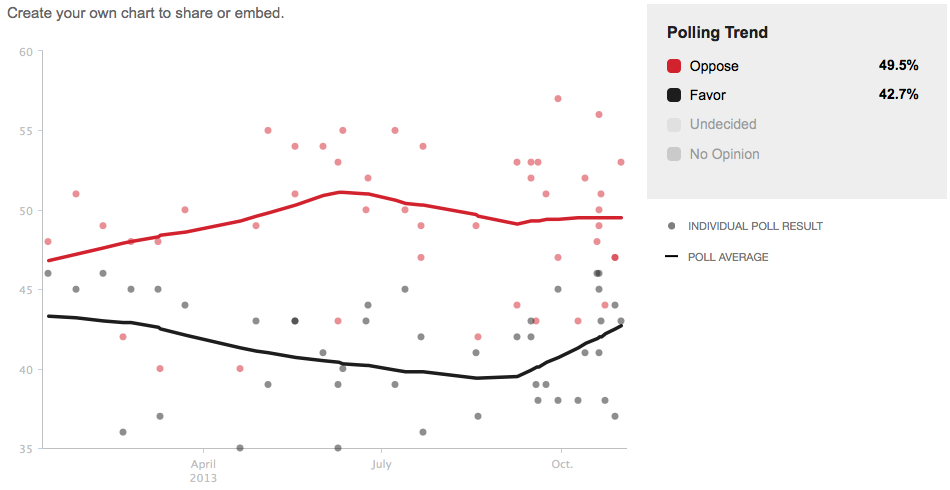
And yet … Americans have not changed their minds on the ACA much over the last few months. Here’s the poll of polls on it since January of this year:

Screen Shot 2013-11-07 at 12.43.21 PM

Since September, support has actually risen, while opposition has remained flat. Given the fiasco of the website, that’s a surprise. This week’s elections also didn’t prove that it is a huge liability. Opposition to the ACA remains very strong in the GOP base, which doubtless helped Cuccinelli in the final week. But McAuliffe ran explicitly on Medicaid expansion and won. Then there’s the calculation of Ohio governor John Kasich in embracing Medicaid expansion. Consider too the relative success of the law so far in a state like Kentucky of all places. Now along comes a poll from Reuters-Ipsos:

The uninsured view the 2010 Patient Protection and Affordable Care Act, commonly known as Obamacare, more favorably since online marketplaces opened – 44 percent compared with 37 percent in September. It found that 56 percent oppose the program compared with 63 percent in September. A higher proportion of the uninsured also said they are interested in buying insurance on the exchanges, with 42 percent in October, saying they were likely to enroll compared with 37 percent in September.

I don’t want to overstate the case but I think it’s also foolish to understate the impact on many people who will get health insurance for the first time in their lives. This reality will matter politically in the end. See Byron York’s take on the number of winners versus the number of losers in pure monetary terms – and Ed Kilgore’s response. People are also not dumb enough to think that cancellation of their policies or sudden premium hikes started with the ACA. It was a constant in the private sector for years. Yes, disruption will tick a lot of people off. But Obama still has three years to get this entrenched – and once in place, it will be mighty hard to remove for the exact reasons that people are so upset right now. Disruption is always unnerving, especially in an area like your health.

We all take this issue personally, as we should. And I’ve been very lucky to have had excellent employer-based healthcare for years. But always at the back of my mind was the fear that I might leave a job with that kind of security, like at TNR or the Atlantic and the Beast, and be stranded and bankrupted by my pre-existing condition, HIV. We’re looking into our own health insurance plan right now for the Dish in the next year, and I’ll let you know how the process goes. But like many, we haven’t been in a mad rush, we have an insurance broker to help us through the process, and it is hard to express the relief I feel that I cannot be denied coverage because I am a survivor of the plague. If we have to pay more, it’s well worth the relief.

I can’t believe I’m the only one who feels this way.

It’s not the health insurance reform I would have wanted – I’d prefer ending the employer subsidy, mandating no exclusion because of pre-existing conditions and creating a more vibrant individual market, including the option of catastrophic insurance. But the GOP never offered that and are still not offering it.

I also feel – call me a squish if you want – that baseline health security, while not a right, is an enormous social good, and that social insurance against the random vicissitudes of life in no way compromises free market principles. I also realized when I started a small business that I could not personally employ anyone and not provide insurance, without violating my conscience. The step from that to embracing universal care is obvious.

So count me among those who suspect the current fiasco is just the beginning of this story. To listen to the Republican critics, you’d think the previous system was wonderful – whereas we all know it wasn’t, that the private health sector was grotesquely inefficient, and that its costs kept soaring, and free-riders were undermining the entire enterprise. At some point – especially when the GOP has to find a nominee who can appeal beyond the base – the Republicans will have to shut up or put up. And I suspect a platform of repealing what Obama is constructing without replacing it with something very similar will be a big vote-loser.

I may be wrong, of course. I have been in the past. But the long game is always worth keeping in mind.

(Photo: By Yoon S. Byun/The Boston Globe via Getty Images)

Police State Watch

After being pulled over for not making a complete stop at a stop sign, David Eckert was suspected of hiding drugs because a police dog alerted and because Eckert was allegedly clenching his buttocks. What happened next:

1. Eckert’s abdominal area was x-rayed; no narcotics were found.

2. Doctors then performed an exam of Eckert’s anus with their fingers; no narcotics were found.

3. Doctors performed a second exam of Eckert’s anus with their fingers; no narcotics were found.

4. Doctors penetrated Eckert’s anus to insert an enema.  Eckert was forced to defecate in front of doctors and police officers.  Eckert watched as doctors searched his stool.  No narcotics were found.

5. Doctors penetrated Eckert’s anus to insert an enema a second time.  Eckert was forced to defecate in front of doctors and police officers.  Eckert watched as doctors searched his stool.  No narcotics were found.

6. Doctors penetrated Eckert’s anus to insert an enema a third time.  Eckert was forced to defecate in front of doctors and police officers.  Eckert watched as doctors searched his stool.  No narcotics were found.

7. Doctors then x-rayed Eckert again; no narcotics were found.

8. Doctors prepared Eckert for surgery, sedated him, and then performed a colonoscopy where a scope with a camera was inserted into Eckert’s anus, rectum, colon, and large intestines.  No narcotics were found.

The police dog, Leo, had made this same mistake before. Jacob Sullum notes that, “if police say a dog is properly trained, they can get a search warrant based on nothing more than the animal’s purported alert, and that search will be upheld unless a defendant can present evidence showing the dog is unreliable”:

Hence if it turns out that Leo’s alerts frequently lead to fruitless searches, that does not necessarily mean he will be deemed unreliable, even if he is wrong more often than he is right (which is often the case with drug-detecting dogs). According to police (and the Supreme Court, which essentially has adopted their point of view), dogs that seem to be making mistakes may actually be alerting to traces of drugs so minute that their existence cannot be confirmed. Hence you can never definitively say that a police dog erred, even though there are many possible sources of error, including distracting smells and conscious or subconscious cues by handlers. Not to mention the fact that cops who want to search someone can always falsely claim a dog alerted.

The upshot is that if a cop wants to explore a motorist’s anus, stomach, intestines, and feces, all he needs is a dog and a judge who takes to heart the Supreme Court’s unjustified faith in canine capabilities.

Mark Perry is repulsed by this violation of civil liberties:

[H]ere’s maybe one of the worst parts of David Eckert’s ordeal:

The Gila Regional Medical Center has billed Mr. Eckert for the “services” it provided without his consent (two forced X-rays, two forced digital penetration exams, three forced enemas and a forced colonoscopy) at the request of local law enforcement officers, and he still receives medical bills for thousands of dollars for these illegal, invasive and painful medical procedures, according to his lawsuit.

Doesn’t this case of forced anal probing and a forced colonoscopy of an innocent victim illustrate that America’s War on Drugs has maybe gone too far, and doesn’t it illustrate that one of the costs of the War on Drugs is that it’s a direct assault on the civil liberties of Americans like David Eckert?

Marijuana And Moralism

.jpg

Last night, we had a spirited discussion of legalizing marijuana on AC360 Later. I’d post a clip but CNN’s clips don’t work when embedded. For a taste, go here. David Frum repeated Ross Douthat’s recent equation of marijuana and gambling legalization:

Both have been made possible by the same trend in American attitudes: the rise of a live-and-let-live social libertarianism, the weakening influence of both religious conservatism and liberal communitarianism, the growing suspicion of moralism in public policy.

Like Conor Friedersdorf, I think that’s too crude an argument. I don’t think human beings will ever see law as entirely amoral, even as we try to account for real differences of opinion over what is moral and reach a workable, neutral-as-possible compromise. As Conor notes, our society has shifted toward new moralisms – “mandates to recycle, laws against dog-fighting, marital-rape statutes, trans-fat bans” – and away from old ones, rather than a move away from moralism altogether. Our sensitivity to the abuse of children is perhaps the greatest sign of a heightened sense of moralism, especially when one looks back and sees how appallingly blind so many were to it for so long. I know Ross will differ on the substance, but I doubt he will argue that my support for marriage equality stemmed from mere libertarianism (which would have led me to oppose all such marital benefits for everyone) but from a deep moral sense that we were (and are) violating the dignity of the homosexual person and perpetuating enormous pain for no obvious reason.

Now, the argument for legalizing marijuana is not quite the same. It’s much more based on the simple argument of personal liberty. But it has Kush_closeits moral components as well. The grotesquely disproportionate impact of Prohibition on African-Americans is an affront to any sense of morality and fairness, just as the refusal to research cannabis for its potential medical uses – to prevent seizures in children, for example – seems immoral to me. Some might argue that the right response to this is decriminalization, not legalization. But keeping marijuana illegal profoundly constrains the potential for medical research on it, sustains a growing and increasingly lucrative criminal industry, and does nothing to keep it from the sole cohort for whom it could do harm: teenagers.

Right now, teens can get it very easily – but because it is illegal, they have to be in contact with criminal elements. Last night, David Frum argued that legalizing it would increase the smoking of weed among the poor and socially marginalized, especially in the inner city, thereby blighting their prospects for advancement in society. It’s an important point to which I would provide several responses.

First off, of all the factors holding those kids back, marijuana-use is trivial, compared with family breakdown, shitty schools, and gang violence. And given the already endemic presence of the plant in the inner city, I doubt legalizing it would increase use in those neighborhoods – as opposed to middle-class areas where the stigma still exists as a major force. What it would do is sever the link between criminal gangs and a recreational pleasure that so many already enjoy. It would cripple the livelihoods of many drug dealers, which is why they would be very happy to join David in his campaign for decriminalization but no further. That’s a very sweet spot for the cartels.

weeed1.jpgThere’s also a premise buried in there that I would question: that weed always makes people lethargic or unmotivated or lacking in initiative. Sure, it does for many. But knowledge of the increasing sophistication of the drug – achieved during the last decade or so – has changed this. Sativa strains, for example, don’t make you sleepy; they can make you very alert and highly creative. Strains that are very high in CBD and low in THC don’t make you high at all. The complexity of the drug’s impact on the many human cannabinoid receptors renders its impact far more variable than crude Cheech and Chong mythology would suggest. And one must recall that the last three presidents all smoked marijuana in the past – the current one being a true enthusiast in Hawaii in the 1970s. Sometimes marijuana can unleash creative potential that would otherwise be buried for life. I’m not arguing that this is always the case, or that weed doesn’t harm many people’s lives. I am arguing that the weed-makes-you-a-failure argument is far too crude for today’s more sophisticated drug and that, besides, it inflicts far less harm than alcohol and tobacco.

I also start from an empirical fact. 23 million Americans smoke marijuana regularly, according to the latest survey. I don’t think the rule of law is well served when 23 million Americans do something that is both pragmatically condoned yet illegal.

It reminds me of the sodomy statutes that David also once defended on exactly the same grounds. In most states they were barely enforced. But millions of gay Americans were de facto committing crimes in their bedrooms. At some point the contradictions mount to such heights a resolution is essential. Anthony Kennedy cut that knot.

I take Ross’s point that we should not inherently distrust the contingent, if somewhat irrational, double standards that history has bequeathed to us. Our difference lies in two strains of conservatism – that which seeks to stand athwart history and yell “Stop!” and that which sees society as constantly changing and the conservative task is to manage that change prudently. There are times for both impulses. But in determining what we should do in any contingent moment requires understanding why the change is happening and how to shape it for the good.

Ross doesn’t explain why he thinks the polls on marijuana legalization have shown such dramatic change in so little time. Or he does so by a general reference to more permissiveness. But when I think of a permissive period, the late 1960s seems like such a moment to me. It was the crucible that created neoconservatism, that turned Ratzinger from a reformist to a reactionary, that created so much of the conservative movement that defined the 1980s and ever since. And guess what? Legalizing pot back then was regarded as anathema:

gv32bf6ay0gwmjp1rv5otq

As Conor notes, the key comparison here is support for legal abortion, a profound moral issue if ever there was one. That graph is very different:

b1tknbxezu-afxekhpvmta

Why would Americans change very little on one issue that is obviously related to morality but shift dramatically on another? I propose the reason is because people have seen marijuana use in their own lives and those of others, see its relative harmlessness, see its benefits (medical and recreational) and have changed their minds based on the accumulating evidence. I wonder what Ross’s explanation is?

(Photo: A picture taken on October 31, 2011 in center Amsterdam, shows cannabis seeds displayed in a tourist shop. By Nathalie Magniez/AFP/Getty.)

$800K!

Looking at our revenue numbers yesterday, I almost fell out of my chair. Our plea for new subscriptions to help us make our 2013 target brought a sudden flood of new Dish-subscribers. We’re so, so grateful and psyched. It pushed us past the $800,000 mark on our way to howler beagle$900,000. If we make that goal and our Founding Members renew in large numbers, we really will be able to take the Dish to a new level – and begin to add long-form journalism to our mix, as we have long wanted. 2014 could be the year we reach real altitude.

It was particularly great to see long-time Dish emailers – the readers who provide so much insight and information to the blog – finally get over their reluctance to pay for anything online and [tinypass_offer text=”subscribe”]. That suggests to us there are many more of you out there who just haven’t gotten around to it yet. For all of you still on the fence,  just ask yourselves if what we offer every day is worth  $1.99 a month or $19.99 a year to you. If it is, help us out and subscribe. And make the house ads – and these posts asking for subs – go away.

Update from a new subscriber:

Sorry it took me so long. I’m a religious daily reader and have been for years. I finished a Master’s last Spring and am currently unemployed (though things now look very promising) so I was trying to wait until I had an income again before spending money. Your post yesterday, however, made me realize how much time I’ve had to read the Dish during the maddening boredom of unemployment and how it has helped keep my mind stimulated. I basically thought to myself, “This costs me as much as a few beers out on a Saturday so why the hell not?”

Another:

I check the Dish multiple times a day, and was an early subscriber. But today, prompted by your recent fundraising post, I bought an additional gift subscription. The reason has been your recent threads on animal cruelty, a topic to which I have devoted almost no thought in the past (frankly: I don’t even really like animals all that much). But your writing on this has persuaded me there is absolutely no moral justification for eating factory-farmed meat, and I will no longer do so. I’ve always thought of the Dish as great entertainment (and a much too effective procrastination tool), but it has now made a tangible impact on my family’s life. Seemed well worth some additional support. Hope you make your funding goal!

Inside America’s Torture Factories

A reader dissents:

You do yourself and your argument no favors when you refer to industrial pork farms – however cruel they may be – as “America’s Concentration Camps.” These farms may be barbaric, but to refer to them as “concentration camps” is spectacularly disrespectful to the six million people who were murdered at Nazi camps.  Unless you believe that a pig’s soul is the full equal of a human one (and I have never got that impression reading you) the comparison is completely inept.

I should have been more sensitive to that in my desire for a provocative title. I apologize. Hence our new headline above. Another reader:

pigs.jpgI just finished reading Dave Warner’s response to your reader’s e-mail and the one thing that stood out was his continuing insistence that the use of gestation cages helped with caring for (and protecting!) their well-being. I’ll let that point aside, but I would have been much more receptive to his point if he’d had the honesty to admit that it also allows for the housing of substantially more pigs for all those concerned hog farmers. Even if he’d tried to pass it off as an unexpected side benefit, I could have given him a nod. To exclude the reason for the incarceration and try to pass it off as the result of medical studies strikes me as the epitome of chutzpah, if that’s the right word.

Another:

In regard to Warner’s comments, not all pork producers agree:

[Bob] Johnson [president of Johnson-Pate Pork Inc.], who has lived on this farm since he was a teenager, saw a business opportunity in getting rid of the cramped crates, as well as eliminating the routine use of antibiotics. So in 2010, his company switched — a big undertaking for a farm that sells 20,000 pigs per year. Traditionalists say that gestation stalls are indispensable because when pigs are housed in groups, they fight — with bigger and fiercer animals injuring smaller ones and getting more than their share of the feed. But that’s not what is on display in the gestation building, a structure about 60 feet wide and 250 feet long occupied by some 625 pregnant sows. They are walking around and lounging quietly in large group pens. Some cool off under sprinklers that go off intermittently, as a few take their turn to eat. When the weather is good, they can go into an outdoor enclosure.

Another:

You quoted the NY Times: “Nine states in the United States have banned the use of these pens …” Everyone should be aware that the farm bill passed by the House, and currently being negotiated by a House/Senate conference committee, contains the King Amendment, which would trample states’ rights and overturn many state protections for animals nationally. It is from, and named for, Rep. Steve King of Iowa. Iowa is the number one pig-torturing state in the USA and the pig torturers are significant contributors to King. From the Humane Society of the United States (pdf):

Rep. King’s amendment takes aim at state laws such as California’s Proposition 2, approved overwhelmingly by voters across the state in 2008 – to ban extreme confinement cages and crates for laying hens, pigs, and veal calves – and a law passed subsequently by a landslide margin in the state legislature to require any shell eggs sold in CA to comply with the requirements of Prop 2. In addition, the King amendment seeks to nullify state laws in Arizona, Colorado, Florida, Maine, Michigan, Ohio, Oregon, Washington, and Rhode Island dealing with intensive confinement of farm animals.

Two other things to consider: 1) while gestation crates may be among the worst torture inflicted upon pigs, even without them their lives would be non-stop misery; and 2) chickens are intelligent and emotional as well and their abuse is similarly atrocious in the egg and meat industries, and birds are exempt from the federal Humane Methods of Slaughter Act. See this recent Washington Post article:

Nearly 1 million chickens and turkeys are unintentionally boiled alive each year in U.S. slaughterhouses, often because fast-moving lines fail to kill the birds before they are dropped into scalding water, Agriculture Department records show. Now the USDA is finalizing a proposal that would allow poultry companies to accelerate their processing lines …

I didn’t think I could find another reason to despise the politics of King, but I just did. Another also defends fowl:

Your essay “Abatement of Cruelty” was forwarded to me by a person who drew attention to your statement that “There are also types of meat. I think we can make distinctions of degree between, say, the emotional experience of a chicken and a pig.” We cannot knowledgeably make such distinctions at all. They are passé. I respectfully point out that your claim – that the emotional experience of a chicken is inferior to that of a pig – is an assertion without a foundation.

Perhaps you are not aware of the modern cognitive science showing that, contrary to false stereotypes and conventional assumptions, birds, including chickens and turkeys and other ground-nesting birds, are every bit as cognitively complex as mammals including dogs and pigs. (See, e.g., The Development of Brain and Behaviour in the Chicken by Dr. Lesley J. Rogers, 1995).

I grew up with dogs and later worked at a farmed animal sanctuary comprising rescued pigs, chickens, turkeys and other animals, many of whom came from so-called “humane” family farms, where abuses are commonplace and whose traditional practices and attitudes are the very basis for the development of industrialized animal farming in the 20th century, e.g. mutilations including painful debeaking, tail docking and castration. And these examples are far from all.

Chickens and turkeys are complexly emotional and intelligent birds. I’ve kept chickens since 1985 and turkeys since 1990. My experience with them influenced my decision to found United Poultry Concerns in 1990. I ask you please to read this essay, “The Social Life of Chickens”, which evokes and speculates about actual chickens.

Another reader:

The information you have shared on pork processing in the US is appalling. I keep kosher and so do not eat pork, but descriptions of these crates are horrifying. And I am shocked that my soon to be re-elected governor vetoed a bill banning them. I immediately went to Empire Kosher’s website only to learn that they do not crate their birds at all … all are raised to exacting standards on small family farms. No antibiotics and only strictly vegetarian feed is good enough for their birds.  I know many non-Jews who only eat Empire for just those reasons.

Still, the kosher meat industry has had its embarrassments as well. Check out the book Postville: A Clash of Cultures in Heartland America by Stephen G. Bloom. A group of Hasidic Jews established a kosher slaughterhouse in a remote part of Iowa, only to be shut down several years later for health and immigration violations. The cost of kosher beef skyrocketed after that disaster back in 2011 (not that it was ever cheap). New sources were found in smaller processors here in the US and in Canada.

The incredibly high cost of keeping kosher is a burden on many Jewish families. But at least I can be assured that our meat – chicken or beef – is being handled in a ethical way.

Another:

One of these days one of my emails to you will make it on the blog.

Others have commented that they buy meat they know is ethically raised in order to circumvent the animal cruelty issue.  My family does as well.  We buy a monthly “meat share” from a local farm; it is essentially a meat CSA.  The farmers work hard to preserve agricultural traditions that have existed in New England for generations. All of the animals are all naturally raised; free of hormones and antibiotics.  The pigs and cattle are pasture-raised.  Not only do we feel better about the meat we are eating, but we are also supporting local farming and agriculture (not to mention that the meat is amazing).  And we consume less meat this way; we buy a certain poundage a month and only use that amount; I do not supplement from the grocery store.  We plan on taking our children to the farm when they are a bit older to explain to them where our meat comes from.  If they decide that they cannot support eating animal meat after the farm visit, I will help them become vegetarians if they want.

One more:

I grew up in NC, which is one of the top hog producing states in the US.  My neighbors raised a few hogs for their own table and when I was a little girl I used to go play in the pig pen with the babies.  What Mr. Warner said about family farmers is total bullshit.  The sows back in the day were allowed to roam freely in the pen until they delivered, when they were separated from the other pigs, because pigs being pigs, the others would eat the shoats if they weren’t protected.   The mother would even eat her own babies in some cases in the first couple of days after birth.

My husband used to call me the pork queen because I loved eating pork so much.  Not anymore.  I haven’t been able to eat pork, beef, or chicken, for years since I saw the video found at Meat.org.  My husband has been vegetarian for 7 years now and I only eat chicken occasionally and never mass produced chicken.  Between the cruelty to the animals and what the poor things are fed, including drugs of all kinds, and the environmental costs, I just can’t do it anymore.

I am so glad you are addressing this issue again.  If we would all stop eating meat for even one day a week, we could send a message to these factory farms that what is being done to these animals is no longer acceptable.

Who Can Beat Christie?

Douthat asks:

Think about the map: To beat a candidate with Christie’s profile one on one, either Paul or Cruz would need to win Florida and then at least part of the industrial Midwest — the places where first McCain in 2008 and then Romney in 2012 successfully fended off the challenges from the right. Does Ted Cruz, whose resume is part Ivy League elite and part Texan evangelical, and whose father probably sets off every non-evangelical alarm bell there is, somehow win enough middle class Catholic Republicans to beat an Irish-Italian former prosecutor in Ohio and Michigan? Does Rand Paul, who veers between showing remarkable political savvy and indulging in not-ready-for-prime-time fumbling, really have what it takes to fundraise, organize, and win in big, not-deep-red states? Especially amid polls showing, as they probably would, that neither of them would fare as well as Christie in a general-election matchup against You Know Wh(illary)o?

Larison agrees that Christie has some major advantages:

The best chance of blocking Christie or any other relative moderate candidate is to have one or more other candidates running that can siphon off some of his moderate and “somewhat conservative” support. There are hardly any likely candidates that would fit that description, and they would have little incentive to compete in the same year as Christie. His re-election win will have the effect of discouraging other would-be relative moderate candidates from running. That is the argument for Christie-as-juggernaut in the 2016 race.

Millman adds his two cents:

Chris Christie is now officially the only Republican with broad popular appeal. No, that appeal is not deep – most people know absolutely nothing about him, and they may come to hate him once they get to know him. Yes, he won against an extraordinarily weak opponent – but if the Democrats thought they had a solid chance of beating him, they would have put up someone stronger. And yes, some of the juicy targets he’s aimed at in New Jersey are not nearly so juicy at the Federal level. None of that matters right now. Right now, the Electability Caucus in the Republican Party has a reasonable candidate. And his most plausible opponent for that title is surnamed “Bush.”

Beinart, on the other hand, points out the challenges Christie will face:

I’m not saying Christie can’t get the GOP nomination. But if he does, his path will be more like the one John McCain unsuccessfully pursued in 2000 than the one Bush took. Like McCain, Christie—who probably can’t win in conservative Iowa and South Carolina—instead will focus on states such as New Hampshire, where independents can vote in the Republican primary. That means unlike Bush, who entered the general election with the GOP’s conservative base already sewn up, Christie will have to spend the weeks following his nomination victory mending fences with the Tea Party activists who didn’t vote for him. He’ll have to do so while also significantly outperforming Bush among the young, female, and minority voters who loathe the GOP’s Ted Cruz-wing.

The Return Of The Digital Black Market

New Silk Road

Silk Road went back online yesterday. Sean Vitka believes the government will find it more difficult shutting it down the second time around:

While the Department of Justice had less motivation to go after Silk Road before the Bitcoin boom, it did take the DOJ over two years to shut down the site. It’s going to be harder to shut down these new bazaar kingpins, largely because they’re armed with the knowledge of everything Ross Ulbricht allegedly did wrong from an operational security standpoint.

And so Silk Road 2.0 is interesting not only as a resurrection story, but because it’s the embodiment of a question that will linger for some time: What was the net effect of shutting down Silk Road?

Very little, argues Joseph Cox:

These deep web marketplaces follow the same process – shut one down and the community simply migrates, or other new sites spring up within a matter of days. As such, there’s a danger to shutting them down in the first place. When there’s a regulated – albeit still illegal – retailer to buy your narcotics from, you can check ratings and reviews and have a good idea that the stuff you’re getting has a high purity level, meaning the drug is both more effective and far less likely to kill you.

When that disappears, you’re forced to either buy on the street – leaving yourself open to product that’s full of cutting agents and other nasty stuff – or move your custom to a new site. And unless that new site comes with positive, reliable reviews, you might be putting more than just your money on the line.

The online community of drug users that has sprung up around these sites is also a useful legacy of the original Silk Road. If people are going to carry on taking heroin, cocaine, LSD and whatever else they can get their hands on regardless of what law enforcement agencies do to stop them, doesn’t it make sense to have a resource where people can learn how to use those substances safely?

Obamacare’s Marriage Penalty

Garance profiles a married couple considering getting divorced because of it:

Any married couple that earns more than 400 percent of the federal poverty level—that is $62,040—for a family of two earns too much for subsidies under Obamacare. “If you’re over 400 percent of poverty, you’re never eligible for premium” support, explains Gary Claxton, director of the Health Care Marketplace Project at the Kaiser Family Foundation.

But if that same couple lived together unmarried, they could earn up to $45,960 each—$91,920 total—and still be eligible for subsidies through the exchanges in New York state, where insurance is comparatively expensive and the state exchange was set up in such a way as to not provide lower rates for younger people. (Subsidy eligibility is calculated using a complicated formula involving income in relation to the poverty line, family size, and the price of plans offered through a state’s marketplace.)

Nona and Aaron’s 2012 income was higher than the 400 percent mark, but not by much.

In New York City, that still doesn’t take you very far for two people. If their most recent months of income are in the same range, they will get no help at all with buying insurance through the exchanges if and when they apply, according to the Kaiser Family Foundation and eHealth subsidy calculators. Premiums for the two for silver-level plans came in at $9,248 for the year.

But if they applied as unmarried individuals with something like their 2012 income, one of them would get at least $3,964 in subsidies toward the purchase of a plan, or possibly even be eligible for Medicaid, thanks to their uneven individual earnings that year. And if they fall below the 400 percent threshold, which Nona says they might this year, they could get substantial subsidies as a couple that are still worth less than what they’d be eligible for as individuals. These gaps are the marriage penalty.