
Face Of The Day

Twitter Goes Public On The New York Stock Exchange

Twitter CEO Dick Costolo adjusts his tie while waiting to see what Twitter’s opening market price will be on the floor of the New York Stock Exchange (NYSE) on November 7, 2013. Twitter went public today, selling at a market price of $45.10, with the initial price being set at $26 on November 6. The IPO drove the seven-year-old company’s value to $25 billion. By Andrew Burton/Getty Images.

Shares of Dish were also strong today:

Screen Shot 2013-11-07 at 5.41.04 PM

Today we hit the $800K mark, with just under two months to reach our $900K goal. Subscribe [tinypass_offer text=”here”] to help us get there. If you’re already a subscriber, you can always buy a gift subscription to help spread the Dish. One of the roughly 200 new subscribers today writes:

This site has been a part of my daily routine for the last few years. Perhaps not my entire outfit, but a clean pair of socks at least. I had been meaning to subscribe before today, to show some appreciation for the amount of labor and love that goes into the creation of such a compelling site. I have felt a certain amount of guilt for not doing so, and from what I know about guilt, it has a way of persisting, eventually becoming its own obstacle. Of course, this guilt does not help anyone get paid, and the feeling lingers like so many neglected well-intentions do. So, I set up my annual subscription, and the dissonance in my mind subsided a bit.

Beyond this, however, I wanted you and the rest of the team to know that I deeply appreciate the mission of the Dish, and I hope to see this sort of business model thrive for scores of years to come.
Auden’s Approach To Nature

Robert Archambeau explores it:

When the wind, in an Auden poem, says “come,” we are not getting a representation of nature as something different from ourselves: we are getting a glimpse of human temptation and desire. When the water in “Streams” comes across as playful, we are not being told about the quality of nature so much as about certain human moods and capacities—Auden’s personification of water is much closer to a Greek naiad than to the streams above Wordsworth’s ruined abbey. When Auden gives us a landscape, he is less interested in it as a place or an ecosystem or as a physical reality—like Schiller’s Greeks, he rushes past its otherness and uses it as a way of describing human psychological states. …

The critic G.S. Fraser once remarked that Auden, unlike many of his contemporaries, was always interested in the moral rather than the sensuous element in his images, writing,

“Lay your sleeping head, my love, / Human on my faithless arm” where most poets would have written something more like, “Lay your golden head, my love / Heavy on my cradling arm.” There is truth in this—Auden’s is a world of psychology and morality rather than of creaturely sentimentality. And, despite his love of a particular kind of landscape, full of disused mines and scarred limestone cliffs, he is never a particularly visual poet, preferring to allegorize, personify, and psychologize where a more usual sort of modern poet would concentrate on physical detail and specificity. Even “In Praise of Limestone,” a poem whose title seems to promise an evocation of a specific natural landscape and its otherness, quickly turns back to the human: “examine this region / Of short distances and definite places,” he writes,
“What could be more like Mother?” You see the pattern: Auden turns to nature to find something specific to the human psychological drama.

Previous Dish on Auden here, here, and here.

Depression Around The Globe

Global Depression

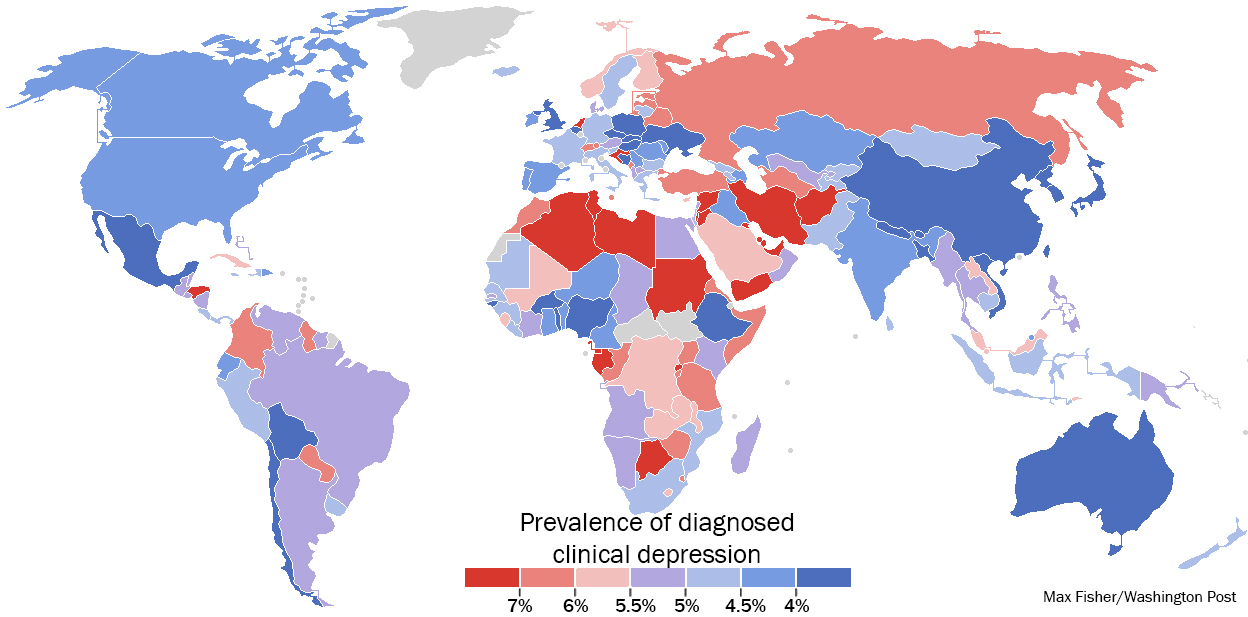
Caitlin Dewey maps the results of a new study:

Globally, they found, depression is the second-leading cause of disability, with slightly more than 4 percent of the world’s population diagnosed with it. The map at the top of this page shows how much of the population in each country has received a diagnosis of clinical depression.

Of course, researchers didn’t go out and test everyone for clinical depression; rather, they used preexisting data. That means we’re not looking at rates of clinical depression, exactly, so much as the rate at which people are diagnosed with clinical depression. People who live in countries with greater awareness of and easier access to mental health services, then, are naturally going to be diagnosed at a higher rate. That may help explain the unusually low rate in Iraq, for example, where public health services are poor.

Taboos against mental health disorders may also drive down diagnosis rates, for example in East Asia, artificially lowering the study’s measure of clinical depression’s prevalence in that region. The paper further cautions that reliable depression surveys don’t even exist for some low-income countries — a common issue with global studies — forcing the researchers to come up with their own estimates based on statistical regression models.

Hathos Alert

Ghoul Skool captions the corporate event promo:

Want to have your husband groped by grown up theater kids all night?  Want to be forced to participate in various corporate themed dance numbers?  Want to know what it’s like at an [Everything Is Terrible!] live show?  Let CHEZ-ZAM take control of your fantarealms and hyperscapes! This has been in my collection for quite some time now, and I hold it very near and dear to my heart.  It is everything I want in a live event.  Period.

Popular Science

Joseph Stromberg explains why scientists draw on pop culture when naming new species, citing the genus of ferns named for Lady Gaga and the jellyfish and bee species named for a character from “The Big Bang Theory”:

“Mostly, when you publish research about termite gut microbes, you don’t get much interest—even most of the people in the field don’t really give a crap,” says David Roy Smith, a scientist at University of Western Ontario who studies these and other types of microorganisms for a living. Recently, though, he saw firsthand that this doesn’t always have to be the case: His colleagues discovered two new species of protists that lived inside termite guts and helped them digest wood, and the group named them Cthulhu macrofasciculumque and Cthylla microfasciculumque, after the mythical creature Chtulhu, created by influential science fiction writer H.P. Lovecraft.

“I remember Erick James, who was the lead author on the study, telling us that he’d named it something cool right before we submitted it, but we didn’t really pay him much attention,” Smith says. “Then, afterwards, day after day, he kept coming into the lab telling us he’d seen an article on the species on one site, then another. By the second week, we were getting phone calls from the Los Angeles Times.” Eventually, James was invited to present work on the protists at an annual conference of H.P. Lovecraft fans, and a search for Cthulhu macrofasciculumque now yields nearly 3,000 results.

Therapist As Muse

While struggling to determine if psychotherapy was helping or hurting her writing, Meredith Turtis talked to other writers about their own experiences in therapy:

Jennifer Egan, who dedicated her Pulitzer Prize-winning A Visit From the Goon Squad to her therapist, “Peter M.,” told me that she couldn’t have written the book without him. “Therapy offered freedom from an endless repetition of neurosis-driven thoughts and ideas,” she said in an email. “I feel that my writing range broadened as a result; it’s as if a whole landscape opened up that had been invisible to me before, sealed as I was inside my echo chamber of worries and fear and guilt.”

Blogging Out Loud

Philosopher and blogger Daniel Little observes that “virtually all the new academic publishing I’ve done in these six years began as a couple of posts”:

You might say I’ve become an “open-source” philosopher – as I get new ideas about a topic I develop them through the blog. This means that readers can observe ideas in motion. A good example is the efforts I’ve made in the past year to clarify my thinking about microfoundations and meso-level causation. Another example is the topic of “character,” which I started thinking about after receiving an invitation to contribute to a volume on character and morality; through a handful of posts I arrived at a few new ideas I felt I could offer on the topic. This “design and build” strategy means that there is the possibility of a degree of inconsistency over time, as earlier formulations are challenged by newer versions of the idea. But I think it makes the process of writing a more dynamic one, with lots of room for self-correction and feedback from others.

Jay Ulfelder concurs:

Intellectual work, and science more generally, is not something that occurs in isolation. It is, essentially, a social process. Blogging ideas as you develop them makes the social aspect of intellectual work more explicit and accelerates it. A blog expands the power of the “computer” working on a particular idea by orders of magnitude, and it opens channels to streams of thought that were harder to discover and flowed more slowly when print journals and letters and conferences had to suffice. This expansion doesn’t make every idea turn out better, but it does increase the chances that one will, and it accelerates the process either way.

Can’t Argue With That

Thomas Frank proposes retiring the phrase “I would argue”:

I’m familiar with this particular cliché-formation because in the early 1980s, when my friends and I were high school debaters, we talked this way all the time. Arguments were what allowed us to keep score back in those days: one team argued for something, the other team argued against it, and the argument was won or lost. But high school debate was a game – a game for teenagers. The point wasn’t for an individual debater actually to believe any particular argument and win the room over with the radiance of his faith; it was for him to be able to argue anything. Insincerity was essential.

For the commentator class, the usage has a similar distancing effect. It’s a sort of shortcut to objectivity, which suggests that the pundit in question doesn’t actually believe something – oh heavens no! – but is merely reporting that the belief might be held by someone, somewhere. So when Nina Easton appears on Fox News and says (in a sentence I have chosen for its utter averageness) that “one could argue that Barack Obama’s smartest political move was putting Hillary Clinton in his cabinet so that she wasn’t outside with Bill Clinton causing mischief,” she isn’t actually asserting this as the truth. She’s only reporting that one might assert this, were one so inclined. Modifying “argue” with “could” or “would,” as Easton does here, distances the wise person even further from the forbidden stuff of opinion.