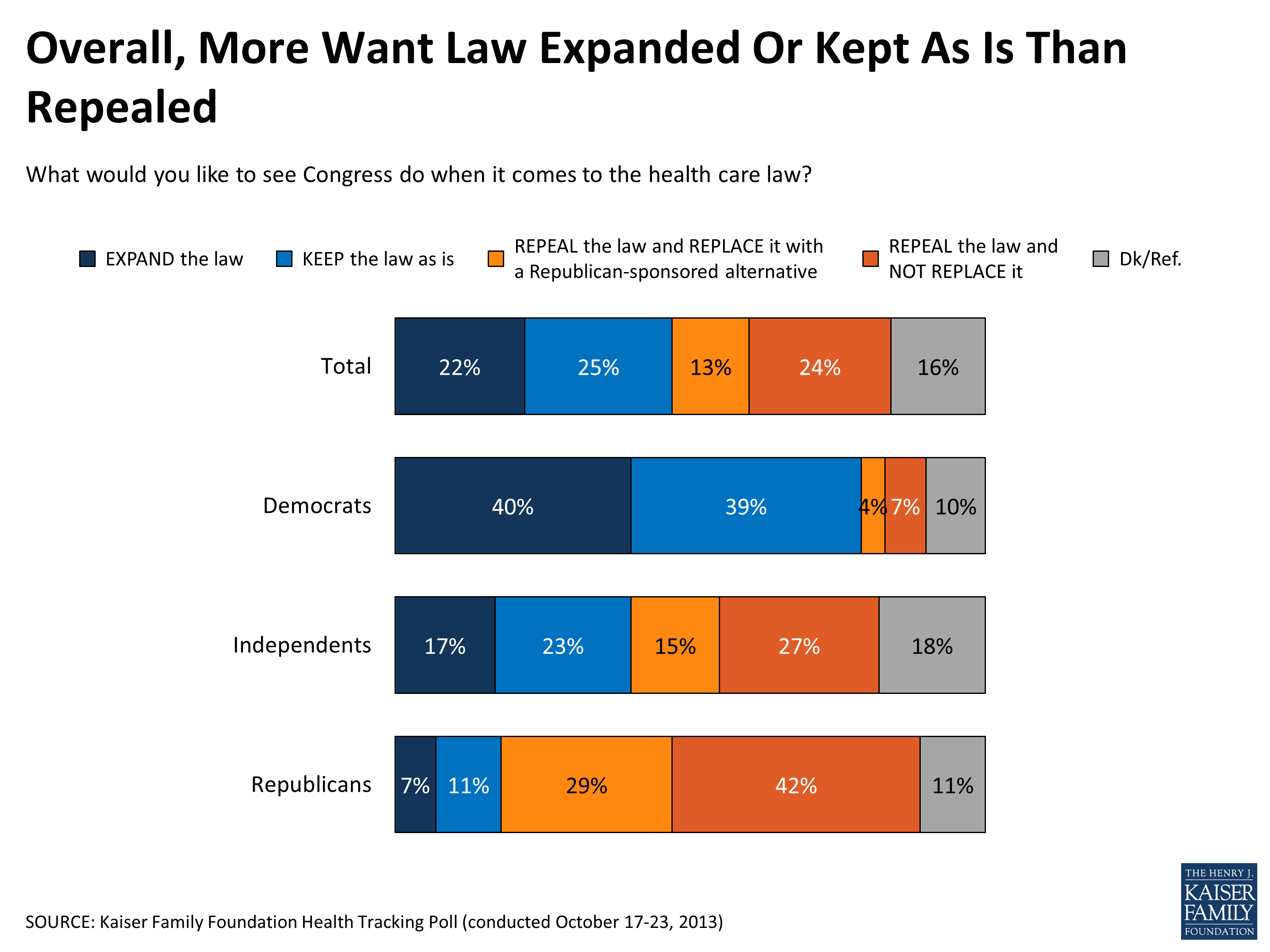
Barro points out that only “29% of Republicans favor replacing Obamacare with a Republican alternative to Obamacare”:
Republicans spent the last two election cycles hammering Democrats for cutting Medicare. Now they are hammering the president for not letting everyone keep their old plans if they like them. The de-facto Republican health policy platform is a defense of the pre-Obamacare status quo, period, and Republican base voters are with them.
But Jonathan Bernstein argues that going back to the old system isn’t an option:
No one is ever going to kick young adults off their parents’ insurance (or change the law so that insurance companies are allowed to do it). No one is going to bring back the various limitations in pre-ACA insurance policies. Some trimming of the new Medicaid rolls might be possible. But no one — no politician who has to face reelection, at least – is going to just toss all those people off their insurance with nothing to replace it.
Beyond all this is simply the Humpty Dumpty-ness of the situation: The old system has been slowly pushed off the wall for three years now, and by this point it’s really beyond repair, whatever the merits or politics of the situation.
I won’t go as far as Jonathan and say that the idea of repealing Obamacare is “dead.” His recitation of what no politician with a brain would do reminds me a lot of all those confident predictions (not by him, but by many others) that no state political leadership would be stupid or benighted or ideological enough to turn down the Medicaid expansion. And there’s also the possibility that Republicans, if they were in a position to do so, would repeal Obamacare and then quickly re-enact some of the easier and more popular provisions, like the provision allowing young adults to stay on their parents’ policies.
“So our animals can’t turn around for the 2.5 years that they are in the stalls producing piglets. I don’t know who asked the sow if she wanted to turn around…. The only real measure of their well-being we have is the number of piglets per birth, and that’s at an all-time high,” – Dave Warner, spokesman for the The National Pork Producers Council, in 2012. For video of what is being done to these animals, see my earlier post here.
I think he’s easily the most formidable GOP candidate for 2016 – on paper. Reviewing the GOP’s presidential hopefuls, a “plugged-in Republican consultant” ranks Christie #1:
Christie is in the 1 slot now and forevermore — he’s about to get huge margins in his historic reelection in a blue state –he’s the successful model for our Party (from a political perspective) and his governing success is exactly what our country needs from a fiscal perspective. He can compete in about 40 of 50 states. Who else can do that AND run as a conservative? No one.
Bouie notes that Christie is winning an impressive share of the black vote:
This isn’t a small thing; a nominee who can return the GOP to its historic performance with African American voters and other minorities, is a Christie who has done substantial damage to Democratic chances. Without the near unanimous support of blacks, Democrats have a much harder time in newly purple states like Virginia and North Carolina, as well as large swing states like Ohio and Florida.
Freedlander points out that Christie is also doing well with Latino voters. But:
Christie’s strong showing in New Jersey among Hispanics may not be enough to convince Republican bigwigs that he can do the same thing nationwide. For one thing, the Hispanic population in New Jersey, while large and diverse, is not representative of the population in the rest of the country. Only Florida boosts more Cuban-American voters, a constituency that has traditionally voted Republican (One of New Jersey’s U.S. Senators, Robert Menendez, is Cuban-American.) In 2009, Christie eked out a slight win against incumbent governor Jon Corzine and still garnered 32 percent of the Hispanic vote. For him to show broad appeal to Latinos nationwide he may have to do better than the 40 percent he is currently polling among Latinos against weak Democratic opposition.
Christie’s pitch to national Republicans is that he can hold that coalition together and rocket way past 47% of the vote. The only question is whether Republicans care enough about winning to take him up on it.
A new report on CIA and Pentagon abuse of prisoners cites damning evidence that medical professionals were fully complicit in the war crimes committed under Bush and Cheney. “Do harm” was their effective ethical mantra – do harm to get patients to say something to stop the pain. Newspeak was, as often under Cheney, a facilitator:
Doctors and nurses were required to participate in the force-feeding of prisoners on hunger strike, against the rules of the World Medical Association and the American Medical Association. Doctors and psychologists working for the DoD were required to breach patient confidentiality and share what they knew of the prisoner’s physical and psychological condition with interrogators and were used as interrogators themselves. They also failed to comply with recommendations from the army surgeon general on reporting abuse of detainees.
The CIA’s office of medical services played a critical role in advising the justice department that “enhanced interrogation” methods, such as extended sleep deprivation and waterboarding, which are recognised as forms of torture, were medically acceptable. CIA medical personnel were present when waterboarding was taking place, the taskforce says.
What on earth would a real doctor do when faced with a waterboarding than do all in her power to stop it? And why are those doctors complicit in these war crimes and betrayal of their core ethics still allowed to practice medicine? Why are they not in jail, along with the war criminals?
Over the weekend, Amy Goldstein and Juliet Eilperin reported that much of Obamacare’s flaws were not due to the president’s lack of attention or focus:
On the balmy Sunday evening of March 21, 2010, hours after the bill had been enacted, the president had stood on the Truman Balcony for a champagne toast with his weary staff and put them on notice: They needed to get started on carrying out the law the very next morning. It was not ready even though, for months beginning last spring, the president emphasized the exchange’s central importance during regular staff meetings to monitor progress. No matter which aspects of the sprawling law had been that day’s focus, the official said, Obama invariably ended the meeting the same way: “All of that is well and good, but if the Web site doesn’t work, nothing else matters.”
But they also report that healthcare.gov was “was hampered by the White House’s political sensitivity to Republican hatred of the law — sensitivity so intense that the president’s aides ordered that some work be slowed down or remain secret for fear of feeding the opposition.” Andrew Sprung sees the logic of this strategy:
The dominant charge in the incompetence indictment is that political considerations drove policy. But in this case, the “political considerations” consisted of sidestepping sabotage or trying to avoid providing new fodder for it. Perhaps in some cases, fear of taking propaganda hits should not have trumped operational considerations. But that’s easy to charge in hindsight. And the “political” considerations — evading sabotage — were in service of getting the law implemented well.
… [I]t seems clear to me that Obama should have drilled deeper into the administrative structure of the website-building project. Charges that the tech project did not have the right leadership or management structure seem well founded. Perhaps the responsibility for failing to find that leadership can be laid at the doorstep of DeParle, or Lambrew, or Sebelius, or Obama, or all of the above. But the decisions that Goldstein and Eilperin detail are not on their faces irrational. The damage done to the law and to the country by Republican sabotage, on the other hand, is unmistakable.
Drum adds, “No federal program that I can remember faced quite the implacable hostility during its implementation that Obamacare has faced.” Tomasky searches for a parallel:
Has there ever been a law in the history of the country as aggressively resisted by the political opposition as this? Republicans didn’t do this with Social Security. Most of them voted for Social Security. They didn’t do it with Medicare. They, and the Southern racists who were then Democrats, didn’t do it with civil rights. There was a fair amount of on-the-ground opposition to that, but it wasn’t orchestrated at the national level like this was. And when the Voting Rights Act was passed the year after civil rights, Southern states in fact fell in line quickly. Check the black voter-registration figures from Southern states in 1964 versus 1966. It’s pretty amazing.
No, to find obstinacy like this, you have to go back, yes, to the pre-Civil War era. The tariff of 1828, the Kansas-Nebraska Act, which led to the civil war in “Bloody Kansas” and ultimately to the Civil War itself.
Sorry to hear you’re leaving New York. I have to emphasize it was a massive blunder to live in Manhattan. I live in Brooklyn and love New York, but I dread going into Manhattan at all, and I would probably kill myself if I had to spend the entirety of every day there. Incidentally, to borrow your metaphor, I think Brooklynites in general look at Manhattan as a mistress too, one kept at a safe distance, since it’s more a Glenn Close sort of mistress (exciting but exhausting to deal with, and deadly).
Another reader:
The best stand up about the reason to leave New York City by the incomparable Patton Oswalt [NSFW]:
Money quote from Oswalt:
New York is a great place to visit, don’t get me wrong. But if you live there full-time, it turns your skull into a cage, your brain into a rat, and the city is just a stick poking the rat all day.
Lou Reed, on the other hand, was more scared of Sweden:
Your relocation and Lou’s passing made me think of this scene from Blue in the Face:
Another reader:
You’re going to love leaving. My appreciation for New York deepened immensely once I got the hell out of there. Now, returning as a visitor is one of the great pleasures of my life – which is a lot more than I can say for the experience of actually calling it home.
Another:
Before you leave New York, you must see (actually hear) this:
A major audio piece, Janet Cardiff’s Forty-Part Motet (2001), will be exhibited at the Cloisters as part of the institution’s 75th-anniversary celebrations (Sept. 10-Dec. 8). Situated in Fort Tryon Park in Manhattan’s Washington Heights neighborhood, the Cloisters is assembled from architectural elements that largely date from the 12th through the 15th century. Forty-Part Motet is an 11-minute recording of the 16th-century choral composition Spem in alium numquam habui by the 16th-century English composer Thomas Tallis. The work’s title translates as In No Other Is My Hope. Forty speakers on metal stands each feature a single voice. The work features a technology called binaural sound, such that the visitor senses voices coming from very specific directions, creating a highly physical experience.
Last weekend I finally made the trek up to The Cloisters, the Metropolitan Museum of Art’s somewhat hokey collection of religious painting and architecture. It was a beautiful autumn day and the views of the Hudson from the promontory are fantastic. But it’s the “sound installation” by Cardiff that is really mind-blowing. It was so beautiful that I literally had to keep myself from openly weeping. And I wasn’t the only one. I saw tears in the eyes of many others. I’m not much on churches and organized religion, but I’m grateful to The Met for providing me with a religious experience.
Another New Yorker:
At the end of a very underrated Kevin Spacey/Danny DeVito movie called The Big Kahuna, there is a long monologue by a voice that gives advice to the audience (find it here). One of the lines is, “Live in New York City once, but leave before it makes you hard”. Having lived here my whole life, I consider this a truism for 99% of people. It can make you hard. It is not an easy day-to-day life. There are many sacrifices to make and many others you have to accommodate. It is not for everyone.
I realize this will make a lot of your readers, and perhaps you, roll your eyes, but it really does take a different kind of person to make this place their home permanently. I want to emphasize that is not a qualitative assessment. The fact is, I will probably leave … but that’s due to money and family. I love living in this place. I thank god every day I live here. Sometimes I’ll be sitting on the train 40 minutes into my 2.5 mile commute and see all the different kinds of (often smelly and pushy) people and realize few places on earth give me the daily opportunities this place gives. I realize you know all of this and it appears your initial disappointments have not grown into a permanent dislike, which is good. Also, I’ll let your comparisons between NYC and D.C. slide … for now.
I never quite understood the urge of others to take a trip to NYC; it’s far too stressful for that. Those other places, where people spread out and grow, that’s where I like to vacation. That seems relaxing to me. NYC is just where things get done – it’s not meant to be something else. Most people don’t realize that. For most, this place is a cartoon before you get here and a gritty, fall to earth upon staying. For me, it’s home.
I’m sorry you don’t like living here as much as I do, Andrew. I hope when you look back on your year here it won’t seem as bad in retrospect. I’m glad you will be visiting; we will welcome you back (but do stay out of my way on the subway … I got things to do).
Yes, it’s a German busker singing Jimmy Somerville’s classic – as Jimmy Somerville just happens to pass by, walking his dog! A Woody Allen Marshall McLuhan moment, if ever there was one:
The [Romney campaign’s VP] vetters were stunned by the garish controversies lurking in the shadows of his record. There was a 2010 Department of Justice inspector general’s investigation of Christie’s spending patterns in his job prior to the governorship, which criticized him for being “the U.S. attorney who most often exceeded the government [travel expense] rate without adequate justification” and for offering “insufficient, inaccurate, or no justification” for stays at swank hotels like the Four Seasons.
There was the fact that Christie worked as a lobbyist on behalf of the Securities Industry Association at a time when Bernie Madoff was a senior SIA official—and sought an exemption from New Jersey’s Consumer Fraud Act. There was Christie’s decision to steer hefty government contracts to donors and political allies like former Attorney General John Ashcroft, which sparked a congressional hearing. There was a defamation lawsuit brought against Christie arising out of his successful 1994 run to oust an incumbent in a local Garden State race.
Then there was Todd Christie, the Governor’s brother, who in 2008 agreed to a settlement of civil charges by the Securities and Exchange Commission in which he acknowledged making “hundreds of trades in which customers had been systematically overcharged.” (Todd also oversaw a family foundation whose activities and purpose raised eyebrows among the vetters.) And all that was on top of a litany of glaring matters that sparked concern on Myers’ team: Christie’s other lobbying clients, his investments overseas, the YouTube clips that helped make him a star but might call into doubt his presidential temperament, and the status of his health.
I think using his brother against him is de trop. But it’s always worth remembering that many many candidates who seem extremely promising on paper can come a-cropper – especially if they display the kind of aggressive cockiness of the New Jersey governor.
No, not for humans. Just for pigs, courtesy of Wal-Mart, which refuses to review its support of housing pigs for their entire lives in crates so tight they cannot turn around. Many of you will be unable to watch this video – and I found it close to impossible. It has some NSFW language in it. But this is the reality we are living with and allowing to continue:
[It] was recorded by an activist who worked undercover at Rosewood Farm in Pipestone, Minn. The video shows workers slamming piglets into concrete floors until they die, castrating them without painkillers, and roughly beating and cursing at sows. But the more egregious abuse, activists say, is standard industry practice: keeping sows in restrictive gestation crates for their entire lives.
This horror is not restricted to one rogue plant. It is widespread. Here is some footage from the largest pork producer in the US, Smithfield, showing the brutal impact of keeping pigs in gestation crates their entire lives:
Some companies have ended gestation crate confinement; others are cutting back; Smithfield says they’ll get rid of them by 2017 (after hemming and hawing on the deadline). More good news:
Nine states in the United States have banned the use of these pens, which are outlawed in the European Union, and about 60 companies – including McDonalds, Burger King and Costco – have begun to demand that suppliers stop using gestation crates. Gov. Chris Christie recently vetoed a bill to ban the crates in New Jersey, a move that may be a sign that Mr. Christie has his eyes set on certain voters in a possible 2016 run for president, Politico reported this week.
On what conceivable grounds could Christie veto a bill banning such barbarism? Pigs are close to dogs in intelligence and emotion. Would we allow puppies to be picked up by the tail and have their heads smashed into concrete? Would we allow corporations to keep a dog in a crate so small it cannot even turn around for its entire life? It’s about time the national press began pestering Christie, Wal-Mart, the National Pork Producers Council, and all those complicit in this evil for an answer. You can email the director of communications at the NPPC, Dave Warner, to convey to him your concerns. Please no abuse. Just a polite expression of concern. He can be reached at warnerd@nppc.org.
Update from a reader:
That video you linked to about Walmart and pig-farming was truly horrible but not even remotely surprising. Bacon is very cheap in the US and this is why. This is also why I became a vegetarian since moving to the US. In Ireland, most of the beef in grass-fed and we used to get home-made sausages from our local butcher. Here, no matter where you eat, you cannot avoid the fact that you are likely to be eating an animal that has been horribly mistreated.
I have no moral objection to eating meat in general – I choose not to now because of the environment and my general health. However, I can’t see how anyone could not consider that treatment morally wrong. Incidentally, I worked in a research lab for a couple of years where we were experimenting on mice. There were very clear, very specific guidelines about what we could and couldn’t do and any procedure required the use of an anesthetic. I didn’t enjoy the job and I wouldn’t do it again but at least I knew that I was doing everything I could to minimize the suffering of the animals. And then you have what you see in that video …
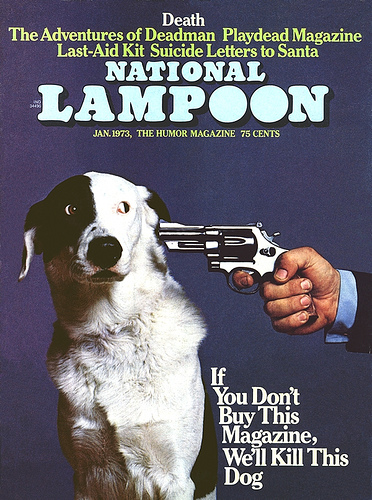
Congenial chuckles were not [founding co-editor Michael] O’Donoghue’s goal. “I’ve always considered comedy what you use to get people to swallow the pill, not the pill itself,” he said, along with this deathless epigram: “Making people laugh is the lowest form of humor.” He considered himself a moralist, and a livid one at that — who was still able to exert mastery over his feelings: “Rage is only interesting when it’s controlled. When you repress those emotions, you always get something artistic and interesting.” His highest-profile heirs today are Chris Rock and Louis CK, whose moral anger fuels their comedy without stepping (in Rock’s case, barely so) over the threshold of Lewis Black’s or Sam Kinison’s exhausting fury, and for whom the point is often less to get a laugh — let alone self-congratulatory applause — than to provoke thought. With O’Donoghue’s influence, and Vietnam’s escalation, the National Lampoon couldn’t help but become more political than its ivory tower predecessor [the Harvard Lampoon], attacking both the right and left for their conservatism and hypocrisy, respectively. And, as with the response to The Onion today, people loved being reminded of their flaws. …
The magazine’s circulation dwindled through the ’80s and published its last issue in 1998, but to most readers, it unofficially ended in 1980, when a vacationing [co-founder Doug] Kenney was found dead at the base of Hawaiian cliff in an apparent suicide at age 32. His death was received by his peers with equal parts sadness and gallows humor; the best line was that Kenney “had slipped and fallen while looking for a place to commit suicide.”
The NL ceded its satirical reign first, in the late ’80s, to Spy magazine, which derided the lifestyles of the rich and famous, and then, in the new millennium, to the media-oriented Onion and Gawker, the politicized Jon Stewart and Stephen Colbert, and finally to anyone with a Twitter account and a misspelled opinion. In the last two decades, the surviving brand has pumped out over thirty films, some given the NL imprimatur, many straight-to-DVD and with titles the original Lampooners would have heaved up only for parodic target practice (2007’s Homo Erectus, aka National Lampoon’s Stoned Age).