When Extremism Is No Vice

Michael Kazin argues that “sometimes, those who take an inflexible, radical position hasten a purpose that years later is widely hailed as legitimate and just.” He points to historical examples:

In the 1830s, the “moderate” way to abolish slavery in the U.S. was to compensate slave-owners and ship their former chattels, nearly all of whom were American-born, to Africa. Extreme abolitionists argued, loudly, that it was a sin to hold human beings in bondage; nothing but immediate freedom would do. “I am aware that many object to the severity of my language; but is there not cause for severity?,” asked William Lloyd Garrison. “I will be as harsh as truth, and as uncompromising as justice. On this subject, I do not wish to think, or to speak, or write, with moderation.” A little over three decades later, his principles were written into the Constitution.

Over time, certain other extremists on the left also turned out to be prophets.

Moderate authorities in politics and the media once lambasted such pioneer woman suffragists as Elizabeth Cady Stanton, militant opponents of Jim Crow like Ida Wells Barnett and W.E.B. DuBois, and early critics of the war in Vietnam like the members of Students for a Democratic Society and the Student Non-Violent Coordinating Committee. But who would now claim that only men should vote, the races should be segregated, and that it was a good idea to send more than a half a million soldiers to Indochina?

His conclusion:

[T]o vaunt moderation over extremism just signals one’s good intentions without communicating anything meaningful about the issues at stake. If you think Bill de Blasio will bankrupt New York or Ted Cruz has no sympathy for the uninsured, then make that argument and drive it home with facts. Insisting that our biggest problems would be solved if everyone crowded into the middle of the road is a lazy attempt to avoid real debate about what divides us. It’s an extreme waste of time.

Bring Back The Guillotine?

dish_guillotine

John Kruzel recommends revisiting the chopping block as a more humane form of execution than lethal injection:

Bringing back the guillotine may sound crazy, but it’s certainly better than the current alternative. It’s better for prisoners because quickly severing the head is believed to be one of the quickest, least painful ways to die. And it’s better for organ recipients because the bodies of guillotined prisoners could be more quickly harvested for viable parts, unlike organs that may become unusable after lethal injection due to hypoxemia. …

Dr. Jay Chapman, the creator of the three-drug cocktail, supports ditching his 1977 invention due to its reputation for causing slow, painful deaths. “The simplest thing I know of is the guillotine,” he told CNN in 2007. “And I’m not at all opposed to bringing it back. The person’s head is cut off and that’s the end of it.” Other doctors have stuck their necks out by protesting lethal injection on the grounds that administering it requires medical professionals to violate the Hippocratic Oath. The American Medical Association officially discourages physicians from participating in lethal injections.

The guillotine sidesteps any Hippocratic hypocrisy. The layman can operate a guillotine just as well as a doctor. As Hanni Hindi wrote in Slate some years ago, “The prisoner facing the guillotine was placed facedown on a large wooden plank, their head secured in a brace and steadied by an executioner’s assistant known as ‘the Photographer,’ who held onto their hair (or, in the case of bald prisoners, their ears). When everything was in place, a 120-pound blade was dropped from 7 feet in the air, immediately severing the prisoner’s head.” It never misses its mark.

Recent Dish on ending lethal injection here and here.

(Photo by Daryl Davis)

The Other Lessons Of 1984

Moira Donovan contends that “Orwell’s most famous work is now so closely associated with our understanding of our own surveillance societies that its role as a work of literature is sometimes overlooked“:

The idea that the human spirit may not always prevail, that there are forces stronger than human personality, was a reverberating wake-up call for someone who, like many millennial teenagers, had been raised to believe in boundless possibility. Neither Winston Smith, nor Julia O’Brien (his lover), nor any of the other characters with which they come into contact are caricatures of political ideologies. They’re individuals, and it’s as individuals that they suffer. For me, bearing witness to such believable distress gave license to my own teenage angst. In a way that was paradoxically liberating, it validated an occasionally gloomy outlook by showing me there was reason to worry about the future: that hardship was real, and that things don’t always work out. Most importantly, it showed me what can be done with that angst, as it’s impossible to read 1984 without getting a sense of Orwell’s own struggles. As he states in the essay ‘Why I Write’: “Writing a book is a horrible, exhausting struggle, like a long bout of some painful illness. One would never undertake such a thing if one were not driven by some demon whom one can neither resist or [sic] understand.”

Previous Dish on Orwell here, here, here, and here.

All The President’s Poets

On the 50th anniversary of JFK’s assassination, Adam Gopnik looks back at the way American literati mourned his death:

John Berryman wrote a “Formal Elegy” for the President (“Yes. it looks like wilderness”); Auden an “Elegy for J.F.K.,” originally accompanied by twelve-tone music by Stravinsky. Robert Lowell—who in the Second World War had gone to prison as a conscientious objector, and in the late sixties became a Pentagon-bashing radical hero—wrote to Elizabeth Bishop that the murder left him “weeping through the first afternoon,” and then “three days of television uninterrupted by advertising till the grand, almost unbearable funeral.” The country, he said, “went through a moment of terror and passionate chaos.” Lowell’s friend and fellow-poet Randall Jarrell called it the “saddest” public event that he could remember. Jarrell tried to write an elegy but could get no further than “The shining brown head.”

The death of J.F.K. marked the last time the highbrow reaches of the American imagination were complicit in the dignity of the Presidency. In Norman Mailer’s “Presidential Papers,” published the month Kennedy died, the point is that there was a “fissure in the national psyche,” a divide between the passionate inner life of America and its conformist, repressed official life: “The life of politics and the life of myth had diverged too far.” For Mailer, Kennedy’s Presidency supplied the hope of an epiphany wherein the romantic-hero President would somehow lead his people on an “existential” quest to heal this breach. It sounded just as ridiculous then, but there was something gorgeous in the absurdity.

Caption for the above video:

It was a cold and sunny day in 1961 [during JFK’s inauguration] and the 87 year old Robert Frost could not read his poem, “Dedication”, that he wrote in honor of this special day for he was blinded by the bright sun. He fumpered on the podium because he could not see it and did not know it well. Richard Nixon came and held his top hat to block the sun for Mr.Frost who was extremely old and having problems. Instead, he recited from memory an oft requested poem, “The Gift Outright.”

A Dishonest Environment

We are tempted to cheat by the smallest things around us:

As it turns out, almost anyone will cheat when given even minor, consciously imperceptible behavioral cues. For instance, in a series of three experiments, a group of psychologists found that lighting could affect cheating. In one study, participants in a dimly-lit room cheated more often than those in a lighter one. While both groups performed equally well on a set of math problems, students in the darker room self-reported that they correctly solved, on average, four more problems than the other group—earning $1.85 more as a result, since they were being paid for each correct answer. The authors suggested that the darkness created an “illusory anonymity”: even though you aren’t actually more anonymous in the dark than in the light, you feel as though you are, making you more likely to engage in behaviors you otherwise wouldn’t. Similar effects have been observed with a variety of situational factors that don’t seem directly related to cheating. We cheat more, for instance, when we’re in a messy environment—one that has more signs of socially deviant behavior, like litter, graffiti, and other rubble.

Previous Dish on cheating here, here and here.

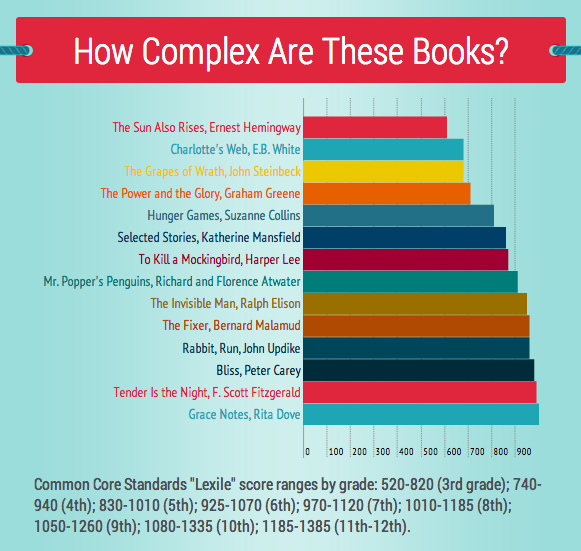
Fifth Grade Is Too Late For Steinbeck?

Screen Shot 2013-11-01 at 7.56.04 PM

According to English professor Blaine Greteman, this seemingly bonkers system of rating “text complexity” is coming to a school district near you:

Lexiles were developed in the 1980s by Malbert Smith and A. Jackson Stenner, the President and CEO of the MetaMetrics corporation, who decided that education, unlike science, lacked “what philosophers of science call unification of measurement,” and aimed to demonstrate that “common scales, like Fahrenheit and Celsius, could be built for reading.” Their final product is a proprietary algorithm that analyzes sentence length and vocabulary to assign a “Lexile” score from 0 to over 1,600 for the most complex texts. And now the new Common Core State Standards, the U.S. education initiative that aims to standardize school curricula, have adopted Lexiles to determine what books are appropriate for students in each grade level. Publishers have also taken note: more than 200 now submit their books for measurement, and various apps and websites match students precisely to books on their personal Lexile level.

Any attempt to quantify literary complexity surely mistakes the fundamental experience of literature.

No one has described that experience better than William Empson, whose Seven Types of Ambiguity wrote the book on literary complexity. A mathematician by training, Empson was no touchy-feely humanist, but he understood that the greatest literary language rarely made “a parade of its complexity.” He particularly admired Shakespeare’s description of trees as “Bare ruined choirs, where late the sweet birds sang,” which he explained contained “no pun, double syntax, or dubiety of feeling”:

but the comparison holds for many reasons; because ruined monastery choirs are places in which to sing, because they involve sitting in a row, because they are made of wood, are carved into knots and so forth…. These reasons, and many more relating the simile to its place in the Sonnet, must all combine to give the line its beauty, and there is a sort of ambiguity in not knowing which of them to hold most clearly in mind.

I try to teach my students to balance such complexities. But many of the smartest and best have learned the Lexile model too well. They’ve long been rewarded for getting “the point” of language that makes “a parade of its complexity,” and they’ve not been shown that our capacity to manage ambiguity without reducing it enables us to be thinkers rather than mere ideologues.

Update from a reader:

I get it, assigning numbers to books seems silly, especially when it leads to conclusions like Mr. Popper’s Penguins is “more complex” than The Grapes of Wrath. The lexile may be a perfectly good way to score “complexity” as it’s narrowly defined here. “Complexity” is just one criterion to consider when choosing books to assign to students. I doubt if any of the folks associated with the Common Core would claim that the lexile measures literary value. And to be clear, I think it’s foolhardy to have rigid rules that assign only books with certain lexiles to certain grades.

Upon graduating from high school, a student should be able to parse a simple contract or legal document. This can be tougher than reading Hemingway – and certainly a lot less pleasurable, and of less artistic value. But when choosing books for students to read, why not consider a book’s complexity, especially when there are other pedagogical goals besides the appreciation of literature?

The Best Time To Drink Coffee

Probably not when you first wake up:

[I]f we are drinking caffeine at a time when your cortisol concentration in the blood is at its peak, you probably should not be drinking it. This is because cortisol production is strongly related to your level of alertness and it just so happens that cortisol peaks for your 24-hour rhythm between 8 a.m. and 9 a.m. on average (Debono et al., 2009). Therefore, you are drinking caffeine at a time when you are already approaching your maximal level of alertness naturally. …

Although your cortisol levels peak between 8 a.m. and 9 a.m., there are a few other times where–on average–blood levels peak again, like between noon and 1 p.m., and between 5:30 p.m. and 6:30 p.m. In the morning then, your coffee will probably be the most effective if you enjoy it between 9:30 a.m. and 11:30 a.m., when your cortisol levels are dropping before the next spike.

The Best Of The Dish This Weekend

Protest in Gaza against power cuts

Some arguments: that Thomas Aquinas was smarter than the New Atheists; that friendship with dogs is all about our shared “spiritedness“; that Rudyard Kipling was more readable than Virginia Woolf; that the Employment Non-Discrimination Act is worth a libertarian critique.

Some beauty: a poem called “X”; an animation triumph; the elders of burlesque.

Leon Wieseltier was meretriciously nasty again; and Richard Rodriguez gave a simple definition of Christian faith in his spiritual memoir, “Darling”:

My brother is no less a good man for not believing in God; and I am no better a man because I believe. It is simply that religion gives me a sense – no, not a sense, a reason – why everyone matters.

Three words: Japanese cunnilingual octopodes (NSFW).

The most popular post of the weekend was “New York, I Love You, But …” followed by New York Shitty.

See you in the morning. And if you want to make the new House ads go away, just [tinypass_offer text=”subscribe”] and the clean, simple Dish you’re used to will be yours for ever. [tinypass_offer text=”Subscribe now!”] and help me stop blegging.

(Photo: A Palestinian boy holds a candle during a protest against power cuts on November 3, 2013 in Gaza City. Gaza’s lone power plant shut its generators on Friday due to a fuel shortage, a move that will likely increase already long blackout hours in the impoverished coastal territory. By Ashraf Amra/Anadolu Agency/Getty Images.)

House Ads And Thanks

We let readers know about incoming House ads for the first time, phasing in this weekend. If you missed the post, here it is.  If you’re a Screen Shot 2013-11-03 at 9.29.31 PMsubscriber, you won’t have seen them – and if you have, remember to log in to make them go away. Special thanks to Special Teams Chas and the crew at Ten Up, for making this possible and putting up with my meddling. So far so great: $3,400 in new subscriptions in our slowest period of the week, which is three times the total of last weekend. We’re now at 31,024 subscribers, $794,000 in gross revenue –  and gaining. Our conversion rate of readers to subscribers went from an average of 2.5 percent to over 6 percent in a day. We might make our goal of $900K if we keep this up.

For subscribers, I thought you’d like to see what some of the ads looked like, because we had a little fun with them. My personal fave:

Screen Shot 2013-11-03 at 8.57.50 PM

That should make the CNN Green Room a little awkward – but hey, prove him wrong! [tinypass_offer text=”Subscribe”]!

Quote For The Day

“I realize now that my prejudices against conservatives were, in many ways, just as uncompromising as the prejudices I’d often projected onto them. They were just people. Not issues. Not votes. People whose daughters go to school with my daughters, whose dogs run away and come back and run away again, whose hands found my shoulders and who didn’t judge, the night I wept over a friend who had taken her own life,” – David James Poissant.

We can talk and bitch and whine and moan about polarization but why not start with ourselves? As I discovered in the decades fighting for gay equality, nothing is more powerful than entering into conversation with someone you fear or dehumanize for their views. If readers have their own stories to tell – not family but friend stories – we’d love to hear from you about bridging the gap. That goes for Republicans engaging Democrats as well, of course. And it also goes for myself.