A Double-Down Cameo

From Heilemann and Halperin’s book on the 2012 campaign and that first debate:

As the full desultoriness of his Denver performance sank in, the president was consumed by a sense of responsibility—and shadowed by fears that his reelection was at risk. Outwardly, he took pains to project the opposite. When his staffers asked how he was doing, he replied, “I’m great.” To Plouffe, who had volunteered to soothe Sullivan, Obama joked, Someone’s gotta talk him off the ledge!

How many times has Plouffe tried to talk me off the ledge? I think twice. But they were texting me that night to tell me to calm the fuck down. For the record, here’s my actual meltdown as it happened. I still don’t think was wrong about his performance that night, as H&H acknowledge. I was wrong about Obama’s ability to bounce back. That’s worth remembering amid his current travails.

The Case Against ENDA

No Child Left Behind

The federal bill banning workplace discrimination against gays, lesbians and transgenders is up for a vote tomorrow. Gay dad Wally Olson makes the case against it – and perhaps his strongest point is on whether it will ever be used:

Statistics from the many states and municipalities that have passed similar bills (“mini-ENDAs”) indicate that they do not serve in practice as a basis for litigation as often as one might expect. This may arise from the simple circumstance that most employees with other options prefer to move on rather than sue when an employment relationship turns unsatisfactory, all the more so if suing might require rehashing details of their personal life in a grueling, protracted, and public process.

To take a similar point on the federal hate crimes law, since it was passed in 2009, there have been two successful prosecutions under the act for anti-gay bias, so far as I can find. One was in March, 2012, in Kentucky, and the second was in Georgia last June. It may well be that neither would have been pursued without the federal law, but still. If I’ve missed any, please let me know. But two successful prosecutions in four years does not suggest a problem so vast that the federal government must be involved. If you care at all about economic liberty, it seems to me you virtually-normalhave to weigh the costs as well as the benefits.
At the same time, the private sector has forged ahead of government, acting rationally to get the best set of employees possible. The Human Rights Campaign annual report (pdf) on voluntary corporate anti-discrimination policies gives us the latest: 88 percent of Fortune 500 companies have non-discrimination policies with respect to homosexuality, and 57 percent also include gender identity in their policies. The progress in the private sector over the last ten years has been remarkable, and HRC can rightly feel proud of their work engaging corporations. But that, of course, suggests that government itself may not be the best way to protect gay employees.

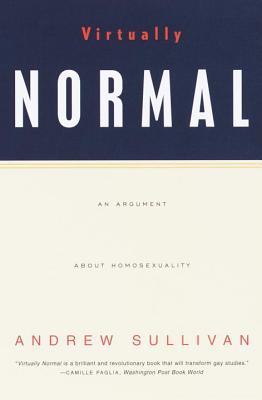
I used to be opposed tout court to such laws on libertarian grounds (and not just for gays but for everyone apart from those subjected to the unique historical burden of slavery and segregation). Virtually Normal also makes the case that the government has no right to compel private citizens not to discriminate against gays when it discriminated so perniciously against gays in civil marriage and military service. But two things have changed my mind over the years.

The first, quite simply, is that the libertarian position on such crimes is largely moot – for good and ill. The sheer weight of anti-discrimination law is so heavy and so entrenched in our legal culture and practice, no conservative would seek to abolish it. It won’t happen. And if such laws exist, and are integral to our legal understanding of minority rights, then to deny protection to one specific minority (which is very often the target of discrimination) while including so many others, becomes bizarre at best, and bigoted at worst. Leaving gays out sends a message, given the full legal context, that they don’t qualify for discrimination protection, while African-Americans and Jews and Catholics and Latinos and almost everyone else is covered by such protections. It’s foolish to stick to a principle, however sincere, in the face of this reality.

Secondly, the federal government has ceased its own discrimination policies in marriage and military service and therefore now has some small sliver of moral standing to lecture private individuals across all states. My objections twenty years ago are now moot.

Put those two developments together and I would not vote against ENDA if I, God help us, were a Senator. But I would vote for it with my eyes open. I don’t think it will make much difference in reality just as I don’t believe hate crime laws make much difference in reality. Of course that’s an empirical question and I promise readers horrified by my luke-warm support of this that I will gladly recant such skepticism if ENDA truly does lead to a flurry of successful suits across the country against anti-gay bias.

But to me, this feels a lot like a) an easy concession to Gay Inc. which has devoted almost its entire existence to this bill, b) an easy vote for a Republican trying to hold onto a marginal seat, c) an even easier way for Democrats to grandstand on the issue, even though it stands a snowball’s chance in Hell of getting through the current House. So I hope it passes. But forgive me for not cheering it on.

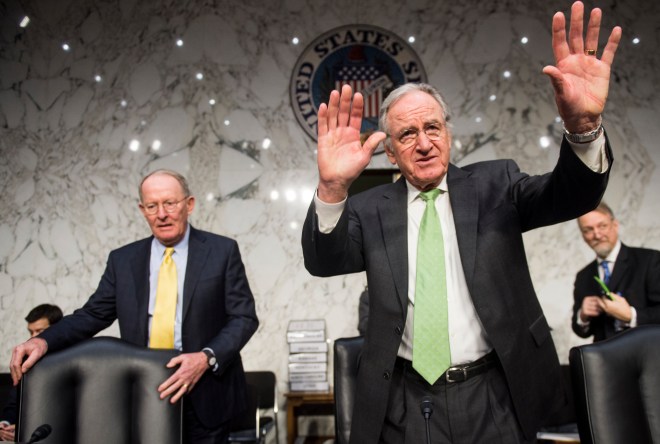
(Photo: Chairman Tom Harkin, D-Iowa, right, tries to quiet a CodePink protester calling for passage of the Employment Non-Discrimination Act on Thursday, Feb. 7, 2013. Sen. Lamar Alexander, R-Tenn., left, takes his seat. By Bill Clark/CQ Roll Call.)

Another Rogue Cop In The Drug War

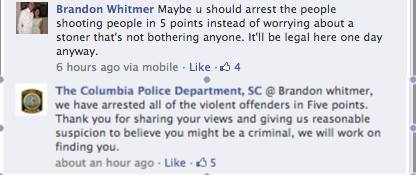
After arresting one man for possessing $40,000 worth of weed in his home, Columbia, South Carolina’s interim police chief got a little blowback from marijuana activists online. Fair enough – the to and fro of public debate. Until we get this on Facebook:

Santiago-1So someone expressing a pro-weed opinion gives the cops “reasonable suspicion” for a raid against him as well. Until we get rid of this ridiculous Prohibition, more of this kind of bullshit will continue.

An Antidote To Hitch

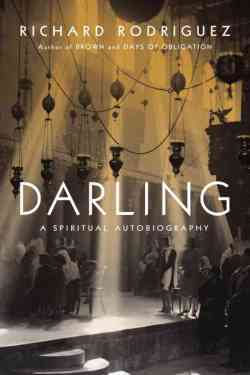
Rubén Martínez reviews Richard Rodriguez’s new book Darling: A Spiritual Autobiography and studies its place in the author’s work on race, religion and assimilation in America:

Darling offers variations on all these themes, at the same time that it takes a leap onto the post-9/11 global stage. It is also a book about the desert. To an extent about place, its more profound darlingpreoccupation is the metaphysical and mystical desert, the cradle of the spiritual trinity of Judaism, Christianity, and Islam. “My faith in a desert God makes me kin to the Jew and to the Muslim,” he writes at the outset.

But to prepare himself and his readers for the journey to Jerusalem, he first makes an inventory of the Orientalist imaginaries of his mid-20th century youth. In Sacramento’s Alhambra Theatre he sees Otto Preminger’s rendition of Palestine (Exodus, 1960) through Paul Newman’s blues: “I became a Zionist at the Alhambra Theatre.” He reads Sir Richard Burton (not the actor but the British explorer), who goes native to smuggle himself into Mecca. In his adolescence there are more substantive encounters. He apprehends the momentous transformation of Cassius Clay into Muhammad Ali, is moved by Malcolm X’s journey from Harlem to Mecca. …

Nothing can quite prepare you for what is to come, even if you’re familiar with Richard’s work. Since Days of Obligation and especially with Brown, he began to develop a lyrical yet radically digressive style that combines a syntactical elegance with narrative and referential leaps not just between chapters but within them as well. One second we are with the Catholic popes of the mid-20th century, a couple of paragraphs later Mark Twain makes it into the conversation, and in short order so do Fellini, Pasolini, and Bergman. From Jerusalem we head to Las Vegas; both deserts of course, but the initial wipe of the frame induces vertigo before he massages the material into thematic coherence. Or not. Sometimes the digression is just a digression, and sometimes a murky erudition remains just that.

Richard and I had a public conversation about his book a couple of weeks ago. It’s a dense, difficult read at times … but it rewards patience. Sometimes, he expresses something as simply and magnificently as the miraculous Pope Francis. To wit:

My brother is no less a good man for not believing in God; and I am no better a man because I believe. It is simply that religion gives me a sense – no, not a sense, a reason – why everyone matters.

The congregation does not believe one thing; we believe a multitude of hazy, crazy things. Some among us are smart; some serene; some feeble, poor, practical guilt-ridden; some are lazy; some arrogant, rich, pious, prurient, bitter, injured, sad. We gather in belief of one big thing: that we matter, somehow. We all matter. No one can matter unless all matter. We call that matter God and we are drawn to it every Sunday.

In an interview with Harper‘s, Richard describes the relationship between his religion and his writing:

I agree with Thomas Aquinas who describes the act of writing as a kind of prayer. Certainly as a person who writes every day it does seem to me that the energy, the inspiration, comes from outside of myself. Yesterday I struggled with this paragraph and nothing came. Today, the words come freely and almost seem to write themselves . . . so, like other writers, I come up with metaphors like grace and the muse and inspiration to explain how it seems that something outside my own efforts had produced the line I could not write by myself.

I don’t mean to become such a— I’ve never liked the word “piety.” And I don’t even like it when people say about me that I am a good man. I just, it makes me nervous — there’s a kind of domestication about such praise. For myself, I prefer the raggedness of my life of faith. I like to consider Andy Warhol a saint, one of the great saints of my lifetime. And I look for God in places like, you know, gay bars, where maybe no one else expects to find Him, in the dark.

Does Assimilation Mean Disintegration?

Jonathan S. Tobin is troubled by the recent Pew survey showing how secular American Jews have become:

Screen Shot 2013-10-30 at 12.05.05 AMIncreasingly, secular Jews have come to see any effort to define group identity in ways that include some but exclude others as distasteful and even hateful. This helps explain the most shocking of the Pew findings: More than a third of those Jews polled said belief in Jesus—the one point that all Jews had once been able to agree was something that put you outside the Jewish tent—should not be deemed a disqualifier. How can this be? Simple: It is just an extreme manifestation of the logic governing the inclusion doctrine.

The very idea that Jewish identity involves drawing lines—lines as seemingly insignificant as who may be a voting member of a synagogue and who may receive honors during services—is itself the problem for many Jews. The non-observant American Jewish mind-set is increasingly uncomfortable with the notion of drawing any boundaries around Jewish identity. And that mind-set has been ironically justified by the organized Jewish community’s breathless pursuit of those [intermarried Jews] who have already chosen to place themselves outside the lines.

Dreher draws a lesson for his fellow Christians:

While we certainly have incomparably more cultural cushion, as Tobin notes, our people are being assimilated too by secularism, via religious indifferentism. Fifty years ago, there was a lot more cultural pressure to affiliate with a church. You felt that you should, that it was the right thing to do. That’s long gone. In a free society in which there is no serious penalty, social or otherwise, for not being Christian, you have to give people a reason to want to be a Christian. As we’ve observed in this space, no church has found the solution to waning Christianity (see Pew’s study on the “Rise Of The Nones”), though the Jewish experience seems to confirm the idea that a religion that does not offer something meaningfully distinctive from the mainstream will not endure. If you fling open the windows of the Church to the world as it is today, you run the real risk of the winds blowing your house down.

Or bringing in the fresh air that makes it inhabitable. It’s a difficult line to tread, but Pope Francis seems to be doing just fine with it.

“Make Your Soul Grow”

In 2006, students at Xavier High School in New York City wrote to Kurt Vonnegut as part of an assignment from their English teacher, Ms. Lockwood. The literary legend wrote back:

I thank you for your friendly letters. You sure know how to cheer up a really old geezer (84) in his sunset years. I don’t make public appearances any more because I now resemble nothing so much as an iguana.

What I had to say to you, moreover, would not take long, to wit: Practice any art, music, singing, dancing, acting, drawing, painting, sculpting, poetry, fiction, essays, reportage, no matter how well or badly, not to get money and fame, but to experience becoming, to find out what’s inside you, to make your soul grow.

Seriously! I mean starting right now, do art and do it for the rest of your lives. Draw a funny or nice picture of Ms. Lockwood, and give it to her. Dance home after school, and sing in the shower and on and on. Make a face in your mashed potatoes. Pretend you’re Count Dracula.

Here’s an assignment for tonight, and I hope Ms. Lockwood will flunk you if you don’t do it:

Write a six line poem, about anything, but rhymed. No fair tennis without a net. Make it as good as you possibly can. But don’t tell anybody what you’re doing. Don’t show it or recite it to anybody, not even your girlfriend or parents or whatever, or Ms. Lockwood. OK?

Tear it up into teeny-weeny pieces, and discard them into widely separated trash recepticals. You will find that you have already been gloriously rewarded for your poem. You have experienced becoming, learned a lot more about what’s inside you, and you have made your soul grow.

God bless you all!

Kurt Vonnegut

Face Of The Day

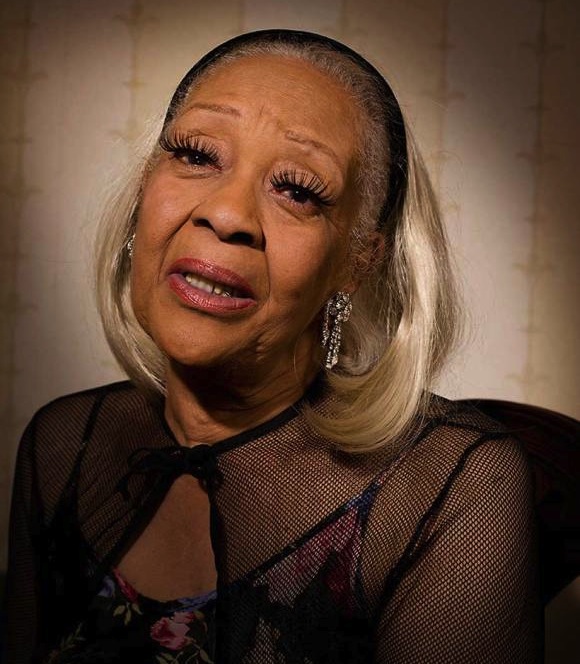
Toni Elling began performing when she was 32 years old and when

David Rosenberg provides background on the above image:

Roughly 10 years ago, photographer Stephanie Diani went to Helendale, Calif., to check out the Miss Exotic World pageant, which is now located in Las Vegas and known as the Burlesque Hall of Fame. … Diani had heard about the Legends of Burlesque—“ladies of a certain age who perform and teach younger dancers,” she said—and found herself watching the women, some of whom were septuagenarians, parading around in scantly clad outfits or even just pasties with an air of confidence that fascinated Diani. She made a mental note to work on a project about them.

Seven years after her visit, Diani decided to research the dancers’ whereabouts and began a series of portraits of the women taken in their homes (or sometimes in a hotel room) wearing either their favorite costumes or something of significance to them. She began with Stephanie Blake in Simi Valley, Calif., who then referred Diani to another dancer. This began a word-of-mouth project that became “Dames: The Legends of Burlesque.”

(Photo of Toni Elling by Stephanie Diani)

Surprised By Joy, Again And Again

In an interview with Christianity Today, Rowan Williams, who recently wrote a book about C.S. Lewis’s Narnia series, ponders the enduring popularity of the scholar, novelist, and Christian apologist. One reason he offers? Lewis was “very good at depicting something about joy”:

If you look at an extraordinary episode in The Voyage of the Dawn Treader, where Lucy finds herself reading a story in a magical book, when she puts the book down she can’t remember the details of the story. She just knows that it’s the best thing she’s ever read, the most enriching and beautiful thing she’s ever encountered. As she’s talking to Aslan afterward she says, “Will you tell me that story again?” Aslan says, “One day I shall tell it to you forever.” It’s that kind of moment where you realize that Lewis has got hold of something that very few writers do manage to crystallize, a sense of absolute immersion in the richness of the moment.

It comes across in The Screwtape Letters, which still read very well, when the one, old devil says to the younger devil that God’s great secret is that he’s a pleasure lover at heart. At the heart of it is joy. That’s Lewis all over.

Williams describes Lewis’s emphasis on joy as anything but naive:

A good deal of Lewis’s life, of course, was marked by enormous stress and great suffering. It’s not as if he had an unchallenged life. Some of the emotional force of his writing does come from his being a motherless child, looking back to that sort of magical world before the suffering broke in—and we all have a little bit of that in us.

But what he does with it then, instead of making it a cozy, backward-looking thing, he unites it to all of these great moral challenges, the challenge of facing up to yourself, the challenge of going on being faithful in prosaic ways day by day. It’s really only by doing the next thing—being faithful in small particulars—that you come to this joy. It’s not magic; it’s not nostalgia. It’s a very fine balance that he deals with remarkably.

So when he comes to write about his wife’s death in A Grief Observed, which is, for many people, the most extraordinary and challenging of all his books, it’s as if you know anything he says about joy or hope is hard won. It’s really something that’s come to him not by glib formulations or easy answers. He really has fought for it.

Previous Dish on C.S. Lewis here and here.

Outrunning Darwinism

Michael White looks at how travel has impacted human evolution:

Our species’ wanderlust has … had a profound impact on how we’ve experienced evolutionary change. Much of our genetic makeup is due to what geneticists call founder effects, meaning that our genes reflect the chance membership of the small band of colonists that we’ve descended from, rather than evolutionary pressure to adapt. The fact that Scots commonly have red hair, while Norwegians have blond hair is likely due to founder effects and not because red hair is better suited to the Scottish climate. Our long tradition of pulling up stakes and seeking our fortunes elsewhere has also had the effect of putting the brakes on natural selection in many cases. One research team studied the fate of seemingly favorable mutations worldwide and concluded that human “populations may be too mobile, or their identities too fluid” for advantageous mutations to spread completely through a population. By moving around so much, we stir up the human gene pool and alter how evolutionary pressures act on our genes.